No products in the cart.
February 2
Hormone balance through yoga: flows for the luteal phase – gentle PMS relief
0 comments

February 2
0 comments
Yes, with the right yoga flow you can wonderfully balance your hormones in the luteal phase and noticeably relieve typical symptoms such as PMS. Through targeted, grounding asanas and conscious breathing, you give your body exactly what it needs in this often sensitive half of the cycle: a signal to relax and let go of tension.
The second half of your cycle, called the luteal phase, is a time of inner change and preparation. Your body is now doing real hard work. After ovulation, your progesterone levels increase in preparation for a possible pregnancy, while estrogen slowly decreases. Many of us clearly feel these hormonal ups and downs.
Maybe you know this too: your energy drops, your fuse becomes shorter, your stomach twitches or your cravings arise. This is absolutely normal! During this phase, your body uses more energy and your metabolism runs differently. So instead of forcing yourself to do a HIIT workout, it's much smarter to work with your body. Give him what he longs for – rest and gentle exercise.
Your nervous system is the conductor of your hormonal orchestra. As soon as stress comes into play, whether from a busy schedule or a hard workout, your body releases cortisol. However, a permanently elevated cortisol level can disrupt the production of progesterone, which in turn can exacerbate the classic PMS symptoms. For example, imagine you've had a stressful week at work - it's very likely that you'll feel this physically in the luteal phase that follows.
Right here sets Yoga for the luteal phase to. Es geht darum, ganz bewusst vom "Kampf-oder-Flucht"-Modus (dem sympathischen Nervensystem) in den "Ruhe-und-Verdauungs"-Modus (das parasympathische Nervensystem) umzuschalten.
Gentle, grounding yoga flows are like a loving message to your body. They signal to him: You are safe, you can relax, you don't have to fight against internal or external stressors.
Especially in cities like Zurich, many women feel the pressure of everyday life, which can further exacerbate the symptoms in the luteal phase. A study shows that in Switzerland around 64 percent of sexually active women between the ages of 15 and 19 use hormonal contraceptives. This can contribute to hormonal imbalances that become noticeable over the course of the cycle. You can find more insights into this in the study hormonal health of women in Switzerland.
Yoga offers you a wonderfully natural way to meet these challenges. You learn to feel your body better again and to give it exactly what it needs. It's not about performance, it's about pure self-care.
If you want to go deeper into how you can generally adapt your training to your cycle, check out our guide Cycle syncing to.
So now let's roll out the mat together. This flow is deliberately designed to ground you in the luteal phase, release stuck tension and gently balance your hormonal system. This is not about perfect posture, but rather about treating yourself with a lot of compassion and really feeling into your body.
We focus on grounding positions, gentle hip openings and a mindful connection between breath and movement. This combination helps to calm our often overactive sympathetic nervous system and instead activate the parasympathetic nervous system - this is the part responsible for relaxation. This, in turn, can reduce the production of stress hormones such as cortisol.
The following infographic shows you again what happens hormonally in this phase: This progesterone increases while the estrogen drops, which often leads to the typical PMS symptoms.
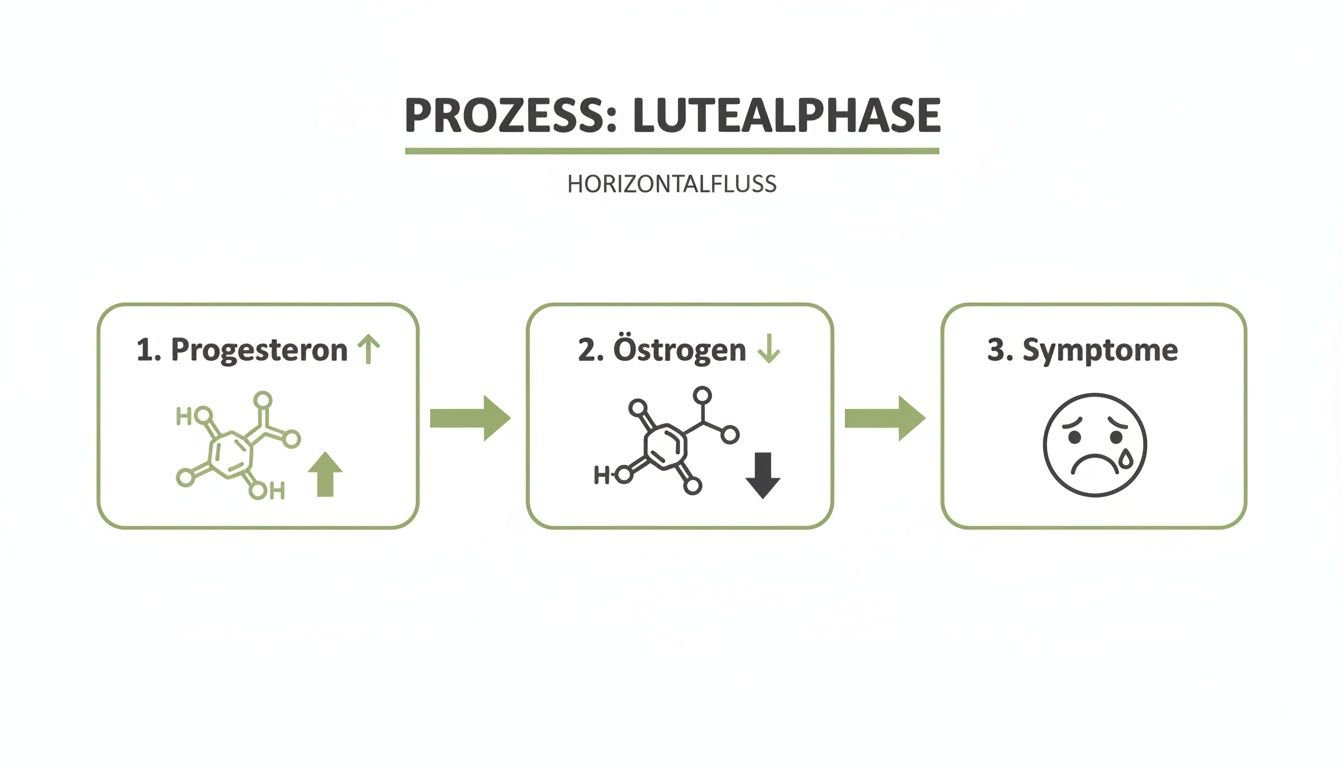
You can see pretty clearly why your body requires more rest and gentle support during this time and not more stress.
Start in a heel seat (Vajrasana) or in a cross-legged position that is comfortable for you. Place your hands loosely on your thighs, close your eyes and take a few deep, conscious breaths. Feel how you come to your mat a little more with each exhalation.
Then begin to gently roll your shoulders back and down to loosen the neck area. Slowly circle your head, first one way, then the other. It's just a matter of releasing initial tension before you start the flowing movements.
Come from sitting on your heels to standing on all fours (Bharmanasana). Briefly make sure your hands are directly under your shoulders and your knees are under your hips. Your back is long and straight.
Repeat this flowing movement 5 to 8 times, entirely to the rhythm of your own breathing. This asana mobilizes the spine, massages the abdominal organs and can relieve mild spasms in the lower back. It also promotes blood circulation in the pelvic area, which is super important for hormone balance.
From the cat-cow movement, slowly push your buttocks back onto your heels and place your forehead on the mat. Your knees can stay together or open as wide as a mat - just see what feels more comfortable for your stomach. You can either stretch your arms forward in a relaxed manner or place them next to your body.
Child's Pose (Balasana) is truly one of the most important poses in the luteal phase.
Balasana signals a feeling of safety and security to your nervous system. It calms the mind, gently stretches the lower back, and helps you look within and fully let go.
Stay here for at least 5 deep breaths. Breathe consciously into your lower back and abdomen and imagine how a little more tension is released with each exhalation.
From Child's Pose, slowly roll up vertebra by vertebra and then come to a lying position on your back. First, place your feet as wide as a mat and let your knees fall loosely together; you can place your hands on your stomach. Take a moment here to explore.
Now bring the soles of your feet together and let your knees gently sink outwards into the lying butterfly position (Supta Baddha Konasana). If the stretch in the hips is too strong, place pillows or blocks under your thighs. Make yourself comfortable!
This regenerative posture is worth its weight in gold for relieving tension in the pelvic and hip areas, where emotional stress often takes hold. It improves blood circulation in the ovaries and uterus. Stay here for 2 to 5 minutes and just breathe deeply into your stomach.
Adjustment for your energy level:
End the flow by drawing your knees to your chest, rocking gently from side to side, and then stretching out in Shavasana (final relaxation) for a few minutes. Give your body time to integrate the practice and let it take effect.
Some days in the luteal phase just feel leaden. Your body is tired, your mind is racing, and a deep inner restlessness is spreading. I designed this restorative yoga flow precisely for such moments - a loving invitation to let go of everything and dive deeply into regeneration.
This is less about dynamic movements and more about letting your body come to rest in soothing, supported positions. So grab whatever pillows, blankets or bolsters you can find. We want to make ourselves really comfortable.
We start sitting with our legs stretched out. Take a large pillow or bolster and place it lengthwise on your thighs. Inhale deeply to lengthen your back, and as you exhale, gently bend forward. Simply let your upper body land on the pillow.
Your arms can rest very loosely next to the pillow, your forehead or a cheek can fit on it. Close your eyes and place the entire weight of your upper body onto the pillow. This supported variation of Paschimottanasana gently stretches the backs of your legs and relieves the often tense lower back without exerting any pressure.
Stay here for 3 to 5 minutes and breathe deeply into your stomach and back.
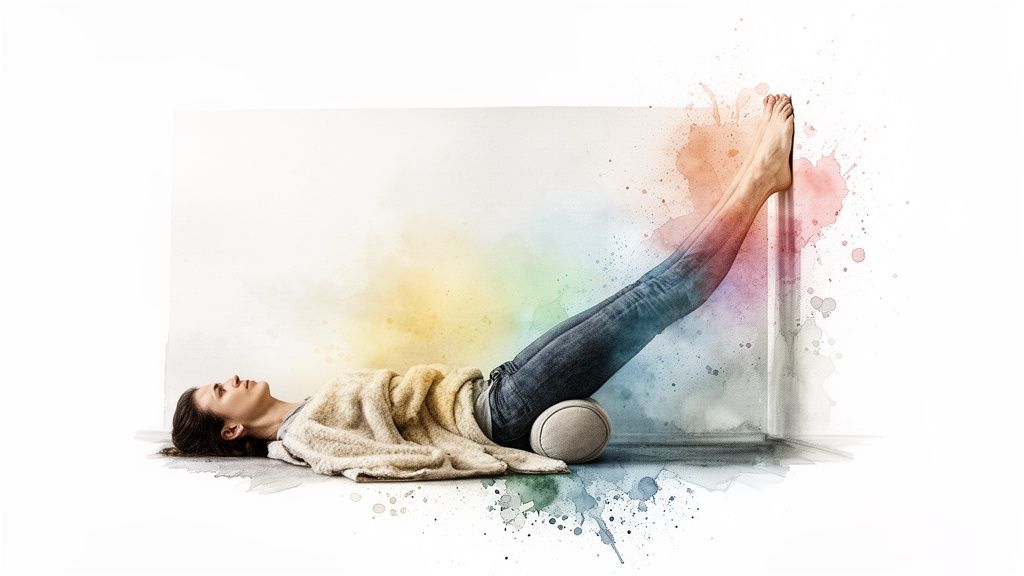
The “Legs on the Wall” pose (Viparita Karani) is a real gift for your nervous system and your circulatory system. Sit sideways as close to a free wall as possible. From there, lie on your back and swing your legs up the wall at the same time.
Your buttocks should be as close to the wall as possible, but only so that it doesn't feel uncomfortable. You can also place a folded blanket under your lower back. Your arms lie relaxed next to you, the palms facing upwards.
This simple reversal has an enormous effect:
Think of this pose as a reset button for your body and mind. It allows you to literally take the burden of the day off your shoulders – and feet – for a moment.
Stay in this position for 5 to 10 minutes and just enjoy the silence. To find even deeper relaxation, you can combine your practice with a guided meditation. Take a look at our comprehensive guide Yoga Nidra in German to.
When you're ready, slowly roll out of Viparita Karani to one side and come back to the supine position. Pull both knees towards your chest and give them a quick hug. Then spread your arms out to the sides at shoulder height.
Now, as you exhale, let both knees gently sink to the right side while your gaze goes very loosely to the left. If you like, place a pillow under your knees to make the pose even softer. Breathe deeply into your left flank and feel the gentle stretch in your spine.
Hold the rotation for about 2 minutes and then carefully switch to the other side. Supta Matsyendrasana massages the abdominal organs, which can aid digestion, and relieves deep-seated tension in the torso.
The effect of such targeted, gentle practices is well documented. A study by the University of Innsbruck showed that women after only 10 weeks Hormone yoga experienced a significant improvement in their well-being, a reduced feeling of stress and better sleep quality. At our Templeshape Studios in Zurich, we integrate restorative poses like these, combined with calming Ujjayi breathing, to support hormone balance in the luteal phase. Such exercises can even reduce hot flashes by up to 30 percent reduce. You can find more exciting details about this study at Research results on hormone yoga.
Your breath is the most direct line to your nervous system. Conscious breathing is particularly important in the often emotionally turbulent luteal phase - in yoga Pranayama called - one of the most effective tools for quickly finding your center again. The best part? All you need is yourself and a few minutes of time.
Here we concentrate on two very essential techniques: balancing alternating breathing and centering Ujjayi breathing.
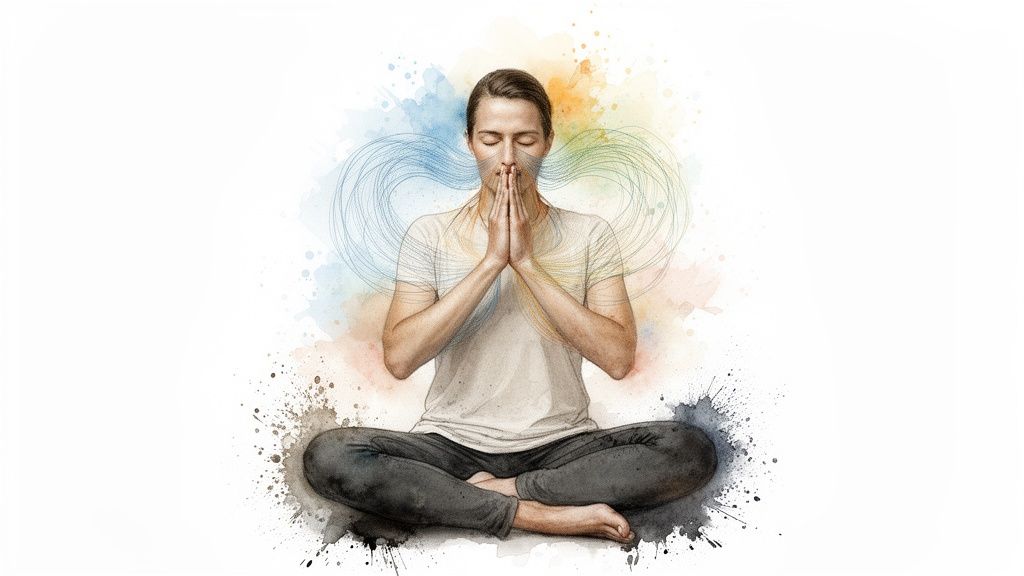
When the feelings in the luteal phase are on a roller coaster, Nadi Shodhana is your anchor. This technique harmonizes the left (creative-emotional) and right (logical-analytical) hemispheres of the brain and has a noticeably calming effect on the entire system.
And it's that easy:
That was one round. Repeat this cycle for five to ten rounds. You will notice how your mind becomes clearer and calmer with each round.
Ujjayi breathing, often called “victorious breath,” is your faithful companion during yoga practice. The gentle rustling that occurs in your throat helps you to direct your focus inwards, creates a soothing warmth and keeps you completely present in the moment.
Imagine breathing on a mirror to fog it up - but with your mouth closed. You create this quiet, whooshing sound by gently narrowing the glottis. Your breathing slows down and deepens on its own.
Try to maintain this breathing rhythm during your yoga flows. It becomes a meditative anchor that connects every movement with your breath and helps you stay completely with yourself.
Both techniques can be wonderfully integrated into everyday life. A few rounds of Nadi Shodhana before an important appointment can work wonders. And Ujjayi breathing? You can even practice this unnoticed in the crowded S-Bahn to ground yourself immediately.
If you would like to delve even deeper into the fascinating world of breathing techniques, you can find our guide on the topic Breathwork in Zurich further valuable impulses and instructions.
Knowing the perfect yoga flows is one thing. But actually integrating this into everyday life when time is short and energy is low – that is the real challenge. But that's exactly the point: your practice should support you and not become another item on your to-do list. Even very short, conscious sessions can make a huge difference to your Hormone balance through yoga in the luteal phase make.
It's about finding a flexible routine that fits your life, not the other way around. Maybe that's ten minutes of conscious breathing in the morning and a regenerative posture in the evening, instead of a full hour on the mat. The key is to be loving with yourself and listen to your body's subtle signals.
To make it easier for you to get started, I have created an example weekly plan. See it as inspiration, not a hard and fast rule. You can postpone, shorten or adapt the units to your energy level as you wish. Some days more exercise feels right, other days maybe just a single pose before bed.
A flexible sample plan that shows you how to easily incorporate yoga flows and breathing techniques into a typical work week.
| day | Morning (5-10 mins) | Evening (20-30 mins) | focus |
|---|---|---|---|
| Monday | 3 rounds of cat-cow | Gentle, grounding yoga flow | Arrive in the week, relieve tension in your back |
| Tuesday | 5 min Ujjayi breathing | Legs on the wall (Viparita Karani) | Calm the nervous system, relieve heavy legs |
| Wednesday | Gentle neck and shoulder circles | Restorative flow (focus on prevention) | Deep relaxation, emotional letting go |
| Thursday | 5-10 rounds of alternate breathing | Lying butterfly with pillow | Find mental balance, open your hips gently |
| Friday | Short sitting meditation | Gentle rotation while lying down | Stimulate digestion and end the week |
| Saturday | Intuitive stretching | Your favorite flow or walk | Movement according to feeling and joy |
| Sunday | No plan – just feeling | Child's Pose (Balasana) | Regeneration and preparation for the new week |
This plan is intended to show you how little it takes to take good care of yourself. The most important thing is that you stick with it and develop a routine that works for you you feels good.
Just as important as the right exercises is knowing what to avoid. Your body is simply more sensitive in the luteal phase and reacts differently to stress.
Therefore avoid:
Your yoga practice is not a competition. It's about building a loving connection with yourself and giving your body exactly what it needs in this moment.
Finally, I would like to address a few questions that I am asked again and again in my courses. Hopefully this will give you even more security and clarity for your own practice on the mat.
Not necessarily, but the devil is in the details – or rather, in the customization. A fast, powerful Vinyasa that pushes you to your limits can quickly overwhelm your body in this sensitive phase and have the opposite effect of what you actually want.
Instead, imagine a “slow flow”: You consciously slow down, hold the individual poses for a few breaths longer and simply leave out jumps or intense crunches. The most important thing is that you honestly feel within yourself every single day. On days when you're bursting with energy, a gentle flow is great. If you feel weak and tired, the restorative flow from this guide is a much better choice for you.
This is of course very individual, but many women tell me that they notice a noticeable change after the first one or two cycles. You may notice that you get through the days before the days more emotionally balanced or that the typical cramps are less intense.
The key here really is regularity. It's not about doing a perfect yoga class once, but about making yoga and conscious breathing a loving habit. Already 10 minutes a day can make a huge difference.
Yes, absolutely! Especially if your cycle is irregular, yoga can help you to develop a much finer sense of your body and its signals. You learn to notice the subtle nuances instead of just relying on the calendar.
And during perimenopause, a time of strong hormonal fluctuations, grounding and restorative exercises are pure gold. They help to calm the nervous system and can noticeably relieve symptoms such as inner restlessness, sleep disorders or hot flashes.
There is a good reason why hormone yoga is so popular in Switzerland. Many women practice at home three to five times a week. Especially for working people in Zurich, fixed course times in combination with breathwork can reduce the perceived stress by up to 40 percent can reduce. If you want to go deeper, you can find an exciting article about it here Effect of yoga on hormonal balance.
Are you ready to find your balance and make your health a permanent habit? At Templeshape GmbH In Zurich we accompany you on your journey. In our supportive community you'll find a variety of classes - from gentle yoga to energizing breathwork. Discover our offers and find your flow https://Templeshape.com.
tags
Hormone balance yoga, hormone yoga, relieve PMS, luteal phase yoga, cycle yoga