No products in the cart.
January 31st
Cycle syncing: Adapt training to the cycle – more strength and well-being
0 comments

January 31st
0 comments
Imagine being able to access your energy and strength exactly when your body is running at full speed - and allow yourself the rest it needs in other phases. This isn't magic, it's the simple but brilliant idea behind it Cycle syncing: You adapt your training to your menstrual cycle. Instead of working against your body, you turn it into your smartest training partner.
Do you know that? Some days you could tear up trees in the gym, other days just walking to the mailbox feels like a marathon. The answer to this usually lies in your hormones. A rigid training program that demands the same amount of power from you every day completely ignores this biological reality. The result? Often frustration, exhaustion or, in the worst case, even injuries.
Your cycle is so much more than just your period. It is a finely tuned orchestra of hormones that not only controls your fertility, but also influences your energy, strength, mood and even the stability of your joints. The two main conductors in this orchestra are estrogen and progesterone. Their ebb and flow throughout the month creates different phases that give your body very different superpowers.
In the first half of the cycle, right after your period, estrogen takes over. You can almost think of it as your own personal performance booster. It boosts your energy, makes you more tolerant to pain and supports muscle building. This is the time when your body is ready for intensive sessions and new best performances.
After ovulation, the lead then switches to progesterone. This hormone has a calming, almost depressing effect. Your core body temperature rises slightly, you get out of breath more quickly and your body tends to retain more water. Heavy weights or fast sprints often feel much more strenuous now. And this is exactly where it starts Cycle syncing an: It intelligently aligns your training according to these hormonal conditions.
Cycle syncing is not a short-lived trend, but a clever strategy to use the biological benefits of your cycle for yourself. It's about working with your body instead of against it - for lasting success and less frustration.
This approach is incredibly relevant, especially in Switzerland, where more and more women are actively pursuing their fitness goals. According to the Fitness Tribune, workout today 1.37 million People in Swiss fitness centers – an absolute record. At the same time, studies by the Federal Office of Sport (FOSPO) show that 68 percent of Swiss women between the ages of 20 and 40 struggle with irregular cycles, which often leads to a lack of motivation.
This is exactly where adapting your training to the cycle can demonstrably help to avoid these slacks. If you'd like to learn more about how a professional can help you, check out how Personal trainer helps you achieve your goals.
By customizing your training, you can say goodbye to the myth of having to give 100% every day. Instead, you learn to see the four phases of your cycle as your own personal strengths:
This smart approach is your key to understanding why training in accordance with your cycle can be a real revolution for your well-being and training success.
To make it easier for you to get started, I have put together a clear table for you here. It gives you a quick overview of the four phases, what happens hormonally and how you can best adapt your training to them.
This table gives you a quick overview of the four cycle phases, their typical duration, the dominant hormones and how this affects your energy and your training.
| cycle phase | Typical duration | Hormonal situation | Energy level & training recommendation |
|---|---|---|---|
| menstrual phase | 3-7 days | All hormones are at a low point. | Low: Focus on regeneration, gentle yoga, walks, light stretching exercises. Listen to your body. |
| follicular phase | 7-10 days | Estrogen increases, and testosterone also increases slightly. | Rising to high: Ideal for building strength (hypertrophy), intense cardio (HIIT) and new challenges. |
| Ovulation phase | 1-3 days | Estrogen and testosterone reach their peak. | Peak: Maximum strength and endurance. Perfect for heavy weights, sprints and personal records. |
| Luteal phase | 10-14 days | Progesterone dominates, estrogen decreases. | Sinking: Focus on moderate exercise, steady-state endurance, technique training and active recovery. |
Think of this table as your personal cheat sheet. Over time you will develop a fine sense of what your body needs in which phase.
So, now that we have clarified the theory, let's get down to business. We will rebuild your training plan so that it is not against you, but rather with works for you and your cycle. The idea of having to perform at the same level every day is outdated. It's more about making clever use of your body's natural highs and lows.
This graphic gives you a quick overview of the four phases, which we will now take a closer look at.
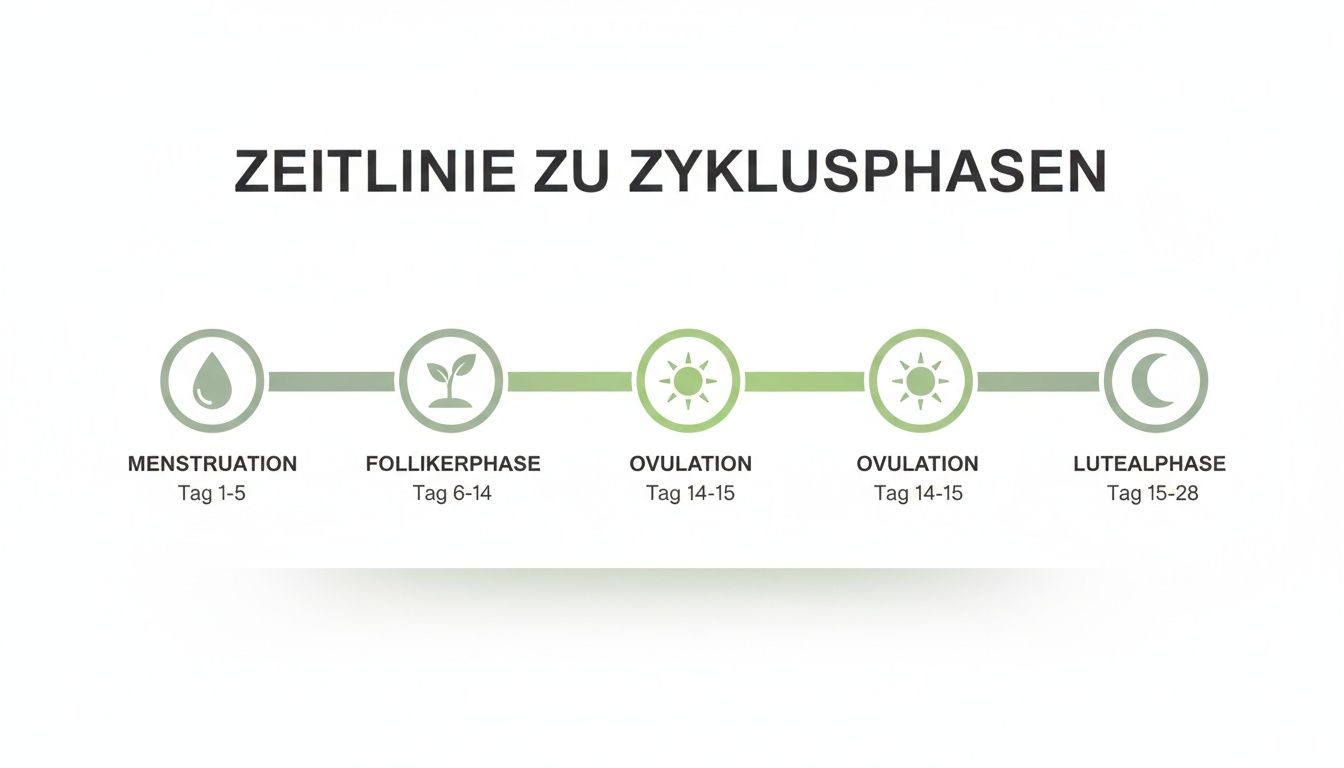
You will immediately see how the energy increases from the quiet menstrual phase to the peak during ovulation and then drops again in the luteal phase. We are now making use of exactly this knowledge.
During your period, your hormone levels, especially estrogen and progesterone, are low. So it's no wonder if you feel tired, weak and perhaps a little introverted. Your body is currently doing hard work and is clearly signaling: time for a break.
But that doesn't mean you have to put your feet up completely. On the contrary, gentle exercise can even help relieve cramps and improve your mood. The trick is to radically reduce the intensity and really listen to your body's signals.
Your training during your period:
High-intensity training, heavy weights or even competitions are now taboo. Give your body permission to recover - it will thank you.
After your period, the follicular phase begins. Imagine it like spring in your body: estrogen slowly increases, energy returns and motivation noticeably increases.
Your body is now ready for new stimuli. The rising estrogen not only improves your mood, but also your insulin sensitivity. This means your muscles can use carbohydrates as fuel much more efficiently. It also supports muscle building. So perfect conditions!
Your training in the follicular phase:
Use this momentum to actively tackle your fitness goals.
Welcome to the peak of your performance! Estrogen and testosterone reach their absolute peak levels around ovulation. You feel strongest, fastest and most enduring now. Your perception of pain is lower and your motivation is at its peak.
This is your personal prime time for top sporting performance. Have you ever wanted to set a new deadlift PR or hit a really tough HIIT class? Now is the perfect moment for it.
A concrete example: Around ovulation (day 12-14) you are ideally prepared for powerful Hyrox or boot camp sessions thanks to the hormone peaks. Templeshapes Airport Health Temple offers unlimited packages for this purpose 179 CHF/month, which depends on sessions 8 CHF/hour runs out. A survey by the Swiss Red Cross (SRK) has shown that 72 percent of working women in Zurich suffer from stress symptoms. Cycle syncing can increase this by up to 35 percent reduce as it virtually halves PMS symptoms such as fatigue. Find out more about them here Training options in the Templeshape Studio in Wiedikon.
Your training during ovulation:
A small note: despite the power, make sure your technique is clean. The high estrogen may make your joints a little less stable.
After ovulation, the fall of your cycle begins. Progesterone takes over while estrogen slowly declines. Progesterone has a more muscle-breaking effect (catabolic) and causes your core body temperature to rise slightly. So you sweat more quickly and your cardiovascular system is put under greater strain.
In the first half of the luteal phase you may still feel quite fit, but in the second half, shortly before your next period, premenstrual syndrome (PMS) often occurs. Your energy decreases, you may be more irritable and cravings come knocking.
Your training focus should now shift from maximum intensity to endurance and technique. Your body is a master at burning fat during this phase, which favors longer, moderate sessions.
Your training in the luteal phase:
Listen carefully to what your body is telling you. If you're feeling tired, it's okay to swap an intense session for a restorative session. It's about training sustainably and in harmony with yourself, not about torturing yourself through it.
To make it easier for you to get started, I have put together an overview for you here. It serves as a compass that shows you at a glance which type of training suits your body best in which phase.
| cycle phase | Optimal type of training | Intensity & Volume | Focus on regeneration |
|---|---|---|---|
| Menstruation (days 1–5) | Regenerative movement, gentle yoga, walks, mobility | Very low | High, prioritize active recovery |
| Follicular phase (days 6–12) | Progress. Strength training, cardio, trying new sports | Medium to high, increasing | Moderate, ensure good sleep |
| Ovulation (days 13–15) | HIIT, maximum strength, competitions, demanding courses | Very high, get peak power | Important to avoid overloading |
| Luteal phase (days 16–28) | Steady state cardio, technique training, Pilates, yoga | Moderate to low, decreasing | High, especially before your period, stress relief |
Don't view this table as a rigid set of rules, but rather as a guide. Your body is unique, and there will be days when you feel different than expected. This is completely normal. Over time you will develop a fine sense of what you need.
The key to successful cycle syncing is understanding your own personal rhythm. Before you can adjust your training, you first have to find out what is actually going on in your body. Don't worry, this sounds more complicated than it is - you don't need a scientific laboratory for this.
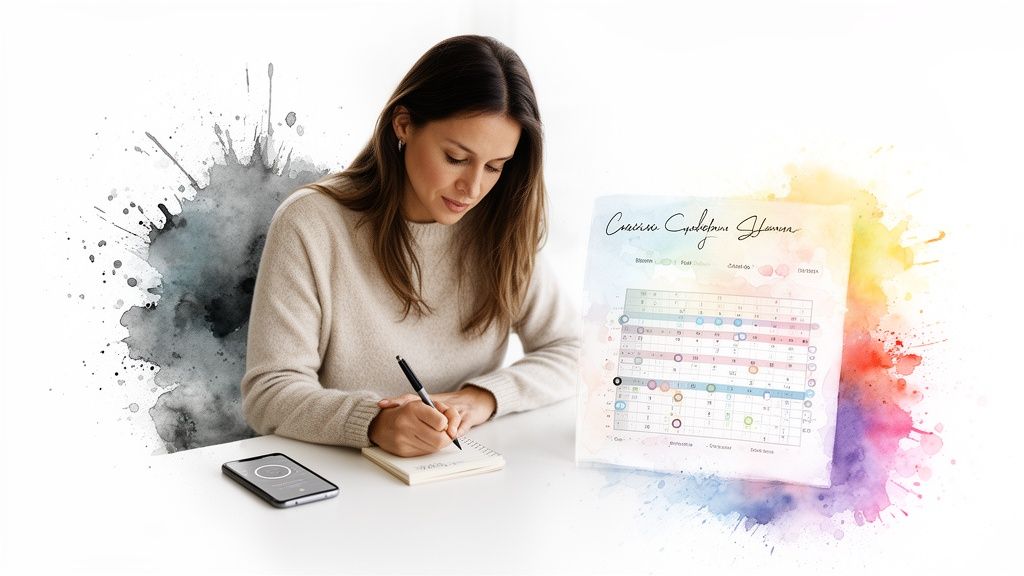
It's basically about building a connection with yourself and interpreting your body's subtle signals. This first step is the absolute foundation for everything that comes after. It will help you adapt training to your cycle without it feeling like an additional chore.
To start tracking, you have various options - from classic to digital. Simply choose the method that best fits into your everyday life and that you actually use regularly.
That's not what's important What, but that That. Find a tool that works for you and stick with it. Consistency is really the key factor here.
Your cycle is so much more than just the first day of your period. To get the full picture, monitor various physical and emotional signals throughout the month. This data is essentially your personal compass.
Just start by taking a few notes every day. It only takes a minute or two and will give you incredibly valuable insights.
Physical signals:
Emotional and mental signals:
Remember: it's not about perfection, it's about awareness. You will probably start to notice patterns after the first month. You will see your energy increase before ovulation and perhaps decrease again before your period.
The best plan is of no use if it cannot be implemented. So that cycle tracking doesn't become another chore that stresses you out, I have a few tried-and-tested tips for you.
This knowledge is the basis for cleverly planning your training, your diet and even your professional tasks. You'll learn when is the best time for an intensive boot camp at Templeshape and when a gentle yoga session will do you much better. Adapting your training to your cycle starts right here – with listening.
The theory behind training according to cycle phases sounds great, but the big question is: How the hell are you supposed to fit it into an already busy routine? Your calendar is bursting at the seams - between your job, friends and a thousand other things.
But here's the good news: you don't have to turn your entire life upside down. It's more about making smart adjustments and getting a better sense of what your body really needs at the moment. See it as a flexible roadmap, not a rigid set of rules.
We love the energy and structure of group classes at the gym. But does a fixed course schedule actually fit the dynamic principle of cycle syncing? Absolutely! The trick is to become the curator of your own training plan.
So instead of just booking any course that fits the time, you consciously choose it to suit your current cycle phase.
Follicular phase & ovulation (approx. days 6-15): This is your time to shine. Off with you to the intensive HIIT & boot camp courses or the demanding Hyrox training at Templeshape. Your body now has the power and resilience to give your all during these sessions.
Luteal phase & menstruation (approx. day 16-5): When the energy starts to fade, it's time for a change of strategy. Browse the course schedule for offerings such as Pilates, yoga flows or mobility sessions. These courses give you strength without completely overwhelming your nervous system.
Think of the course schedule like a buffet. Every day you decide which “dish” suits your body best that day. It's not about giving up your favorite courses, but rather enjoying them at the optimal time.
You can even customize your training within a course. Do you go to a boot camp during your luteal phase? No problem. Simply use lighter weights, give yourself slightly longer breaks, or skip the most explosive jumps. A good coach will fully understand this and support you.
Let's make it concrete. Let's take Anna, a working woman with an office job who is trying to three to four times a week to train. This is what your month could look like:
| Week | cycle phase | focus | Anna's training plan |
|---|---|---|---|
| Week 1 | Menstruation (days 1–5) | regeneration | Mon: rest day, Wed: 30 min walk, Fri: gentle yoga class, Sun: mobility routine at home |
| Week 2 | Follicular phase (days 6–12) | Building strength & energy | Mon: Strength training (full body), Wed: HIIT & Bootcamp course, Fri: Strength training (lower body), Sun: Longer bike tour |
| Week 3 | Ovulation (days 13–15) | Peak performance | Tue: Hyrox training, Thu: sprint intervals on the treadmill, Sat: challenging power yoga course |
| Week 4 | Luteal phase (days 16–28) | Endurance & technique | Mon: Longer run (moderate pace), Wed: Pilates class, Fri: Strength training (technique focus, lighter weights), Sun: Hike |
You see: Anna's plan is anything but boring and adapts perfectly to her energy level. She doesn't torture herself through a hardcore workout on day 3 of her cycle, but rather uses her energy peaks when they're really there.
Of course, not every cycle runs like a Swiss clock. What about special challenges such as an irregular cycle, PCOS or after pregnancy? Even then – or especially then – cycle syncing is an incredibly valuable tool.
If your cycle is irregular or you're dealing with PCOS (Polycystic Ovarian Syndrome), stubbornly counting days often doesn't help. This is where it becomes even more important to listen to your body’s signals.
After giving birth, your body is in total restructuring and healing mode. Hormones, pelvic floor, the entire statics – everything has to be rearranged. A gentle, regeneration-focused approach is not just an option, but a must.
It is precisely in these special phases of life that the true strength of cycle syncing becomes apparent: It teaches you to remain in constant dialogue with your body and to give it exactly what it needs for healing, regeneration and sustainable strength. Your training adapts to your life - not the other way around.
By the way, this principle of adaptation does not only apply to the female cycle. If you want to learn more about how you can generally adapt your training to your internal clock, read our article on training according to the circadian rhythm.
Training tailored to your cycle is a huge step towards better well-being, but it's only half the battle. What you eat, how you sleep and how you deal with stress have at least as much influence on your hormonal balance. You can only achieve true harmony when you synchronize your diet and lifestyle.
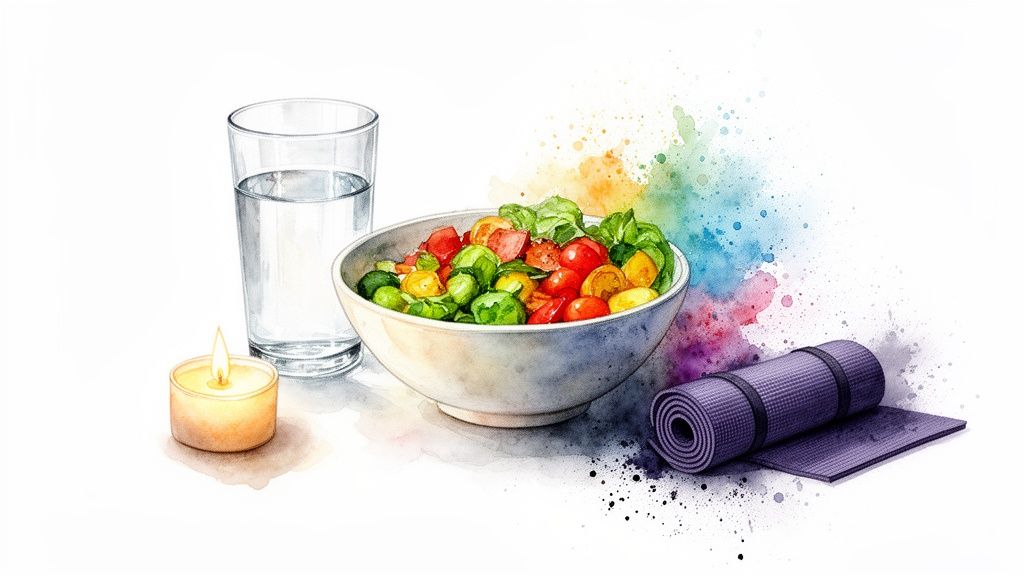
Your body has different needs in each phase, not just in the gym, but also in terms of nutrients. By giving him what he really needs, you can stabilize your energy levels, relieve PMS symptoms and optimize your recovery.
Think of your body as a garden that needs different care depending on the season. In the first half of the cycle, the follicular and ovulation phase, your metabolism often runs a little slower. Light, nutritious food is just the thing right now.
Follicular phase (spring): Your estrogen levels rise, your body is in rebuilding mode. Support it with fermented foods like kimchi or yogurt and light proteins like fish or legumes. Fresh salads and lots of vegetables give you the power you need.
Ovulation phase (summer): Around ovulation, your liver needs support, and antioxidants are your best friends here. So choose berries, green leafy vegetables and cruciferous vegetables such as broccoli or cauliflower.
In the second half, the luteal phase, your metabolism suddenly goes into overdrive. You burn more calories and your body craves complex carbohydrates and certain minerals to stay balanced.
Magnesium can work wonders, especially in the second half of the cycle. It helps relax muscles—a boon for cramps—and supports the nervous system, which can reduce mood swings.
So consciously include magnesium-rich foods such as dark chocolate, nuts, seeds and green leafy vegetables in your diet. You can find out more about the effects of this power mineral in our article about it Master mineral for relaxation with magnesium deficiency.
Your sleep quality can suffer, especially in the luteal phase, when calming estrogen drops and progesterone rises. Many women feel more restless and wake up more often at night. Right now, good sleep hygiene and conscious moments of relaxation are worth their weight in gold.
Try avoiding screens before bed and instead establishing a small, relaxing ritual. A cup of herbal tea, a warm bath, or a few pages in a book can signal your body that it's time to shut down.
Beyond optimizing training and nutrition, there are other important aspects of female well-being in professional life, such as the topic of a Prohibition of employment during pregnancy. This holistic approach, which takes your body into account in all its facets, is the key to sustainably improving your quality of life and balancing your hormones naturally.
You now have a good overview of how you can balance your training with your cycle in order to feel more energetic and simply better. But very practical questions often arise, especially at the beginning. Here I have collected the most common insecurities that we encounter in everyday life at Templeshape so that you can get started with confidence.
Don't worry, even with an irregular cycle you can benefit incredibly from cycle syncing. The focus then simply shifts away from fixed calendar days and towards the direct signals that your body sends you. It's about learning to listen to your inner voice again.
Consciously track your energy level, your mood and your general physical feeling. Do you feel energetic and strong? Perfect, this is your green light for an intensive workout. On days when you feel rather weak and tired, you consciously choose regenerative sessions such as gentle yoga or a long walk. This way you respect your body's needs, no matter how long or short your cycle is.
No, definitely not! The thought of having to throw everything over the top puts many people off. But cycle syncing is not about a radical revolution, but rather an intelligent evolution of your training.
You can stick to your favorite sports and classes. The key is adjusting the intensity. For example, instead of a super heavy strength session in your luteal phase, you could do a lighter technique session, reduce the number of repetitions or lengthen the breaks a little. Often it is precisely these small, conscious adjustments that make the biggest difference to your well-being and protect you from exhaustion. If you're generally worried about training too much, our guide on the topic will help you Recognize and avoid overtraining additional security.
Your body is not a machine that works at the push of a button. It is a complex system and takes some time to adapt. But the good news is: Many women report noticeable, positive changes within the first or second cycle.
Maybe you notice that you suddenly have more energy, your PMS symptoms are milder, or you just feel more comfortable in your skin overall. But give yourself and your body at least three full cycles Time to really understand the patterns and reap the full benefits. Patience and listening carefully to your signals are your most important companions here.
An extremely important question. If you use hormonal contraception - for example using the pill, the ring or the hormonal coil - your natural hormonal cycle is suppressed. The typical fluctuations in estrogen and progesterone that control classic cycle syncing then do not occur or only take place to a very weak extent.
Das heisst aber nicht, That du auf die Vorteile eines angepassten Trainings verzichten musst. Du kannst stattdessen das Prinzip des "Body-Syncing" anwenden. Das bedeutet ganz einfach:
So you still work in harmony with your body and its needs - even without the natural hormonal pacemaker.
Are you ready to take your training to a new level and work in harmony with your body? At Templeshape GmbH You'll find the perfect classes for each phase of your cycle - from energetic HIIT workouts to regenerative yoga flows.
Discover our course schedule now and find your perfect session!
tags
Cycle syncing, fitness for women, women's health, hormonal balance, training according to cycle