
Wellbeing
Yoga training Switzerland: Find the right yoga training for you
Are you considering yoga training in Switzerland? Wonderful! In doing so, you are taking the first, decisive step on a journey that will enrich you incredibly and take you far beyond the yoga mat. In-depth training, as is now offered in many places in Switzerland, not only gives you the tools you need to teach […]
Are you considering yoga training in Switzerland? Wonderful! In doing so, you are taking the first, decisive step on a journey that will enrich you incredibly and take you far beyond the yoga mat. In-depth training, as is now offered in many places in Switzerland, not only gives you the necessary tools for teaching. Above all, it deepens your own practice and your understanding of yourself.
# Your path to becoming a certified yoga teacher
Yoga training is so much more than just performing postures correctly. It is a profound examination of you, your body and a philosophy that is thousands of years old. It’s best to imagine this path like building a house: each level of training is an important construction phase that builds on the previous one and makes everything more stable.
The demand for well-trained yoga teachers in Switzerland has exploded in recent years. This is your chance to turn your passion into a career or simply take your knowledge to a new level for yourself.
# The importance of yoga in Switzerland
Yoga is no longer a niche topic, but is now firmly anchored in Swiss society - a recognized practice for better health and well-being. The numbers speak for themselves: According to a survey by the Federal Office of Sport (FOSPO), around 12 percent of the Swiss population aged 15 and over regularly practices yoga. That’s about 1.04 million people!
For comparison: in 2007 this share was just under 6 percent. So we’re talking about a doubling in less than two decades. You can find more details about this exciting development on bildung-schweiz.ch.
This growing need creates a stable foundation for you if you want to pursue professional yoga training in Switzerland. It means more opportunities to teach in studios, run your own courses or offer specialized workshops.
# The basic training levels
In order to gain a foothold in this world, it is important to know the internationally recognized standards. They form the framework for almost every serious training program you will find and help you assess the quality of an offer.
The most common formats are:
-
200-hour training (your foundation): This is the classic introduction and the basis for everything that comes afterwards. Here you will learn the basics of asanas (postures), pranayama (breathing techniques), anatomy and philosophy. After graduating, you will be qualified to teach your first yoga classes safely and competently.
-
300-hour advanced training (The Structure): This training is aimed at you if you already have a 200-hour certification under your belt and would like to delve deeper. Here you will specialize your knowledge in advanced topics such as therapeutic yoga, complex sequencing or a specific yoga style.
-
500 Hour Certification (Your Finished Home): This title is not a single, separate training course. It is the result of your 200-hour basic training plus 300-hour advanced training. Reaching this level signals a truly comprehensive and deep expertise.> An important thought for your path: The number of hours is a good indicator of the depth of training. But in the end, what really counts is the quality of the teachers and the curriculum. They are crucial for your personal and professional development.
This guide is designed to give you a clear overview of the different Yoga training courses in Switzerland. This will help you make an informed decision that feels right for you.
# The different training formats in detail
If you look around for yoga training in Switzerland, you will quickly notice: the number of hours is only half the story. A 200-hour training is not just a 200-hour training. Let’s take a closer look under the hood to see what’s behind the numbers so that you can find exactly what suits you and your path.
It’s best to imagine the training stages like building a house. Each level has its own purpose and prepares you for the next step. The foundation must be solid before you put up the walls and roof.
This graphic shows you how the stages typically build on each other.
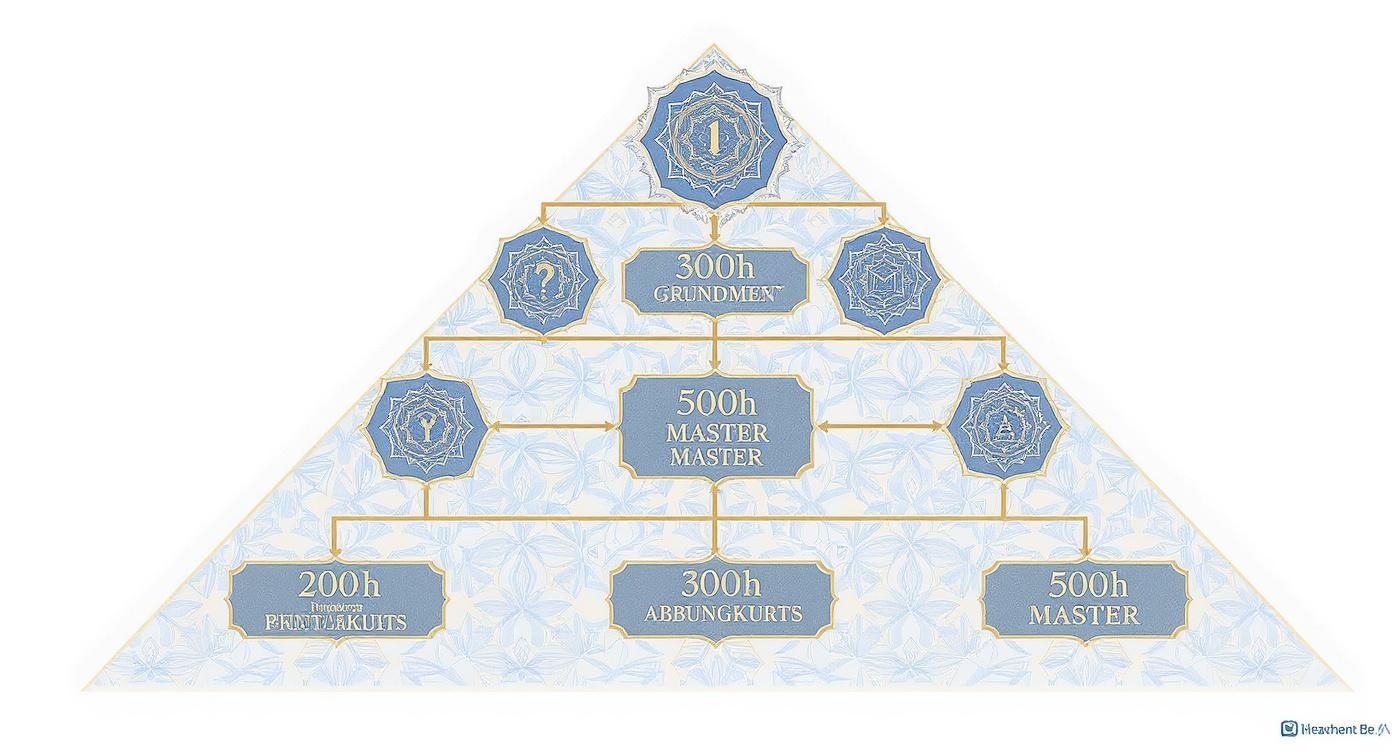
You can see it for yourself: the 200-hour training is the essential foundation for everything that comes afterwards.
# The 200-hour basic training: your entry ticket
The 200-hour training is your foundation, the absolute core of your knowledge. Here you will be given the basic tools you need to be able to teach safely and with confidence.
You will delve deep into the correct alignment of asanas (postures) and learn how to guide them precisely and adapt them for different bodies. A large part is also dedicated to anatomy - because only if you understand how the body ticks can you help avoid injuries.
At the same time, the door opens to the fascinating world of yoga philosophy. You will engage with ancient texts such as the Yoga Sutras by Patanjali and learn how to sensibly structure your first yoga class.
The 200-hour training is not the end, but the beginning of your journey. It gives you the license to learn and grow – both on the mat and as a person.
In Switzerland, most training courses are based on international standards. The basic training includes 200 teaching hours and usually lasts between 9 and 12 months part-time. The price here is usually between 2,500 and 4,500 CHF.
# The 300-hour advanced training: For more depth
You’ve got your 200 hours under your belt, maybe you’ve been teaching for a while and you feel: There’s more. Then the 300-hour training is the next logical step. Imagine it like a master’s degree after your bachelor’s degree. This is no longer about the basics, but rather about deepening and specializing.
Now you can concentrate on topics that really interest you. Possible focal points include:* Advanced Anatomy: Learn in more detail how to deal with specific physical problems.
- The Art of Sequencing: Develop the ability to create creative, intelligent, and thematically well-rounded yoga classes.
- Yoga Therapy: Learn how you can use yoga specifically to support healing processes.
- Philosophy & Meditation: Dive even deeper into the spiritual aspects of yoga and refine your own meditation practice.
This advanced training turns a good teacher into an excellent one. You’ll gain confidence, find your own voice, and be able to offer your students a much richer, deeper experience.
# Specializations: Find your focus
In addition to the major training courses, there are countless shorter training courses with which you can specialize in a very specific yoga style or target group. These courses usually last between 30 and 100 hours.
A classic example is a Yin Yoga training. Here you concentrate fully on this calm, meditative practice, learn the specific postures, the meridian theory behind them and how to create a space of deep relaxation.
Other popular niches include:
- Prenatal & Postnatal Yoga
- Children’s yoga
- Yoga for seniors
- Restorative yoga
Such specializations are perfect for finding your niche and becoming an expert in a specific field. They ideally complement your basic training and make your profile as a teacher unique. A deep understanding of body and mind, as taught in mindful movement practices, is of great value here. If you are interested in the connection between body awareness and movement, you might also like our article about somatisches Pilates als Revolution deiner Fitness.
The following table summarizes the most important differences for you.
# Comparison of training types 200h vs. 300h vs. specialization
A direct comparison of the content, goals and requirements of various yoga training formats in Switzerland.
| Feature | 200-hour basic training | 300-hour advanced training | Specialized further training (e.g. Yin Yoga) |
|---|---|---|---|
| Target | Creating a foundation to be able to teach safely | Deepen knowledge, find your own voice as a teacher | Become an expert in a specific niche |
| Target group | Yoga Practitioners Who Want to Become a Teacher | Certified 200h teachers (RYT-200) | Teachers who want to expand their offerings |
| Contents | Asana Alignment, Anatomy, Philosophy, Sequencing Basics | Advanced asanas, therapeutic approaches, philosophy deepening | Specific techniques, target group adaptations, theory of style |
| Duration | 9-12 months (part-time) | Variable, often modular over 1-2 years | 30-100 hours, often on weekends or as an intensive course |
| Requirement | Solid own yoga practice | Completed 200h training | A 200-hour training course is usually recommended |
| Result | Certification as a yoga teacher (e.g. RYT-200) | Advanced certification (e.g. RYT-500 upon completion) | Certificate for the respective specialization |
As you can see, each step logically builds on the previous one. In the end, choosing the right format is a very personal decision. Ask yourself: Where am I in my journey right now? What do I want to learn? And most importantly: which style and philosophy speak to my heart?
# Quality and recognition of yoga trainingA nice certificate can be printed quickly, but what is really behind it? If you are looking for the perfect yoga training in Switzerland, it is crucial to separate the wheat from the chaff.
Quality and recognition are not empty marketing words here. They are your ticket to professional studios and the guarantee that your large investment of time and money will pay off in the long term.

# International vs. national recognition
In the yoga universe there are various organizations that want to set standards. In Switzerland you will come across two names again and again: the international Yoga Alliance and the national Yoga Association Switzerland. If you understand what they stand for, you can better assess the direction of a school.
The Yoga Alliance is a US organization and the world’s largest industry association. If a school is registered as an RYS (Registered Yoga School), it meets certain minimum standards for curriculum and number of hours. For you as a graduate, this means an internationally recognized basis - particularly valuable if you would like to teach abroad.
The Yoga Association Switzerland, however, focuses on deeper, country-specific quality criteria. Recognition is often linked to a longer period of training (often over four years) and stricter examination regulations. This label becomes particularly relevant if you are seeking recognition from Swiss health insurance companies so that your future students can have part of the course costs reimbursed.
You could say: A Yoga Alliance certificate is like an internationally recognized bachelor’s degree - it opens doors worldwide. Recognition by the Yoga Association Switzerland is more like a federal certificate - a strong quality feature that is specifically tailored to the Swiss market.
# Your checklist for quality
A fancy logo alone doesn’t make for good training. Real quality is in the details. Use the following checklist to critically examine each school you shortlist. This way you can be sure that in the end you don’t just have a piece of paper, but real, in-depth knowledge in your hands.
The most important checkpoints for your selection:
- Experience of the main trainers: Do the lead teachers have at least 10 years of active teaching experience? A training is only as good as the people who lead it.
- Curriculum Transparency: Can you view the detailed syllabus online? You should know exactly how many hours are spent on anatomy, philosophy, asana practice and didactics.
- Group size and supervision: What is the maximum number of participants allowed? Smaller groups – for example under 20 people – enable much more personal support and individual feedback.
- Cost clarity: Is everything really included in the price? Ask specifically whether there are additional fees for teaching materials, exams or the certification itself.
- Experience reports and references: Are there authentic testimonials from previous graduates? If you ask, a reputable school will be happy to connect you directly with former participants.
# Recognize red flags
Sometimes it’s the little things that should make you suspicious. Learn to listen to your gut feeling and recognize warning signs early.A classic red flag is a vague description of the teacher. If the website only says “taught by a team of experienced yoga teachers” without specific names, photos and biographies, you should be careful. You have a right to know who you are learning from.
Another red flag is the lack of credible testimonials. If you only find perfectly worded, anonymous quotes, but no real stories from graduates with names or social media profiles, you should investigate. Real enthusiasm is not so easy to hide.
By examining these points, you will go from being just a prospect to being an informed candidate. You don’t invest blindly, but make a conscious decision for training that will really help you advance as a yoga teacher and as a person.
# Plan costs and time realistically
Yoga training is probably one of the most valuable investments you can make in yourself. But hand on heart: In addition to all the anticipation, you also need an honest look at finances and time. Let’s talk openly about the numbers so you know what to expect and make a decision that really fits your life.
For a well-founded 200-hour yoga training in Switzerland you should plan a budget between 3,500 and 5,000 CHF. This price range is absolutely normal and has good reasons - it depends on various factors, which we will now take a closer look at.
# What affects the price
The costs are made up of many small puzzle pieces that ultimately shape the quality and experience of your training. A big item is often the location of the school. For example, an education in the heart of Zurich or Geneva will logically cost more than one in a rural area. This is simply due to the higher rents for the studios and the general cost of living, which is reflected in the overall price.
Other important price factors are:
- Reputation and experience of the trainers: Teachers with years of experience and an international reputation can of course charge higher prices. Here you pay for concentrated knowledge and a deep wealth of experience.
- Group Size: Smaller, more intimate groups mean more personal attention and individual feedback. This luxury is often reflected in a slightly higher course price.
- Scope of teaching materials: Are all books, scripts and perhaps even access to an online platform already included in the price? That can make a big difference.
My tip: Ask the schools you are interested in directly to see what is included in the price. Are exam fees covered? Do you have to buy the specialist literature separately? Be sure to clarify this beforehand so that there are no unpleasant surprises later.
# Choose your time model: sprint or marathon?
In addition to money, time is the second big variable that you have to think carefully about. Basically there are two common formats, and each has its own rhythm.
1. The intensive course (sprint) This format is like a deep dive: you completely immerse yourself in the world of yoga for three to four weeks at a time. Imagine living and breathing yoga from morning to night, without distractions.* The advantages: You can concentrate fully on the content without everyday life getting in the way. The learning process is extremely compressed and you build an incredibly close connection with your group - an experience of a lifetime.
- The disadvantages: You have to be able to take complete time off for this time, which can be a real challenge both professionally and family-wise. And the wealth of information is huge. There is little time to let what you have learned sink in and integrate it.
2. Part-time training (marathon) This model usually lasts nine to twelve months, often with lessons on the weekends or in individual block weeks. You integrate learning into your existing life.
- The advantages: You can integrate the training wonderfully into your job and family life. Between the modules you have enough time to digest the content, practice it and incorporate it into your own practice. Everything grows slower, but often more sustainably.
- The Disadvantages: It takes a good amount of discipline and perseverance to stay on the ball for such a long period of time. The training becomes an integral part of your everyday life, which also requires good organization.
The choice between these two paths is extremely individual. Be honest with yourself: Which rhythm suits my learning style and my current life situation? There is no right or wrong here - just what works for you without burning you out.
# Find the best yoga schools in Switzerland
Now it gets specific: Where exactly can you find the one yoga training in Switzerland that feels like a second home for you? The offer can seem overwhelming at first glance, but with the right approach the search becomes clear and targeted. Switzerland offers you a fascinating variety - from vibrant studios in urban centers to quiet oases in the middle of the mountains.
It’s best to imagine your search like a map. There are clear hotspots, but also hidden gems. Your job is to find the place whose energy and philosophy truly align with your own vision.
# The yoga hotspots in Switzerland
A look at the geographical distribution shows a clear trend: most providers of yoga training are in urban and German-speaking regions. You can find around 70 percent of the schools in German-speaking Switzerland, with Zurich, Lucerne and Basel being the most important centers. In Zurich alone there are at least five renowned schools that offer both 200 and 500 hour training courses. More details about Verteilung der Yogaschulen in der Schweiz findest du auf bookyogaretreats.com.
Of course, cities like Zurich offer you a huge selection. You can get to know different styles and teachers, attend trial lessons and get a real feel for the respective community. This is a big advantage for making comparisons and making sure it fits. If you would like to find out more about the diverse local scene, take a look at our article about Yoga in Zürich Wiedikon (District 3).
But don’t underestimate the magic of an education away from the hustle and bustle. A retreat format in the Alps can be an incredibly profound, intense experience. The tranquility of nature helps you to concentrate fully on yourself and the teachings - an undisturbed journey within, without the distractions of everyday life.> Your choice of location shapes the entire experience. Ask yourself honestly: Do I need the energy and diversity of the city or the silence and focus of nature to learn and grow optimally?
# A compass for school philosophies
Every yoga school has its own DNA, its unique philosophy. It’s not just about what is taught, but above all how. To make it easier for you to find your way, we will introduce you to three typical orientations that you will often encounter in Switzerland.
1. Traditional and classic: For example, Hatha Yoga according to Sivananda Imagine a school built on a clear, proven tradition. Here you will learn a holistic approach that views asanas, pranayama (breathing exercises), relaxation, nutrition and positive thinking as equal pillars.
- What to expect: A fixed sequence of 12 basic poses, a strong focus on breathing techniques and meditation. Classes are often calm, disciplined and spiritually profound.
- Who it’s suitable for: If you’re looking for an authentic, genuine yoga experience and appreciate a clear structure based on decades of tradition.
2. Modern and athletic: For example Vinyasa Flow In contrast to this is a modern, dynamic school. It’s all about flowing movements that are synchronized with the breath. Creativity, music and athletic demands are often in the foreground.
- What to expect: Challenging, creative sequences that challenge your strength and flexibility. You will learn how to build intelligent flows and create an energizing atmosphere in the room.
- Who it’s suitable for: If you love a physically demanding practice, enjoy movement and want to learn how to teach modern, dynamic yoga classes.
3. Spiritual and energetic: For example Kundalini Yoga These schools place a strong focus on working with life energy (Kundalini). It is a very transformative practice that goes far beyond the purely physical and delves deeply into the energetic levels.
- What to Expect: Specific sets of exercises (Kriyas) that combine dynamic movements, powerful breathing techniques, mantras and meditation to awaken the energy in the body.
- Who it’s for: If you’re looking for a profound spiritual experience and are passionate about the energetic aspects of yoga.
These examples show how different Yoga training in Switzerland can be. Take the time to study the schools’ websites carefully, attend information events and - most importantly - talk to graduates. Find the community where you feel welcome and truly at home, not just as a student, but as a person.
# Your career as a yoga teacher after training
Congratulations, the certificate of your Yoga training in Switzerland is freshly printed in your hands! But what comes next? The reality after training often looks a little different than you might have dreamed of. This section is intended to give you an honest and practical compass for your first steps into the professional world.It’s best to say goodbye to the idea of teaching courses in a fancy studio that are immediately booked up. This is of course a wonderful goal, but the path to get there usually begins with smaller but incredibly important steps. For the vast majority of newly qualified yoga teachers, this means gaining valuable experience through substitute lessons or offering their first courses for friends, family and acquaintances.
Those first few hours are pure gold. Here you can practice in a safe environment, refine your announcements, learn to work with very different body types and slowly build up the self-confidence that you will need later for larger classes.
# Employment or self-employment
Basically, there are two main paths open to you after your training. Both have their own advantages and disadvantages. It is important that you decide honestly which path suits your personality and your current life situation.
- The path to employment: A permanent position in a fitness center, a larger yoga studio or perhaps even in a hotel brings one thing above all: security. You have a regular income, don’t have to worry about marketing or renting space and are part of an existing team.
- The path to self-employment: The freedom to design your own courses, set your own prices and determine your own working hours - that’s of course incredibly tempting. But this freedom comes with a backpack full of responsibility.
As a self-employed yoga teacher, you are your own boss, your own marketing department and your own accountant. This means, for example, that you have to take care of registering with the AHV, insurance and finances. This requires discipline and a certain entrepreneurial mindset.
# Find your unique niche
At first glance, the yoga market seems huge and perhaps even overcrowded. That’s exactly why it’s so important that you find your own small, fine niche. Ask yourself honestly: Who does my yoga heart beat the loudest for? What are my particular strengths?
Having a niche does not mean excluding others. It means being the absolute best and clearest solution for a very specific group of people.
Maybe you are the perfect teacher for stressed office workers and offer short, sweet yoga sessions directly in companies. Or your strength lies in gentle, regenerative yoga for seniors, which promotes mobility and joy of life. Your niche makes you visible and attracts exactly the students who suit you. A focused offering such as targeted private lessons can also be a great start; If you would like to find out more about it, you will find valuable tips in our Guide für Yoga-Privatstunden.
# Your first students win
You rarely find your first students through large, expensive advertising campaigns. Rather, it’s about authentic connections and creative ideas in your immediate environment.
A personal Instagram profile where you not only show perfect poses but also share your thoughts about yoga can work wonders. How about collaborating with your favorite café for a “Yoga & Brunch” event? Or you offer free trial lessons in the park in the summer. Talk to people, tell them about your passion and be brave. Your enthusiasm is your best marketing tool to successfully get your career as a yoga teacher rolling.## The most burning questions about yoga training
Here we clarify the questions that we always come across in the studio when it comes to yoga training in Switzerland. We want to answer you directly and honestly so that you can make your decision with a good feeling.
# Do I have to be super flexible for the training?
No, absolutely not. Yoga training is not about tucking your feet behind your head. Rather, you learn to understand your own body and adjust the postures so that they work for you. The journey is the goal, not the perfect, acrobatic pose.
Honestly: Many people do training just for themselves. Imagine it like an intensive journey to yourself that deepens your understanding of yoga in a way that would never be possible in normal classes. It is an investment in your personal growth.
# Can I really teach after 200 hours?
Yes, the certificate officially gives you the qualification for this. But the best way is to start slowly and consciously. Maybe start by giving lessons to friends, offering free classes in the park in the summer, or taking on a substitute lesson at the studio.
Every great teacher started small. Courage and confidence grow with every lesson you teach. It’s about the practical experience.
# How much does a good yoga training cost in Switzerland?
For a well-founded 200-hour training course in Switzerland you should expect prices between 3,500 and 5,000 CHF. Be skeptical of extremely cheap offers - they often sound too good to be true.
Quality has its price, especially when it comes to the experience of the trainers and personal support. Always take a close look at what is included in the price to avoid unpleasant surprises such as additional costs for teaching materials or exams.
Your Yoga training in Switzerland is the foundation for a wonderful new path. Make this decision consciously and well-informed.
Ready to start your own journey and make exercise an integral part of your life? At Templeshape GmbH in Zurich you will find a community that supports you and courses from yoga to HIIT that will accompany you on your path. Discover our offers and find the perfect course for you on https://templeshape.com.
Templeshape
Turn reading into action.
Discover the Templeshape offer that fits your next step.
View schedule