Wellbeing
Techniques de respiration dans le yoga: practice the pranayama – respiration profonde, concentration et bien-être
There is more to the term pranayama than just “breathing correctly”. It is the conscious art of directing and cultivating your life energy – called prana in yoga – through targeted breathing exercises. Think of it not simply as deep breathing in and out, but as a powerful tool that allows you to directly influence your nervous system […]
There is more to the term pranayama than just “breathing correctly”. It is the conscious art of directing and cultivating your life energy – called Prana in yoga – through targeted breathing exercises. Don’t just think of it as deep inhaling and exhaling, but as a powerful tool that you can use to directly influence your nervous system, reduce stress, and clear your head.
# Why conscious breathing changes your life
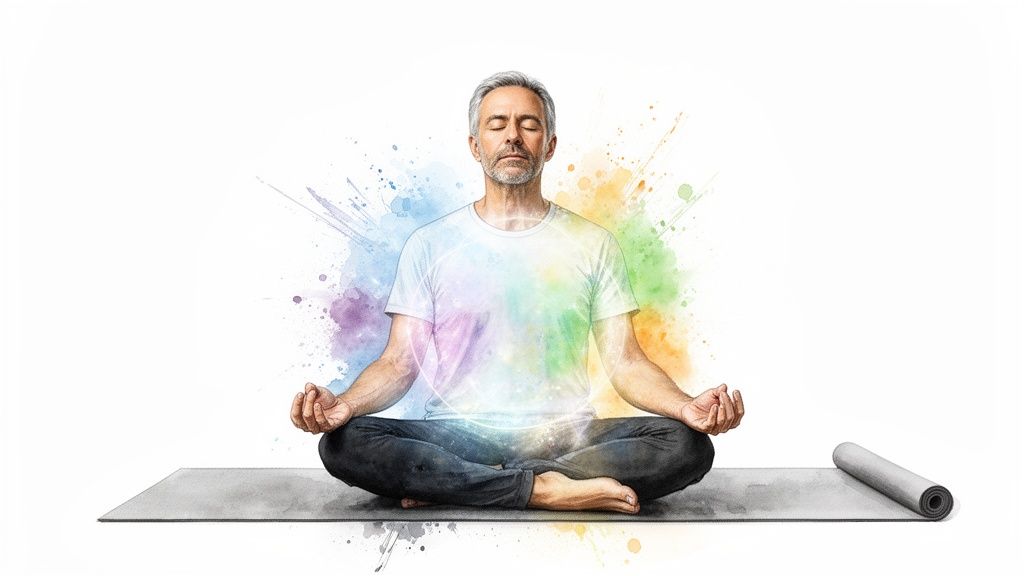
You may be wondering how something as mundane as breathing can make such a profound difference to your overall well-being. The answer lies in the thousands of years old breathing techniques of yoga, pranayama. It’s about shifting from unconscious autopilot into the conscious driver’s seat of your inner state.
Your breath is like a remote control for your nervous system. In hectic everyday life, we are often caught in “fight or flight” mode, which is reflected in shallow, rapid breathing. With targeted pranayama you will learn to break this cycle and instead activate the “rest and digest” mode.
# The direct line to your inner peace
The connection between breathing and mental state is not some esoteric nonsense, but pure biology. Slow, deep breathing signals to your brain that everything is okay. This happens primarily through the activation of the vagus nerve, the main player in relaxation and regeneration in our body. If you would like to find out more about how you can deinen Vagusnerv mit einfachen Übungen im Alltag stimulieren, we have further tips for you here.
By consciously directing your breath you can:
- Reduce stress hormones: The levels of cortisol and adrenaline drop noticeably, making you more relaxed. For example, imagine breathing deeply and slowly for five minutes before an important presentation. You will notice how your heartbeat decreases and you become calmer.
- Slow down your heartbeat: A calmer pulse directly leads to a feeling of deep relaxation. You can even measure this with a smartwatch: After a few rounds of alternate breathing, your heart rate visibly drops.
- Create mental clarity: The carousel of thoughts spins more slowly and your concentration improves.
Pranayama is your anchor in the storm of everyday life. It is the tool that you always carry with you to find your center in every situation - be it before an important meeting in Zurich or in a chaotic moment as a mother.
# More than just taking a breath
Pranayama is not just about breathing deeply into your stomach. It is a very nuanced practice with countless techniques, each with a specific effect. Some have an invigorating effect like an espresso in the morning, others have a calming effect like a warm blanket in the evening.
Especially in an urban environment, you may feel the need to find a balance. In fact, the practice of pranayama techniques in yoga in Switzerland, especially in the canton of Zurich, has increased significantly in recent years. According to a study, 68% of employees in Zurich report chronic stress, with 42% citing breathing techniques such as pranayama as effective stress relief.
At Templeshape, we specifically use these powerful techniques to help you build sustainable health habits. We’ll show you how to use your breath as a valuable resource to deepen your yoga practice and experience every day a little more consciously and balanced.
# Four basic pranayama techniques to get you startedWell, now it’s getting practical. Learning breathing techniques in yoga means, above all, experiencing first-hand how you can consciously control your condition. I’ll take you by the hand and guide you through four central pranayama exercises. They are a fantastic foundation for your practice, each with their own unique superpower and perfect moment.
# Ujjayi Breathing – The sound of the ocean within you
The Ujjayi breathing – often translated as “victorious breath” or “ocean breath” – is the rhythmic foundation in many dynamic yoga styles such as Vinyasa or Ashtanga. The trick is to create a gentle, audible whoosh at the back of your throat.
Just imagine breathing on a mirror with your mouth closed. This quiet sound occurs because you are narrowing your glottis ever so slightly. This sound becomes your anchor: it keeps your mind in the here and now while your body flows through the asanas. At the same time, Ujjayi warms you up from the inside and helps you find a wonderfully consistent flow.
Practical tip: In the beginning it is often easier if you hold a hand in front of your mouth and breathe on it with your mouth open, as if you were fogging up a window pane. Feel the warmth. Then close your mouth and try to maintain that exact feeling and sound while continuing to breathe gently through your nose.
# Nadi Shodhana – the balancing alternate breathing
Do you sometimes feel completely scattered or emotionally out of sync? Then Nadi Shodhana is your go-to tool. This alternate breathing is an incredibly powerful tool for bringing your nervous system back into balance - i.e. finding the balance between the activating (sympathetic) and the calming (parasympathetic) part.
To practice, gently close your right nostril with your right thumb and inhale from your left. Then take your ring finger, close your left nostril, open your right one and breathe out again. Immediately breathe in again on the right, close it and breathe out again on the left. That was a full lap.
Just a few rounds can work wonders. They create incredible mental clarity and noticeably reduce stress.
# Kapalabhati – The breath of fire for an energy kick
Do you need a morning kickstart that’s more sustainable than a double espresso? Then Kapalabhati – the “skull-luminous breath” or “breath of fire” – is exactly your thing. This technique is less about calming and more about cleansing and activating.
The entire focus is on a powerful, jerky exhalation through the nose. Imagine that you are suddenly pulling your abdominal wall inwards. The inhalation then happens completely passively, as if the body were taking a breath again on its own. A good image is to imagine that you want to blow a small fly away from the tip of your nose.
- Application: Perfect in the morning to get your circulation going and your head awake.
- Caution: If you use this technique to cause arterial hypertension or cardiac problems, you will be exposed or exposed to the vertige.
# Bhramari – Le bourdonnement apaisant de l’abeille
Bhramari Pranayama, the «respiration of the abeilles», is one of the methods les plus rapides pour apaiser ton système. It’s a good idea that the tourbillon de pensées s’emballe or que tu te sens submergé par la colère, l’anxiété or le stress.You inspire profondément and expirant, you produce a bruit bourdonnant, all comme une abeille. To reinforce the effect, you can make your eyes open with the pouces and pose other things on the face of the face. The vibration of the bourdonnement has an effect that is immediately present on the nerve system.
These four techniques are a wonderful box with tools for sound quotidien. Pour te garder à l’œil, j’ai prepared a petit récapitulatif.
# Quatre techniques de Pranayama in a coup d’œil
This table sums up the exercises of Pranayama with more importance for the debutants and the watchful eyes of the principles that are the best moments for the practitioners.
| Technique | Effet | Best moment for practice |
|---|---|---|
| Ujjayi | Centrant, réchauffant, focalisant | Pendant to the practice of yoga asana |
| Nadi Shodhana | Equilibrant, apaisant, clarifiant | At every moment, take a moment to experience stress or meditation |
| Kapalabhati | Energisant, purifiant, vivifiant | Le matin ou avant une tâche mentalement exigeante |
| Bhramari | Profondément apaisant, anxiolytique, ancrant | The evening, avant de sleep or in cas de bouleversement émotionnel |
Discovering these breathing techniques in yoga, you need a click between the mains. A key that allows you to contribute to active activity plus equilibrium and bien-être dans ta vie quotidienne.
# Ton plan de Pranayama pour les quatre premières semaines
The best way to practice Pranayama and to have a veritable soutien au quotidien is a plan that works very well. From the beginning of the debut with a variety of techniques and long sessions, comments in words. The plan for four days is conçu pour s’intégrer même in les emplois du temps les plus chargés – tu verras comment quelques minutes per day peuvent faire une énorme différence.
The plan constructs progressivement ta practice: nous commençons par la respiration Ujjayi et avançons jusqu’à la pratique Bhramari.
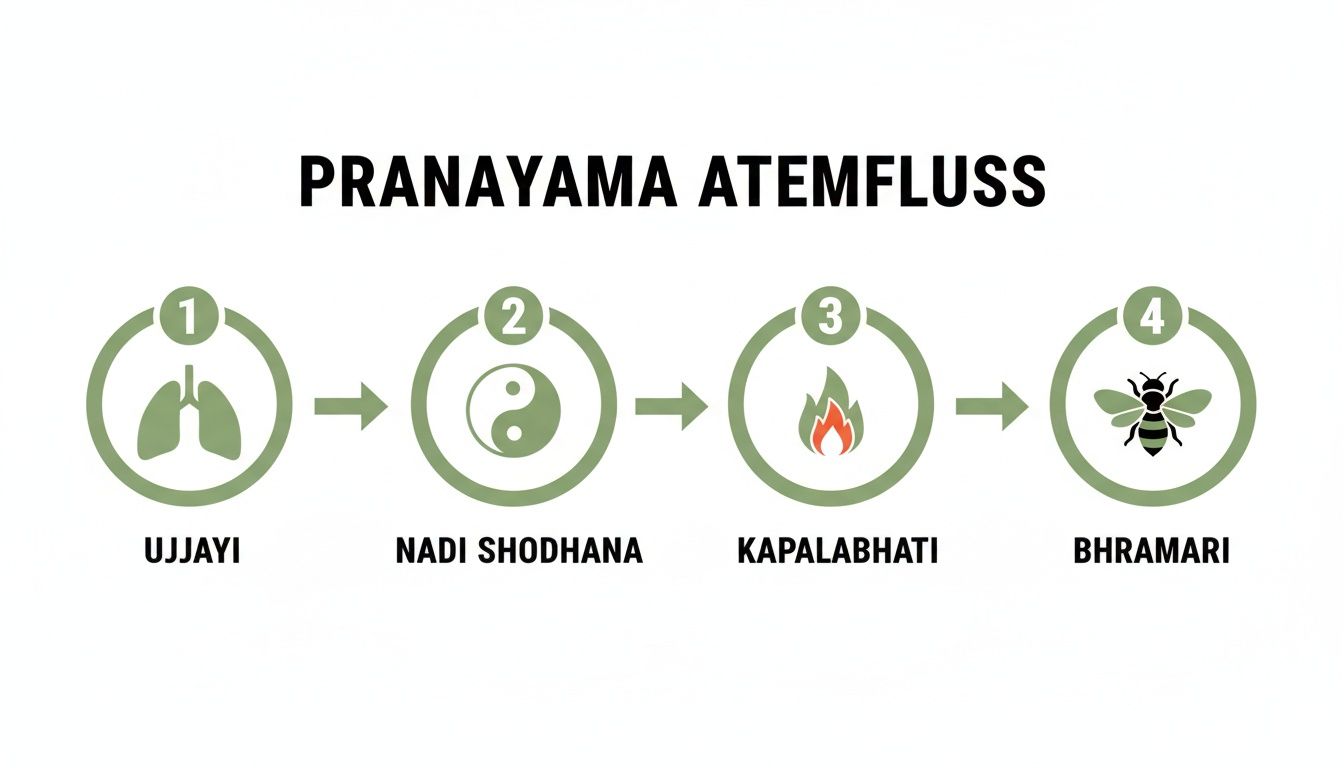
Ici, tu peux voir comment chaque technique s’appuie sur la precédente. Ainsi, au fil du temps, tu obtiens un ensemble d’outils polyvalents que tu peux utiliser selon tes besoins.
# Semaine 1: Concentration on the fondations
Au cours de la première semaine, nous nous consacrons entièrement à la respiration Ujjayi. Prends chaque jour cinq minutes de temps, ideally juste après le réveil. Installe-toi comfortable, ferme les yeux et trouve ce doux bruit océanique dans ta gorge.
Ton seul objectif? Rest the concentration on the respiration after a few minutes. Il ne s’agit pas de perfection. The development experience is a sensation for this base technique and a small, solid routine.
# Semaine 2: Amener l’équilibre dans le système
D’accord, Ujjayi is maîtrisée. Maintenant, ajoutons a new element. Au cours de la deuxième semaine, tu étends ta practice à sept à dix minutes per day.
- Minutes 1-3: Commence comme d’habitude avec ta respiration Ujjayi. Reconnecte-toi, recentre-toi.
- Minutes 4-7: Pratique immediately after Nadi Shodhana, the respiration alternates. Quatre à cinq tours are not parfaits for commencement. If it is passe bien, n’hésite pas à en faire quelques-us de plus.
The rapid realization of the respiration stimulates Ujjayi and the respiration alternée équilibrante creates a wonderful harmony in the sound corps and sound esprit.
# Semaine 3: Energy and purificationMaintenant, ça devient plus actif! Au cours de la troisième semaine, nous intégrons une technique qui te rend éveillé et clair. Ta practice dure maintenant environ dix à two minutes. Ideal for the matin.
Commence à new par quelques minutes d’Ujjayi, suivies de quelques rondes de Nadi Shodhana. Ensuite, you join a round of Kapalabhati (la respiration du fire) with environron 20-30 rapid souffles. The most important thing is that there is a moment in the silence.
Kapalabhati is intense, alors écoute ton corps. If you feel like you’re there, there’s a break. But this is the réveiller ton corps document, pas de le surcharger.
# Semaine 4: Apaisement et approfondissement
Dans la finale your premier mois, nous complétons ton kit d’outils de pranayama. The practice is maintained in an environment of 15 minutes. The maintenant is a flexible routine that can be easily adapted to the same quotidien.
Ajoute à la fin de ta séquence actual Bhramari, la respiration des abeilles. After Ujjayi, Nadi Shodhana and a double round of Kapalabhati, prends trois à cinq rondes for the bourdonnement incroyablement apaisant.
After the last few days, you can continue to apprise the techniques of breathing plus the effects of yoga, but you will also have a solid base. As maintenant un répertoire dont tu peux tirer selon la situation - que tu aies besoin d’un coup de fouet d’énergie, d’équilibre ou d’un profond calme.
# Erreurs frequententes en pranayama et comment les éviter
The security and sound are very important so that you can begin with the pranayama. These breathing techniques are not difficult to breathe, but this is also the case. Mais comme pour tout entraînement intense, il y a quelques points auxquels tu devraise faire attention pour ne past te surcharger. La bonne nouvelle: si tu connais les obstacles typiques, tu peux les éviter facilement dès le départ.
L’une des plus grandes erreurs que j’observe toujours chez les débutants est le forçage de la respiration. Pranayama is not a competition that allows you to breathe more long-term or breathe more life. Considère cela plutôt comme un dialogue doux et conscient avec ton corps.
# Apprends à écouter les signaux your corps
Ton corps te parle constamment – tu dois juste apprendre à l’écouter. Te sens-tu étourdi? Ressens-tu une oppression dans la poitrine or une agitation soudaine et inexplicable? This sont des panneaux d’arrêt clairs. This is not an inspection, but there is a sign of vigilance.
Voici quelques errors typiques et comment tu peux les corriger facilement:
- Ambition once placed: You start directement with 100 souffles from Kapalabhati, because you have the same part. Mieux: Commence with 20-30 souffles and prepares ensuite a moment to resent the silence. The augmentation viendra d’elle-même, semaine après semaine.
- Retenir sa respiration à tout prix: Tu retiens ta respiration (Kumbhaka) jusqu’à ce que ton visage devienne bleu et que tout se contracte. Mieux: Tiens ta respiration longtemps que cela te semble détendu et sans effort. The natural impulse of the inhaler is present, there is no doubt.
- Posture tendue: Tu fronces les sourcils, serres les mâchoires et relèves les épaules vers les oreilles. Mieux: Détends consciemment ton visage, ta mâchoire et tes épaules prior to commencing the exercise. A double sourire peut déjà faire des merveilles.> Il ne s’agit pas de faire un exercice “parfait”, mais de trouver une pratique qui se sente bien pour toi. Moins est presque toujours plus ici. Ta respiration does always feel free and soutenante, jamais forced.
# Quand certain techniques on the basis of a break
These breathing techniques are convenient for the life phase or health safety jacket. Parfois, il est plus say d’adapter un exercise ou de s’en abstenir temporairement.
An attention particulière is required in this case:
- Hypertension artérielle: Les techniques qui créent beaucoup de pression dans le corps, comme un Kapalabhati très intense ou une apnée prolongée, ne sont pas le meilleur choix ici. Concentre-toi plutôt sur des exercises équilibrants et apaisants comme la respiration alternée (Nadi Shodhana).
- Grossesse: Pendant la grossesse, you devrais éviter tous les exercises qui retiennent la respiration (Kumbhaka) or qui créent une forte pressure dans la cavité abdominale. Une respiration abdominale douce, profonde et consciente est en revanche un merveilleux accompagnement pour toi et ton bébé.
Juste parce que ces subtleties sont si décisives, un enseignement qualifié en début is tout simplement précieux. Dans nos cours Templeshape, nous veillons à ce tu apprennes les techniques de manière sûre et correcte pour ton corps. Nous créons un space où tu peux expérimenter sans pression et poser toutes tes questions. Ainsi, you feel the debut in security and two entourages in the practice of Pranayama.
# Ainsi, the Pranayama devient ton super pouvoir au quotidien.
Chez Templeshape, nous vivons our slogan “Make Health Your Habit” chaque jour. The tools and equipment are always there with the following: ta respiration. The Pranayama is more or less simply «respirer profondément». Nous te montrons comment établir ces techniques non seulement dans le cours, mais comme une partie intégrante your mode de vie actif.
The integration begins in subtlety directly in our courses. Tu remarqueras rapidement comment nous utilisons spécifiquement différentes techniques de respiration dans le yoga et d’autres cours pour approfondir la pratique et te prendre là où tu en es.
# Ta respiration dans nos cours
Dans nos flows de yoga dynamiques, tu rencontreras par exemple la respiration Ujjayi. Elle ressemble à un bruit de mer, génère de la chaleur interior et t’aide à brisk à travers les asanas with concentration et puissance. Dans des Heures plus calmes comme le Pilates ou des sessions de Breathwork spécifiques, nous réduisons notre intensité. Ici, nous nous concentrons sur des techniques apaisantes qui régulent ton système nerveux et te permetettent de te détendre profondément.
Mais même dans nos cours chargés en énergie, la respiration joue un rôle principal:
- Avant l’entraînement HIIT: The rapid series of Kapalabhati provides vital energy and preparatory mental and physical activity at a high level of intensity. A veritable coup de fouet!
- Après le bain de glace: Des respirations profondes et ciblées sont ici précieuses. Elles aident ton corps à se réchauffer rapidement and à passer d’un choc thermal à un état de vigilance calme.
Notre objectif est simple: nous voulons te montrer ta respiration est ton lien direct à plus d’énergie, d’équilibre ou de relaxation - selon ce dont tu as besoin à ce moment-là. C’est le pont qui rely le corps et l’esprit.
# The material on the outside worldThe real potential of the Pranayama is revealed as soon as possible by the emphasis on the walls of the studio. Les techniques that you learn that are not like small pieces that you can use in the tumultuous quotidien.
Imagine that you sit in the office and that the classic coup de fatigue de l’après-midi se fait sentir. From the front of a café, you spend three minutes pouring over the cycles of Nadi Shodhana. You can also see the point at which you feel claire and see it après.
Ou le soir, lorsque les pensées ne veulent tout simplement pas se calmer: cinq cycles de Bhramari can arrêter le carrousel dans ta tête et te bercer doucement vers le sommeil. C’est précisément ces petits moments conscients qui font la plus grande différence tout au long de la journée.
This is not the case with the aesthetics, but it also has concrete effects. Les statistics for the region of Zurich montrent que 52% les pratiquants de yoga dormant mieux et réduisent leurs angoisses grâce au Pranayama. Chez nous, au Templeshape, même 62% nos membres féminins rapportent une résilience émotionnelle visiblement renforcee grâce à une pratique régulière de la respiration.
L’intégration is réellement plus simple que do ne le penses. You can reserve a session of Breathwork from now on or you will practice the exercises with each other, depending on the individual. You find more information in notre comparaison entre la pratique en studio et à domicile.Ainsi, ta respiration devient ton compagnon le plus fidèle pour plus d’équilibre et de bien-être - chaque jour.
# These questions are plus frequent questions about pranayama
Encore et encore, des questions similaires sur le Pranayama apparaissent dans nos cours Templeshape. Voici un résumé des plus importantes pour lever tes dernières incertitudes et te preparer à aller sur le tapis en te sentant bien.
# Combien de fois dois-je pratiquer le Pranayama pour ressentir quelque chose?
La régularité prime sur la durée – always. Même cinq à dix minutes per day you can souvent avoir un effet plus puissant que do ne le penses. Beaucoup de nos membres ressentent déjà une concentration plus claire et une paix interior plus profonde après une ou deux semaines.
This means you can reduce the stress in a durable way and recalibrate the nerve system, creating a regular habitable environment. Consider the brossage quotidien de tes dents pour ton âme.
# Is it fair to choose the time to practice pranayama?
Oui, absolutely. La plus grande erreur des débutants est de forcer la respiration au lieu de laisser couler naturellement. Si tu en veux trop, tu peux vite te sentir étourdie ou mal à l’aise - ce qui est bien sûr exactement l’opposé de ce que nous voulons atteindre.
Advance donc progressivement and apprends à écouter les signals subtles your corps. A good course of introduction is inestimable for learning the technique correction of the début. The règle d’or est: si quelque chose ne se sent pas bien, arrête immédiatement.
# Source breathing technique to help you quickly combat stress?
If you let yourself be overcome by stress, the respiration alternée (Nadi Shodhana) is incroyablement efficace. The balance of the sound system nerves and agitates with a button for re-initialization for the ensemble of sound systems.
Also La respiration des abeilles (Bhramari) is fantastic for arrêter le tourbillon des pensées et apaiser immédiatement l’esprit. It’s easy to do a little bit and discover the source of these techniques to make you feel like you’re in the moment.The frontière between the working respiratory system and the meditation are souvent floue. You should approfondir the subject, this is also on the différences entre la respiration consciente et la méditation.
Prêt à ressentir la puissance de ta proper respiration? Chez Templeshape the pranayama is a partie intégrante de nos cours, pour t’aider à développer des routines saines qui perdurent. Consult notre offer and find the course that is convenient to https://templeshape.com.