
Longevity
Pilates for back pain: safe exercises – your practical guide
Back pain can ruin your whole day. But you can break this cycle of pain and restricted movement. This is exactly where Pilates comes in for back pain - with safe exercises that not only provide short-term relief, but also get to the root of the problem: weak deep muscles and unfavorable posture patterns. It's about strengthening your core corset […]
Back pain can ruin your whole day. But you can break this cycle of pain and restricted movement. This is exactly where Pilates for back pain comes in - with safe exercises that not only provide short-term relief, but also get to the root of the problem: weak deep muscles and unfavorable posture patterns. It’s about strengthening your core and stabilizing your spine from the inside out.
# How Pilates can combat your back pain
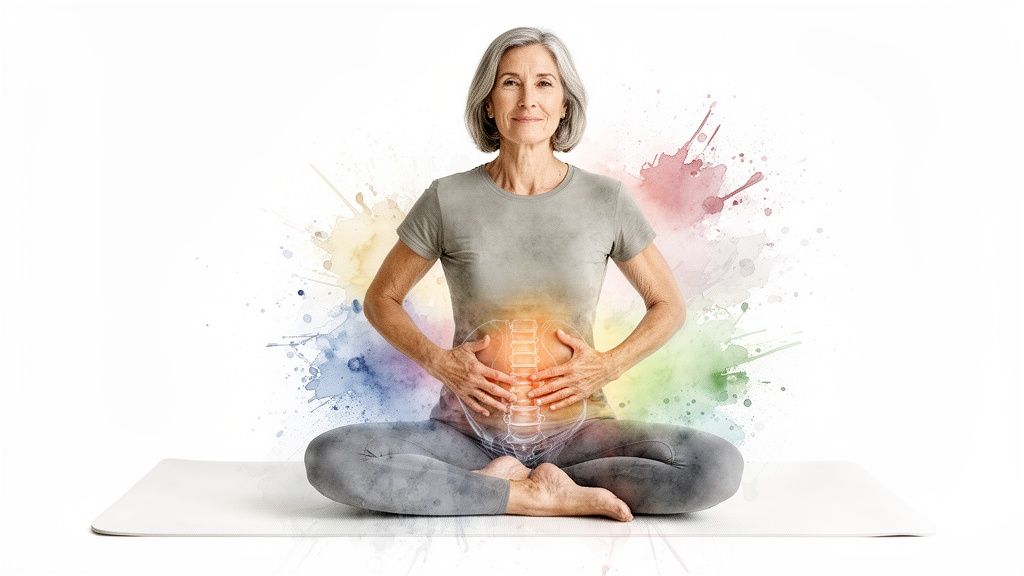
That constant pulling in your lower back, the tension after a long day at the office or the fear that a careless movement could trigger the pain again - does that sound familiar? You are definitely not alone in this.
This is a huge issue, especially in Switzerland. The Rheumatism League’s Back Report Switzerland 2020 showed that 50 percent of respondents suffer from back pain several times a week or month. This is a significant increase from 39 percent in 2011. Another study even assumes that around 75 percent of Swiss people between the ages of 30 and 60 are affected. The main reasons? Muscle tension, overwork and stress - often a direct result of sitting for hours in the office or home office. You can find more details about this in ausführlichen Rückenreport der Rheumaliga Schweiz.
Pilates goes a decisive step further than many other training methods. It not only relieves symptoms but targets the cause of the problem.
# The secret lies in your powerhouse
The heart of the Pilates method is the so-called “Powerhouse”. Think of it like an internal, muscular corset that supports and stabilizes your entire core. It is composed of:
- The deep abdominal muscles: Especially the transverse abdominal muscle (Musculus transversus abdominis), which lies like a natural belt around your waist.
- The back muscles: Especially the small, deep muscles directly on your spine.
- The pelvic floor: The muscular foundation that supports your organs and supports the spine from below.
- The diaphragm: Your most important breathing muscle, which is closely connected to the entire core muscles.
If this powerhouse is weak, your spine loses its support. The large, superficial muscles then have to take on the stabilization work - a task for which they were not designed at all. You know the result: tension, poor posture and eventually pain.
Pilates teaches you how to specifically activate and strengthen this powerhouse. Every single exercise starts from this stable center. In this way, you relieve your spine and effectively protect it from the harmful stresses of everyday life.
# More than just building muscle
But Pilates is much more than just strength training. It trains your body awareness in a way that permanently changes your everyday life. You learn to first notice unfavorable posture patterns – such as the typical slumping at your desk – and then actively correct them.
For example, imagine you’re sitting at the computer and suddenly feel your shoulders fall forward. With the Pilates awareness you have learned, you can straighten up straight away, slightly tense your powerhouse and relieve your back.It’s about taking back control of your body. Through slow, precise, and controlled movements, you’ll learn to target muscles you may not have even known you had. This focus on the quality of movement makes training incredibly safe and effective, especially when you are already in pain. You build a strong, functional core that carries you not only in training, but in every movement of your life.
# The cornerstones for safe training
Before you get on your mat, we need to talk briefly about foundation. These basic principles are not dry theoretical stuff, but rather your most important tool for training that really helps your back and doesn’t put additional strain on it. Imagine them like the statics of a house - without them, every exercise is shaky and, in the worst case, even harmful.
Pilates is never about speed or doing as many repetitions as possible. Quite the opposite: a single, clean and controlled movement will give you infinitely more benefits than ten quick ones where you rush through the exercise. It is precisely this conscious execution that awakens your deep muscles and gives your spine the support it needs.
# The foundation: The six Pilates principles
These six pillars are the heart of the Pilates method. They interlock and are the key to ensuring safe exercises for back pain.
- Control: Every movement is intentional and guided. You never use momentum, but rather consciously control your body against gravity. A classic example: rolling slowly, vertebra by vertebra, rather than simply letting yourself fall backwards.
- Concentration: Focus all of your attention on the muscles that are currently working. Look closely: Is your stomach tight? Are your shoulders relaxed? This connection between head and body is crucial for immediately feeling and correcting mistakes.
- Centering: Every movement starts in your body center, your “powerhouse”. Before you even lift an arm or a leg, consciously activate your deep abdominal and back muscles. This stable center protects your lower back like a natural corset.
These first three principles create the basis. The next three bring elegance and efficiency to your movements.
# Move with precision and flow
Quality over quantity – that is the mantra that should accompany you through every single exercise.
- Precision: The details really matter here. The exact position of your feet, the alignment of your knees or the length of your spine – these little things decide whether an exercise is effective or potentially harmful.
- Breathing: Your breath is the engine. Typical Pilates breathing – in through the nose and out through the slightly open mouth – helps you target your deep abdominal muscles. The powerful exhalation stabilizes your powerhouse during exertion, while the inhalation usually serves as preparation.
- Flow of movement: The exercises flow smoothly into one another. There is no jerking or abrupt stops, but a harmonious, almost dance-like rhythm. This not only protects your joints, but also makes your muscles supple.> When you internalize these principles, your entire training changes. You will feel like you are no longer just doing exercises mechanically, but rather developing a deep understanding of your body. This is the true essence of Pilates.
Once these basics are in place, every exercise becomes safer and many times more effective. If you would like to go even deeper, you will find even more valuable information in our Pilates for Beginners Guide. Think of this foundation as your personal insurance against injury. It ensures that every movement is good for your back and strengthens it sustainably.
# Your 7 best exercises for a strong back
Now it’s getting concrete. We’ve talked about the foundation, now let’s bring that knowledge to the mat. Here are seven of the safest and most effective Pilates exercises that often work wonders for back pain.
But remember: it’s not about looking perfect, it’s about connecting with your body. Every exercise must feel good. If you feel pain, take a break, take a step back, or adjust the movement. Your body always gives you the right feedback - we just have to learn to listen again.
# 1. The Pelvic Clock
This exercise is the perfect start to gently mobilize your pelvis and wake up the deep abdominal muscles. Imagine there is a flat clock on your lower abdomen. The 12 points to your head, the 6 points to your feet.
Lie on your back with your feet hip-width apart and your arms relaxed next to you. Breathe in to prepare yourself. As you exhale, gently tilt your pelvis backwards so that your lower back presses onto the mat - so you move to 12 on the clock. As you breathe in, let go and tilt your pelvis in the other direction, creating a small hollow back - that’s 6.
Repeat this gentle rocking motion a few times. Then you can start to paint a circle with the cymbal in a clockwise direction, slowly tracing all the numbers. After a few laps, change direction.
Tip from the studio: Many people reflexively tense their glutes here. Try to really control the movement from your deep abdominal muscles. It’s very small, but incredibly effective.
# 2. The Cat-Cow
An absolute classic, and for good reason. It mobilizes your spine in all directions and releases stubborn tension. Ideal for gently warming up your back while activating your abdominal muscles.
To do this, get on all fours. Your hands are directly under your shoulders, your knees are under your hips, your back is long and neutral. As you exhale, round your back upwards, vertebra by vertebra, like a cat. Your chin pulls towards your chest, your tailbone curls up.
When you inhale, reverse the movement. You let your back sag gently, raise your gaze slightly and open your chest forward. But be careful not to just “sag” in the lower back, but rather to maintain the length.
- Important: Your breath guides the movement, not the other way around. Take your time.
- Adjustment: If you have sensitive wrists, you can lean on your fists. If your knees hurt, just put a folded blanket underneath them.
# 3. The Bridge (Shoulder Bridge)The bridge is a fantastic exercise for strengthening the entire back of the body - from the thighs to the buttocks to the lower back. Strong gluteal muscles are the most important counterpart to the often shortened hip flexor muscles and thus provide enormous relief to the lumbar region.
Lie on your back again with your feet up. Exhale and slowly roll your pelvis and then your spine upward, vertebra by vertebra, until you form a straight line from your shoulders to your knees. Hold briefly at the top and breathe in. With the next exhalation you roll down again just as slowly and in a controlled manner.
Typical mistakes and how to avoid them:
| The error | The correction |
|---|---|
| The ribs push out upwards. | Imagine you are wearing a corset. Keep your ribs gently pulled in and down. |
| The knees fall outwards. | Imagine holding a small ball between your knees. Always keep them hip-width apart. |
| The power comes from the lower back. | Concentrate fully on actively tensing your buttocks to lift your hips. The back just follows. |
# 4. Leg lifts while lying down (leg lifts)
This exercise looks deceptively simple, but is extremely effective for training the deep abdominal muscles without putting any strain on your back. It’s less about leg movement and more about stabilizing the torso while something is moving.
Lying on your back with your feet up, activate your powerhouse by gently pulling your belly button towards your spine. Exhale and slowly lift one leg into the “tabletop” position (90-degree angle at hip and knee). Inhale and lower your foot again in a controlled manner until the tips of your toes briefly touch the mat.
Then switch sides. The be-all and end-all of this exercise: Your pelvis and lower back don’t move a millimeter**. You remain absolutely stable on the mat the entire time.
# 5. Thread the Needle
A wonderful exercise to mobilize the often stiff thoracic spine and loosen the shoulders. A flexible thoracic spine is the key to relieving pressure on the neck and lower back.
Start on all fours again. As you inhale, lift your right arm to the side and up towards the ceiling, your gaze following your hand. Open your chest as wide as is comfortable. As you exhale, thread your right arm under your left until your right shoulder and temple gently touch the floor.
Stay in this stretch for a moment, then come back up while inhaling. Repeat this a few times before switching sides.
# 6. The clam shell
This exercise specifically targets the lateral gluteal muscles (gluteus medius). This muscle is crucial for the stability of your pelvis and helps prevent pain in the lower back and sacroiliac joint (SIJ).
Lie on your side, bend your knees and place your feet together. You can rest your head relaxed on your lower arm. Engage your obliques to lift your waist ever so slightly off the floor. As you exhale, lift your upper knee, but keep your feet together - like a seashell opening. When you breathe in, you close it again.
Pay close attention to ensuring that your pelvis remains stable and does not tip backwards. The movement is small and only comes from the hips.
# 7. Child’s PoseThe perfect exercise to finish off. It gently stretches the back, creates space in the lumbar region and calms the nervous system.
From a four-legged position, simply sit on your heels. The knees can be closed or slightly open. Bend your upper body forward and place your forehead on the mat. You can either stretch your arms out in front of you or place them relaxed next to your body.
Now breathe deeply into your back. With each inhalation, feel your ribs expand and your lower back gently stretch. Stay here for a few breaths and enjoy the relaxation.
# Make Pilates your daily ritual: The 15-minute routine
The biggest lever for a pain-free back is and remains regularity. But honestly, who has time for hours-long training sessions in the stress of everyday life? The good news is: you don’t need them at all. It’s the small but constant impulses that give your body the signal to build new, stronger patterns.
This is exactly why we developed this crunchy 15-minute routine for you. It is designed so that you can effortlessly slip it into your day - be it as an energetic start to the morning, as a conscious break in the home office or as a relaxing end to simply let go of the tensions of the day.
Don’t see this plan as a rigid corset, but as your personal template. It follows a proven structure that ensures that your back is optimally warmed up, challenged and relaxed again at the end.
# This is how your 15-minute unit is structured
Each unit is divided into three simple phases. This logical sequence gently prepares your muscles and joints, specifically strengthens your core and ultimately ensures soothing relaxation. This way you get the most out of every minute on the mat.
- Phase 1: Warm-up & mobilization (approx. 4 minutes): We gently wake up your body. With exercises such as the cat hump and the pelvic clock, we bring targeted movement into your spine, relieve initial tension and get your powerhouse ready for work.
- Phase 2: Strengthening & Stabilization (approx. 8 minutes): Now it gets strengthening. Here you combine two to three of the safe exercises from the previous chapter - think of the bridge or the leg raise. The focus is entirely on controlled execution in order to strengthen your inner muscle corset.
- Phase 3: Cool-down & stretching (approx. 3 minutes): Finally, we bring calm back into the system. Gentle stretches such as child’s pose or the eye of the needle help to loosen stressed muscles and shut down the nervous system.
The following graphic shows you an exemplary sequence to gently mobilize your back and strengthen it at the same time.
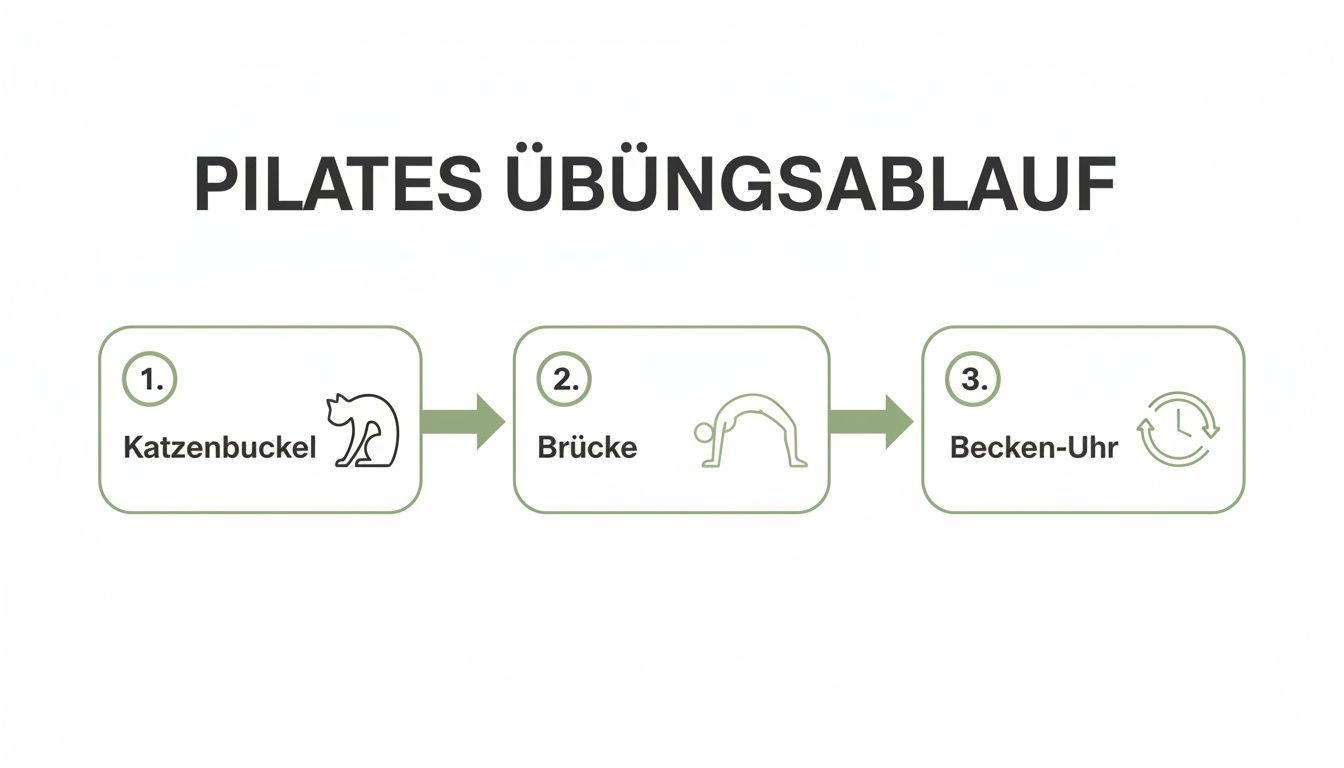
This combination of mobilization (cat’s hump, pelvic clock) and strengthening (bridge) is a wonderfully balanced little workout for your spine.
# A concrete plan for your 15 minutes
Here’s a suggestion for how to fill your time on the mat. Do the exercises slowly and with full concentration. Always remember: The quality of the movement counts many times more than the sheer number of repetitions.
Warm up:
- Pelvic Clock: 10-12 gentle reps (back and forth).
- Cat’s Hump: 8-10 flowing repetitions in the rhythm of your breathing.
**Strengthening:**1. Bridge: 2 sets of 10-12 reps. Roll up and down one vertebra at a time. 2. Lying Leg Raises: 2 sets of 8-10 reps per side. Keep your torso absolutely stable.
Cool down:
- Child’s Pose: Hold the position for 5-8 deep breaths and consciously send the breath into your lower back.
Your key to success: Consistency beats intensity. It is far more effective to schedule these 15 minutes three times a week than to struggle for an hour once a month. Your body loves reliable routines.
The effectiveness of regular training has been well proven. Pilates has established itself in Switzerland as an effective method against non-specific back pain. Studies show that training once a week for six weeks noticeably improves your health and mobility. Another study found significantly greater pain relief from Pilates compared to traditional exercise therapy after just four weeks. Since at least 80 percent of the Swiss population will have to deal with back pain at some point in their life, regular training is a sustainable investment in your own health.
If you’re looking to expand your routine or simply find new inspiration, you’ll find many more effektive Pilates Übungen für Zuhause in our comprehensive guide. Make this short session your personal ritual for a strong, healthy back.
# Pitfalls when training - and when you should listen to your body
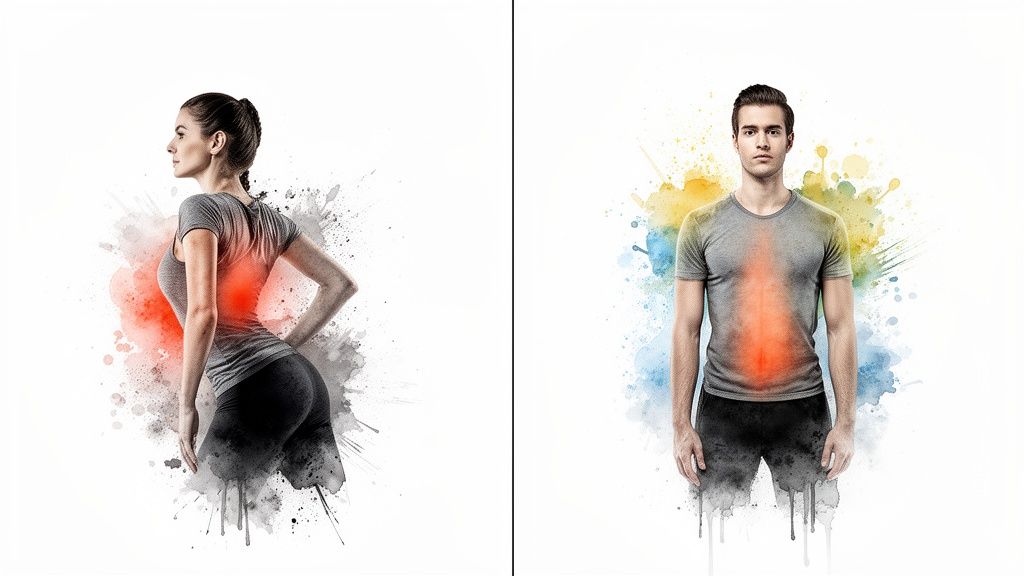
When training for a healthy back, the following always applies: safety first. Even the best exercise can backfire if done incorrectly. That’s why we’ll now take a look at the typical mistakes that tend to creep in at the beginning - and how you can avoid them from the start.
It’s about developing a fine feeling for your body. You have to learn to feel when a movement is good and when it is more of a burden. This awareness is the key to truly safe and effective training.
# Typical sources of errors and how to recognize them
Many mistakes happen unnoticed and quickly become a habit. But don’t worry, with a few simple self-correcting tricks you’ll quickly get it under control.
- The unnoticed hollow back: Especially when doing exercises while lying on the back, such as leg raises, many people tend to fall into a hollow back as soon as it becomes strenuous. Your tip for correction: Place your hands flat under your lower back. You should feel gentle, even pressure on the back of your hand throughout the exercise.
- Holding our breath: When we are tense, we often unconsciously hold our breath. This increases the pressure in the abdominal cavity and only leads to more tension. Your tip for correction: Concentrate on breathing out consciously and powerfully during the effort - for example when lifting the pelvis in the bridge. Your breath guides the movement.
- Quick, jerky movements: If your strength starts to wane, you might want to use momentum to help. But this contradicts the Pilates principle of control. Your tip for correction: It’s better to do one fewer repetition, but do each one slowly and with full control. Here, less is definitely more.
Always remember: Pilates is not a competition. It’s not about how high you can get your leg, but how stable you can keep your torso.You shouldn’t underestimate how important clean and safe execution is, especially when you look at the numbers. Back pain is a huge issue: In Switzerland, around 60 percent of all disability applications are due to back problems. Studies clearly show that Pilates can reduce pain by strengthening the core and improving posture. However, since the symptoms recur in 60 percent of those affected, safe execution is crucial to breaking this vicious circle. More about the Zusammenhänge von Rückenschmerzen und Prävention erfährst du auf ffhs.ch.
# Your body’s warning signals
Just as important as the right technique is knowing and respecting your own limits. Your body is pretty clear and sends clear signals when something is wrong.
Stop exercising immediately and seek medical or physical therapy advice if you notice any of these symptoms:
- Sharp, stabbing pain: A slight pulling or burning sensation in the muscles is completely normal. It is not a sharp, sudden shooting pain. This is a clear stop signal.
- Referring pain: If the pain radiates from the back into the leg, arm or buttocks, a nerve may be irritated.
- Feelings of numbness or tingling: These discomforts are always a reason to have it checked out by a specialist.
- Persistent aggravation: If your back pain is significantly worse than before for 24 hours after exercise, then the exercises or intensity are probably not appropriate for your current condition.
Training responsibly means listening to these signals. A break from training and a professional clarification are not a step backwards. On the contrary, it is the smartest and safest way to have a sustainably healthy back.
# What else concerns you: Frequently asked questions about Pilates for back pain
Finally, I would like to address the questions that I always come across in everyday studio life. They are intended to take away any remaining insecurities and create even more clarity so that you can start your training confidently and safely. By the way, it’s totally normal to have a lot of questions at the beginning - that just shows that you take your body and your health seriously.
These answers summarize our years of experience and the typical concerns of people looking for safe exercises with Pilates for back pain.
# How many times a week should I do Pilates?
To really make a difference when it comes to back pain and feel lasting success, two to three sessions per week are ideal. The real key to success is regularity, not necessarily the length of each individual session.
Even our 15-minute routine can make a huge difference if you stick to it consistently. It is just as important that you give your body time to regenerate. Learn to listen carefully to his signals. Some days a gentle mobilization feels just right, while others you may be ready for a more challenging strengthening sequence.
Your body loves rituals. Two to three fixed appointments per week with you and your mat are infinitely more effective than a single, long session if you happen to find time. Consistency always defeats intensity.
# Can I do Pilates if I have a herniated disc?This question is extremely important and the answer to it must be crystal clear: In the case of an acute diagnosis such as a herniated disc, the green light from your doctor or physiotherapist is absolutely essential.
Pilates is often a fantastic and important part of rehabilitation, but the exercises need to be tailored specifically to you and your specific diagnosis. Inappropriate or incorrectly performed standard exercises could make the situation worse and do more harm than good. Here, individual personal training or a special rehabilitation course is the safest and by far most effective choice for you.
# Is training on the reformer better than on the mat?
Neither – neither of the two variants is generally better. They simply offer different benefits and a different training feel. Mat training is a fantastic way to work exclusively with your own body weight and build a deep, genuine connection to your powerhouse. It is the basis of everything.
The Reformer, a special Pilates device, works with spring balancers. These can both support movements and provide additional resistance.
- Support: The springs can help you learn movements correctly and target the deep muscles in a much more targeted manner. This is a huge help, especially in the beginning.
- Resistance: Once you’ve mastered the basics, they allow for much more intense strength training.
The guided movement on the reformer gives many people a great feeling of security, especially if they already have back pain. It’s best to just try both to find out what feels best for your body at the moment. Many also combine both to benefit from all the advantages.
# Does Pilates also help with neck tension from an office job?
Absolutely! Pilates is a holistic training that always sees the body as a unit. Neck tension is often just the last link in a chain of poor posture that starts much further down.
By consistently strengthening your powerhouse, your entire posture improves. If your torso is stable, your neck and shoulder muscles no longer have to do all the holding work and can finally let go.
Targeted exercises that mobilize the thoracic spine and strengthen the muscles around the shoulder blades have a direct effect on the typical office tension. Deep Pilates breathing also helps to reduce mental stress - which is all too likely to get stuck in your neck. If you would like to better understand the differences and similarities between different training methods, please read our article Pilates oder Yoga, which will give you further insights.
At Templeshape GmbH we understand that the path to a pain-free back is very personal. Our experienced trainers in Zurich accompany you with specialist knowledge and empathy, regardless of whether you train on the mat or the reformer. Find the perfect course for you in our studios and take the first step towards a stronger, healthier you. Discover our diverse offering and become part of our community.
Erfahre mehr und buche deine erste Stunde auf templeshape.com
Templeshape
Turn reading into action.
Discover the Templeshape offer that fits your next step.
View schedule