
Fitness
This is how you can overcome your inner bastard: The easy way to motivation
Overcoming your inner weaker self has less to do with struggle and discipline than you think. It's more about outsmarting your brain's ingrained impulse to conserve energy. The trick is to take small, almost ridiculously easy steps to break the initial resistance. This is how you establish new routines without having to [...]
Overcoming your inner weaker self has less to do with struggle and discipline than you think. It’s more about outsmarting your brain’s ingrained impulse to conserve energy. The trick is to take small, almost ridiculously easy steps to break the initial resistance. This is how you establish new routines without having to exert enormous willpower every day.
# Understand your inner bastard and turn it into an ally

Imagine a normal evening: you had a firm plan to go to training. As soon as you are home, the sofa attracts you with an almost magical power. What is happening at this moment has nothing to do with laziness, but is pure biology.
Your brain has been programmed since time immemorial to conserve energy - a perfectly sensible survival strategy. Constantly fighting this instinct is incredibly stressful and often doomed to failure.
The key is not to view this internal resistance as an enemy. Instead, think of it as a part of you that you can manage cleverly. Instead of judging yourself for the hesitation, try to understand the real reasons behind it.
# Why your brain loves the sofa
Most of the time it’s not the huge hurdles that slow you down, but rather many small, inconspicuous stumbling blocks. There are simple but extremely effective mechanisms behind this:
- Decision fatigue: After a long day full of decisions at work, your mental battery is simply empty. The choice between a sofa and a sports bag then becomes a real burden.
- Fear of being overwhelmed: Just the thought of a sweaty hour in the fitness center can seem overwhelming.
- Lack of clarity: You know you should do something, but you don’t have a crystal-clear, simple plan for the very first step.
Stop fighting your bastard. Better make a pact with him. The goal is not to defeat him, but to outsmart him using clever strategies and use his energy for your benefit.
This change in perspective is absolutely crucial. If you sit in the office all day, you know this phenomenon all too well: you decide to work out after work, but you end up straight on the sofa.
The will to move is definitely there in Switzerland. Over 1.37 million people are members of a fitness center in this country. Among 15 to 65 year olds it is around one in five people.
To see overcoming obstacles from a different perspective, it’s worth taking a look at die Bash-Busters Philosophie. It’s also about creating a completely new dynamic through conscious mindfulness and small adjustments in everyday life. You can find out more about the incredible power of the Achtsamkeit in our guide.
# Break the initial resistance with micro-habits

The biggest mistake when building new routines? You’re taking on way too much right from the start. This initial overzealousness is your inner bastard’s best friend because it almost always leads to disappointment and gives him the perfect excuse to send you back to the couch.A concrete example: You haven’t been very active for months, but now you plan to do intensive training five times a week. That’s a surefire recipe for frustration. The key to success lies in the exact opposite: in the quiet but enormous power of tiny, almost ridiculously simple habits.
This is exactly where the principle of micro-habits comes into play. It’s about finding actions that are so small that your brain can’t find any reason to resist. Instead of an hour of HIIT, simply start with a tough 10-minute workout at home. Instead of 30 minutes of meditation, you only take five conscious breaths when you get up.
# This is how you build unstoppable momentum
The real trick is to dock these mini-routines into existing, established habits. This method is called Habit Stacking and is an incredibly effective tactic for outsmarting your inner weaker self.
You use an action that you already do every day as a trigger for your new micro-habit. Your brain doesn’t have to make a new decision, it just follows a familiar pattern.
Here are a few simple examples from practice:
-
Your goal: Bring more exercise into your everyday life.
-
Existing habit: You make coffee every morning.
-
New micro-habit: While the coffee is brewing, do 10 squats right in the kitchen. Complete.
-
Your goal: Less stress, more mindfulness.
-
Existing habit: You sit down at your desk to work.
-
New micro-habit: Before you boot up the computer, take three deep, conscious breaths.
Your goal is not perfection, but regularity. A two-minute exercise you do every day is infinitely more valuable than that hour-long workout you keep putting off.
Once these small steps become completely second nature, you can slowly increase them. This gentle approach creates a positive feedback loop: you experience small successes immediately, which greatly strengthens your motivation for the next day. If you want to delve deeper into the psychology behind it, you can find valuable strategies in our Leitfaden zur Gewohnheitsänderung.
Get started with micro habits
Big goals can seem intimidating. The trick is to break them down into tiny first steps that are so easy you can’t put them off. Here are a few ideas of what that could look like:
| Your big goal | Your micro-habit (max. 5 minutes) | When & Where? |
|---|---|---|
| Daily training | 10 push-ups and 20 squats | Immediately after getting up, next to the bed |
| Meditate regularly | Concentrate on your breath for a minute | After you sit down at the desk |
| Drink more water | Drink a large glass of water | Immediately after brushing your teeth in the morning |
| Eating Healthier | Eating an apple | As a snack at 3 p.m. before cravings hit |
| Read every day | Reading a page in a book | Right before falling asleep in bed |
Even one of these small actions, carried out consistently, builds momentum that will take you further than any over-ambitious plan.
# Design your environment for success
An often underestimated but crucial factor is your environment. Make it as easy as possible to do the right thing and as difficult as possible to not do it.Lay out your sports clothing in a clearly visible place the evening before. Place your yoga mat unrolled next to the bed. Place a filled water bottle directly on your desk, in your line of sight.
Each of these small adjustments reduces the mental effort you need to get started. This is how you trick your inner bastard before he even has the chance to speak up with his typical excuses. You build unstoppable momentum based on small but consistent successes.
# This is how you get exercise into even the busiest of everyday lives
Is your calendar bursting at the seams? And the idea of squeezing in regular exercise feels like you have to invent an eighth day in the week. You probably know that. But the key to finally putting your inner bastard on a leash is not to find more time. It’s about using the time you have more cleverly.
From now on, view exercise as an irrefutable appointment with yourself. That takes a bit of discipline at the beginning, of course. But you’ll quickly notice that this routine ends up giving you a lot more energy than it costs you.
# Fixed appointments for working people
When you work, your calendar is sacred. So treat your sports sessions just like you would your most important business meeting: enter them as fixed, non-postponable appointments. A vague plan like “do some exercise on Tuesday evening” is practically a written invitation to your bastard to thwart your plans.
Make it specific. An entry like “Tuesday, 6:30 p.m. - 7:15 p.m. HIIT class at Temple” creates a completely different commitment. Block this time in your calendar and defend it as if it were a client meeting. It is a conscious decision for your health - and it has at least the same priority as any professional project.
# Smart routines for moms
Everyday life as a mother is often unpredictable and determined by the needs of others. Fixed, hour-long training times? Mostly a utopia. The trick is to weave the movement seamlessly into the existing routines of family life.
- Bedtime is your time: Even a quick 15-minute workout while baby is napping can do wonders for your energy levels.
- Active playground action: Turn a visit to the playground into your personal training session. Do a few squats while pushing your child on the swing, or have a little race across the lawn.
- Moving together: Makes activity a family affair. A bike ride on the weekend, a spontaneous dance party in the living room – all of that counts and is fun.
Let go of perfectionism. That is the most important point. An imperfect but completed 10-minute workout is infinitely more valuable than the perfect hour in the gym that you never end up finding time for.
# The power of the group in the company
There is a huge opportunity here for teams in companies. Doing sport together is not only good for everyone’s health, it also brings the team together incredibly. If your colleague next to you grits his teeth and pushes through, you won’t give up so easily.Regular team workouts, a joint running group during the lunch break or an internal company pedometer challenge can outsmart the individual’s weakness through this gentle, social pressure. Suddenly it’s fun to achieve goals together. As soon as the first happiness hormones flow, a positive cycle is created, because Endorphine sind der Schlüssel zum Glücklichsein beim Sport.
And by the way, it’s a myth that only young people are looking for ways to become more active. The 50+ generation in particular is often extremely motivated to overcome their inner weakness - usually for very specific reasons such as health prevention, pain reduction or the desire to stay fit and independent for a long time. The fitness industry is adapting to this with offers that focus more on health and appreciative care, without any pressure to perform.
# Your tried and tested 4-week timetable becomes a routine
Theory is all well and good, but now it’s time to get down to business. Let’s put the puzzle pieces together and build a structure that will almost automatically get you to your goal. This tried-and-tested 4-week timetable is your very personal guide to taming your inner weaker person step by step and making exercise a permanent, natural habit.
Each week has a clear focus that builds on the previous one. This way you don’t overwhelm yourself, but rather build a stable foundation for sustainable success. You’re not running a sprint here - you’re establishing a routine that sticks.
# Week 1: Focus on pure regularity
In the first week only one thing counts: Consistency. Forget about intensity or any performance goals for now. Your only job is to implement your tiny micro-habit every single day. It’s about proving to your brain: Hey, I’m serious this time.
Whether it’s ten squats immediately after getting up or a five-minute stretch before brushing your teeth - the action itself is almost irrelevant. The only important thing is that you do it without exception. In this way you lay the foundation and create the self-evidence that you need for everything else.
# Week 2: The first increase
Okay, you’ve shown that you stick with it for seven days. Time for the next, logical step. Now we increase the intensity very slowly and in a controlled manner. Your inner bastard has noticed that you won’t let up, so he’s ready for a small, doable challenge.
- Plan two fixed appointments: Consciously block two fixed time slots of 20-30 minutes in your calendar. These are your dates with yourself for a real workout.
- Choose something you enjoy: Whether it’s a tough HIIT class online, a jog in the forest or strength training at home - the joy of movement is and remains your strongest ally.
- Keep your micro-habit: On the days without a regular workout, just keep doing your little routine from week 1. This way the rhythm is maintained.
The following infographic shows you how you can cleverly integrate these new routines into your everyday life - whether at work, with your family or as part of a team.
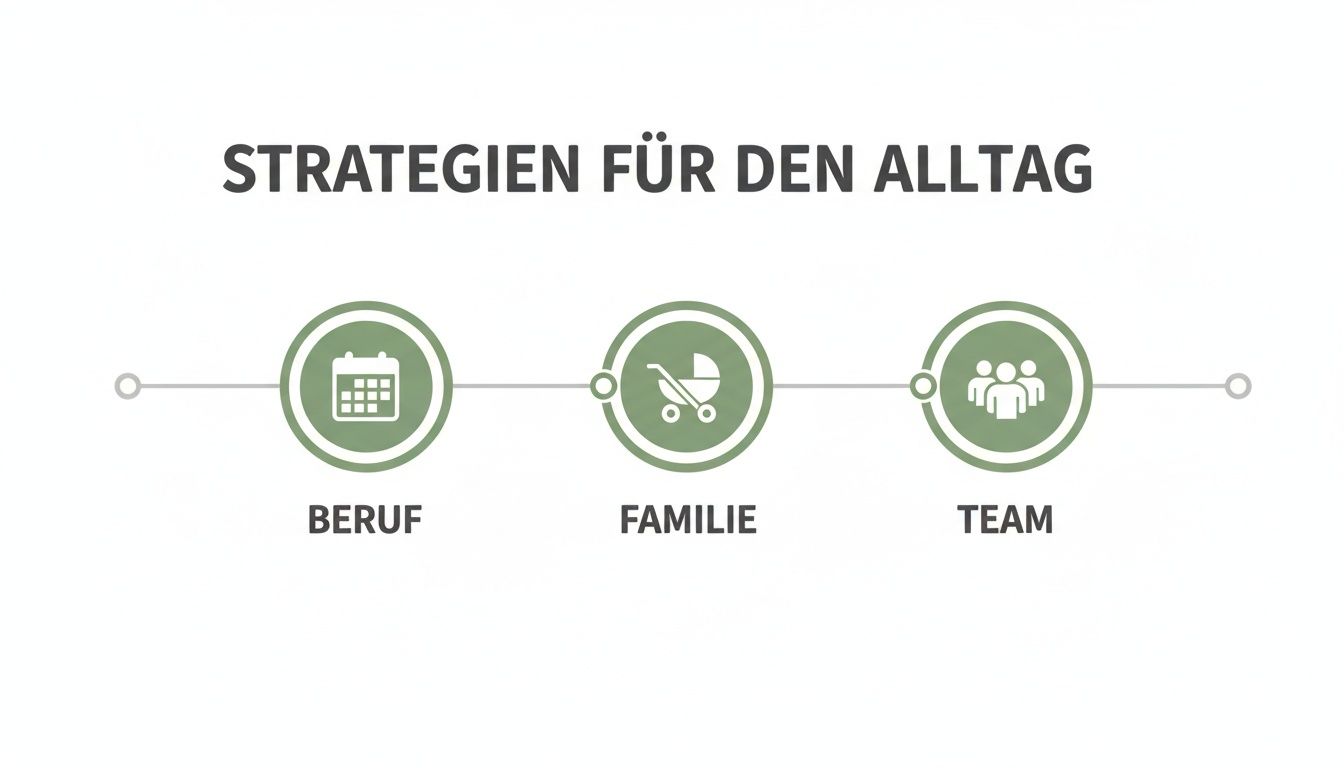
You see: There are suitable anchor points for every life situation to make exercise normal.
# Week 3: The power of communityYou have created a solid foundation that you can be proud of. In week three, we tap into one of the most powerful sources of motivation of all: social commitment. Starting out on your own is a huge accomplishment. But sticking with it together is often much easier and much more fun.
Your bastard is a master of excuses when he only has to negotiate with you alone. As soon as another person is involved, he becomes surprisingly quiet.
Arrange a date to exercise with a friend, book yourself into a group course or join a local running group. The positive energy and gentle pressure of community often works wonders. They also carry you through the days when your own motivation is low.
# Week 4: Reflection and Adaptation
The fourth week is absolutely crucial to your long-term success. Now it’s time to pause for a moment, take stock and adjust your strategy for the future. You’ve collected valuable data about yourself in the last few weeks and now you know much better what works for you - and what doesn’t.
Consciously take the time to honestly answer these questions:
- What worked best? Which workouts did you really enjoy? What times of day did you have the most energy?
- Where were the biggest hurdles? On which days was it particularly difficult to overcome your inner weakness and why was that?
- What are your next steps? Do you want to increase the intensity further, maybe try a new sport or increase the number of training sessions you do?
This reflection process helps you to further optimize your routine. This way you can make sure that it really fits into your life and that you stay motivated. You now have the tools to turn this 4-Week Plan into a lifelong, healthy habit.
To make it easier for you to get started, I have summarized the plan in a clear table. It serves as a guide and shows how the individual weeks logically build on each other.
# # Overview of your 4-week plan
| week | Focus | Concrete action | Target |
|---|---|---|---|
| Week 1 | regularity | Perform one micro-habit (e.g. 5 minutes of stretching) every day. | Make the action second nature. |
| Week 2 | Increase intensity | Plan a 20-30 minute workout twice a week, maintain the micro-habit. | Get your body used to higher levels of stress. |
| Week 3 | Commitment | Plan at least one sporting activity with others (course, friend, team). | Use social support as a motivation booster. |
| Week 4 | Optimization | Reflect on the previous weeks and adapt the plan for the future. | Develop a sustainable, personalized routine. |
Don’t see this table as a rigid set of rules, but as your personal roadmap. Customize it, make it your own, and celebrate every little success along the way
# What to do when motivation drops?
Sure, there will be those days. Days when your motivation is at zero. You wake up and just the thought of exercise feels like climbing Mount Everest. This is completely normal, it is human.
What matters is how you deal with it. A day like this is not a setback, but simply part of the bigger picture, your path.The first and decisive step? Be honest with yourself. Learn to differentiate clearly between real physical exhaustion and that loud, convincing voice of your inner weaker self. Do you really feel drained, sick or overtrained? Then a break is exactly the right thing and absolutely necessary. Most of the time it’s just the mental resistance that tries to slow you down.
# Your emergency kit for motivation holes
If you notice that it’s just the bastard whining, you need an emergency kit. A few immediately effective techniques to break through that initial resistance and get you moving before the excuses take over.
A good example is the 5 minute rule. You just say to yourself, “Okay, I’ll just do five minutes.” Not more. Everyone can do that. Put on your sports clothes and get started. The highlight of the matter? The beginning is almost always the biggest hurdle. And after these five minutes you often feel so good that you keep going on your own.
What also helps immensely is visualization. Close your eyes for a moment and remember your personal “why”. Feel the feeling after a really good workout – that energy, the pride. This positive image is often the little spark you need to get off the couch.
A bad day doesn’t make a bad week. The way you react to a dip in motivation determines whether it’s a one-time blip or whether it jeopardizes your hard-earned routine.
# Flexibility instead of rigid plans
If your original plan just feels wrong today, be flexible. Instead of skipping your workout completely, just adjust it. Maybe today isn’t the day for an intense HIIT workout, but how about a brisk walk in the fresh air? Or a relaxing yoga session?
Sometimes just watching inspiring motivierende Zitate und Sprüche is enough to recharge your batteries.
External commitments are also powerful leverage. The yoga course that you have already paid for or the fixed appointment with a training partner – these are often the decisive nudge. You don’t want to let anyone down, least of all yourself.
These strategies are your safety net. They catch you and prevent a small dip in motivation from turning into a complete standstill. Learn to listen to your body, but don’t let your inner weaker self trick you.
# Frequently asked questions about inner weakness
Finally, we will clarify a few questions that we come across again and again in our courses and discussions. They are intended to take away any remaining uncertainties and be a very practical starting aid.
# How long does it take to overcome your inner weaker self?
Of course, there’s no one-size-fits-all answer, but studies show that it takes on average about 66 days for a new habit to truly run on autopilot. Much more important than the exact duration is the regularity.
Rather, concentrate on actually following your new little routine every single day. The magic moment comes when you stop thinking about it and just do it. This is the point at which you have finally put your bastard on a leash.
# What if I miss a day?Not the end of the world! A missed day doesn’t mean you failed or that everything was in vain. The biggest mistake you can make now is to give up completely. Be gentle with yourself and just carry on the next day as if nothing had happened.
One slip-up doesn’t make you a failure. The only thing that matters is how quickly you get up and keep going.
Just don’t fall into the “all or nothing” trap. An imperfect plan that you stick to consistently is worth a thousand times more than the perfect plan that makes you throw in the towel at the first obstacle.
# How do I stay motivated in the long term?
Long-term motivation has little to do with pure willpower. Rather, it’s about creating a system that supports you, even when the initial euphoria wears off. Here are the three most important pillars for this:
- Find your big “why”: Connect your goals to something that really affects you. Do you want to be fitter so you can play around with your children without any worries? Would you like to reduce stress so that you can finally be more relaxed at work? A strong why is the anchor that pulls you through every low point in motivation.
- Celebrate your successes, even the small ones: Make your progress visible. Check off each completed day on a calendar or use a simple app. These little visual moments of success release dopamine and are like a pat on the back for your brain - it wants more of it!
- Find allies: Whether it’s a regular training partner, a weekly class or an online community - social commitment is an incredibly powerful driver. It’s just a lot harder to cancel training if you know someone is waiting for you or asking.
If you incorporate these elements into your everyday life, you create an environment in which your inner bastard becomes increasingly restricted. You develop a positive momentum of your own that allows you to carry on almost on your own.
Are you ready to take the first, decisive step and finally tame your inner weaker self? At Templeshape GmbH you will find the structure, energy and community you need to make exercise a solid and positive habit in your life. Entdecke jetzt unsere Kurse und starte deine Reise.
Templeshape
Turn reading into action.
Discover the Templeshape offer that fits your next step.
View schedule