
Wellbeing
Losing weight with yoga: effective ways, exercises and nutritional tips
Yes, you can lose weight with yoga. And sustainably. But it's about so much more than just the calories you burn on the mat. It's this unique blend of physical exertion and mental reframing that brings real, lasting results. How to really lose weight with yoga Maybe the first thing you think about when you think of yoga is [...]
Yes, you can lose weight with yoga. And sustainably. But it’s about so much more than just the calories you burn on the mat. It’s this unique blend of physical exertion and mental reframing that brings real, lasting results.
# How to really lose weight with yoga
Maybe when you think of yoga, you first think of relaxation and gentle stretching. How is this supposed to help you lose weight? The key lies in the profound effect that a regular practice has on your entire body and mind. Yoga is not a quick trick, but a method that turns several important adjustment screws at the same time.
Instead of just fixating on the number on the scale, you’ll learn to feel real change. You suddenly notice how your jeans fit looser, you have more energy for everyday life or your posture straightens. It is precisely this holistic approach that makes losing weight with yoga so effective – and motivating.
# More than just burning calories
Sure, dynamic yoga styles like Vinyasa or Power Yoga really get your heart rate up and challenge your muscles. But the decisive advantage lies in the clever combination of different effects that reinforce each other:
- Building Lean Muscle: Powerful poses like the warrior sequences or the plank shape your body and build lean muscle mass. More muscle means a higher basal metabolic rate - so your body burns more calories even when you’re sitting on the sofa. For example, imagine holding Warrior II pose for several breaths; You can immediately feel the tension in your thighs and arms. This is building muscle in action.
- Leave stress: Yoga has been proven to lower levels of the stress hormone cortisol. A constantly elevated cortisol level is poison for any weight loss ambition: it promotes cravings for sweet and fatty foods and promotes the nasty storage of belly fat. Less stress often means less uncontrolled eating. For example, you might be more likely to reach for chocolate after a stressful day, while you might be more in the mood for tea after a relaxing yoga session.
- A better body feeling: Through yoga you build a much stronger connection with yourself. You will learn to correctly interpret your body’s signals - such as real hunger and satiety. This mindfulness intuitively helps you make healthier dietary choices without having to chastise yourself. For example, you don’t eat an apple because it is “healthy”, but because you feel that your body needs fresh energy.
The true power of yoga for losing weight is not just in the movement. It lies in the changing relationship you develop with your body, your food and your daily habits.
Before we move on, let’s take a quick look at how yoga compares to classic endurance training. Both have their place, but their focuses are different.
# Yoga vs. traditional cardio at a glance
| Here’s a quick comparison contrasting the primary effects of dynamic yoga and classic cardio training on the body and mind when losing weight.aspect | Dynamic yoga (e.g. Vinyasa) | Traditional cardio (e.g. running) |
|---|---|---|
| Primary Focus | Strength building, flexibility, mental balance | Cardiovascular endurance, calorie burning |
| Calorie consumption | Moderate to high, depending on intensity | High, directly dependent on duration and intensity |
| Muscle building | Yes, building lean, defined muscles | Minimal, mainly in the stressed legs |
| Stress reduction | Very high through breathing & mindfulness | Moderate, due to endorphin release |
| Body perception | Very high, central part of the practice | Low, focus is often on performance |
| Joint stress | Low to moderate, flowing movements | High, especially when running or jumping |
| Afterburn Effect | Moderate, increased by building muscle | Low to moderate |
As you can see, it’s not about what is “better”. It’s about what works best for you and your goals. Yoga offers a more comprehensive approach that goes beyond just burning calories, while cardio is an incredibly effective way to burn energy quickly. The best strategy? Often a combination of both!
# What science says
By the way, this holistic effect is not just a feeling, but has been scientifically proven. An insightful study has shown that overweight women lost measurable body weight and, above all, waist circumference after just twelve weeks of regular Hatha yoga practice - and all without any accompanying diet.
This perfectly underlines what we see again and again in practice: the effect of yoga goes far beyond burning calories. It is the improved body awareness and the more mindful lifestyle that make the real difference. Read more about these interesting study findings on tagesanzeiger.ch.
# Your timetable for the first 8 weeks
Okay, enough theory – now let’s get down to business! A good plan is half the battle, which is why I’ve put together a simple but incredibly effective 8-week timetable for you. This is how you get straight into action and make yoga a habit.
We start gently to create a solid foundation. Afterwards we increase our strength in a targeted manner so that there is no boredom and the fat burning runs at full speed.
The be-all and end-all of the first four weeks is very clear: build routine and consistency. Your body first has to get used to the new movements. It’s about developing a real connection with your mat and integrating yoga into your everyday life, without any pressure.
This graphic summarizes the core mechanisms we activate with our plan to lose weight with yoga.
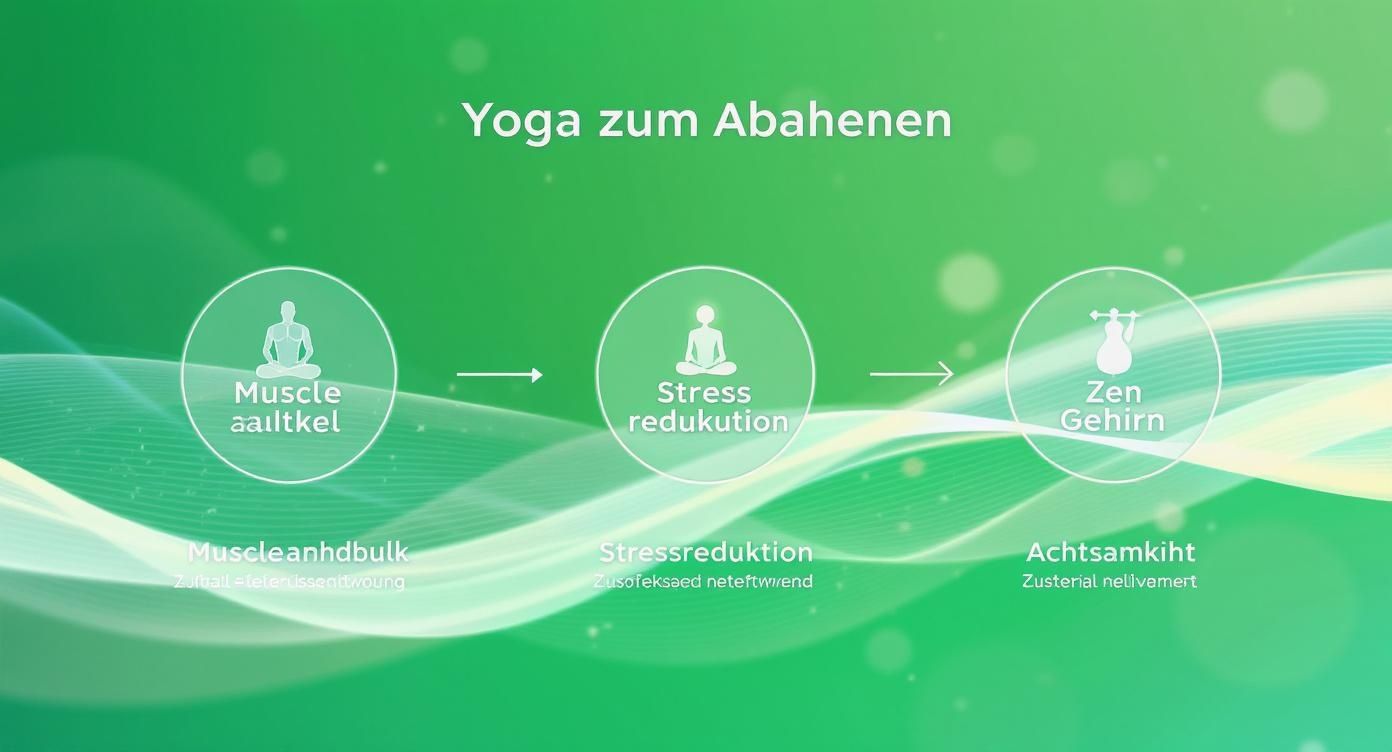
You see: it’s about so much more than just calorie consumption. Building muscle, reducing stress and mindfulness are pieces of the puzzle that fit together perfectly here.
# Phase 1: Weeks 1-4 – Laying the foundation
The initial phase is all about establishing a habit. Aim for three fixed yoga sessions per week. Each session should last between 45 and 60 minutes - the perfect time frame to challenge your body without overwhelming it.
The right mix of styles is crucial. Choose flows that combine strength, endurance and flexibility.* Monday: Power Vinyasa Flow (60 minutes): Start the week powerfully. A dynamic flow boosts your metabolism and gives you energy.
- Wednesday: Hatha Yoga (45 minutes): Here you concentrate on clean alignment and hold the asanas a little longer. This builds targeted strength and trains your body awareness immensely.
- Friday or Saturday: Restorative or Yin Yoga (45 minutes): Treat your body to active recovery. Gentle stretches help your muscles regenerate and let the stress of the week melt away.
In this phase, regularity is more important than intensity. Completing three moderate sessions is worth its weight in gold - much more than completely exhausting yourself once and then needing a week off.
# Phase 2: Weeks 5-8 – Increase intensity
Your foundation is in place. Now it’s time to step it up a gear! Your body is ready for new stimuli, which we use to further fuel fat burning. We increase the frequency and bring a breath of fresh air into your practice.
Add a fourth training session per week. This can be another dynamic Vinyasa flow or something completely different that you feel like doing.
We also incorporate short, HIIT-inspired sequences into your usual flows. This means you integrate small, high-intensity intervals. Imagine: plank hold for a minute, immediately followed by 30 seconds of fast mountain climbers, and then back into downward dog. That gets your pulse racing!
A weekly plan could then look like this:
- Monday: Power yoga with HIIT elements (60 minutes)
- Tuesday: Active break (e.g. a long walk)
- Wednesday: Strengthening Hatha Flow (60 minutes)
- Thursday: Additional session: Pilates or another Vinyasa flow (45 minutes)
- Friday: Active break
- Saturday: Yin Yoga for regeneration (60 minutes)
- Sunday: Rest day
Depending on the intensity of your practice, you can burn between 180 and 600 calories per hour with yoga. For visible success, at least three to four intensive sessions per week are ideal. But even short daily sessions of 15-20 minutes can work wonders to build a solid base of strength and conditioning. More about Effektivität von Yoga beim Abnehmen liest du bei stamwerk.ch.
This 8-week plan is your framework. Listen to your body and always adapt the intensity to your daily form. It’s not about perfection, it’s about sticking with it and making constant progress.
# The most effective yoga styles and asanas for burning fat
Let’s be honest: Not every style of yoga makes you sweat and shed the pounds. If your goal is clearly “to lose weight,” then gentle stretching alone is simply not enough. We need to look at the dynamic, powerful styles that get your heart rate up and build targeted muscle - because that’s where the key to success lies.
Choosing the right style can be the difference between “I just don’t see results” and a real sense of achievement. The important thing is to find a practice that challenges you, but is still fun enough for you to actually stick with it.
# Find your flow for burning fat
Dynamic yoga styles are essentially a flowing workout that combines movement and breathing. They are often really sweaty and their intensity feels more like a classic strength endurance training session.* Vinyasa Yoga: This is the creative, flowing style. No two hours are the same, which makes it extremely varied. You move from one posture (asana) to the next in sync with your breathing, which really gets your cardiovascular system going.
- Power Yoga: The name says it all. This variation is an even more energetic, athletic form of Vinyasa. The focus here is clearly on building strength and endurance. If you like to really work out, you’ve come to the right place.
- Ashtanga Yoga: A very traditional and structured style with a fixed sequence of postures. The practice is extremely physically demanding and builds immense strength and discipline through the constant repetition of the series.
For anyone who is now curious: Some studios also offer an exciting mix of these intense flows and Pilates elements, known as Yogalates. If you want to learn more about this powerful fusion, check out our guide that explains alles Wichtige zu Yogalates als Fusion-Workout.
# Your 3 most important asanas for losing weight
No matter what style you choose, a few basic asanas almost always pop up. They are real powerhouses for your weight loss success. Concentrate on performing these exercises cleanly and with full tension.
Your goal is not to complete as many exercises as possible. It’s about performing each individual posture consciously and with full muscle tension in order to achieve the maximum effect.
# # 1. The Sun Salutation (Surya Namaskar)
The sun salutation is actually not a single asana, but a whole sequence - and a complete workout in itself. It warms up your entire body, stimulates circulation and uses almost every large muscle group.
If you flow through sun salutations A and B several times at the beginning of your practice and accompany each movement with a breath, you will quickly notice how your pulse increases and you start to sweat.
# # 2. The Chair Pose (Utkatasana)
This exercise may seem harmless, but it has a lot to it. Utkatasana is a real killer for your thighs and glutes. Training large muscle groups is essential because they are your body’s biggest calorie consumers.
How to do it right:
- Stand with your feet together.
- Bend your knees and lower your buttocks deeply, as if you were sitting on an invisible chair.
- At the same time, lift your arms straight up. Keep your back long and pull your belly button firmly towards your spine to avoid falling into a hollow back.
- Hold the position for 5-8 deep breaths. You should feel a noticeable burning sensation in your thighs - that’s the sign that it’s working!
# # 3. The Plank Pose (Phalakasana)
The plank, also known as “the board” in yoga, is the ultimate exercise for a strong core. Strong core muscles not only stabilize your entire body, they also shape a slim waist and improve your posture in everyday life.
Make sure your body forms a straight line from your heels to the top of your head. Tighten your stomach, legs and buttocks and actively push yourself out of your shoulders. Try to hold the position for 30 seconds at the beginning and then slowly work up to a minute or even longer.
# How mindful nutrition supports your yoga successYour training on the mat is only half the battle. You will only see real, lasting results when losing weight with yoga if you combine your exercise with a conscious diet. But don’t worry: it’s not about strict diets or counting calories, but about nourishing your body mindfully and nutritiously.
This approach fits perfectly with yoga philosophy. You will learn again to listen to your body’s signals and give it exactly what it needs for your flows and the regeneration afterwards. The goal is to have a healthy, stress-free relationship with food that empowers you.

# Eat mindfully instead of dieting
Eating mindfully means putting full focus on your meal. Instead of eating at your desk or in front of the TV, consciously take your time. This will help you feel much better when you are really full and avoid unconscious overeating.
Try integrating these simple habits into your everyday life:
- Eat slowly and chew thoroughly: You will only feel full after about 15-20 minutes. When you eat more slowly, you give your brain a chance to receive the signal in time.
- Turn off distractions: No smartphone, no TV. Just concentrate on the taste, texture and smell of your food.
- Listen to your body: Before eating, ask yourself: Am I really hungry or is it just hunger out of boredom or stress?
Mindfulness doesn’t end when you get off the yoga mat. Putting them on your plate is one of the most effective steps to sustainably regulate your weight.
When you apply these principles, you will strengthen your connection to your body and develop an intuitive sense of what is good for you. You can find even more in-depth information in our comprehensive Ernährungsratgeber für Yogis, which will help you tailor your diet perfectly to your practice.
# The right fuel for your muscles
What you eat before and after your yoga session can make a huge difference to your performance and weight loss success. It’s about providing your body with the right building blocks at the right time.
Before yoga: A light, carbohydrate-rich meal about 1-2 hours before your practice is ideal. It gives you quickly available energy for your flow. Think of a banana, a handful of dates or a small porridge.
After yoga: After training, your body is literally crying out for nutrients to regenerate and build muscle. A combination of high quality protein and complex carbohydrates within 60-90 minutes of the session is optimal.
A few ideas for a perfect post-workout meal:
- A large salad with quinoa, chickpeas and chicken breast strips
- Greek yogurt with berries and a few nuts
- A protein smoothie with spinach, almond milk and half a banana
Protein in particular is crucial if you want to lose weight with yoga. Not only does it build lean muscles that increase your basal metabolic rate, but it also keeps you full for a long time and effectively prevents food cravings.
# How to properly measure your progress and stay motivated
Imagine giving your all on the mat, slowly building up strength and muscles with yoga - and then this: the scales barely move or even show more. Frustrating, right? This is a classic and the moment when many lose motivation.The reason is simple: muscles are denser and therefore heavier than fat. So while you’re losing fat, your weight may stagnate or even increase slightly. That’s why the number on the scale is often the worst guide. Let’s focus on progress that you can actually see and feel.
These alternative methods will give you a much more honest and motivating picture of your transformation. They show you that Losing weight with yoga is much more than just a number.
# Make successes visible
The best indicators of your progress are often what you see in the mirror or feel on your clothes. So it’s better to use a tape measure than a scale. It’s worth checking the same areas every two to four weeks.
- Measuring circumferences: Write down the circumferences of your waist, hips and thighs. Even a centimeter or two less is a huge success and a clear sign that something is happening.
- Progress Photos: It may sound strange at first, but it works wonders. Take photos of yourself at the beginning and then about once a month - ideally always in the same clothes and pose. You will be surprised at the visual changes that the scales don’t tell you.
- The fit of your clothes: Do you feel how your jeans suddenly fit looser on the hips? Or does the T-shirt fit better on the arms? These are the real victories in everyday life.
A good smartwatch can also help to optimally record your progress in losing weight with yoga. It not only tracks calories, but also sleep and activity levels. Here you will find a suitable selection, even if your budget is limited: the beste Smartwatch unter 50 Euro.
Progress is not a straight line upwards. There will be weeks when you make big leaps and others when little seems to be happening. Trust the process and celebrate every little success along the way.
# More than just physical changes
Your body is changing, but what about your head and how you feel? A training diary is an invaluable tool for recording this mental and emotional progress. Don’t just write down what flows you did. Write down how you felt during and afterward.
Pay particular attention to changes in these areas:
- Your energy level in everyday life
- The quality of your sleep
- Your mental clarity and concentration
- Your general mood and calmness
These non-physical gains are often the most powerful motivators. They show you how profoundly yoga improves your overall well-being. The Achtsamkeit practice you learn on the mat naturally carries over into the rest of your life.
And science proves you right. Studies show that yoga not only contributes to weight loss - on average, test subjects lost 2.32 kg - but also massively improves general health. Particularly impressive: In a Zurich study, after just six months, 79% of practitioners no longer needed painkillers for their back pain.
# Your questions, my answers: everything you need to lose weight with yoga
You probably have a few questions in mind before you get started - everyone does! The same insecurities keep cropping up in my courses, especially at the beginning. That’s why I’ve summarized the most important points for you so that you can get on your mat with a clear and safe feeling.
# How quickly do I see the first results?That’s probably the question of all questions and the honest answer is: It depends on you. Your starting point, your diet and above all your consistency are crucial.
If you manage to get on the mat three to four times a week, you will probably feel noticeably fitter, stronger and simply more alert after just two to four weeks. This feeling is often the first, big reward!
Visible changes, such as a tighter silhouette or that your favorite jeans fit looser again, usually take a little more time. Expect around six to eight weeks. Be patient with your body. Losing weight with yoga is not a sprint, but more of a marathon - but one that brings you to your goal sustainably and with a great body feeling.
# Is yoga alone enough to lose weight?
For many, the answer is clearly: yes! Especially if you come from a rather inactive lifestyle, a regular, intensive yoga practice is an absolute blast. You build muscle, your metabolism gets a real boost and you learn to reduce stress - this combination is unbeatable.
But do you want to give your results an extra kick? Then incorporate one or two hard cardio sessions per week. A round of running, cycling or jumping rope is ideal. This maximizes calorie burning and is really good for your cardiovascular system.
My most important advice: Find a routine that you really enjoy and that you can realistically integrate into your everyday life. There’s no point in forcing yourself to do five workouts only to throw in the towel in frustration after three weeks.
# I’m a total beginner - what’s the best way to get started?
Every beginning is… doable if you know how! To avoid frustration, getting started correctly is worth its weight in gold. Look specifically for courses or online videos that are clearly marked as “Beginner”, “Beginner” or “Level 1”.
- Start with Hatha Yoga: This style is slower and places a lot of emphasis on correct alignment in the postures (asanas). This is how you build a clean and secure foundation.
- Be gentle with yourself: No one is born a yoga professional. It’s completely normal if you wobble, shake or just need a break. Listen to your body.
- Use tools: Blocks, straps and pillows are your best friends! They help you find the postures safely, even if there is still a lack of flexibility in one place or another.
# Yoga after pregnancy – what do I have to consider?
First of all: congratulations, mom! Your body has achieved incredible things and now deserves time and attention. Before you start yoga again, getting the “go” from your doctor or midwife is absolutely essential. Also wait until your postnatal course is completed.
Take it easy. Special postnatal yoga courses are best. These are designed to strengthen your pelvic floor and rebuild the often weakened core muscles safely and effectively. In the beginning, intensive, straight abdominal exercises (such as crunches) and deep twists are taboo.
Are you ready to take the first step on your journey to a stronger, healthier you? At Templeshape GmbH you will find everything you need: powerful flows, regenerative units and a community that supports you every step of the way. Find the course that suits you now and make your well-being a habit: https://templeshape.com.
Templeshape
Turn reading into action.
Discover the Templeshape offer that fits your next step.
View schedule