No products in the cart.
January 30

Do you often feel tired and listless or struggle with your weight even though you actually eat a “healthy” diet? You've probably heard countless times that sugar and carbohydrates are the real villains that are crippling your metabolism. But this widespread one Sugar myth overlooks a crucial truth: High-quality, natural carbohydrates are not the enemy, but the essential fuel for your thyroid.
The constant scaremongering about carbohydrates has led many of us to lump all carbs together. This can be a fatal mistake for your hormone balance. Think of your thyroid—that little, butterfly-shaped gland in your neck—as your body's powerhouse. It controls how quickly you burn energy and has a hand in your mood, your digestion and even your body temperature.
To do this important job, it needs the right fuel. And these are natural carbohydrates.
Think of your body as a high-performance car, built for optimal power. What happens if you put cheap, dirty gas in the tank? The engine sputters, loses power and simply doesn't run smoothly. The exact same thing happens if your diet consists mainly of refined sugar - i.e. sweets, pastries and sugary drinks.
This “cheap gas” causes your blood sugar to go on a rollercoaster ride, increases inflammation, and stresses your entire system, including your thyroid.
High-quality, natural carbs, on the other hand, are like premium fuel. You can find them, for example, in:
These complex carbohydrates provide your body with consistent, long-lasting energy. They also contain important fiber, vitamins and minerals that your thyroid urgently needs for smooth hormone production. The blanket demonization of carbohydrates robs your body of exactly this important fuel. Find out more about what the problem with modern diets really lies and why radical renunciation is often the wrong way.
To make the whole thing more tangible, here is a small comparison:
This table compares common myths about carbohydrates with scientific facts and shows you at a glance what your thyroid really needs.
| The myth | The scientific reality | What that means for you |
|---|---|---|
| "Alle Kohlenhydrate sind schlecht und machen dick." | Refined sugar and complex carbs have completely different effects. Natural, fiber-rich carbohydrates stabilize blood sugar and provide sustainable energy. | Make a clear distinction between a sweet potato and a piece of cake. One is fuel, the other is a short-term kick with consequences. |
| "Eine Low-Carb-Diät ist der beste Weg, um abzunehmen und den Stoffwechsel anzukurbeln." | Your thyroid needs glucose (from carbohydrates) and insulin to convert the inactive hormone T4 into the active T3. A deficiency can slow down this process. | If you're constantly tired and aren't losing weight, a low-carb diet that's too strict could be slowing down your thyroid. |
| "Zucker ist Gift für den Körper." | Refined sugar in excess promotes inflammation and stresses the body. Natural sugars from fruits come packaged with vitamins, minerals and fiber that slow absorption. | Enjoy fruit without a guilty conscience! They provide important nutrients that your thyroid loves. Instead, cut back on added sugar. |
As you can see, it's the quality that matters, not just the category. The right selection makes the difference.
A look into the past clearly shows how crucial the right supply of nutrients is. Imagine Switzerland at the beginning of the 20th century. In many regions, especially in the Alpine valleys, people suffered from huge swellings on their necks - the so-called goiter. This picture was commonplace and the cause was a massive iodine deficiency. According to historical records, in some cantons such as Bern or Graubünden there were up to 50 percent of the population affected.
This story teaches us an important lesson: a single missing nutrient can shut down an entire system.
Fortunately, today we have the iodine deficiency largely under control thanks to iodized salt. But the principle remains the same: your thyroid depends on a constant supply of very specific nutrients.
Modern “goiter” may no longer be visibly swollen, but it presents with symptoms such as chronic fatigue, weight gain and lethargy. The cause is often not the lack of food, but rather the wrong choice of food.
So it's not about cutting out carbohydrates completely. It's about choosing the right ones. The combination of nutrient-rich, natural carbs and essential trace elements makes your thyroid a real super organ - for more energy and joy of life in your everyday life.
Did you know that your thyroid cannot work properly without sufficient carbohydrate intake? It is the engine of your metabolism and needs the right fuel to provide you with energy. When this fuel is lacking, your body switches into a kind of emergency mode - and the result is often fatigue and unexplained weight gain.
The fascinating mechanism behind this is hormone conversion. Your thyroid primarily produces the hormone thyroxine, more commonly known as T4. The only problem is: T4 is largely inactive. You can think of it like a key that doesn't quite fit into the lock yet.
In order for this hormone to have its full effect, your body must first convert it into the highly active hormone triiodothyronine, or T3, convert. T3 is the actual power hormone that gives your cells the signal to burn energy and rev up your metabolism. And this is exactly where natural carbohydrates come into play.
This crucial conversion step takes place primarily in your liver and kidneys. The whole process relies on a specific enzyme whose function depends directly on whether enough glucose is available. Glucose is the simplest form of sugar that your body gets from carbohydrates.
Without enough glucose in the blood, this process slows down dramatically. Your body interprets a lack of carbohydrates as a distress signal, as a kind of hunger or stressful situation. His logical reaction to that? Save energy. It slows down the conversion of T4 into active T3 in order to slow down the metabolism and conserve valuable resources.
Imagine your metabolism like the heater in your house. The inactive T4 is the fuel that is stored in the basement. Natural carbohydrates provide the electricity (glucose), so to speak, to pump that fuel up and turn on the heat (your active T3). If there is no electricity, the fuel remains unused in the basement and the house becomes cold.
This concept map shows the difference between good and bad fuel for your thyroid.
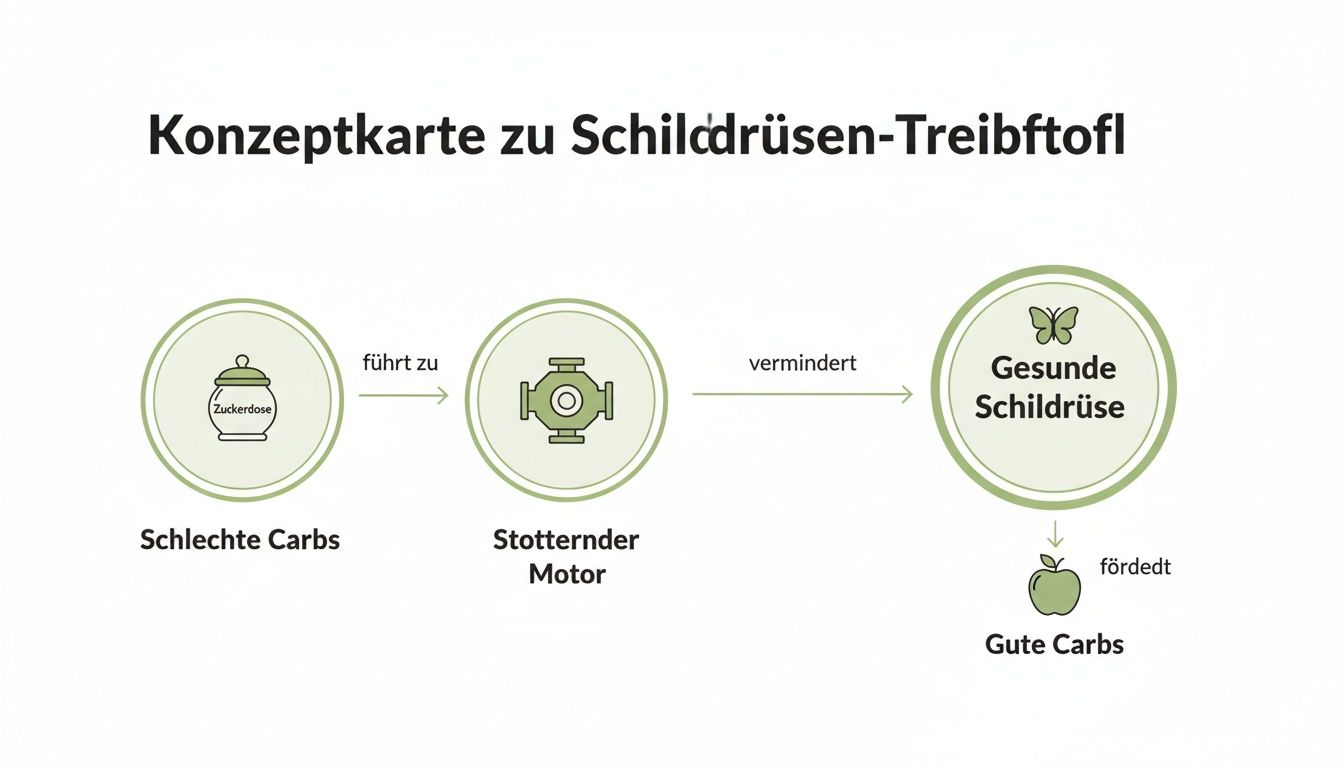
As you can see, bad carbs like refined sugar lead to a sputtering metabolic engine, while good carbs from natural sources make your thyroid bloom like a butterfly.
Now you may be wondering how insulin fits into this picture. Finally, insulin often has a bad reputation because it is associated with sugar spikes. But here too, the quality of the carbohydrates makes the crucial difference. Insulin is a hormone that your body releases after eating carbohydrates to move glucose from the blood into the cells.
It plays a supporting role for your thyroid. A moderate and stable insulin level, as occurs after consuming complex carbohydrates, signals safety and energy availability to the body. This signal is an important co-factor for the smooth conversion of T4 to T3.
It only becomes problematic when there are constant and high insulin spikes caused by refined sugar and white flour products. These lead to blood sugar fluctuations and can promote long-term inflammation in the body - which puts additional stress on your thyroid.
Here's why choosing your carbs is so important:
Refined carbs (e.g. white bread, sweets):
Natural, complex carbs (e.g. whole grains, legumes, sweet potatoes):
So, a diet rich in whole grains, lentils, quinoa, and starchy vegetables will nourish your thyroid instead of taxing it. It provides the necessary fuel for hormone activation and ensures a stable environment in which your metabolism can run optimally.

Did you know that your thyroid has a close ally that is far too often overlooked? This ally is your gut. It is so much more than just a digestive organ - it is a veritable command center that communicates directly with your thyroid and significantly influences its function.
This communication takes place via a fascinating community of trillions of microorganisms: yours Gut microbiome. These beneficial bacteria are absolutely crucial to your health. One of their most important tasks is to support your thyroid hormones. Actually find around 20% of conversion from the inactive T4 into the active power hormone T3 directly in your intestine.
A healthy microbiome is like a hard-working team of helpers that ensures that the final, crucial step of hormone activation runs smoothly. But of course this team also needs the right food to stay productive.
Imagine your intestines like a blooming garden. The good bacteria are the beneficial plants that bear fruit and keep the weeds at bay. Harmful bacteria are the weeds that will overgrow anything if you give them the chance. The food you give this garden determines what grows.
The absolute favorite food of your good intestinal bacteria fiber, also called dietary fiber. These indigestible carbohydrates from plant foods are a real feast for your microbiome. When the bacteria ferment these fibers, they produce short-chain fatty acids like butyrate as a thank you. These have an anti-inflammatory effect and strengthen your intestinal wall.
A diet high in refined sugar and processed foods does the exact opposite. It feeds the harmful bacteria and leads to an imbalance that experts call Dysbiosis designate.
Dysbiosis in the intestine is like a smoldering fire in the body. It promotes silent inflammation, which not only affects your digestion, but can also directly disrupt sensitive thyroid function and block the all-important hormone conversion.
The quality of your carbohydrates is the key to a healthy gut and therefore a happy thyroid.
In Switzerland people eat a lot of carbohydrates. On average we take between every day 350 and 385 grams to us. The problem lies not in the quantity, but in the quality Sugar myth additionally fired. Alarming 84 percent This intake comes from grains and added sugar, while the important dietary fibers are significantly lacking at only 22-26 grams per day. At the same time, an estimated 15 to 20 percent of the Swiss population has thyroid problems. More details about Carbohydrate consumption in Switzerland you can find it here.
These numbers make it clear how important it is to shift the focus from pure quantity to the quality of carbs in order to optimally support the thyroid.
Strengthening your microbiome is easier than you might think. It's not about complicated diets, but about consciously integrating nutrient- and fiber-rich foods into your everyday life. Here are a few simple examples:
By consciously nourishing your gut with these natural, fiber-rich carbohydrates, you create the ideal environment for healthy hormone metabolism. Not only do you support your digestion, you also actively strengthen the hidden connection to your thyroid, thereby laying the foundation for more energy and well-being.
The theory sounds good, but the real challenge starts in the supermarket and in your kitchen, right? Your everyday life is probably already full. So how do you manage to implement this knowledge without making healthy eating the next big stress factor?
Don't worry, it's not about completely changing your life overnight. It's about small, conscious adjustments that make a huge difference to your thyroid and your energy levels. Think of this section as your practical guide, tailored to different life situations.
As a professional in Zurich, you're probably familiar with this: long working days, quick lunch breaks and the dreaded afternoon slump that makes you reach for the next quick sugar. But this is exactly where you can start and specifically support your thyroid. Your goal is to keep your blood sugar stable so you have consistent energy.
A concrete example:
The time during and after pregnancy is an absolutely exceptional hormonal situation. Your body is doing incredible things and your energy needs are skyrocketing. At the same time, there is often hardly any time for elaborate meals. Quick, nutritious snacks and simple meals are worth their weight in gold here.
Your body needs one thing above all else: constant, high-quality fuel. Natural carbohydrates are not a luxury, but a necessity to replenish your energy reserves and support your thyroid during this sensitive phase.
Here are a few simple examples:
The iodine status in Switzerland is generally good thanks to iodized salt, but the right combination of nutrients is crucial, especially in stressful phases of life. A report from the Federal Office for Food Safety and Veterinary Affairs (BLV) showed 2019that bread and convenience foods are one of the main sources of iodine. This makes it all the more important to rely on high-quality, natural carbohydrates with a low glycemic index. Whole grains, vegetables, and legumes help prevent blood sugar spikes, which can increase inflammation and put unnecessary stress on your thyroid. If you want more about the Nutrition situation in Switzerland If you would like to find out more, you can find the comprehensive report here.
As an athlete, you know how crucial energy is for your performance and regeneration. Timing your carbohydrate intake correctly can make all the difference. Carbs are the most important fuel for your muscles during intensive training sessions.
Before training (approx. 1-2 hours before):
Your goal is to replenish your muscles' glycogen stores. An easily digestible meal with complex carbohydrates is ideal for this.
After training (within 1-2 hours):
Now it's about quickly replenishing the used energy. This will initiate regeneration and reduce muscle soreness.
By strategically planning your carbohydrate intake, you not only optimize your athletic performance, but also actively support your thyroid function and your overall hormonal balance. A thorough knowledge of the change from primary grain to mass milling can help you choose the best sources for your diet. This means your diet becomes the basis for strength, endurance and well-being.
A smart diet with natural carbohydrates is an incredibly powerful tool to support your thyroid and simply feel better. But - and this is really important for us to emphasize - nutrition is the basis, but it never replaces a professional medical diagnosis. This section is intended to help you recognize when self-optimization has reached its limits and it is time to consult a professional.
Your body often sends pretty clear signals when something is out of balance. These signs should not be taken lightly, especially if they persist. Be sure to see a doctor if you notice one or more of the following symptoms.
Both an underactive and an overactive thyroid can manifest itself through a wide variety of symptoms. Pay particular attention to these warning signs:
If this sounds familiar, it's really time for a medical evaluation. A targeted blood test quickly provides clarity here.
A professional diagnosis is the be-all and end-all in order to get to the bottom of the cause of your symptoms and start the right treatment. Your doctor will usually check certain blood values.
The most important parameters are:
A medical evaluation is not only important for acute symptoms. In certain phases of your life you should also think about this as a preventive measure. This is especially true for one existing desire to have children or if you already have one Autoimmune disease How Hashimoto's Thyroiditis was diagnosed.
At Templeshape, our goal is to empower you to make smart and responsible decisions about your health. This means using the full power of nutrition, but also knowing when to rely on medical expertise. A good one Preparation for nutritional advice By the way, it can help you collect your observations and conduct conversations with experts even more effectively.

After all this information, you probably still have a few specific questions floating around in your head. Super! This shows us that you really care about your health. In order to clear up any remaining confusion, we have collected the most frequently asked questions about carbohydrates, the sugar myth and your thyroid.
First things first: We have to be clear between refined sugar and that natural sugar in fruits or whole grain products. Industrially added sugar is a real stress factor. It can increase inflammation in the body and cause blood sugar levels to go on a roller coaster - both of which indirectly put a strain on your thyroid.
A radical renunciation is usually not necessary. It is much more effective to consciously reduce sweets, sweetened drinks and highly processed foods. Instead, focus on the complex carbohydrates that your thyroid so desperately needs for hormone conversion. Always remember: an apple is in a completely different league than a chocolate bar.
There are tons of fantastic options, but these three are real powerhouses that you can easily incorporate into your everyday life:
The key is diversity. Consider these three your basic pillars and supplement them with many other nutrient-dense foods such as lentils, whole grain rice, pumpkin and berries. This way you can ensure that your thyroid really gets everything it needs.
Yes, she can actually do that. A very strict low-carb or ketogenic diet can noticeably reduce thyroid function. Your body needs glucose – energy from carbohydrates – to produce the inactive thyroid hormone T4 into the active T3 to convert. If carbohydrates are missing, this important process slows down. The result can be typical symptoms of hypothyroidism, such as fatigue or unexplained weight gain.
Especially for you as a woman, a sufficient amount of natural carbohydrates is essential to keep your hormone levels and your cycle in balance. For most people, a moderate, quality-conscious carbohydrate intake is a much more sustainable and healthy strategy for their thyroid health.
Are you ready to regain your energy and make your health a habit? At Templeshape GmbH you'll find the support and motivation you need - from energetic classes to relaxing yoga to inspiring retreats. Discover our offers and become part of our community. Find your course now at templeshape.com.
tags
Energy metabolism, hormone balance nutrition, natural carbohydrates, thyroid health, thyroid sugar myth