No products in the cart.
January 30

Do you often feel overwhelmed, tired or tense? If so, you are not alone. What many people don't know: A Magnesium deficiency could be the invisible cause behind it. This mineral is absolutely crucial to your ability to truly relax and reduce stress. You could almost say that magnesium is the natural calmant for your nervous system.
Imagine your body like a giant orchestra. In order for the music to sound harmonious in the end, you need a conductor who gives each instrument the right use. Magnesium takes on exactly this role in your body - it directs the interaction between the nervous system and muscles.
If this conductor is missing, the entire system falls out of sync. The result is internal chaos: your nerves are constantly overstimulated, your muscles cramp much more easily and you feel as if you are constantly under electricity. This is no coincidence, because magnesium directly affects our stress axis.

When you are stressed, your body releases the hormone Cortisol off – it puts you on alert. This is where magnesium comes into play: It acts as a natural antagonist and helps to slow down the release of cortisol. If there is a deficiency, this regulatory mechanism can be disrupted and your stress level remains chronically elevated.
At the same time, magnesium stimulates the production of an important messenger substance in the brain: GABA (Gamma-aminobutyric acid). GABA has a calming effect on your central nervous system and slows down neuronal overreactions. Just think of it like the brake pedal for your brain.
Magnesium is so much more than just a mineral - it is a fundamental building block for your inner peace. It helps your body switch from “fight-or-flight” mode to “rest-and-digest” mode.
The demands of our modern lives - be it in your demanding job, as a mother or as part of corporate health programs - cause your magnesium needs to skyrocket. Many people feel very stressed by their job. Especially in professions such as nursing, this is often caused by structural problems such as constant overtime due to a lack of staff additionally reinforced.
A magnesium deficiency directly sabotages your ability to relax. The good news: You can break this cycle. Once you understand how this master mineral for relaxation works, you've taken the first step toward finding your inner balance. In addition to proper nutrition, exercise also makes a huge difference. In our article you can find out more about how you can Reduce stress through exercise and yoga can reach.
The next sections will show you specifically how to recognize the signs of a deficiency and what you can do about it.
A magnesium deficiency rarely knocks loudly on your door. Much more often, it quietly sneaks into your everyday life, disguised as everyday complaints that you might simply blame on stress or too little sleep. But it is precisely these subtle signals that your body sends you when it lacks the crucial “relaxation mineral”.
Forget the classic leg cramps for a moment - they are a well-known sign, but they are far from the only sign. A magnesium deficiency can manifest itself in a variety of ways and can noticeably affect both your physical and mental performance.

Do you often feel exhausted in the morning, even though you supposedly have slept enough? This constant, inexplicable exhaustion is a typical warning sign. Magnesium is on over 300 metabolic processes involved in producing energy for your cells. If it's missing, your body is basically on the back burner. You can find out everything about the causes and what you can do about it in our article about Fighting fatigue – causes and tips.
But the signs go further. Maybe you know the feeling of being restless or constantly nervous without having a specific reason for it. Your thoughts are racing, you have trouble switching off and are easily irritable. This is because magnesium calms your nervous system. If there is a deficiency, the stimulus threshold drops - you simply react more sensitively to stress.
This table shows you at a glance which physical and mental signs indicate a magnesium deficiency and which processes in the body are behind it.
| symptom | Possible physical cause | Example from your everyday life |
|---|---|---|
| Sleep problems | Magnesium regulates sleep hormones such as melatonin and calms the nervous system. A deficiency disrupts this rhythm. | You toss and turn in bed for hours, often wake up at night or don't feel refreshed in the morning despite 7-8 hours of sleep. |
| Headaches & Migraines | A lack of magnesium leads to tension in the muscles and blood vessels in the head and neck area. | You often suffer from tension headaches, especially after a long day at your desk. |
| Craving for chocolate | Your body instinctively signals the need for magnesium-rich foods. Dark chocolate is a top source. | In the afternoon you feel an almost insatiable appetite for chocolate, even though you're not actually hungry. |
| Muscle twitching | The nervous system is overexcited, resulting in uncontrolled, fine muscle contractions. | Your eyelid has been twitching for days or you notice subtle twitches in your thigh after exercise. |
Often it is the sum of these small but persistent complaints that indicates a deficiency.
By the way, these symptoms are not uncommon, especially in Switzerland. A comprehensive study by the Federal Office for Food Safety and Veterinary Affairs (BLV) shows that a large part of the population does not reach the recommended magnesium intake. Young women between the ages of 18 and 34 in particular only take on average 282 mg per day often too little, although the reference values are 300-310 mg. You can find out more about these exciting findings in detailed report from the BLV.
To make these abstract symptoms more tangible, let's look at two typical examples that you may know from your own environment.
Case study 1: The working mother
Anna juggles a demanding job with family life. In the evening she is completely exhausted, but still cannot fall asleep because her thoughts are racing. She often wakes up at night with tense shoulders and suffers from headaches during the day. She blames her craving for chocolate in the afternoon on stress - but it could be her body's cry for magnesium.
Case study 2: The manager in stress
David is constantly under pressure at work. He has noticed a constant twitching of his eyelids for some time and often feels nervous and unfocused. Although he exercises regularly, he suffers from muscle cramps more often after training than before. His inner tension makes it difficult for him to really switch off after work.
Both examples show how a magnesium deficiency manifests itself in everyday life. It's not the dramatic clinical pictures, but a collection of small complaints that gradually reduce your quality of life. By learning to correctly interpret these secret signs, you are taking the first and most important step towards regaining your energy and inner peace.
Do you pay attention to your diet, but still often feel drained, tense or just not at your best? Don't worry, you are absolutely not alone. Many people wonder why they are missing this essential “relaxation mineral” even though they are making an effort. The answer is often more complex than just “eaten too little spinach” – it runs deep into our modern lifestyle.
A magnesium deficiency rarely occurs because of a single mistake. It is usually an interaction of several factors. Imagine your magnesium level like a bank account: If expenses (consumption) constantly exceed income (absorption), you will slip into the red. This is exactly what happens to your body's own stores.
Even if you shop consciously, it has become a real challenge to cover your magnesium needs through food alone. A big problem lies in our soil. These are often so depleted by intensive agriculture that they contain significantly fewer minerals than they did 50 years ago. This means: The carrot or broccoli on your plate today often provides less magnesium than the vegetables from grandma's garden.
Added to this is the high proportion of heavily processed foods in our diet. When processing whole grains into white flour or sugar beets into refined sugar, up to 80% of the original magnesium content is lost. These “empty” foods fill your stomach, but not your mineral stores - and quickly drag your balance down.
A magnesium deficiency is rarely the result of a lack of effort. More often, it is a direct consequence of our modern environment and our eating habits.
Is your everyday life demanding? Are you juggling a demanding job, family and perhaps intensive training sessions at Templeshape? This is exactly where one of the biggest magnesium thieves of our time lurks: stress.
Under pressure, your body releases stress hormones such as cortisol and adrenaline. This reaction forces your cells to release magnesium, which is then increasingly excreted in the urine. The more stress you have, the faster your depots will empty. The fatal thing about it is the vicious circle: stress eats up magnesium, and a magnesium deficiency in turn makes you more susceptible to stress.
The same applies to sports. If you exert yourself during an intensive HIIT workout or train for a Hyrox competition, you not only lose water through sweat, but also valuable minerals such as magnesium. At the same time, your body urgently needs the mineral for muscle contraction, energy production and the all-important regeneration afterwards.
Your needs can quickly skyrocket, especially due to:
In addition to diet and stress, there are a few other habits that unnoticed nibble away at your magnesium reserves in everyday life. These factors can significantly increase the excretion of the mineral and promote a deficiency.
Coffee and alcohol
The beloved coffee in the morning or the glass of wine at the end of the day can stimulate magnesium excretion via the kidneys. Caffeine and alcohol have diuretic effects, causing more minerals to be flushed out of your body than normal. If you consume regularly, you can noticeably reduce your magnesium balance.
Certain medications
Some commonly prescribed medications are also known to be magnesium robbers. They can either block absorption in the intestines or increase excretion via the kidneys. These include, for example:
If you recognize yourself in one or more of these points, that is the first and most important step towards improvement. It's not about doing everything perfectly overnight. It's about understanding the true causes in order to then be able to take targeted countermeasures. In the next section we will show you how to refill your storage cleverly and sustainably.
The good news is: A magnesium deficiency isn't a fate you just have to accept. Quite the opposite! You can replenish your stores in a targeted and, above all, sustainable way - and usually without expensive powders or pills, directly on your plate.
This section is your practical roadmap for a diet rich in this important relaxation mineral. We focus on how you can easily integrate magnesium power into your everyday life so that you feel energized and calm again.
When it comes to magnesium, think of everything that is green, nutty and wholesome. Mother Nature has gifted us with an abundance of delicious foods that are chock-full of this valuable mineral.
Your shopping list for full magnesium stores could look like this:
This variety makes it easy for you to pack magnesium naturally into your meals.
Knowledge is good, implementation is better. It's not about completely upsetting your diet. It's often the small, conscious adjustments that make the biggest difference.
Imagine building one small habit at a time. Every magnesium-rich meal is like a deposit into your personal “relaxation account”. Over time, these contributions add up and pay off in the form of more energy and inner peace.
Here are a few simple ideas that you can implement immediately:
These small changes fit into any busy schedule and will help you increase your intake effortlessly.
It's one thing to eat magnesium-rich foods. Another is to make sure your body actually absorbs the mineral. This process is called Bioavailability, and with a few tricks you can improve it significantly.
An important partner for magnesium Vitamin B6. It acts like a door opener and helps to get the magnesium into your cells. Good sources of vitamin B6 include bananas, chickpeas, salmon and poultry.
Also avoid combining magnesium-rich meals with foods that are very high in calcium, such as a large glass of milk. Both minerals compete for absorption in the intestine, and an excess of calcium can slow down magnesium absorption.
The reality in Switzerland shows that a conscious diet is important. According to the menuCH study, women of all age groups on average do not reach the recommended reference values for magnesium. Particularly in French-speaking Switzerland and Ticino, women's intake is often only 85-90% of the target. An exception are men in German-speaking Switzerland between the ages of 35 and 50. They are the only group with around 105% is above the reference value. You can find more insights into this in the Results of the national nutrition survey.
By paying attention to a nutrient-rich diet and smart combinations, you are laying the foundation for a balanced magnesium balance - and thus for more relaxation and well-being.
Sure, a magnesium-rich diet should always come first. But there are phases of life and situations in which your needs skyrocket to such an extent that you can hardly cover them through food alone. This is exactly when high-quality magnesium supplements can be a really useful addition to specifically replenish your stores and ensure your well-being.
This is not about blindly following a trend. It's about giving your body targeted support when it needs it most. Certain circumstances are real “magnesium robbers” and simply require a higher intake.
Not everyone has to immediately resort to capsules or powder. But for certain groups, an extra dose of magnesium can make a noticeable difference for energy and inner peace.
This decision tree gives you quick guidance as to whether a supplement is worth considering for you.
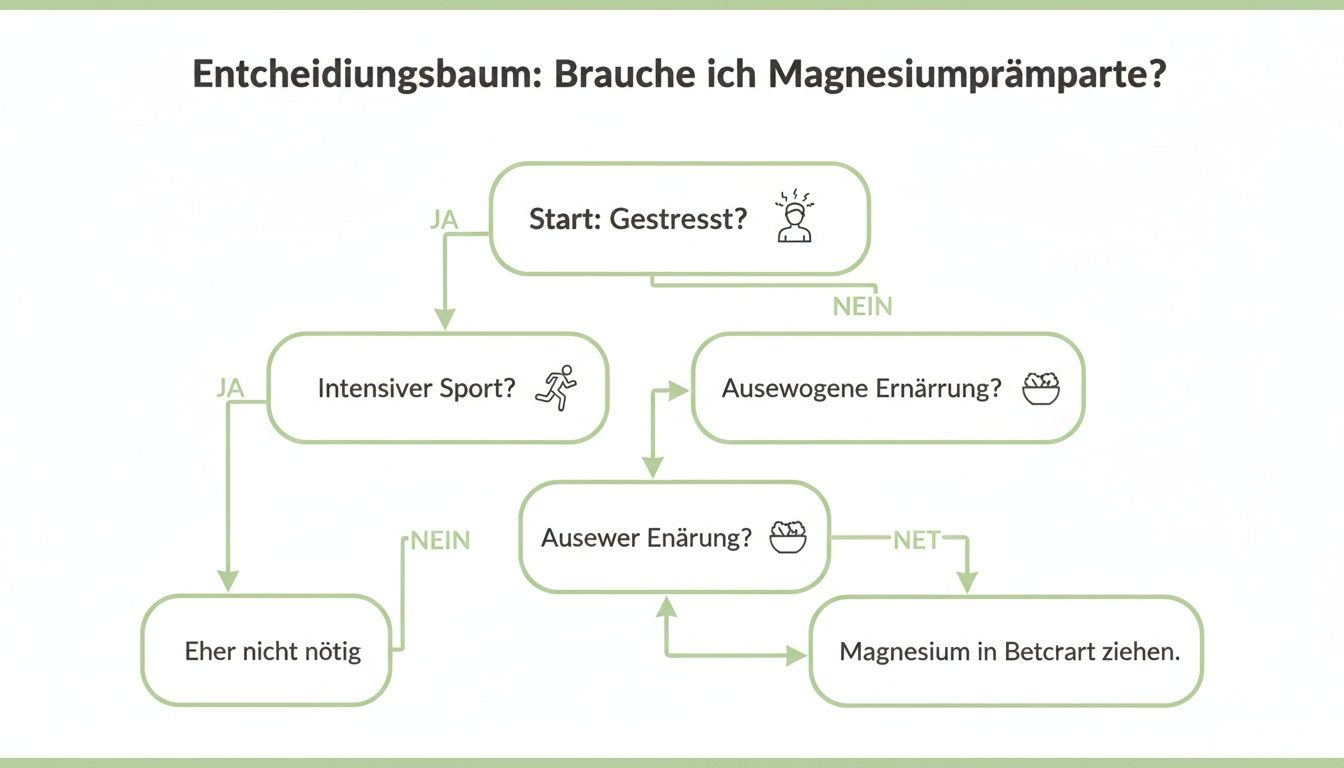
The graphic shows it clearly: Your lifestyle and diet are the decisive factors that determine whether additional magnesium makes sense for you.
If you decide on a supplement, you will quickly find yourself in front of a huge shelf. The crux of the matter lies in the chemical compound to which the magnesium is bound. This connection determines how well your body can absorb the mineral (Bioavailability) and what purpose it is best suited for.
Choosing the right form of magnesium is crucial for the effect. Think of it like buying running shoes: you choose exactly the model that suits your goal - be it a short sprint or a long marathon.
So when you're standing in front of the shelf, it's good to know which shape is right for you.
A comparison of the most common magnesium compounds, their bioavailability and their specific benefits for relaxation, digestion and muscle health.
| Magnesium form | Main advantage | Ideal for you |
|---|---|---|
| Magnesium citrate | Very bioavailable, has a slightly laxative effect | Quickly replenish your stores, support digestion |
| Magnesium glycinate | Excellently bioavailable, very gentle on the stomach, calming effect | Stress relief, better sleep and relaxation (your top choice!) |
| Magnesium oxide | High magnesium content, but low bioavailability | Short-term relief from constipation, less to correct the deficiency |
In short: If your goal is inner peace and better stress resistance, that is Magnesium glycinate clearly the best choice for you.
The nutritional supplement market is booming, and for good reason. In Switzerland alone there were impressive results 1.9 million packs Magnesium preparations were sold, which corresponds to sales of 65 million francs - a whopping increase of 27% since 2019. But despite this popularity, around 29% of women and 26% of men due to a deficiency. This shows how important the correct selection and application are. More about the Background of this trend in Switzerland you can read about it here.
Knowing about magnesium is the first, important step. But the real magic only happens when you bring this knowledge into your everyday life. It's not about turning your life upside down overnight. Your path to more relaxation begins with small, conscious decisions that develop into powerful habits over time.
The goal is a lifestyle that naturally supports your magnesium balance and sustainably strengthens your resistance to stress. Think of it like building muscle here at Templeshape: Continuity and the right technique bring success, not a one-time effort.
Even tiny adjustments to your daily routine can make a huge difference to your well-being. It's these little rituals that signal to your body: It's time to switch from stress mode to recovery mode.
Here are a few simple but effective strategies you can try right away:
These practices are the perfect complement to a magnesium-conscious diet. Together they create a solid foundation for your inner balance.
Your path to a relaxed life is not a sprint, but a marathon. Every conscious decision to have a magnesium-rich meal or a short relaxation break is a step in the right direction.
In the end, it's about finding a routine that suits you and your life. Maybe it's the magnesium-rich smoothie in the morning, the handful of nuts in the afternoon, or taking magnesium glycinate in the evening. Combine these building blocks with practices that help you mentally switch off.
By cleverly combining nutritional knowledge, targeted supplementation when necessary and relaxation-promoting habits, you can build a strong protective shield against the stress of everyday life.
If you would like to delve deeper into relaxation techniques, you will find valuable tips on the subject in our guide Mindfulness. Your path to a more relaxed, more energetic you begins now - with the first small, conscious decision.
You've now learned a lot about the central role magnesium plays in your relaxation and stress levels. Nevertheless, a few very specific questions often arise at the end. Don't worry, this is completely normal.
Here I have collected the most common uncertainties for you and answered them briefly and concisely so that you can start the implementation with a good feeling.
This is a very individual matter and depends largely on how empty your stores really are and which form of magnesium you use. For very acute things like nasty muscle cramps, a higher dose of a readily available magnesium citrate can often bring noticeable relief within just a few hours.
But when it comes to the deeper effect on your nervous system - i.e. stress, inner restlessness and sleep problems - you need a little more patience. The aim here is to sustainably replenish your body's own depots. Many people notice a significant improvement in their inner peace and sleep quality after about 1 hour two to four weeks regular intake. This effect can be observed particularly well with magnesium glycinate. So give your body a little time to accept the change.
Yes, this is theoretically possible, but fortunately it is usually not a problem if the kidneys are healthy. Your body has a clever protective mechanism built in: everything it doesn't need is simply excreted through the intestines. The most typical sign of a dose that is too high is loose stools or mild diarrhea.
An overdose from your normal diet alone is practically impossible. The risk actually only exists when taking high-dose supplements in an uncontrolled manner. So it's best to always stick to the dosage recommendation on the product.
If you notice that your digestion is reacting, simply reduce the dose or divide it into several small portions throughout the day.
The perfect time depends entirely on your goal. Would you particularly like to use the relaxing effect for better sleep and get your nervous system in the mood for nightly regeneration? Then that is it Take about an hour before bedtime ideal. Magnesium glycinate in particular can optimally develop its calming effect here.
If your focus is more on general energy production and supporting your muscles throughout the day, you can easily take your magnesium in the morning. If you have a rather sensitive stomach, it is often a good idea to take the magnesium with a meal - this significantly improves tolerance.
If you're specifically interested in reducing stress and sleeping more deeply, then that's it Magnesium glycinate clearly the best choice. In this compound, the magnesium is coupled to the amino acid glycine.
This gives you two decisive advantages:
This smart combination makes magnesium glycinate the first choice for anyone who wants to specifically shut down their nervous system and find more inner peace.
Are you ready to make your health a habit and find your inner balance? At Templeshape GmbH We support you with courses such as yoga, Pilates and breathwork to reduce stress and recharge your batteries. Discover our diverse offering and find the perfect course for you https://Templeshape.com.
tags
Relaxation, healthy eating, inner restlessness, magnesium deficiency, stress management