No products in the cart.
January 29

Imagine being able to complete your workout when your body is at its most efficient - without having to fight through every single repetition. This is exactly what yours allows you to do circadian rhythm, your inner 24 hour clock, which controls so much more than just your sleep. If you align your training with this internal clock, you will make optimal use of your natural energy peaks and regeneration phases.
Each of us has this internal clock that regulates hormones, body temperature and energy levels 24 hours regulated across. This rhythm is mainly controlled by light and darkness. It is the reason why you feel awake, tired, strong or hungry at certain times.
Two hormones in particular are crucial for your training:
Training that works against this natural hormonal cycle often feels unnecessarily laborious and usually does not deliver the desired results.
Your personal rhythm is determined by yours Chronotype certainly. Most people can be roughly divided into two categories: Larks (early risers) and Owls (late riser). Larks are most productive in the morning and get tired early in the evening, while owls don't really get going until later in the day and stay awake longer.
Knowing your chronotype is the first and most important step in planning your training cleverly according to your internal clock. This simple infographic will help you classify yourself.
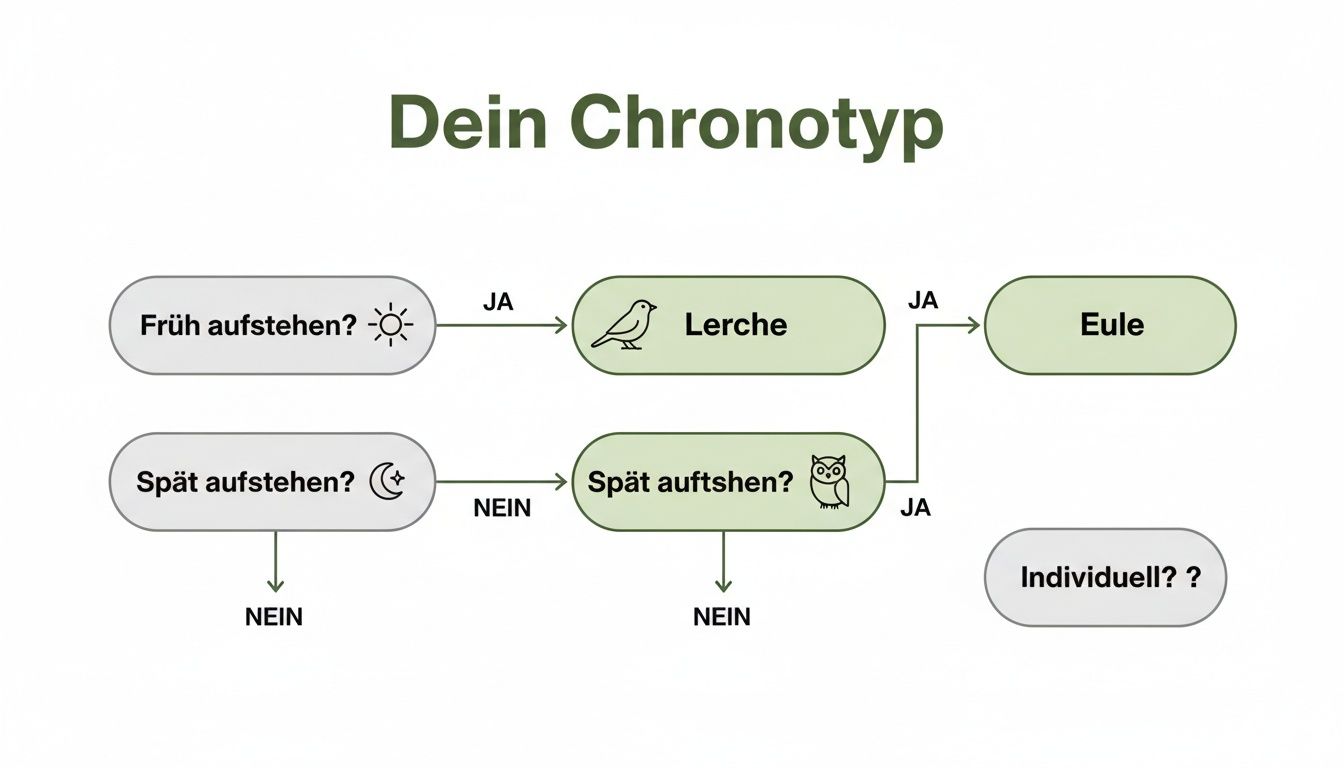
The graphic shows it clearly: your natural wake-up and bedtime times are the best indicator of whether you are more of a lark or an owl. This knowledge is the basis for truly tailoring your training plan to you.
The key is not to ignore your body's signals, but to use them specifically for your benefit. Instead of forcing yourself to do an intense HIIT workout in the morning, strength training in the late afternoon might be much more effective for you. You can find more details about the scientific background in our comprehensive article about it circadian rhythm.

As soon as you know your chronotype, it's time to get down to business: concretely planning your workouts. It makes a huge difference, When you train - depending on whether you want to build muscles, push your endurance or simply become more flexible. The right time of day can be your strongest ally.
The idea is simple: We use your body's natural performance peaks instead of fighting against them. Not only do you get more out of every single training session, but you also have noticeably more energy and joy.
Early mornings are perfect for short, explosive training sessions. Your body secretes the most at this time Cortisol - a hormone that makes you awake, alert and ready for the day. You should take advantage of this natural energy boost for high-intensity workouts.
Imagine dying 8 a.m to one of our HIIT & Bootcamp courses in Zurich. This is often exactly the time when your body reaches its first performance peak. This is not esotericism, but biology. Swiss research confirms this: A study showed that the maximum heart rate of test subjects reached a clear peak around this time - a clear indication of higher motivation. If you want to go deeper, you can find it here further findings from this Swiss study on circadian rhythms.
This biological “prime time” makes the morning perfect to really challenge your cardiovascular system and get your metabolism going at full speed for the rest of the day.
Is your goal building muscle or increasing your maximum strength? Then it's best to plan your sessions for the late afternoon. Between 4 and 7 p.m Several physiological processes are running at full speed:
Strength training in the Templeshape studios after work is not only practical, but also makes absolute biological sense. You train exactly when your body is best prepared for strenuous exertion.
Your body is not a machine that performs the same way around the clock. Planning your training in the late afternoon is like training with the wind at your back - you reach your goal with less perceived effort.
The evening should be about winding down and regenerating. Intensive workouts are now rather counterproductive because they can disrupt the production of the sleep hormone melatonin and keep your nervous system unnecessarily active. The result: You lie in bed wide awake, even though you should be tired.
Instead, quieter sessions are ideal for ending the day. Classes like yoga, Pilates or breathwork help you reduce stress, activate your parasympathetic nervous system (the “rest nerve”) and prepare your body for a restful night.
A gentle evening routine not only improves your flexibility, but above all your sleep quality - and this is the absolute basis for every training progress.

The theory behind training according to the internal clock is one thing. But how do you fit it all into a hectic everyday life in Zurich? The good news: You don't have to completely turn your life upside down.
The key is to find a clever structure that works for you. Your circadian rhythm doesn't require perfection, just a little more consistency.
To show you what this can look like, I have designed two example weekly plans. See it as inspiration, not as a rigid rule. You can adapt them flexibly and they show you how to do different types of training - like the ones you do with us Templeshape find – balanced with the all-important rest.
This plan is for you if your day is dominated by meetings and deadlines and you need your training as an energy boost and mental balance. The focus here is on short, crisp units that can be easily integrated into everyday working life.
A well-structured plan is your anchor in everyday life. It takes the burden of decision-making off your shoulders and makes it easier to make health a habit, even when your calendar is full.
This plan is intended for mothers who want to build up energy again after giving birth, strengthen their body in a targeted manner and consciously take time for themselves. The units are designed to support recovery and calm the nervous system.
Again, these are just templates. Find what feels good for you and play with the times and activities until they fit your own personal rhythm.
Aligning your training with your internal clock is a huge step forward. But honestly, that's just one piece of the puzzle. In order for your circadian rhythm to be truly stable and powerful, it needs a solid foundation. And this rests on three crucial pillars: Sleep, nutrition and light.
Think of these three elements as the precise adjustment screws for your internal clock. If you control them consciously, you will not only optimize your success in training. You will also improve your quality of life, your concentration and your mood. It's often the small, inconspicuous adjustments that have a surprisingly big impact.
What you eat and most importantly When you eat it has a direct connection to your energy level and your internal clock. It's not just about calories, it's about timing your nutrient intake so that it syncs perfectly with your body.
Two simple rules can make a huge difference here:
Just these small adjustments to the timing of your meals support your natural rhythm and ensure stable energy - without the afternoon slump.
Light is by far the most important external clock for your circadian rhythm. In the morning it is the signal for your body to stop producing the sleep hormone melatonin and instead release the activating hormone cortisol. In the evening the darkness has exactly the opposite effect.
Your body needs clear signals. Give it bright light in the morning and consistent darkness in the evening. The basic principle for a healthy sleep-wake rhythm is that simple.
And here's how you can put it into practice:
We in Switzerland in particular feel every year how sensitive our system is. The time change measurably disrupts the circadian rhythm. Data from the Federal Statistical Office show that after the change to summer time, the number of emergencies increased 6.5 percent increases. Heart attacks and strokes are becoming more common because our internal clock is being violently altered. A strong argument for consciously cultivating your own rhythm in everyday life.
These routines around light and sleep are not small things - they are the basis for everything else. If you strengthen these pillars, you will notice how much easier your training suddenly becomes. Many of these principles are also part of our approach, which you can find in our guide on the topic Biohacking for beginners you can read.

A circadian rhythm that's out of balance doesn't just make you tired - the effects are much deeper. Imagine your internal clock like the conductor of a huge orchestra. If he gets out of sync, all the instruments will soon start playing chaotically. You feel this chaos on all levels, physically and mentally.
If your sleep-wake cycle is constantly disrupted - whether due to shift work, jet lag or simply a lifestyle of long nights in front of the screen - then your entire hormonal system suffers. This can have a massive impact on your well-being and lead to serious long-term health risks.
One of the most sensitive areas is our psyche. A chronically disturbed rhythm has been proven to increase the risk of mood disorders such as depression and anxiety. The connection is so strong that sleep problems are often considered one of the first warning signs.
Did you know that? Up to 80% of patients in Switzerland who suffer from depression or schizophrenia also struggle with sleep disorders that are directly attributable to a disturbed circadian rhythm. In people with delayed sleep phase syndrome, it has even been reported 75% diagnosed with depression. You can Find out more about this Swiss study on the internal clock and psychein order to understand the connections even better.
A stable rhythm is the foundation for mental resilience. When you ignore your body clock for long periods of time, you not only weaken your body, but also your ability to cope with everyday stress.
Your metabolism also follows a strict schedule. If you eat at irregular times or are active at night, you disrupt the very hormones that are responsible for hunger, satiety and fat burning.
This has very concrete consequences:
This knowledge is not intended to worry you, but rather to show you how much power you have over your well-being. It underlines how important it is to consciously structure your own everyday life - from the right timing for training to optimal recovery.
A balanced rhythm not only strengthens your performance, but is also the key to how you Activate your mitochondria and find 100% more vitality.
Theory is one thing, everyday life is another. You've now read a lot about how to coordinate your workouts, sleep, and even your meals with your body clock. But what if real life gets in the way? This is exactly where we start.
I have collected the most frequently asked questions that I come across again and again in coaching and in our courses. Think of it as your personal compass that will help you clear up any remaining uncertainties and let the principles of biorhythm really work for you.
This is probably the biggest hurdle for most of us. Are you an “owl” but your job basically forces you into your sneakers before the sun comes up? Don't worry, it's not about perfection. It's about smart adjustments.
In such a case, flexibility is everything. Don't force yourself to do a brutal HIIT workout in the morning that will only stress your body. Instead, choose a gentler session that awakens you rather than drains you - a dynamic yoga flow or a Pilates session, for example.
Maybe you can use your lunch break for a brisk walk in the fresh air? This not only recharges your batteries with daylight and stabilizes your rhythm, but also gives you a real energy boost. In the end, perfect timing isn't what counts everyone day, but the Consistency of your routine over the week.
Yes, absolutely. Your physical performance fluctuates throughout the day, and this also affects factors that are crucial for injury prevention. Your coordination, muscle strength and even your flexibility are not constant variables.
Your core body temperature reaches its peak in the late afternoon. This means your muscles and ligaments are more supple and have better blood flow. This time is often ideal for technically demanding or heavy strength exercises, as the risk of injury tends to be lowest here.
But no matter when you train: a thorough warm-up is and remains your best insurance against injury. Simply adjust the intensity of your warm-up to the time of day - in the morning it may take a few minutes longer to get your body up to operating temperature.
First things first: Be patient with yourself. A change is a big change for the body, and it loves habits. Depending on how much you adjust your routine, it can take anywhere from a few days to two weeks for everything to settle in.
Take things step by step. Instead of setting your alarm two hours earlier overnight, try this 15 minute increments. Move your get-up time forward a little every day or every other day. Actively support your body:
A solid routine is the strongest anchor for your internal clock. The more consistently you use these little helpers, the faster your body will get used to the new rhythm - and you will feel the positive energy.
Are you ready to take your workouts to the next level and make your health a habit? At Templeshape In Zurich you will find the courses, the community and the expertise to adapt your training perfectly to your inner rhythm. Discover our timetable and find the energy that is within you. Visit us at templeshape.com and start your journey.
tags
Biorhythm fitness, chronotype training, internal clock, training by time of day, circadian rhythm training