No products in the cart.
February 6
Somatic Yoga: Gently release stress in the body - discover peace and serenity
0 comments

February 6
0 comments
Do you often feel tense but can't pinpoint the reason? This is a familiar feeling for many of us. Your body stores stress, sometimes even for years. Right here sets Somatic yoga an: It helps you to release these deep tensions through gentle movements that you feel from within and to signal to your nervous system that it is safe.
Have you ever noticed how your shoulders almost pull themselves up when you're stressed? Or how your jaw clenches without you consciously controlling it? These reactions are your body’s automatic protective mechanisms. But if stress becomes a constant condition, these patterns can become entrenched - like a protective armor that you constantly carry around with you.
Somatic Yoga is not another workout that pushes you to your limits. Rather, it is an invitation to start a deep conversation with your body. The term “Soma” comes from Greek and means “the body experienced from within”. So instead of forcing perfect posture from the outside, you learn to turn your attention inward and really feel where the tension is. A concrete example: Instead of just paying attention to the external form in Krieger II, in Somatic Yoga you ask yourself: "Where do I feel tension in my hips? How does my breath feel when I raise my arm?"
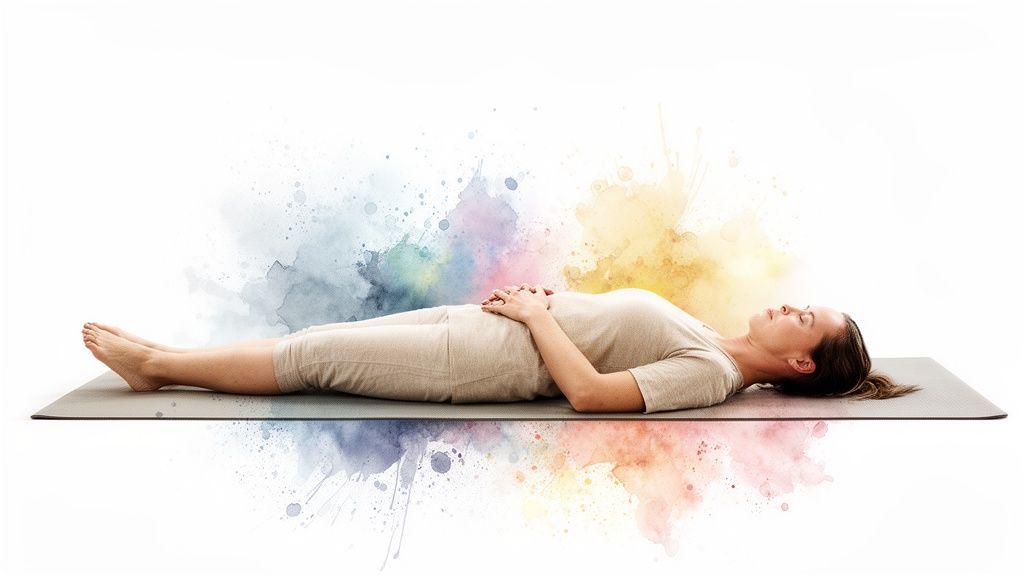
The key to understanding lies in your autonomic nervous system. This system unconsciously controls everything important such as heartbeat, breathing and digestion. Its two main actors are:
When there is chronic stress, the accelerator pedal is basically constantly depressed. Somatic Yoga helps you gently step on the brakes again. By making slow, conscious movements, you give your brain new, safe information and signal to it that the danger has passed. This breaks the vicious circle of tension.
The vagus nerve plays a very central role. It is the main nerve of the parasympathetic nervous system and therefore our superstar for relaxation. In our article you can find out more about how to target your Stimulate the vagus nerve and reduce stress in everyday life can.
Somatic Yoga is not about doing, but about listening. It's about giving your body permission to let go of old patterns instead of forcing it into new shapes.
You may be wondering what exactly is different from a normal yoga class? Here’s a quick overview of what makes this practice so unique.
| aspect | Somatic yoga | Classic yoga (e.g. Vinyasa) |
|---|---|---|
| focus | Inner experience (interoception), feeling the movement | External shape, correct alignment, aesthetics |
| tempo | Very slowly, carefully, often with breaks | Dynamic, flowing, often tied to the rhythm of breathing |
| Goal | Regulating the nervous system, solving patterns, self-awareness | Strength, flexibility, endurance, spiritual practice |
| Instructions | Invitation to feel: “How does that feel?” | Clear instructions: “Lift your leg, stretch your arm.” |
As you can see, Somatic Yoga is less about the perfect pose and more about consciously letting go from within.
The turn to mindful, body-oriented methods is no longer a niche movement. The practice of yoga in Germany has experienced enormous growth in the last ten years. Currently practicing 13 percent of Germans practice yoga – that corresponds to around 11 million people and is a fourfold increase in just a decade.
This trend clearly shows that holistic approaches such as Somatic Yoga are firmly anchored in modern stress management. This practice teaches you to understand your body's subtle signals and help it truly let go. It's a journey back to yourself, where you learn not to push away tension, but to gently dissolve it.
Now it gets practical. We put the theory aside and you can feel for yourself what Somatic Yoga is really about: the gentle, conscious letting go of stress that has become lodged in the body.
Forget for a moment everything you've heard about complicated poses or pressure to perform in yoga. We start with two very simple but incredibly deep movements. You can implement them immediately and build a direct, honest connection with your body.
The most important thing? There is no “right” or “wrong”. The goal is not to perform the exercise perfectly, but to explore with curiosity how you feel while doing it. Give yourself permission to be radically slow. Only in this slowness does your nervous system have the chance to learn and store new, relaxed movement patterns.
This basic movement is a wonderful way to start. It lets you rediscover the subtle, often forgotten connection between your pelvis, lower back and your entire spine.
For many of us, chronic tension accumulates, especially in the lower back, in the lumbar spine - a result of prolonged sitting, stress and unconscious posture patterns. This exercise helps to gently release exactly this tension.
This is how you get into the movement:
Repeat this rocking motion a few times, following the rhythm of your own breathing. The range of motion is completely unimportant. It's all about feeling.
What do you perceive? Does the movement feel fluid or rather jerky? Is there a direction that feels easier? Just be a curious observer of your own feelings.
A tense neck and hard shoulders? Most of us probably know that. They are the classic symptoms of everyday stress, especially if you spend a lot of time at your desk.
This exercise is like a mini massage from the inside. It helps you release stuck tension in the shoulder girdle and restore a feeling of space and lightness in this area.
Your instructions for more ease:
The quality of the movement is crucial here, not the number of repetitions. Imagine you are moving in slow motion. By consciously listening to your body's subtle signals, you give your nervous system the signal to switch to a state of calm and relaxation.
The combination of mindful movement and conscious breathing is an incredibly powerful tool. Would you like to delve deeper into the power of breathing? In our guide you will find exciting insights into the topic Breathwork in Zurich and how you can use it for yourself.
These two simple exercises are your first, valuable step to Somatic yoga to experience and understand with all your senses, like you Gently release stress in your body can.
Your yoga practice should adapt to your life, not the other way around. Honestly, who has a full hour of time every day just for themselves? But the good news is: you don't need that at all. Just a few minutes of mindful movement can hit the reset button and get your nervous system back on track.
That's why I've put together two short but incredibly effective sequences for you. They are designed so that you can easily incorporate them into your everyday life To gently release stress in the body – exactly when you need it most. It's not about adding another item to your to-do list, but rather creating small, conscious islands of calm for yourself.
We are all familiar with sitting at a desk for long periods of time. Shoulders, neck and lower back are the typical victims who sooner or later show up with tension. You can do this mini-sequence right in your office chair. No changing, no mat needed.
Consider this routine your secret weapon against afternoon slumps and built-up tension. It wakes your body up again, brings awareness to the tense areas and all without you breaking a sweat.
Process of your mindful office break:
This short break breaks the vicious circle of tension and gives you noticeably new energy.
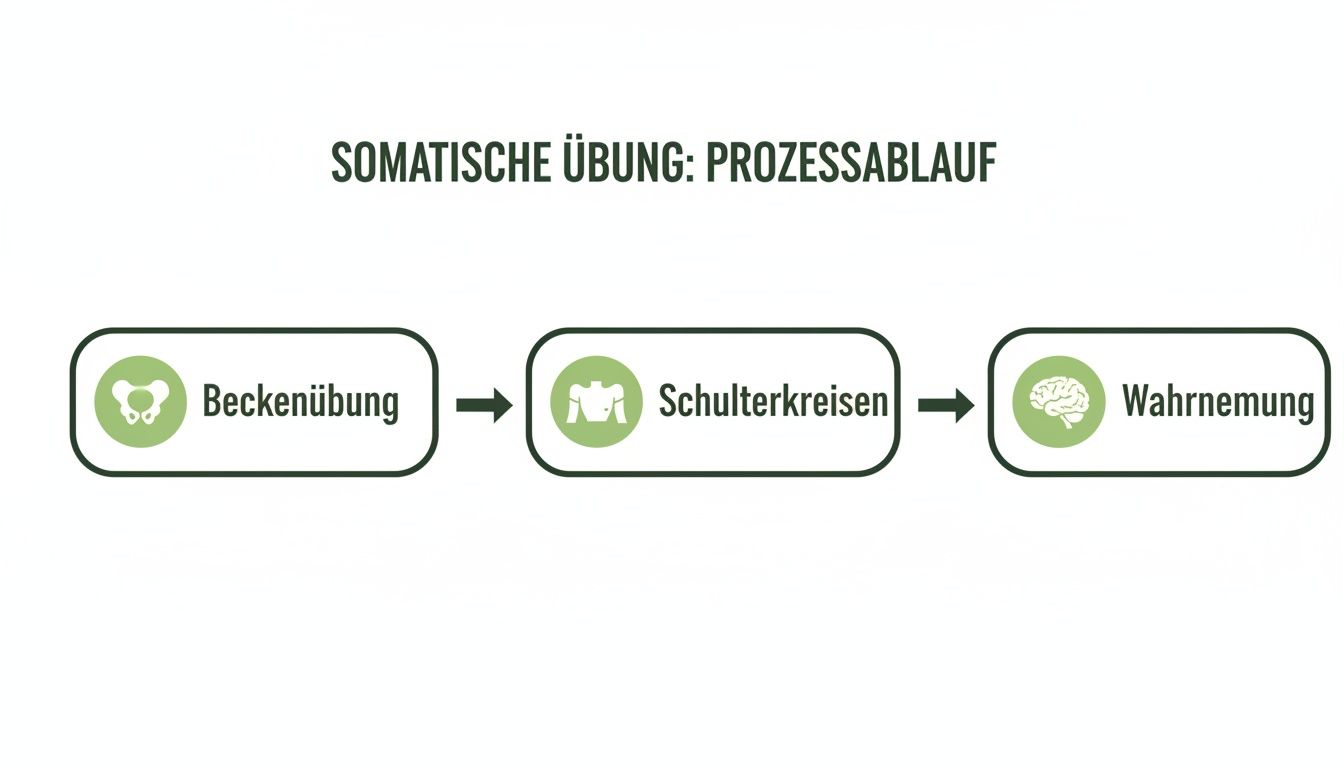
This simple principle - starting from the center of the body and releasing blockages and then coming into conscious awareness - is the core of every somatic exercise, even in these short everyday routines.
After a long day, your head often continues to whir, even after the laptop has long since been closed. This sequence is your very own ritual for flipping the switch - from work mode to a well-deserved, relaxing evening. Here we consciously take a little more time to address deeper tensions throughout the body, from the often firm hips to the tense jaw.
This practice is your conscious decision to leave the day behind you. It combines mindful movements with calm breathing to shut down your nervous system and prepare you for regeneration.
Make yourself comfortable on a mat or soft carpet.
Your ritual for winding down:
These sequences are simple but powerful tools for reconnecting with yourself throughout the day.
Find the right sequence for your moment - regardless of whether you only have a short time or want to relax deeply.
| sequence | Length of time | focus | Ideal for |
|---|---|---|---|
| Office reset | 10 minutes | Neck, shoulders, spine | Quick relaxation at your desk to prevent tension. |
| After-work ritual | 20 minutes | Hips, lower back, jaw | To make the transition from a stressful day to a calm evening. |
Just try out which routine feels best for you. Even small, regular sessions make a huge difference to your well-being.
Somatic Yoga is there for every body. Honest. This is not about achieving perfect form, but rather finding a movement that feels right and beneficial for you personally. Let's take a look at how you can adapt the practice to your individual circumstances so that you really get the most benefit from it.
Your body is unique and your needs are constantly changing. That's why flexibility is key Somatic yoga to design it in a way that really nourishes you and helps you, To gently release stress in the body.
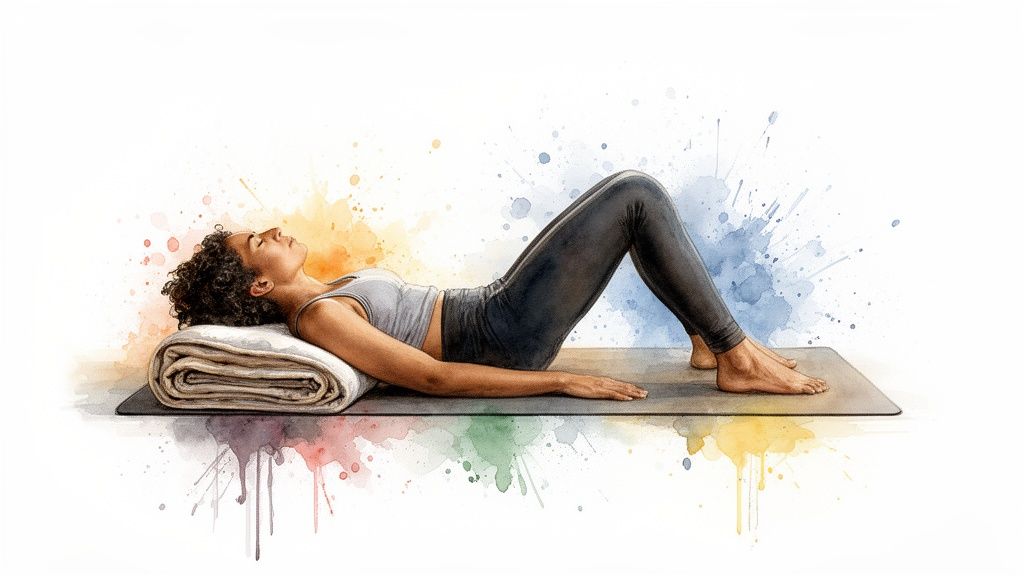
The period after birth is a phase of huge changes - physically and emotionally. Your body has achieved incredible things and now deserves special attention. Somatic Yoga can wonderfully support you in your recovery.
The focus is on gentle reactivation and relief. Instead of putting yourself under pressure, it's about building a loving connection with your body again.
Your body knows exactly what it needs. Somatic Yoga gives you the tools to listen again and understand your signals instead of ignoring them. It is a practice of self-care that is invaluable, especially during these intense times.
Sitting at a desk for a long time often leads to this feeling of rigidity in the body. The good news: You don't have to wait for the yoga mat to take countermeasures. Many somatic exercises can be performed very inconspicuously directly on the chair.
These small breaks in movement break the monotonous posture patterns and signal your nervous system that it can relax.
Your mini movements at work:
If you're new to the world of yoga, it can all seem a little intimidating at first. But Somatic Yoga is the perfect way to get started because it requires absolutely no prior knowledge or special flexibility.
The most important tip is: be gentle with yourself.
The most important and at the same time most liberating rule in Somatic Yoga is: Your body is always right. This practice is incredibly gentle and safe in nature, so the risk of injury is negligible. Nevertheless, a conscious, mindful attitude is the key to really getting the most out of your time on the mat.
This is about developing a whole new sensitivity to your body's subtle signals. Over time, you'll learn to recognize the difference between a pleasant feeling of release—perhaps a gentle tug or deep relief—and a real warning sign, like sharp pain.
Somatic Yoga is not a competition against yourself. It is an invitation to make friends with your body. Letting go of deep-seated tension is a process, not a switch that you simply flip.
A central principle is to never work into the pain. If a movement doesn't feel good, it's not a sign of weakness, it's valuable information. Your body communicates with you and asks you to adjust.
Sometimes the tiniest, gentlest movement is the most effective. When you overwhelm yourself, your nervous system reflexively switches to protection and creates new tension - exactly the opposite of what you want to achieve. You can also find deep relaxation in practices such as Yoga Nidra. Learn more about the art of conscious sleep and how you can Yoga Nidra in German can regenerate even deeper.
Rushing and haste have absolutely no place in somatic practice. Only if you move slowly, almost meditatively, does your brain have the time it needs to recognize old, stuck movement patterns and learn new, healthier ones. Give yourself permission to be radically slow.
Be patient with yourself and your body. The principles of mindfulness are fundamental to this. To deepen your practice, it can help to understand how Mindfulness in everyday life as a tool against stress and hectic pace can serve. Every breath and every movement, no matter how small, is a step on the way, To gently release stress in the body.
Precisely because Somatic Yoga is so different from most yoga styles you know, questions often arise. This is completely normal. Here I have collected the most common answers for you so that you can start your own practice with a good and safe feeling.
No, absolutely not. This is one of the biggest myths that stops many people from even trying yoga. Somatic Yoga is suitable for every fitness level, every body type and every age.
This isn't about performance, acrobatic poses or how flexible you are. The focus is solely on gentle, mindful movement and on consciously feeling your body again from the inside out. So you don't need any previous knowledge.
You'll be amazed, but yes 10 to 15 minutes daily can make a huge difference to your well-being. In Somatic Yoga, regularity counts for much more than the duration of a single session.
Your nervous system learns through repetition. If you regularly give him short impulses to relax, you will help him establish new, healthier patterns. So instead of putting pressure on yourself, listen to your body. Integrate the practice in a way that feels good and feasible for you.
The greatest progress lies not in practicing longer, but in feeling more often and more consciously. Every minute you give yourself is a valuable contribution to gently releasing stress in your body.
Caution is the top priority here. If you have acute pain, recent injuries or immediately after an operation, you should Always consult your doctor or physiotherapist first.
Somatic Yoga is a wonderful support for chronic tension and for prevention. However, it should never be seen as a substitute for necessary medical treatment. Once you have the green light from professionals, the gentle practice can help you regain a sense of confidence in your body.
At first glance, some movements may look similar, but the intention behind them is completely different. And it is precisely this difference that is crucial to understand why Somatic Yoga gently release stress in the body can.
So it's less of a physical training and more of a conscious dialogue with your body.
Are you ready to deepen your connection to your body and reduce stress sustainably? At the Templeshape GmbH you can find a safe space to establish exercise as a beneficial part of your everyday life. Discover our diverse courses - from calm yoga to activating workouts - and find exactly what you need now.
Check out our courses and start your journey to greater well-being
tags
Mindfulness exercises, body awareness, somatic yoga, letting go of stress, yoga against stress