No products in the cart.
February 5

Forget everything you've heard about pelvic floor training. What I as Pelvic floor training 2.0 has nothing to do with the isolated tension that many people have in mind. Rather, it is the key to your entire Core stability and a powerful body feeling.
We're talking about intelligent interaction that strengthens your core from the ground up - and that's crucial for every age and every fitness level.
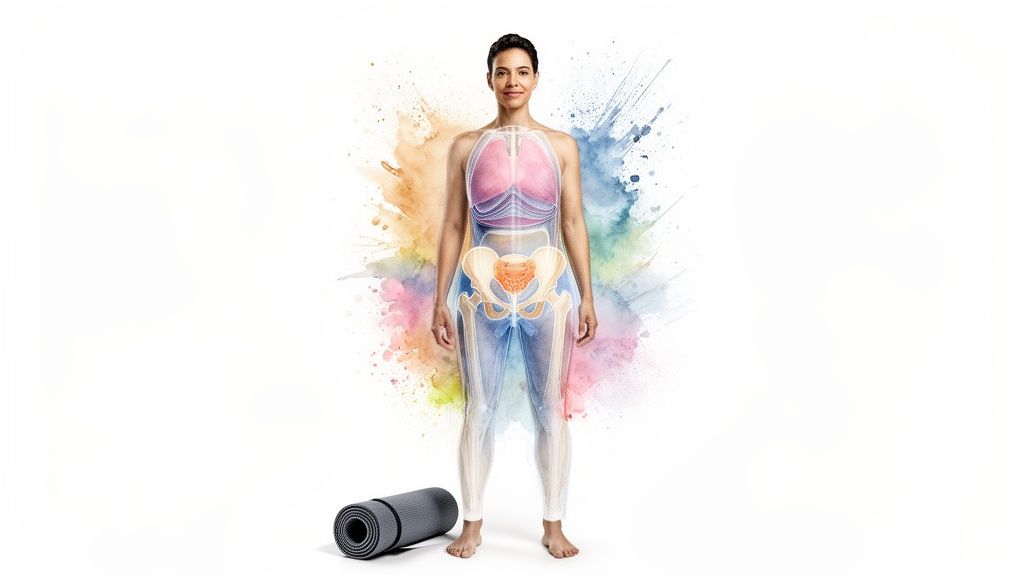
When you hear the word “pelvic floor,” you might think of new mothers or an invisible muscle group that you’re supposed to somehow tense while sitting. But honestly? This idea is outdated and falls far short. Your pelvic floor is the foundation of your core and plays inextricably with other important muscles.
It's best to imagine your torso, your core, as a well-coordinated team: the pelvic floor is the supporting basis. Your deep abdominal and back muscles form the stabilizing walls. And your diaphragm, our main breathing muscle, is the flexible roof. Only when all of these team members work together harmoniously will true, functional stability arise from within.
A functional pelvic floor is much more than just a muscle that “holds tight”. It is crucial for:
This holistic understanding makes it clear why pelvic floor training 2.0 is relevant for all of us. No matter whether you sit at your desk for hours, push yourself to your limits in a HIIT class or just want to get through everyday life without any symptoms.
A strong, responsive pelvic floor is not only important for continence, but also increases your athletic performance, improves your posture and strengthens your overall body awareness.
And no, the issue doesn't just affect women after pregnancy. People who are particularly active in sports often unknowingly expose their pelvic floor to high levels of stress. In Switzerland, stress incontinence among female athletes is a widespread but often hidden problem.
Studies show that between 20 and 84 percent of all female athletes involuntarily lose urine during physical exertion. The numbers are different for sports like CrossFit (84%) or volleyball (65%) particularly high. But almost half of all recreational athletes in fitness centers also know this problem. More about the You can read about the connections between the pelvic floor and sport in this study.
These numbers make it abundantly clear how important integrated training of the pelvic floor and core is. Here you lay the foundation for a strong, resilient core that supports you in every situation.
Here you can see at a glance what distinguishes the modern, holistic approach from traditional training.
| feature | Pelvic floor training 1.0 (traditional) | Pelvic floor training 2.0 (holistic) |
|---|---|---|
| focus | Isolated tensing and relaxing, often while sitting or lying down. | Dynamic integration into whole body movements. |
| Goal | Primarily ensure continence, often purely statically. | Core stability, power transfer, posture, breathing. |
| Interaction | Muscles are viewed in isolation. | Considers the pelvic floor, diaphragm, abdominal and back muscles as a unit. |
| breathing | Often neglected or misused. | Breathing is the central pacemaker for movement. |
| Everyday relevance | Hardly any transfer into functional everyday movements. | Training prepares you for real stress (lifting, sneezing, running). |
| For whom? | Mostly for women after childbirth or incontinence. | For all ages and genders, from athletes to seniors. |
As you can see, the modern approach is about making the pelvic floor an intelligent and responsive part of your entire body again - not a muscle that you only control in isolation.
Before you jump into complex exercises, you need to make a crucial connection. The key to your pelvic floor – and therefore to your overall core stability – lies not in raw muscle strength, but in your breathing. More precisely: in diaphragmatic breathing.
Imagine your pelvic floor like a flexible, internal hammock. Your diaphragm, this large breathing muscle directly under the lungs, is his direct dance partner. With each natural inhalation, your diaphragm lowers and your pelvic floor gently and effortlessly arches down and gives way. When you breathe out, the diaphragm rises again and your pelvic floor springs back up just as gently.
To consciously perceive this subtle interplay, try this simple exercise:
Repeat this a few times. This isn't about tensing up, it's just about perceiving.
The goal is to feel the natural reaction of your pelvic floor to your breath - without actively pressing or tensing your buttocks or abdominal muscles.
A common mistake is to hold your breath or unconsciously tense the muscles in your buttocks and thighs. Focus on consciously letting these areas relax. This fine perception is the absolute basis for every effective pelvic floor training 2.0. In order to further train this body feeling, supportive practices such as: Yoga bar offers very valuable impulses.
As soon as you feel this connection, you can use it specifically in your everyday life. Next time you pick up a heavy shopping bag, exhale and use the natural lifting motion of your pelvic floor to stabilize your core. This small adjustment makes a huge difference to your stability.
If you would like to find out more about how you can use different breathing techniques in a targeted manner, also read our article on Breathwork in Zurich and how you can use it for yourself. This conscious connection between breath and core is the indispensable basis for everything that follows.
Now it's time to get down to business. Your pelvic floor and your core don't need hours of workouts, but rather the right impulses that really fit your life. That's why I've put together a program that's tailored to your needs - whether you're in the office, expecting a baby or preparing for your next run.
The key is to pack core activation into functional, everyday movements. This is how you build strength that you can actually use. Each exercise comes with a simple variation to get you started and an option for improvement so that you can continually develop.
Sitting for long periods of time is toxic to the core muscles and promotes a passive posture. But don't worry, with these inconspicuous exercises you can activate your core right at your desk without anyone noticing.
The chair activator: Sit upright on the front edge of your chair. Your feet are hip-width apart and firmly on the ground. Exhale and gently activate your pelvic floor by imagining pulling your ischial bones toward each other. At the same time, tense your lower stomach as if you were closing a zipper. Hold this gentle tension 5-10 seconds, while you continue to breathe calmly. With the next inhalation you release the tension again.
The leg raise challenge: Stay seated upright. Exhale, activate your core as described above and then lift one leg just a few centimeters off the floor. Hold briefly, then release again in a controlled manner. Switch sides. The most important thing is that the upper body remains stable and the back does not round.
Pregnancy is less about maximum strength and more about keeping the pelvic floor flexible and responsive. Gentle mobilization prepares him for birth and can at the same time relieve nasty tension in his lower back.
This is a wonderful exercise for this Cat-cow flow on all fours. Concentrate on consciously relaxing and expanding the pelvic floor as you breathe in (cow position, slightly hollow back). As you breathe out (cat's hump), gently activate it and pull it inwards and upwards.
This conscious connection of breath and movement is pure gold. It trains your perception and helps you to let go during birth and to find your muscles again in a targeted manner.
The following infographic shows you this fundamental process of pelvic floor breathing, which forms the basis for absolutely every exercise.
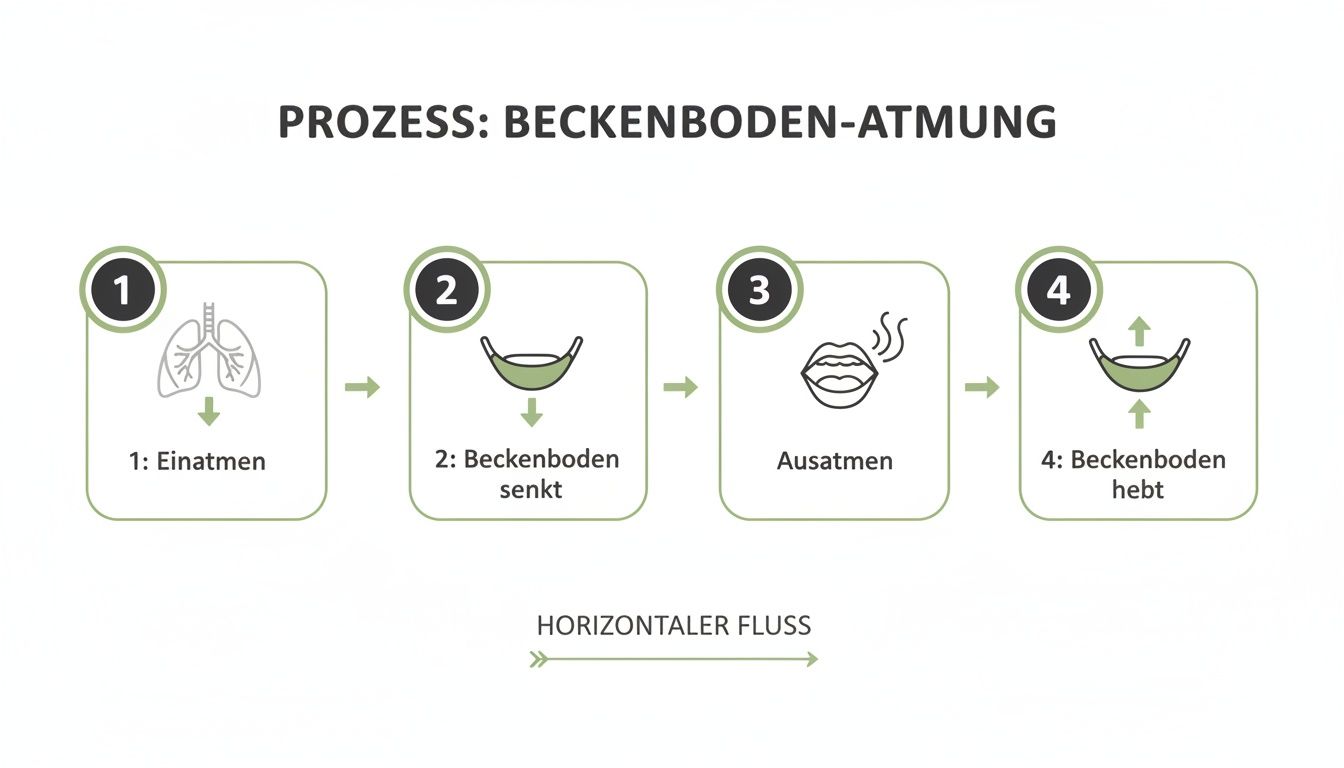
The graphic shows how your pelvic floor gives way when you breathe in and rises when you breathe out - a completely natural rhythm that you use for your training.
Pregnancy and childbirth put enormous strain on your pelvic floor. After a vaginal birth, your risk of urinary incontinence increases by a factor 9.2. Although there is a lack of long-term data, a broad expert consensus recommends starting targeted pelvic floor training as early as possible. The good news: Studies show that structured group training can be just as effective as individual lessons.
The Pelvic bridge with breathing control is one of the safest and most effective exercises for your return to work.
Are you looking for more safe and effective postpartum exercises? Then be sure to check out our guide Pelvic floor exercises after birth to.
For you as an athlete, a responsive pelvic floor is essential. It must provide stability and cushion the pressure in the abdominal cavity during high-impact activities such as running or CrossFit. That's why we integrate core control into dynamic movements here.

You don't just build true strength on the training mat - you live it in everyday life. The best exercises are of little use if what you learn doesn't flow into your daily movements. But that's exactly where the biggest opportunity lies: Every day gives you countless opportunities to strengthen your core stability.
The beauty of it? It's often just a matter of tiny, conscious adjustments. You don't have to plan extra time; you can transform everyday activities into effective mini-workouts for your core.
Your pelvic floor is active around the clock, most of the time completely unnoticed. But if you give it a little targeted attention, you can relieve it enormously and strengthen it at the same time.
When lifting: Regardless of whether you are lifting a crate of water, your sports bag or your child – breathe out beforehand and gently activate your pelvic floor and deep abdominal muscles. This conscious tension shortly before strain stabilizes your lumbar spine and protects against excessive downward pressure. Just imagine zipping up an inner zipper from bottom to top.
When coughing or sneezing: Such reflexive movements create enormous pressure in the abdominal cavity. Instead of doubling over, try standing up slightly and reflexively briefly tensing your pelvic floor. This acts like an internal shock absorber.
When standing: Many of us tend to stand passively, with our knees bent and our backs slightly hollow. Instead, keep your pelvis neutral, distribute your weight evenly on both feet and feel a gentle, uprighting tension from your center.
Knowing your core activation can take your training in classes to a whole new level. Suddenly it's no longer just about the external muscles, but about a deep strength that comes from within.
By the way, group classes are a fantastic way to stay motivated. A major investigation with almost 5,000 women has shown that guided pelvic floor training in a group can be just as effective as individual therapy. Pure methods such as yoga or Pilates alone are often not enough if there is no targeted targeting of the core. The key lies in conscious integration, which we teach in our courses - which is particularly important for... 49% is important for young athletes who suffer from stress incontinence. Find out more about the Effectiveness of pelvic floor training in different formats.
Remember: every squat becomes more powerful, every yoga pose more stable and every jump safer when you consciously activate your core. Your training will not only be more effective, but also safer.
This is how you can specifically use it:
By making these small but impactful adjustments, you'll make core stability an integral part of your life - and benefit from more strength, security and a better body feeling, 24 hours a day.
Your body is constantly talking to you. Most of the time there are positive signals, like a pleasant sore muscle, that shows you that your training has worked. But sometimes they are small, quiet warnings - and you should take them really seriously.
Training independently is great and incredibly valuable. But there are moments when we reach our limits. It is therefore crucial to recognize when the right time is to seek professional support.
Many people are familiar with this feeling of insecurity: Is this pulling sensation in the abdomen still normal or is it already an alarm signal? Why does the incontinence just not get better even though I exercise regularly? Am I doing something wrong or is there something completely different behind it? This is exactly where I want to give you a little more clarity.
Under no circumstances should you simply dismiss or ignore some symptoms. If you notice any of the following signs, it's time to see a specialist physiotherapist or doctor and get to the bottom of the matter.
Be particularly careful about these points:
Your training should give you a feeling of strength and security. If instead it causes persistent pain, discomfort or a worsening of your symptoms, this is a clear sign to get help.
A physical therapist who specializes in the pelvic floor can do so much more than just instruct exercises. Through a tactile examination, she can determine precisely whether your muscles are too weak, too tense or perhaps even both. This precise diagnosis is the basis for a therapy plan that is truly tailored to you and your body.
She helps you refine your control, can use manual techniques for relaxation and gives you exactly the exercises that you really need. So don't hesitate to take this step. Accepting the right support is not a sign of weakness, but of strength and self-care.
Finally, I would like to clarify a few questions that we come across again and again in everyday studio life at Templeshape. You probably recognize yourself in one or the other. My goal is to clear up any remaining insecurities so that you can start your training for a strong, functional core with confidence.
This modern understanding of core stability often raises new questions, especially if you have only ever known traditional pelvic floor training.
We hear this question almost every day. The answer is actually quite simple: Regularity beats intensity. Your pelvic floor is a muscle like any other – it needs constant, but not excessive, stimulation to get stronger.
For starters are three to four short sessions per week of around 10-15 minutes completely sufficient. But much more important than long, isolated sessions is integrating them into your everyday life. For example, use the waiting time at the checkout or brushing your teeth for short activation exercises.
Remember: every time you consciously exhale and tighten your core before lifting something heavy, it's a priceless workout. Quality and awareness are the key here, not pure quantity.
Yes, absolutely – and that is a crucial point in pelvic floor training 2.0. An overtrained, constantly tense pelvic floor is just as problematic as one that is too weak. In technical language we call this one hypertonic pelvic floor muscles.
A tense pelvic floor can lead to pain in the pelvic area, problems with urination or even pain during sexual intercourse. That's exactly why the relaxation phase is at least as important as the tension itself. Always make sure to let go after each activation and give the muscle time to recover.
If you feel like your muscles are tense rather than weak, then gentle stretches and, above all, deep diaphragmatic breathing are your best friends.
A clear and loud: Yes, absolutely! Even though the topic has historically been pushed into the female corner, a functional pelvic floor is just as crucial for the stability of your entire torso as a man. It supports your organs, ensures your continence - a big issue especially after prostate surgery - and plays an important role in sexual function.
The exact same principles apply to you. The control often works well with the idea of gently pulling the area between the scrotum and anus inwards and upwards. If you integrate this into strength training, for example with squats or deadlifts, it not only protects your back, but also improves power transmission enormously.
How your body feels is the first and most important indicator. Many of our members are already reporting back one to two weeks from better perception and finer control of your core muscles. You may simply feel more upright, stand more stable, or feel more confident when you lift something.
Until measurable improvements in strength occur or symptoms such as stress incontinence subside significantly, it can six to eight weeks last. The most important thing is: stay patient and consistent. Each small step builds on the previous one and lays the foundation for a long-term strong and healthy core.
Are you ready to take your core stability to the next level and experience the principles of pelvic floor training 2.0 in a motivating and supportive environment? At Templeshape GmbH you'll find exactly the courses and community you need to make exercise a sustainable habit. Discover our diverse offerings from Pilates to functional training to special mom workouts and start your journey to a stronger center today.
tags
Pelvic floor exercises, pelvic floor training 2.0, core stability, fitness Zurich, postnatal gymnastics