No products in the cart.
March 17th
Exercices du périnée après l’accouchement pour un tronc fort
0 comments

Félicitations, ton bébé est la ! A special period begins with the maintenant and the good news for the body is essential. Des exercises du plancher pelvien après l’accouchement Sont la clé pour retrouver la connection avec ton center du corps et poser les bases d’une rééducation efficace.

The post-natal period is a period of enormous change. Ton corps accompli des choses incroyables. En particulier, ton plancher pelvien a été fortement mussicité et étiré par la grossesse et l’accouchement. It's not as normal as this zone is sent to a different level, but it's not as easy as it sounds.
C'est précisément pour this raison que des exercices ciblés, mais surtout doux, sont maintenant incroyablement importants. It also means that it is simple to make the sport new. A plancher pelvien fonctionnel is the base of the stability of the tone corps.
Imagine ton plancher pelvien comme un hamac élastique. The soutient tes organes, control les ouvertures du corps and stabilize ta colonne vertébrale. After the accouchement, the “hamac” is for the moment assez relâché et a besoin de temps et des bonnes impulses pour retrouver son ancienne élasticité.
Avant même de penser à des exercises plus complexes, une autre tâche s'impose: tu dois apprendre à ressentir de new consciemment ton plancher pelvien. For women's names, it represents the plus grand défi au début, car les connexions nerveuses peuvent être temporairement perturbées après l'accouchement.
Il ne s’agit pas encore de force, mais uniquement de perception. The decoder signals the subtle tonal corps signals and activates the good muscles – without a fair appeal from the muscles of the fesses or the abdomen. Prends le temps nécessaire, c’est un processus qui demande de la patience.
These premiers exercises in perception doux sont fondamentaux. It reactivates the connections between the nerves of the muscles and the preparatory tonal corps in an entrainment plus intensity in the cadre of reeducation. Considère cela comme la fondation sur laquelle repose tout ton entraînement futur. Without this foundation, there are risks of t’entrainer de manière inefficace or même incorrecte.
If you have a long time in the pelvic floor, you will not be able to wait until you have chosen for the régénération, but you will also be able to overcome the problems in the long term. Beaucoup de women trouvent inconfortable de parler de sujets comme l’incontinence, mais les statistiques montrent à quel point ce défi est répandu.
In effect, in Switzerland, après and accouchement vaginal, jusqu’à 11% of women souffrent d’incontinence urinaire ou fecale. This perte involontaire can survenir spontaneousément ou être causée par des injuries à l'accouchement et augmente souvent avec le nombre d'accouchements. You can find more details about the subject in the Brochure d'information SGGG 2022..
Accorde-toi et à ton corps du temps. The rééducation is not a course, but a voyage back is a force. This little pas, the tension is consciente and the relaxation is a great success.
This statistique souligne pourquoi ton plancher pelvien n’est pas a detail secondaire, mais un aspect central de ta santé après l’accouchement. Grâce à des exercices précoces et appropriés, tu peux sécuriser activationment ton incontinence et minimiser le risk de descente de l'uterus ou de la vessie plus tard.
The key to success is in the combination of contraction, relaxation and respiration. A very frequent error is not focused on the contraction. It is also important to be able to fully relax the skin. A plancher pelvien constamment tendu est en effet tout also problem qu’un plancher trop faible.
The respiration is part of the plus importance. Essaie dès le début de lier l’activation à ton expiration:
This synchronization is carried out on the muscles of the muscles profoundly and on the tensions. Tes premiers exercises du plancher pelvien après l’accouchement Consistent donc surtout en exercises de respiration et de perception que tu peux réaliser comfortable allongée.
The big question that preoccupies before the new mother is: “Quand puis-je enfin recommender à faire quelque chose?” En particulier, read exercises du plancher pelvien après l’accouchement figures in this list. The response is also individual, ton accouchement et que toi-même. If you don't have a signal from the universe, you may have a plan that doesn't help you guide.
Ton corps accompli une performance énorme et a maintenant principalement besoin de quelque chose: du temps pour guérir. Cela ne veut pas dire que tu dois passer des semaines les pieds levés sans rien faire. Contrary to this, you may hear the regeneration of the debut of your manners.
These quelques jours après l'accouchement, tu peux et devrais commencer avec des exercises de perception et de respiration très doux - bien sûr, seulement si tu te sens prête. Il ne s'agit pas encore de force, mais de rétablir d'abord une connection avec ton center du corps, ton plancher pelvien.
This can be very simple: all the comfort on the floor, with the pieds on the large hanches and place the mains on the bas-ventre. Respire profondément and détendue in the tone of the ventre, feeling the paroi abdominale se soulève. À l’expiration, laisse-la retomber doucement. Rien that respiration consciente stimulates the circulation sanguine and favors the guérison.
Ton corps t’envoie des signaux très clairs. A light tiraillement, a pressure incomfortable verses the base or the feeling of the douleur will be a signal d'arrêt sans équivoque. Écoute attentivement et accorde-toi a pause.
These are all premier exercises and they are not perturbed by the guérison des blessures, but they are also favorites. Ils aident ton uterus à retrouver sa forme et peuvent influencer positivment les lochies.
The shape doesn't have to be chemin vers la force se déroule dépend bien sûr en grande partie de ton expérience de la naissance. The processus de guérison varie et donc also le moment pour des exercices plus intensifs.
Peu importe comment tu es née, les six à huit premières semaines sont consacrées à l'arrivée et à la régénération fondamentale.
The decision-making tape is intended to control gynécologique in a general setting six days a week après l’accouchement. C'est ici que l'on verifie si tout a bien guéri et si la rééducation se déroule comme elle le devrait.
If your gynecologist gives the green light, you can start with a structured postnatal course. Only from this point on does the actual strength building begin. You should only attempt any exercises that go beyond pure perception and gentle activation after receiving this medical approval.
This appointment marks the transition from gently rediscovering your body to targeted training. If you want too much too soon, you risk disrupting healing and causing long-term problems such as prolapse or incontinence. Give your body the time it truly deserves.
So now it gets practical. Your body has already done a lot of regeneration work in the first few weeks. Now it's about specifically rebuilding and strengthening the connection to your pelvic floor. The following Pelvic floor exercises after birth are made precisely for this early stage - they are gentle, safe and incredibly effective if you do them right.
Everything starts with correct activation. Put aside thoughts of strength or great effort for now. Your most important goal is to feel the three layers of your pelvic floor again and to link their movement with your breathing. This is and remains the basis for everything that comes next.
Your pelvic floor is not a simple sheet of muscle, but a clever network of three layers that lie on top of each other. In order to target them specifically, inner images often work much better than dry, technical instructions. Your brain loves such ideas and then sends exactly the right impulses to the muscles.
Probier einfach mal aus, welches dieser Bilder bei dir am besten "Klick" macht:
Such pictorial instructions help you target the fine, deep muscles instead of accidentally cheating on the large, external muscles like the butt or thighs.
The very best exercises to start with are those where you can work without any pressure and in a relaxed position. The supine position is perfect for this because your pelvic floor doesn't have to fight against gravity.
1. The pelvic swing while lying down
This exercise gently mobilizes your pelvis and at the same time awakens your deep abdominal and pelvic floor muscles.
2. The bridge with focus
Almost everyone knows the bridge, but with the right focus it becomes a brilliant exercise for the pelvic floor.
These two exercises are a perfect introduction. You can easily integrate them into your everyday life, for example in the morning immediately after waking up in bed or in the evening to wind down.
The following process will show you how to safely increase your training over time.
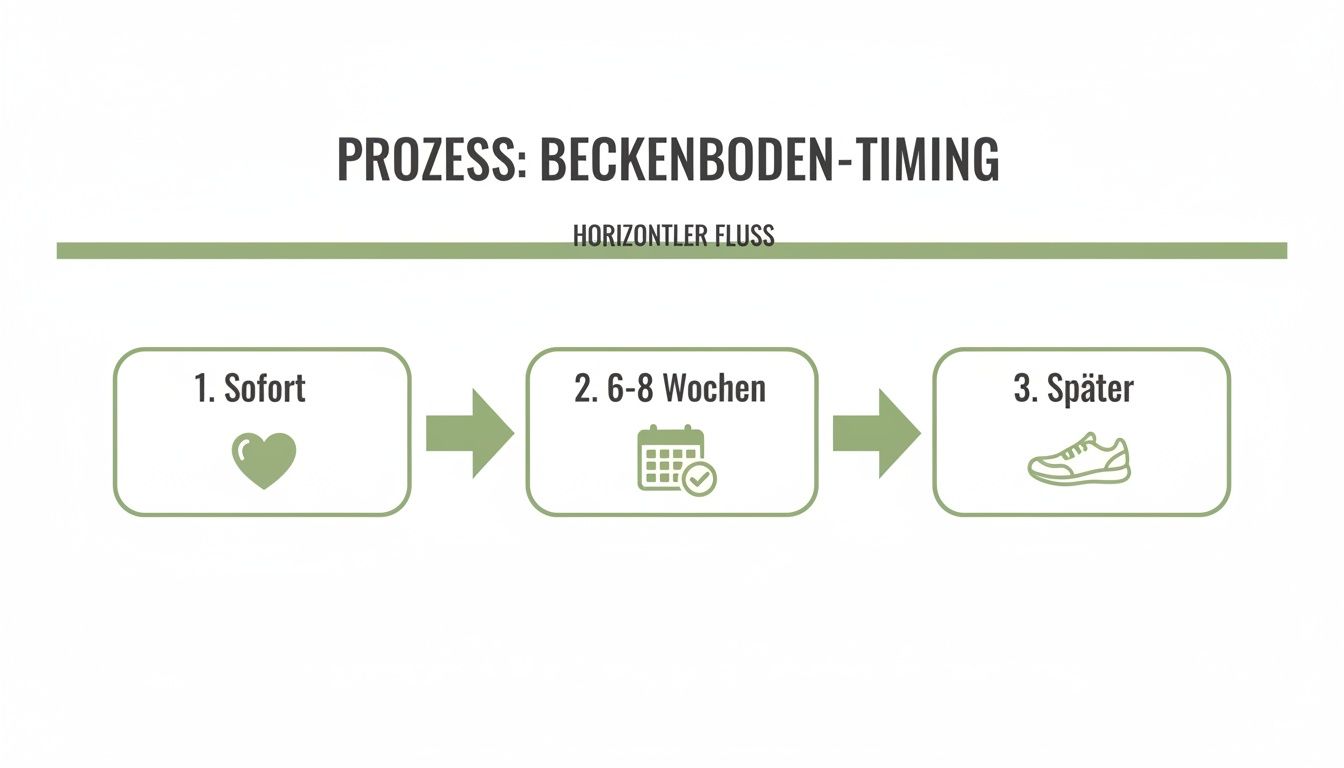
The graphic makes it clear: recovery is a journey in stages. It starts with gentle awareness immediately after birth, moves on to structured development after the doctor's approval and finally leads you safely back to more demanding sports.
Once you feel comfortable lying on your back, it's time to bring gravity into play. Exercises while sitting or standing place greater demands on your pelvic floor because it now has to actively support the weight of your organs.
You can make these short activations unnoticed anywhere - while waiting at the supermarket checkout, brushing your teeth or while rocking your baby in your arms.
Important: It's not about how long you train for at a time, but rather how often you consciously control your pelvic floor throughout the day. Regularity beats intensity, especially in the beginning.
In Switzerland, pelvic floor training is strongly recommended for all women after childbirth as it has been proven to reduce the risk of urinary incontinence. Studies show an impressive risk reduction of at least 60%. Targeted training also helps women who don’t (yet) have any problems to avoid them in the future. You can find out more about the scientific background here SGGG expert letter on the subject of the pelvic floor.
Your body will quickly become stronger. That's why it's important that you let the intensity of your training slowly increase with you. This is called progression.
However, it is just as important to adapt (modify) an exercise if it still feels too difficult. If you notice that you can't maintain the tension during the bridge, just don't lift your pelvis quite as high. Does training while standing still feel weird? Then take a step back to the seated exercises.
Your body sets the pace. Good training is always built on a solid foundation. If you feel that you are ready for more and would benefit from the community with other mothers, a course like Pilates with baby be the perfect next step for you. There you can safely continue to work on your strength under professional guidance.
Finally! You feel a connection to your pelvic floor again and are fully motivated to work with it Pelvic floor exercises after birth to really get started. This is fantastic! But be careful, especially at the beginning there are a few typical stumbling blocks that can slow down your progress or, in the worst case, even harm you.
When it comes to pelvic floor training, the following definitely applies: less is often more, as long as the quality is right. It's not about pushing with brute force. The secret is to activate the right muscles specifically and in harmony with your breathing.
This is the classic mistake. Instead of targeting the fine, deep pelvic floor muscles, you unconsciously accelerate with the large, external muscle groups - i.e. your butt and thighs. The result? You train everything possible, just not what really matters.
How that feels: You automatically squeeze your buttocks tightly together. You may also feel your inner thighs getting hard or your stomach sucking in as if you were trying to slip into jeans that were way too tight.
The correction: When practicing, place your hands loosely on your bottom and thighs. Do they stay soft and relaxed? Super! Concentrate fully on the inner idea of gently pulling your ischial tuberosities towards each other and upwards, without any movement being seen from the outside.
A great trick is to do the exercise while sitting on a soft ball or rolled up towel. You should feel a slight pressure that pulls inwards and upwards - and not a gripping of the butt muscles.
Many of us tend to reflexively hold our breath when we exert ourselves. However, this is absolutely counterproductive when it comes to pelvic floor training. If you hold your breath and press down, you create massive pressure in the abdominal cavity. This pressure puts direct pressure on your already weakened pelvic floor. So you work against it instead of strengthening it.
How you can tell: Your head turns red, maybe even the veins in your neck bulge, and your breath catches as soon as you tense up. You feel a clear downward pressure instead of a gentle upward lift.
Here's how to do it correctly: Couple the tension always to your exhalation. Breathe out very calmly and audibly, for example with a quiet “pfff” or “ssss” sound. Exhaling automatically activates your deep abdominal muscles, which support your pelvic floor, and prevents dangerous clenching.
Pelvic floor training is not a cardio workout. Fast, jerky repetitions have absolutely no effect here. Your pelvic floor consists largely of muscle fibers that respond best to slow, conscious and sustained tension.
Es kommt also viel mehr auf die Qualität jeder einzelnen Wiederholung an, als einfach nur eine bestimmte Anzahl "abzuarbeiten".
The relaxation phase is at least as important as the tension itself. Only a pelvic floor that can completely let go is truly healthy and functional. Too much ambition can quickly lead to overload. In our article about the signs of Overtraining Find out more about how to correctly interpret your body's warning signals.
Your body is sending you clear signals - you just have to learn to listen. If you notice certain symptoms, you should stop your training immediately and, if in doubt, it is better to seek professional advice if you do too much rather than too little.
Watch out for these warning signs:
If you experience any of these symptoms, slow down immediately. Take a break for a day or two and then try a simpler exercise or significantly fewer repetitions. If problems persist, please do not hesitate to contact a physiotherapist who specializes in the pelvic floor or your midwife. You can use touch to check whether you are targeting the right muscles and put together a tailor-made program for you.

Everyday life with a newborn turns your own schedule completely upside down. Fixed dates for a one-hour workout? To most new moms, this sounds like science fiction. But here's the really good news: your pelvic floor benefits much more from short, regular pulses than from rare, long training sessions.
The greatest success lies in continuity. The key is yours Pelvic floor exercises after birth to incorporate them into your everyday life so cleverly that they become a pure habit - without any additional time investment.
Your day is full of opportunities for an invisible mini-workout. You just have to learn to recognize these moments and use them to your advantage. This works best if you link new routines to existing habits.
Here are a few concrete examples from practice:
Diese kleinen "Trainings-Snacks" summieren sich über den Tag und machen einen riesigen Unterschied für deine Stabilität und dein Körpergefühl.
In addition to active strengthening, it is at least as important to protect your pelvic floor from unnecessary pressure. Certain everyday situations seem like a strong burden from above - here you can learn to actively counteract it.
Your pelvic floor is your inner trampoline hero. It absorbs shocks and reacts quickly. Give it the chance to do its job by proactively activating it.
Dieses Prinzip nennt sich "Gegenhalten" oder präventive Anspannung. Du spannst deinen Beckenboden also just before a burden comes. This trains his reflexes and protects him from overload.
Practice counter-resistance specifically with these actions:
By making this conscious activation a habit, you create a protective shield for your core. This is practical regression that goes far beyond isolated exercises.
Even if training is the basis in everyday life, a structured course can work wonders. Under professional guidance, you will not only learn the correct technique, but also stay motivated. In addition, exchanging ideas with other mothers is worth its weight in gold - you quickly realize that you are not alone with your challenges.
If you're ready to take the next step and want to combine core strengthening with other exercises, a dedicated class may be just the thing. Take a look at our guide Fitness with babies and toddlers to find the perfect option for you and your needs. This means your pelvic floor naturally becomes part of your new, active life as a mother.
After giving birth, the world turns upside down and your own body often feels foreign. Countless questions arise, especially when it comes to regression and the pelvic floor. Don't worry, this is completely normal! I have collected the most important answers for you here so that you feel safe and well informed.
Ici, il est clair que la régularité l’emporte sur la durée. Ton plancher pelvien en profite beaucoup plus si tu l'actives brièvement plusieurs fois par jour, plutôt que de suivre un entraînement long une fois par semaine. The object is created in a new habitude and renews the lien between the head and the muscles.
An excellent point of departures’entraîner trois fois par jour pendant environ cinq minutes.Le plus genius? These mini-séances can be easily integrated into the mother's tone. Imagine by example that you have a pendant with the brossage des dents, another one in allaitant or in a nourrissant ton bébé, and can also be found in a just avant de t’endormir. Ainsi, you crées a lien fort avec ton center sans te surmener.
Les terms are souvent confondus, mais ils ne signifient pas la même chose. Imagine-le plutôt ainsi: The entraînement du plancher pelvien est le fondement absolument essentielfor all the reeducation.Without a solid base, the house is unstable.
En bref: tone entraînement du plancher pelvien est la première pierre et le plus importance des éléments sur lesquels tout repose.
Tout d'abord: respire profondément. Don’t do it absolutely for yourself with sentiment! After the stress and the wear and tear are extremely high for the accommodation, it is all but normal that the zone is engourdie or you feel the same way or something other than “non-concern”. Less connections nerveuses doivent d’abord se régénérer. The maintenant is the patient with everything in it and the body.
Travaille with the images mentales pour récupérer lentement la perception. Imagine by example that you feel the soul ever doucement a small bille with ton vagin and the tirer vers l’intérieur. Ou essaie de déplacer doucement tes deux tubérosités ischiatiques l’une vers l’autre. After a few weeks, you will have to go back and forth, but you will not have to ask for professional help. A physiotherapist specializing in the skin of the pelvis pourra palper de l'extérieur si tu sullicites les bons muscles, and t'aidera de manière ciblée.
The patience is part of the training and is more important. The sensation of the tonal plancher pelvien revient – parfois, il faute juste un peu plus de temps et un soutien ciblé.
You can see the desire for remettre in the shoes of the course and the lancer. Mais surtout pour les sports à forte impact (High-Impact) comme le jogging, le saut à la corde or même les classiques abdominaux, the prudence is de mise. Chaque saut crée une immense pression vers le bas – une charge pour laquelle ton plancher pelvien doit d’abord être prêt.
The règle de base est: au plus tôttrois à cinq mois après l’accouchementand then you complete a course of reeducation, you begin and progress. The condition is préalable that the ton plancher pelvien is “resistant aux chocs”. Cela signifie que tu ne perds pas d’urine en sautant et que tu n’as pas de sensation de pression ou de corps étranger vers le bas. A professional control of the plancher pelvien by a spécialiste te thundera the fire green and the security don't do as besoin pour ta reprise.
The period after the accommodation is a phase of major changes, pas seulement physiquement. It is also a souvenir of professional questions. He is now a liberator of information at the forefrontles informations importantes concernant la grossesse sur le lieu de travailpour etre bien preparée.
Is it possible to strengthen the center of the profession and change it with other mères? Chez Templeshape GmbH You'll find special courses like our Mama Workouts, which are sure and effective on the course. Trouve dès maintenant le cours qui te convient surhttps://Templeshape.com.
tags