Es befinden sich keine Produkte im Warenkorb.
Februar 8

You are looking for more peace in your everyday life, but you ask yourself: Breathwork vs. Meditation: What suits your lifestyle? The short answer is: Breath work is ideal for you if you have one active, fast method for immediate stress reduction or energization. meditation on the other hand, is your way if you have one passive, long-term practice for mental clarity and emotional stability.
In a world that constantly demands your attention, the longing for an inner anchor is great. Both breathwork and meditation are powerful tools for achieving exactly that - but they do it in very different ways.
The decision to use a method depends largely on your personal goals, your available time budget and your lifestyle.
Are you looking for a quick reset button that you can press in the middle of your hectic work life? Or would you like to build a sustainable routine to calm your thoughts in the long term and sharpen your ability to concentrate?
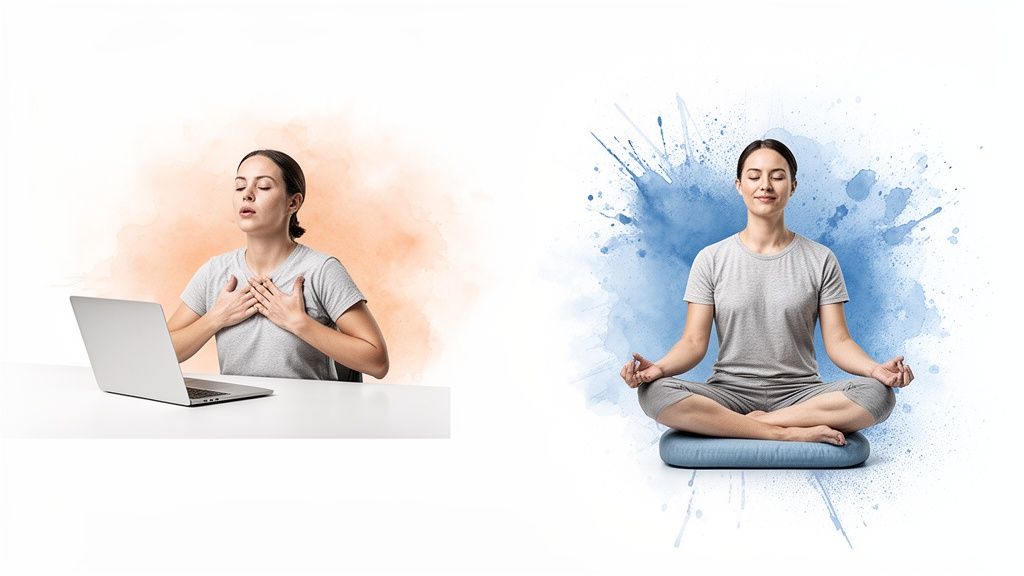
Breathwork is like a sprint for your nervous system - short, intense and with an immediate effect. Meditation is more like a marathon - it requires endurance and consistency to get you to your goal in the long term.
To give you an initial orientation, I have summarized the most important differences in a clear overview. This table will help you quickly identify which practice might suit you best in your current life situation.
This table summarizes the key differences and helps you quickly identify the right method for your current needs.
| feature | Breath work | meditation |
|---|---|---|
| Approach | Active: You consciously control your breathing. | Passive: You watch your thoughts. |
| focus | Physical sensations and nervous system. | Mental clarity and awareness. |
| Effect | Often immediately noticeable, intense and physical. | Long term, gradual and mental. |
| Time expenditure | Flexible, starting now 5 minutes effective. | Regularity is crucial, often 10-20 minutes. |
| Ideal for | Quick stress relief, energy boost, emotional discharge. | Inner peace, concentration, self-reflection. |
Beide Wege sind wertvoll. Es geht nicht darum, was "besser" ist, sondern was now works for you.
To answer the question “Breathwork vs. meditation – which suits your lifestyle?” To clarify this for you, we first have to get to the root. Both practices can help you achieve greater inner peace, but their paths to achieving this are fundamentally different. Think of it like a sprinter and a marathon runner: both are athletes, but their training couldn't be more different.
Breathwork is one active practice. This is about consciously controlling your breath and using it for your benefit. You use specific techniques - sometimes fast and energizing, sometimes slow and deeply relaxing - to directly address your nervous system.
You could almost describe it as a light switch for your own body: you can consciously switch on “energy” or “relaxation”. You often feel the effects immediately and very physically.
Breathwork is about Do. You actively intervene in a process that would otherwise take place completely unconsciously, thereby creating a very specific state.
Breathwork is your tool to actively change your state. It is direct communication with your autonomic nervous system in the language of breath.
Meditation, on the other hand, is one passive exercise of pure observation. Instead of actively changing something, you learn to simply notice what is there at the moment: your thoughts, your feelings, the sensations in your body.
The goal here is not to compulsively stop the thoughts. Rather, it's about building a healthy distance from them. You become an observer of your own mind without being carried away by every single thought. Imagine your thoughts are like clouds in the sky - you're sitting in a meadow, watching them go by without jumping on one. If you are interested in gentle, passive relaxation techniques, ours might be too Articles about Yoga Nidra something for you.
You often feel the effect of meditation more subtly and it unfolds over a longer period of time. It's like a training for your mind that will lead you to greater mental clarity, emotional stability and deep inner peace in the long term. You're essentially building a calming muscle that gets a little bit stronger with each session.
If you have to decide between breathwork and meditation, two questions are often crucial: How quickly do I notice something and how much time does it cost me? The answer to this is not black and white, but depends largely on what you need at the moment - a quick reset for the moment or a profound, long-term change in your mental landscape.
Breathwork is your choice for that immediate effect. Think of it like an espresso for your nervous system: short, intense and with an effect you feel immediately. By actively controlling your breathing, you can specifically change your physical and emotional state in just a few minutes.
The biggest advantage of breathwork is clearly the quick, measurable effect. You don't have to practice for weeks to notice a difference. Even a single, short and intense session can be proven to reduce your stress levels or give you a boost of energy when you need it most.
This direct physical feedback often makes getting started uncomplicated and motivating. Science also confirms that breathing exercises are particularly effective at reducing stress and improving mood - often even faster than pure meditation practice. A controlled study with 140 participants showed that the group that practiced breathing exercises experienced significantly greater increases in their positive mood over 30 days.
Meditation, on the other hand, shows its strengths more in the long term. It's like training muscles: A single workout feels good and may give you a short pump, but you only build real strength and endurance through it regular, ongoing practice on.
Breathwork gives you the fish for the moment, meditation teaches you to fish for life.
The time required for meditation is often set somewhat higher. While you can achieve a lot with just 5 minutes of breathwork, most teachers recommend at least one meditation session 10 to 20 minutes daily to plan. This gives your mind the time it needs to really calm down and immerse itself in the state of pure observation.
The effect is subtler, but all the more lasting. Over time you will notice how you, for example:
Incidentally, both techniques have a strong effect on our autonomic nervous system, especially on the vagus nerve, which is responsible for our relaxation response. If you are specifically looking for techniques to shut down your system, also take a look at our article on Exercises to stimulate the vagus nerve.
In the end, the choice is a question of your goal. If you're looking for a quick reset, breathwork is unbeatable. If you want to train your mind sustainably and make it more resilient, meditation is the more reliable way.
The decision between breathwork and meditation actually has less to do with the methods themselves and more to do with you and your everyday life. Your current life situation, your goals and even your personality play the main role in determining which practice will ultimately benefit you the most. It's about finding the right tool for the right job.
You will really consistently follow a method that fits seamlessly into your daily routine. So let's look at a few very specific scenarios so you can get a better feel for what might be right for you.
Imagine working in Zurich, rushing from one meeting to the next and your head is spinning. You hardly have time for a real break, but you can feel the stress level rising and your concentration slowly slipping away.
For you, breathwork is like a mental espresso: it works immediately, has no calories and you can squeeze it in between two appointments.
This decision tree shows you the way depending on whether you are looking for an immediate effect or a long-term change.
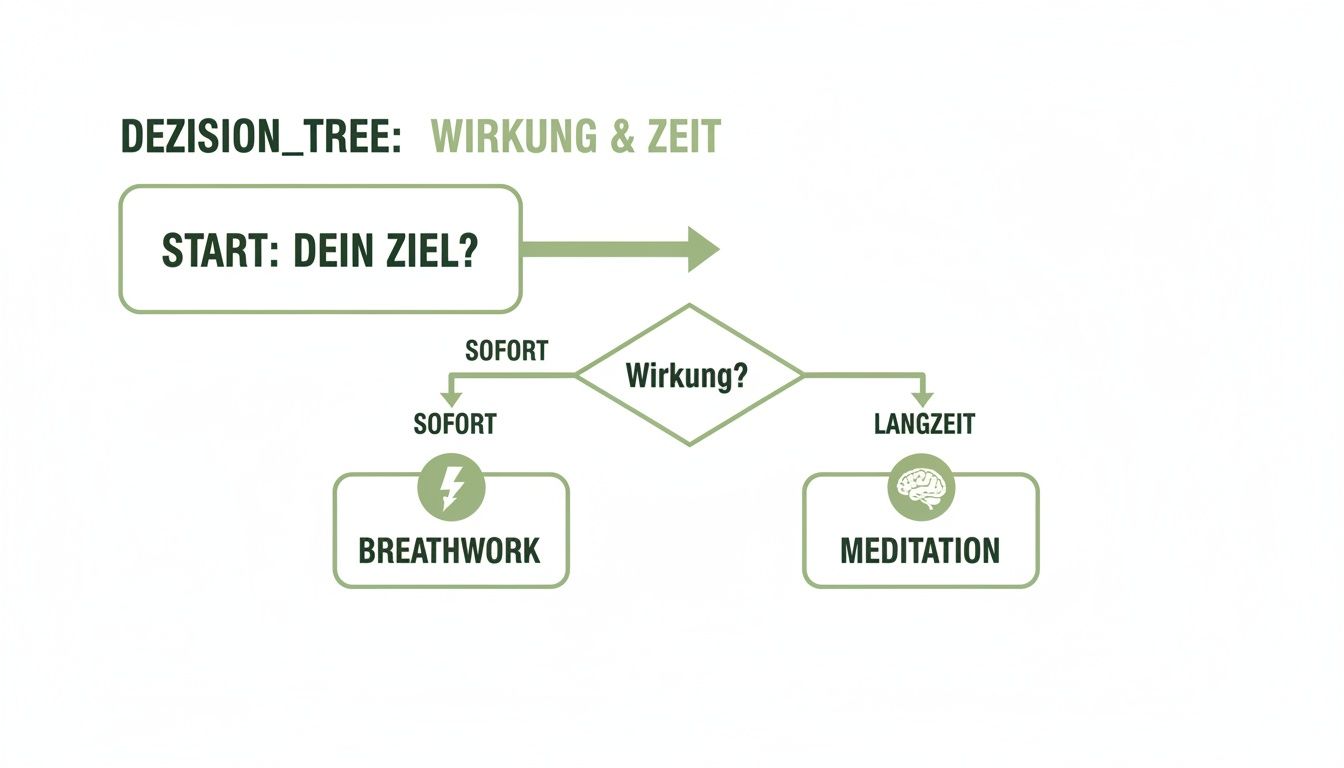
The graphic makes it clear: If you need direct intervention to change your condition immediately, breathwork is your tool of choice. But if you want to change your mental patterns sustainably, meditation is the better path.
Your life as a mother is full of love, but also often unpredictable and chaotic. You juggle countless balls at the same time, your own needs are usually neglected and you long for an inner anchor that helps you stay calm and present even in stormy moments.
Interestingly, scientific data shows that women meditate significantly more often than men. These differences indicate different needs, which is relevant to targeted wellness programs. For example, meditate in Hamburg 38 percent of the population regularly, while Berlin with 25 percent is also well above the national average. More about the Dissemination of meditation practices in research you can read about it here.
You train hard to improve your performance. Your focus is on regeneration, mental strength in competition and optimizing your physical processes. You just want to get everything out of yourself.
Theory is all well and good, but in the end only one thing counts: What do you actually implement? The best method is always the one you use regularly. Both breathwork and meditation only develop their full power when they become a habit. Here I will show you how you can incorporate both practices into your everyday life without much effort.
The good news is: You don't have to carve out hours of your day for this. Just a few minutes of mindfulness will make a huge difference if you stick with it.
Breathwork is the perfect quick start because you don't need any previous knowledge and you'll feel the effects immediately. You can use this simple routine to activate yourself in the morning or to wind down in the evening - whatever you need.
Box breathing (Square breathing):
Repeat this cycle for five minutes. This technique is incredibly effective for balancing your nervous system and instantly feeling grounded again.
When it comes to meditation, it is the regularity that counts, not the duration. Instead of overwhelming yourself with the goal of immediately meditating for half an hour, start with realistic ones 10 minutes a day.
The magic of meditation lies not in the length of a session, but in the consistency of the daily routine.
Create a little ritual for yourself: a fixed place, a fixed time. For example, right after getting up on a pillow in the corner of your bedroom. This helps your brain establish the new habit more quickly. The practice is becoming more and more important in Switzerland and Germany. Studies show that already 40 percent of Germans have had experiences with it. What is remarkable is that 15 percent meditate and over several times a week 95 percent report positive effects such as more calmness. You can find out more about this in these exciting study results on meditation.
Why choose when you can have the best of both worlds? The clever combination of both methods brings out their respective strengths optimally for you.
A proven approach: Start your meditation session with a short breathwork exercise. Start with three to five minutes of box breathing. This helps you reduce physical stress and calm the stream of thoughts. You will notice that it will be much easier for you to immerse yourself in the silent observation of meditation.
We at Templeshape help you find a routine that really motivates you. In our guided Breathwork and ice bath sessions in Zurich Under professional guidance, you will learn to use the power of your breath specifically for your benefit - the perfect starting point for making health a habit.
At the end of the whole “Breathwork vs. Meditation” debate there is actually a very simple truth: It’s not about which is “better” across the board. The only question that really matters is: What suits you, your lifestyle and your personal goals best right now?
You could say: Breathwork is your direct tool for quick, noticeable changes. It is the reset button that you press to actively control your energy and catapult yourself out of everyday stress.
Meditation, on the other hand, is your long-term companion. It trains your mind for deeply anchored inner stability and lasting serenity.
Both practices are incredibly powerful and do not have to be mutually exclusive - on the contrary, they complement each other ideally. A short, sweet breathwork session, for example, can be the perfect introduction to deeper meditation.
At Templeshape in Zurich we know from experience: There is no template for health and well-being. Your path is unique, and that's exactly why you don't have to choose with us - we offer you both.
Experience the intense power of your breath in our guided breathwork courses. Or find meditative silence and physical mindfulness in our diverse yoga classes. We invite you to try both out and find out for yourself what supports you best at the moment.
We accompany you on this path - with clear structures, professional guidance and a community that motivates you. Discover how you can bring more energy and at the same time more peace into your life with targeted exercises. Find out more about our Breathwork offer in Zurich and start your journey.
At the end of our big comparison, we have a few answers to the questions that we keep coming across in our studios in Zurich. They should help you get rid of any remaining uncertainties and make the right choice for you.
One of the most common questions is whether you can mix the two methods at all.
Yes, absolutely! The two actually complement each other perfectly. A short breathwork session before your meditation acts as a booster for your practice. It helps you to let go of physical tension and finally bring the carousel of thoughts to a halt.
Try it with five minutes of box breathingto shut down your nervous system. You will notice that it will be much easier for you to find the silent observation of meditation and to really immerse yourself deeply in peace.
Think of breathwork as a warm-up for your mind. You prepare the field so that meditation can fall on really fertile ground.
Another point that comes up again and again is safety - especially when it comes to more intensive breathing techniques.
Safety always comes first. If you have certain pre-existing conditions, you should use intensive breathing techniques with caution. This is particularly true for:
Intensive methods are also not recommended during pregnancy. In all these cases you should practice such only after express consultation with your doctor start. However, gentle, calming breathing exercises are almost always harmless and can even be beneficial.
This is the question that is all about one thing: patience. Some people feel a pleasant calm the first time, but that is the exception. The really deep, lasting effects of meditation usually only become apparent after you have stuck with it regularly for a few weeks.
Always remember: you are training a mental muscle here. It takes time and Constancyto notice real changes such as better focus, more emotional balance and less everyday stress. Patience is really your most important companion here.
Are you ready to experience for yourself what conscious breathing and movement can do for you? At Templeshape In Zurich we give you the perfect setting to start or deepen your practice - with professional guidance and a community that motivates you. Discover our courses and make health your new habit.
Find your course now https://Templeshape.com and start your journey.
tags
Mindfulness practice, breathwork vs meditation, mental health, stress management, templeshape Zurich