Es befinden sich keine Produkte im Warenkorb.
Dezember 31

Congratulations, your baby is here! Now is the beginning of a very special time, and the right support for your body is crucial. Litter Pelvic floor exercises after birth are your key to finding the connection to your body center again and laying the foundation for strong recovery.

The postpartum period is a phase of enormous change. Your body has done incredible things. Your pelvic floor in particular was heavily stressed and stretched during pregnancy and birth. So it's completely normal if this area feels strange, maybe even numb or just weak.
This is exactly why targeted, but above all gentle, exercises are so incredibly important now. And it's about much more than just being able to do sports again at some point. A functional pelvic floor is the basis for your entire body stability.
Stell dir deinen Beckenboden am besten wie eine elastische Hängematte vor. Sie stützt deine Organe, kontrolliert die Körperöffnungen und stabilisiert deine Wirbelsäule. Nach der Geburt ist diese "Hängematte" erst mal ziemlich ausgeleiert und braucht Zeit und die richtigen Impulse, um ihre alte Spannkraft zurückzubekommen.
Before you even think about more complex exercises, you have a completely different task: you have to learn to consciously feel your pelvic floor again. This is initially the biggest challenge for many women because the nerve connections can be temporarily disrupted after the birth.
This is not about strength at all, but purely about perception. It's about interpreting your body's subtle signals and targeting the right muscles - without using your buttocks or abdominal muscles. Give yourself time, it is a process that requires patience.
These first, gentle perception exercises are the be-all and end-all. They reactivate the muscle-nerve connections and prepare your body for the more intensive training in the postnatal course. Think of it as the foundation on which all your further training is built. Without this foundation, you risk training ineffectively or even incorrectly.
If you specifically address your pelvic floor shortly after birth, you will not only do something for regeneration, but also prevent long-term problems. Many women find it uncomfortable to talk about topics like incontinence, but the numbers show how widespread this challenge is.
In fact, people in Switzerland suffer after a vaginal birth up to 11% of women due to air or fecal incontinence. This unwanted loss can occur spontaneously or due to birth injuries and often increases with the number of births. You can find more background information on this in the SGGG information brochure 2022.
Give yourself and your body time. Regression is not a race, but a journey back to your strength. Every small step, every conscious tension and every letting go is a big success.
These statistics make it clear why your pelvic floor is not an afterthought, but a central aspect of your postpartum health. Through early and correct exercises, you can actively ensure your continence and minimize the risk of a later prolapse of the uterus or bladder.
The key to success lies in the perfect combination of tension, relaxation and your breathing. A very common mistake is to just focus on tensing. But it is just as important to be able to completely let go of the pelvic floor. A permanently tense pelvic floor is just as problematic as one that is too weak.
Your breathing is your most important partner. From the beginning, try to couple activation with your exhalation:
This synchronization helps you target the deep muscles and at the same time avoid tension. Your first Pelvic floor exercises after birth These are primarily breathing and perception exercises that you can do in a relaxed manner while lying down.
Die eine grosse Frage, die fast jede frischgebackene Mama umtreibt, ist: "Wann darf ich denn endlich wieder was tun?" Insbesondere die Pelvic floor exercises after birth are at the top of the list. But the answer to that is as individual as your birth and you. There is no universal starting point, but there is a clear roadmap that you can follow.
Your body has achieved an enormous feat and now needs one thing above all: time to heal. But that doesn't mean you should put your feet up and do nothing for weeks. Quite the opposite – you can gently support regeneration right from the start.
Just a few days after birth, you can and should start with very gentle perception and breathing exercises - of course only if you feel like it. This is not about strength, but rather about building a connection to your body center, your pelvic floor.
This can look very simple: Lie comfortably on your back, place your feet hip-width apart and place your hands on your lower stomach. Breathe deeply and relaxed into your stomach and feel the abdominal wall rise. As you breathe out, let it sink gently back down. This conscious breathing alone stimulates blood circulation and supports healing.
Your body gives you very clear signals. A slight tug, an unpleasant downward pressure or even pain are an unmistakable stop sign. Listen carefully and give yourself a break.
These very first exercises are so gentle that they do not interfere with wound healing but actually promote it. They help your uterus to recede and can have a positive effect on the weekly flow.
What your path back to strength looks like depends heavily on your birth experience. The healing process varies, and so does the time for more intensive exercises.
No matter how you gave birth, the first six to eight weeks are all about arrival and basic regeneration.
The crucial milestone is your gynecological follow-up, which is usually six to eight weeks after birth takes place. Here we check whether everything has healed well and whether the recovery is progressing as it should.
If your gynecologist gives the green light, you can start with a structured postnatal course. Only from this point on does the actual strength building begin. You should only attempt any exercises that go beyond pure perception and gentle activation after receiving this medical approval.
This appointment marks the transition from gently rediscovering your body to targeted training. If you want too much too soon, you risk disrupting healing and causing long-term problems such as prolapse or incontinence. Give your body the time it truly deserves.
So now it gets practical. Your body has already done a lot of regeneration work in the first few weeks. Now it's about specifically rebuilding and strengthening the connection to your pelvic floor. The following Pelvic floor exercises after birth are made precisely for this early stage - they are gentle, safe and incredibly effective if you do them right.
Everything starts with correct activation. Put aside thoughts of strength or great effort for now. Your most important goal is to feel the three layers of your pelvic floor again and to link their movement with your breathing. This is and remains the basis for everything that comes next.
Your pelvic floor is not a simple sheet of muscle, but a clever network of three layers that lie on top of each other. In order to target them specifically, inner images often work much better than dry, technical instructions. Your brain loves such ideas and then sends exactly the right impulses to the muscles.
Probier einfach mal aus, welches dieser Bilder bei dir am besten "Klick" macht:
Such pictorial instructions help you target the fine, deep muscles instead of accidentally cheating on the large, external muscles like the butt or thighs.
The very best exercises to start with are those where you can work without any pressure and in a relaxed position. The supine position is perfect for this because your pelvic floor doesn't have to fight against gravity.
1. The pelvic swing while lying down
This exercise gently mobilizes your pelvis and at the same time awakens your deep abdominal and pelvic floor muscles.
2. The bridge with focus
Almost everyone knows the bridge, but with the right focus it becomes a brilliant exercise for the pelvic floor.
These two exercises are a perfect introduction. You can easily integrate them into your everyday life, for example in the morning immediately after waking up in bed or in the evening to wind down.
The following process will show you how to safely increase your training over time.
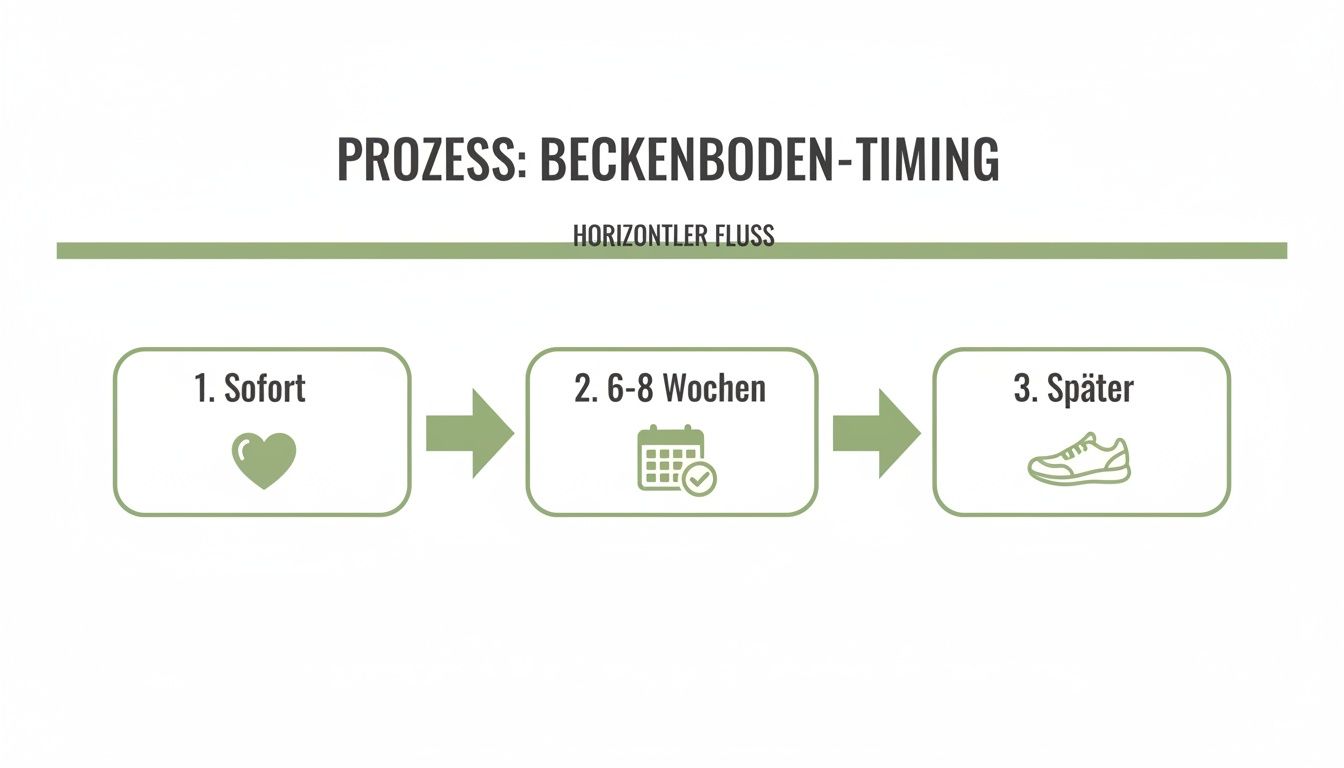
The graphic makes it clear: recovery is a journey in stages. It starts with gentle awareness immediately after birth, moves on to structured development after the doctor's approval and finally leads you safely back to more demanding sports.
Once you feel comfortable lying on your back, it's time to bring gravity into play. Exercises while sitting or standing place greater demands on your pelvic floor because it now has to actively support the weight of your organs.
You can make these short activations unnoticed anywhere - while waiting at the supermarket checkout, brushing your teeth or while rocking your baby in your arms.
Important: It's not about how long you train for at a time, but rather how often you consciously control your pelvic floor throughout the day. Regularity beats intensity, especially in the beginning.
In Switzerland, pelvic floor training is strongly recommended for all women after childbirth as it has been proven to reduce the risk of urinary incontinence. Studies show an impressive risk reduction of at least 60%. Targeted training also helps women who don’t (yet) have any problems to avoid them in the future. You can find out more about the scientific background here SGGG expert letter on the subject of the pelvic floor.
Your body will quickly become stronger. That's why it's important that you let the intensity of your training slowly increase with you. This is called progression.
However, it is just as important to adapt (modify) an exercise if it still feels too difficult. If you notice that you can't maintain the tension during the bridge, just don't lift your pelvis quite as high. Does training while standing still feel weird? Then take a step back to the seated exercises.
Your body sets the pace. Good training is always built on a solid foundation. If you feel that you are ready for more and would benefit from the community with other mothers, a course like Pilates with baby be the perfect next step for you. There you can safely continue to work on your strength under professional guidance.
Finally! You feel a connection to your pelvic floor again and are fully motivated to work with it Pelvic floor exercises after birth to really get started. This is fantastic! But be careful, especially at the beginning there are a few typical stumbling blocks that can slow down your progress or, in the worst case, even harm you.
When it comes to pelvic floor training, the following definitely applies: less is often more, as long as the quality is right. It's not about pushing with brute strength. The secret is to activate the right muscles specifically and in harmony with your breathing.
This is the classic mistake. Instead of targeting the fine, deep pelvic floor muscles, you unconsciously accelerate with the large, external muscle groups - i.e. your butt and thighs. The result? You train everything possible, just not what really matters.
How that feels: You automatically squeeze your buttocks tightly together. You may also feel your inner thighs getting hard or your stomach sucking in as if you were trying to slip into jeans that were way too tight.
The correction: When practicing, place your hands loosely on your bottom and thighs. Do they stay soft and relaxed? Super! Concentrate fully on the inner idea of gently pulling your ischial tuberosities towards each other and upwards, without any movement being seen from the outside.
A great trick is to do the exercise while sitting on a soft ball or rolled up towel. You should feel a slight pressure that pulls inwards and upwards - and not a gripping of the butt muscles.
Many of us tend to reflexively hold our breath when we exert ourselves. However, this is absolutely counterproductive when it comes to pelvic floor training. If you hold your breath and press down, you create massive pressure in the abdominal cavity. This pressure puts direct pressure on your already weakened pelvic floor. So you work against it instead of strengthening it.
How you can tell: Your head turns red, maybe even the veins in your neck bulge, and your breath catches as soon as you tense up. You feel a clear downward pressure instead of a gentle upward lift.
Here's how to do it correctly: Couple the tension always to your exhalation. Breathe out very calmly and audibly, for example with a quiet “pfff” or “ssss” sound. Exhaling automatically activates your deep abdominal muscles, which support your pelvic floor, and prevents dangerous clenching.
Pelvic floor training is not a cardio workout. Fast, jerky repetitions have absolutely no effect here. Your pelvic floor consists largely of muscle fibers that respond best to slow, conscious and sustained tension.
Es kommt also viel mehr auf die Qualität jeder einzelnen Wiederholung an, als einfach nur eine bestimmte Anzahl "abzuarbeiten".
The relaxation phase is at least as important as the tension itself. Only a pelvic floor that can completely let go is truly healthy and functional. Too much ambition can quickly lead to overload. In our article about the signs of Overtraining Find out more about how to correctly interpret your body's warning signals.
Your body is sending you clear signals - you just have to learn to listen. If you notice certain symptoms, you should stop your training immediately and, if in doubt, it is better to seek professional advice if you do too much rather than too little.
Watch out for these warning signs:
If you experience any of these symptoms, slow down immediately. Take a break for a day or two and then try a simpler exercise or significantly fewer repetitions. If problems persist, please do not hesitate to contact a physiotherapist who specializes in the pelvic floor or your midwife. You can use touch to check whether you are targeting the right muscles and put together a tailor-made program for you.

Everyday life with a newborn turns your own schedule completely upside down. Fixed dates for a one-hour workout? To most new moms, this sounds like science fiction. But here's the really good news: your pelvic floor benefits much more from short, regular pulses than from rare, long training sessions.
The greatest success lies in continuity. The key is yours Pelvic floor exercises after birth to incorporate them into your everyday life so cleverly that they become a pure habit - without any additional time investment.
Your day is full of opportunities for an invisible mini-workout. You just have to learn to recognize these moments and use them to your advantage. This works best if you link new routines to existing habits.
Here are a few concrete examples from practice:
Diese kleinen "Trainings-Snacks" summieren sich über den Tag und machen einen riesigen Unterschied für deine Stabilität und dein Körpergefühl.
In addition to active strengthening, it is at least as important to protect your pelvic floor from unnecessary pressure. Certain everyday situations seem like a strong burden from above - here you can learn to actively counteract it.
Your pelvic floor is your inner trampoline hero. It absorbs shocks and reacts quickly. Give it the chance to do its job by proactively activating it.
Dieses Prinzip nennt sich "Gegenhalten" oder präventive Anspannung. Du spannst deinen Beckenboden also just before a burden comes. This trains his reflexes and protects him from overload.
Practice counter-resistance specifically with these actions:
By making this conscious activation a habit, you create a protective shield for your core. This is practical regression that goes far beyond isolated exercises.
Even if training is the basis in everyday life, a structured course can work wonders. Under professional guidance, you will not only learn the correct technique, but also stay motivated. In addition, exchanging ideas with other mothers is worth its weight in gold - you quickly realize that you are not alone with your challenges.
If you're ready to take the next step and want to combine core strengthening with other exercises, a dedicated class may be just the thing. Take a look at our guide Fitness with babies and toddlers to find the perfect option for you and your needs. This means your pelvic floor naturally becomes part of your new, active life as a mother.
After giving birth, the world turns upside down and your own body often feels foreign. Countless questions arise, especially when it comes to regression and the pelvic floor. Don't worry, this is completely normal! I have collected the most important answers for you here so that you feel safe and well informed.
The following applies here: regularity beats length. Your pelvic floor benefits much more if you briefly activate it several times a day than if you power through a long training session once a week. It's about creating a new habit and continually refreshing the connection between mind and muscles.
A great starting point is three times a day for around five minutes to train. The great thing about it? You can easily incorporate these mini units into your everyday mom life. For example, imagine doing one lap while brushing your teeth, one while breastfeeding or feeding your baby, and perhaps another just before falling asleep. This is how you build a strong connection to your center without overwhelming yourself.
The terms are often lumped together, but they do not mean the same thing. It's best to think of it like this: pelvic floor training is absolutely crucial foundation for your entire recovery. Without a strong foundation, the whole house is shaky.
In short: Your pelvic floor training is the first and most important building block on which everything else is built.
first einmal: tief durchatmen. Du bist mit diesem Gefühl absolut nicht allein! Nach der enormen Belastung und Dehnung bei der Geburt ist es völlig normal, dass sich der Bereich taub oder irgendwie "nicht zugehörig" anfühlt. Die Nervenverbindungen müssen sich erst wieder regenerieren. Das Wichtigste ist jetzt, geduldig mit dir und deinem Körper zu sein.
Work with inner images to slowly bring back perception. For example, imagine you want to gently pick up a small marble with your vagina and pull it inward. Or try gently moving your two sitting bones towards each other. If you still don't feel anything after a few weeks, don't hesitate to get professional help. A physiotherapist who specializes in the pelvic floor can feel from the outside whether you are controlling the right muscles and give you specific help.
Patience is your most important training partner. The feeling for your pelvic floor returns - sometimes it just needs a little more time and targeted support.
I can understand the desire to finally slip back into my running shoes and get started. But caution is advised, especially in high-impact sports such as jogging, jumping rope or classic sit-ups. Every jump creates enormous downward pressure - a strain for which your pelvic floor has to be fit again.
The rule of thumb is: at the earliest three to five months after birth und erst, wenn du einen Rückbildungskurs komplett abgeschlossen hast, solltest du langsam wieder damit anfangen. Die Grundvoraussetzung ist, dass dein Beckenboden "stossfest" ist. Das heisst, du verlierst beim Hüpfen keinen Urin und hast kein Druck- oder Fremdkörpergefühl nach unten. Ein professioneller Beckenboden-Check bei einer Fachperson gibt dir grünes Licht und die Sicherheit, die du für den Wiedereinstieg brauchst.
The time after birth is a phase of big changes, not just physical. Professional questions also often arise. It can be very relieving to find out early Important information about pregnancy at work to be informed in order to be well prepared.
Are you ready to strengthen your core under professional guidance and exchange ideas with other mothers? At Templeshape GmbH You will find specialized courses like our Mama Workouts that will accompany you safely and effectively on your journey. Find the right course for you now https://Templeshape.com.
tags
Strengthening the pelvic floor, pelvic floor exercises after birth, postnatal training, postnatal exercises, postpartum exercises