Es befinden sich keine Produkte im Warenkorb.
Dezember 31

Congratulations on your baby! If you are now wondering how to find the right one Postgraduate course in Zurich for you, you've come to the right place. By the way, a course like this is much more than just a bit of gymnastics - it is a targeted investment in your long-term health and well-being after pregnancy and birth.
Does your body feel strange after giving birth? This is absolutely normal and just shows what an incredible feat he has accomplished. A targeted recovery course is the crucial step so that you feel strong, safe and at home in your body again. It's about rebuilding the foundation of your body systematically and, above all, sustainably.
Just imagine your pelvic floor like the trampoline of your core. Pregnancy and birth put a lot of strain and stretch on this trampoline. Without targeted training, it can happen that it loses tension.
A weak pelvic floor is not an abstract problem, but can have very concrete and unpleasant consequences that put a strain on everyday life with a baby:
A professional rehabilitation course in Zurich comes into play here and counteracts these problems.
A good recovery course is not a quick fitness fix. See it as a sustainable investment in your health. It lays the foundation for all further sporting activities and gives you the strength you need for the demanding everyday life of a mother.
In contrast to a normal fitness program, postnatal training focuses entirely on the specific needs of your body after birth. You learn to consciously perceive and activate your deep muscle layers again. You could say it's about re-establishing the connection between your head and your muscles.
A great example is diastasis recti - the gap between the rectus abdominal muscles. Incorrect exercises like classic crunches can actually make this gap worse. In a guided course, you'll learn the right techniques to help your abdominal muscles heal safely and effectively. You build stability from the inside out.
If you later want to intensify your training and include your baby, you can find our guide on the topic Pilates with babies or toddlers valuable tips for the next step.
Many new mothers ask themselves: When is the right moment to start postnatal recovery? The answer is actually quite simple and depends on how your birth went. First things first: your body needs time after birth. Time to heal.
Be sure to give him that break. It is the basis so that your body can recover and the subsequent training really bears fruit. As a rule of thumb:
A good postgraduate course is not a boot camp. Forget the thought of sweaty workouts. Instead, it's a mindful, gradual process that brings you back into connection with your body. Think of it as a journey back to your center.
Everything starts with the perception. Many women can hardly feel their pelvic floor after giving birth. This is completely normal. With targeted, very gentle exercises you will learn to consciously control this important muscle again. It's about re-establishing the fine connection between your brain and your muscles.
After that follows activation. Now special breathing techniques come into play that wake up your deep abdominal and back muscles – your core. You will learn how to stabilize your core through conscious breathing alone. A technique that will help you enormously in everyday life, for example when lifting your baby.
Fortunately, professional aftercare is firmly established in Zurich. The University Hospital of Zurich (USZ), for example, starts its courses 6 to 8 weeks after birth. Eight lessons are about finding the joy in movement again and strengthening the body's foundations. You can find more information directly at Courses offered by the USZ.
Week after week the program increases. The exercises become more complex and demanding, but always adapted to your progress. You may start with small movements while lying down and slowly work your way up to functional exercises while standing. The goal is crystal clear: to get you fit for the real challenges of your new everyday life.
Lifting the baby out of the crib, carrying the baby seat, pushing the stroller - all of this requires a strong and stable core. It is precisely this everyday strength that you will build up in a well-structured postnatal course in Zurich.
This graphic shows your body's journey very nicely: from the stress caused by pregnancy, through the weakened phase immediately after birth, to the newly gained strength through targeted regression.
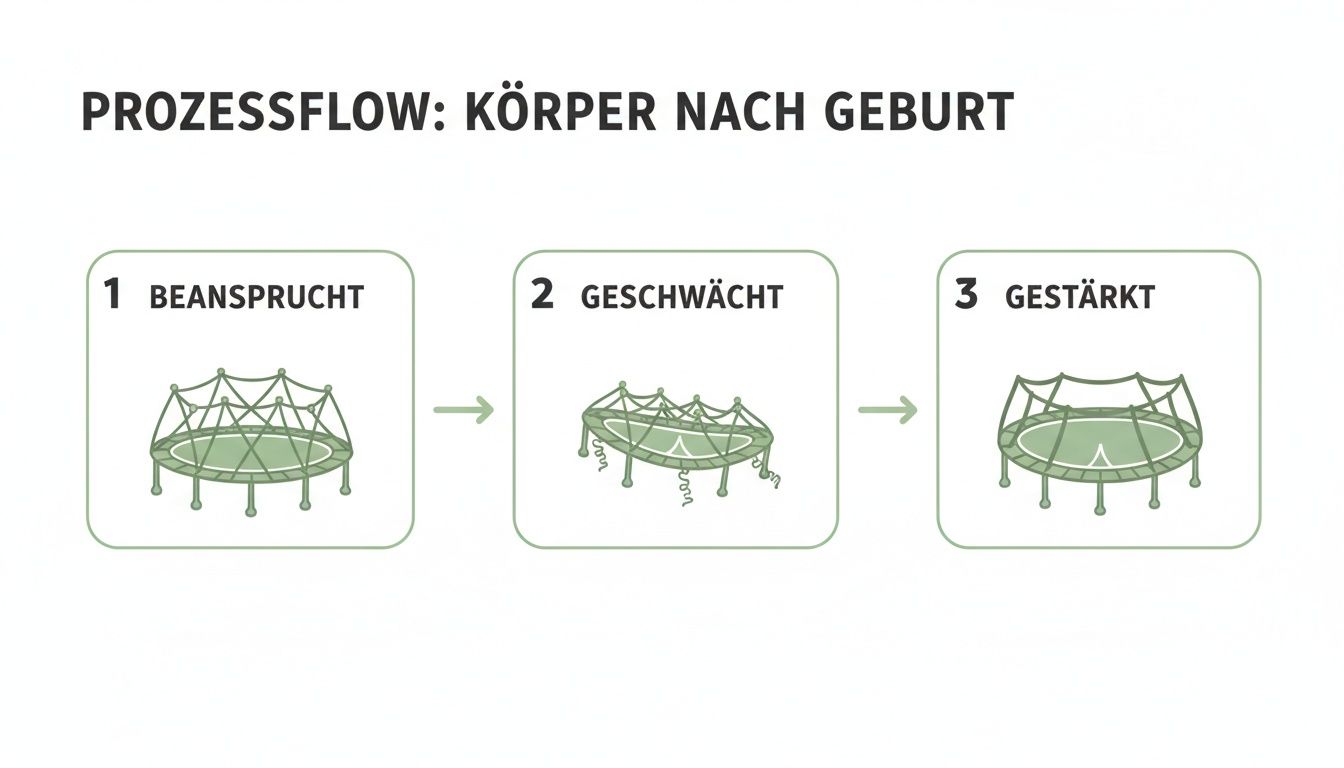
The trampoline analogy makes it clear: regression is not just about restoring the old state. It's about consciously strengthening your foundation - for a resilient and healthy future as a mother.
The selection of Postgraduate courses in Zurich is huge – so huge that it can almost overwhelm you. So that you don't lose track and make the best decision for you, we have put together a small checklist. Because the perfect course depends entirely on you, your needs and your current life situation.
The first thing you should do is take a close look at the qualifications of the course leader. Who leads the course? Is it a midwife, a specialized physiotherapist or a certified trainer with further training in the postnatal area? Each of these experts brings their own strengths.
For example, a physiotherapist can be the right choice if you are struggling with specific physical problems such as severe back pain or a severe diastasis recti. A midwife, on the other hand, often has an incredibly deep understanding of the entire period after birth, including topics such as breastfeeding or baby care.
The next item on the list: the type of course. Are you longing for a conscious break just for yourself or would you rather train together with your baby? Both have their advantages and disadvantages. A course without a baby gives you the valuable freedom to concentrate fully on yourself and your body.
A course with a baby is of course super practical because you don't have to organize any care. Sure, it can be distracting when your little one gets restless. Just think about what feels best for you and your current situation.
The location of the course has a decisive influence on the atmosphere. Large hospitals often offer structured, medically based courses. Smaller, specialized studios, on the other hand, usually create a more personal and communal atmosphere.
The provider itself also plays a role. Whether hospitals, birthing centers, freelance midwives or specialized studios – the offering in Zurich is really diverse. If you value a personal, almost familiar atmosphere, a studio could be just the thing for you. A great overview of various Pilates studios in Zurich and their focuses By the way, you can also find it here.
By the way, the high demand for qualified care after birth is no coincidence. Current figures show that outpatient postpartum care is steadily increasing in the canton. Qualified postnatal courses, which are often led by midwives, are an important pillar here and are supported by many health insurance companies.
And that brings us to the last, but by no means least important point: the costs. The good news is that many health insurance companies contribute to the costs of a postnatal course if it meets certain quality criteria.
It's best to look out for certifications like QualiCert. This label is a good sign that the course is recognized by most Swiss supplementary insurance companies. The safest way to go is to ask your health insurance company directly which providers and course formats they specifically subsidize. This way you avoid unpleasant surprises and can book the course that really suits you in a relaxed manner.
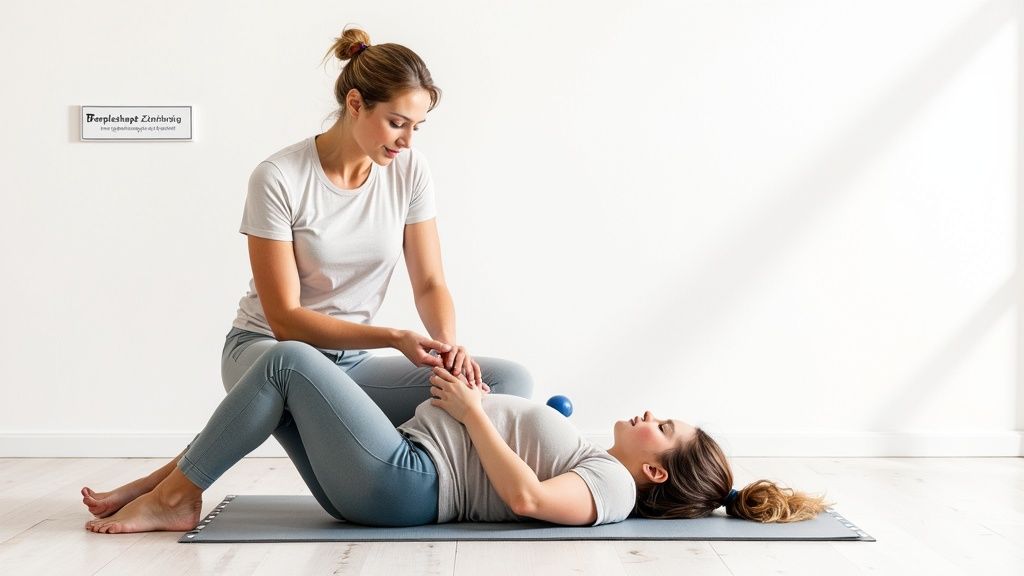
For us at Templeshape, recovery is much more than just doing a few exercises. It is a journey back to you, to your body feeling and your strength. We see it as an opportunity to not only make you physically strong again, but also to give you mental security and self-confidence for your new everyday life with a baby.
Our holistic concept is therefore based on three pillars that go hand in hand. Our goal? To provide you with sustainable results - a stable center that carries you through everyday life and that you can trust in the future.
In the heart of ours Postnatal courses in Zurich is an intelligent mix of methods that we have specifically tailored to the needs of your body after birth.
We weave these three building blocks into a flowing and highly effective workout that strengthens your body safely and sustainably.
Perhaps the most important factor in your success is the person who guides you. Our team consists of certified trainers who not only have enormous expertise in postnatal training, but are also mothers themselves. So you know the physical challenges and emotional rollercoaster rides from your own experience.
With us you can expect support full of empathy and real understanding. Our trainers sense exactly when you need a gentle boost of motivation and when you just need encouragement. They create a safe space in which you can let go and concentrate fully on yourself.
This mix of professional expertise and personal experience ensures that you always feel in good hands.
We know only too well: life with a baby is often anything but plannable. That's why we have developed various course formats that can be flexibly adapted to your needs.
Our courses take place in small groups, which guarantees intensive and personal support. If you would like even more individual support, our personal training is the perfect choice for you. Here we can specifically address your personal goals and any complaints such as diastasis recti.
But at Templeshape you'll find more than just training. You become part of a community of mothers who are in the same phase of life and support each other. The exchange between each other is an invaluable part of our company Postnatal courses in Zurich. If you're curious, just get to know us and the atmosphere in one Non-binding trial lesson at Templeshape know.
Facts and figures are one thing. But what really matters are the real stories of women who have been right where you might be right now. Nothing is more honest than your personal experiences.
Read for yourself what they say about ours Postnatal courses in Zurich tell. This will give you a feel for the atmosphere here and see what is possible with the right support. These are more than just nice words - they are proof that you are not alone with your feelings and goals. Get inspired. A strong, good body feeling after giving birth doesn't have to remain a pipe dream.
After a cesarean section, many women feel unsure how they can regain control of their core. That's what happened to Sarah, who came to us twelve weeks after the birth of her son. She had the feeling of being completely “cut off” from her abdominal muscles and was very worried about doing something wrong during training.
«I really had respect for the first hour. But the trainer immediately took away my fear. With very gentle breathing exercises and super precise instructions, I learned to reconnect with my deep abdominal muscles. That was an incredible aha moment. After eight weeks, my stomach not only felt tighter - above all, I had confidence in my body back."
Sarah's story perfectly illustrates how a specialized course makes all the difference after a belly birth. It's about having the right knowledge and guidance that makes you feel confident.
Julia came to us because she had been constantly struggling with lower back pain since the birth of her daughter. All the carrying and lifting made it worse every day and robbed her of an incredible amount of energy in her everyday life.
During the course, she quickly understood the connection: the pain came directly from her weakened core muscles and an inactive pelvic floor. Through the targeted mix of strengthening and mobilization, we were able to work directly on the cause.
Julia's success is a prime example of how postnatal recovery directly improves the quality of life by tackling typical "mommy aches and pains" at the root.
Sure, training is important. But for many of our mothers, the extras are just as important. The community in the course and the open exchange with other women in exactly the same phase of life are an invaluable support.
The course quickly becomes a fixed date of the week that is just yours and that you look forward to. Here you will find understanding, encouragement and often new friendships that last far beyond the course period.
You've already gotten a great overview of the world of postnatal recovery. But often it's the small, specific questions that are still floating around in your head. This is completely normal! Let's clarify the most common ones so that you can start with a really good feeling.
A cesarean section birth is a major abdominal operation, we must not forget that. Your body simply needs more time to heal here, and we fully respect that in training. Please give yourself and your scar something 10 to 12 weeksbefore you start a course. Very important: Get the okay from your gynecologist beforehand.
In the course itself we approach the whole thing very carefully. The initial focus is on protecting the scar and at the same time gently waking up the deep muscle layers. We leave out anything that puts direct pressure on the stomach. Instead, we work a lot with conscious breathing and fine control exercises to slowly and safely rebuild the connection to your body center.
Ah, the money question – super important and absolutely justified! The good news is: Yes, most Swiss health insurance companies contribute to the costs Postnatal courses in Zurich, usually through supplementary insurance. The magic word here is often QualiCert.
QualiCert is a quality label for health-promoting exercise offers. If a course has this seal, the chance of your additional insurance covering the costs is very high.
To be on the safe side, it's best to do this:
This means you have clarity about your finances right from the start and there are no unpleasant surprises.
Yes, absolutely! We often hear this concern, but it is unfounded. Breastfeeding and gentle postnatal training tailored to your needs are not a contradiction - on the contrary, they can complement each other perfectly. Moderate training has no negative impact on your milk production or the quality of the milk.
A little tip from practice: It's best to do your training immediately after a breastfeeding meal. Then your chest is a little emptier and training often feels more comfortable for you. Just listen to your body's signals, drink enough water and enjoy the exercise that is good for you.
Diastasis recti – that sounds like a complicated diagnosis at first, but it is something completely normal after pregnancy. Just imagine the gap created between the rectus abdominis muscles. The connective tissue in the middle (the Linea Alba) has been stretched considerably by your growing baby bump and now needs help to come together again.
Diastasis recti is a core topic in a good postnatal course. At the beginning we will look together to see whether and how severe the gap is in your case. You will then learn specific exercises that will help you close it again. The main thing is to activate the deep, transverse abdominal muscles. They work like an internal corset and gently pull the rectus abdominal muscles back together. By the way, classic crunches or sit-ups are absolutely taboo here - they would only increase the pressure in the abdominal area and even make the gap worse. Professional guidance is really crucial for success here.
By the way, the city of Zurich recognizes how important this issue is. It actively supports families and lists various course offerings in its guide that help thousands of mothers every year. Studies show that professional guidance reduces the risk of long-term consequences such as pelvic floor weakness by up to 40% can lower. More about the Offers for families on stadt-zuerich.ch you can read it directly there.
Are you ready to feel strong and comfortable in your body again? At Templeshape GmbH We accompany you on this path with expertise, empathy and a wonderful community. Find the right course for you and start your journey back to your center.
tags
Pelvic floor training Zurich, mother fitness Zurich, postnatal training, recovery after birth, recovery courses Zurich