No products in the cart.
January 8

Are you also faced with the big question: Pilates or yoga? Let me tell you right now: the answer is probably simpler than you think.
If you specifically target your Build muscleIf you want to shape a steel-hard core and improve your posture from the ground up, then Pilates is your path. On the other hand, if you are looking for a holistic approach, Flexibility, stress relief and focuses on the deep connection between body and mind, then yoga will be your anchor.
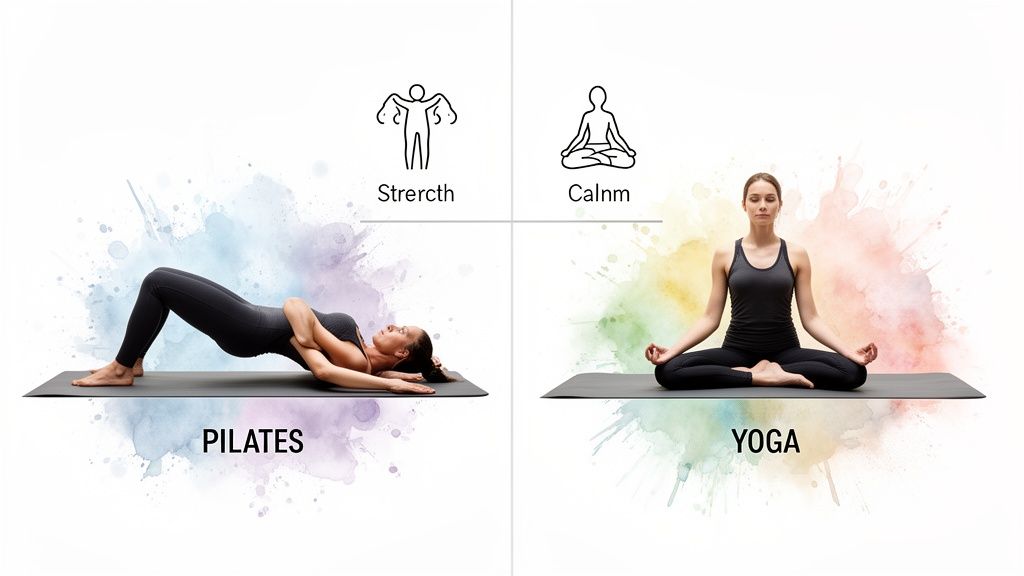
You are definitely not alone with this question. What once started as a niche trend has firmly established itself in the health and fitness world. Both disciplines promise you strength, flexibility and mental balance - but the paths to get there couldn't be more different.
This guide should be your personal compass. I'll take you by the hand and show you the subtle but crucial differences and also the similarities. In the end, you will find the method that not only suits your body, but also your lifestyle and your personal goals.
Mindful movement methods are booming. Not without reason: By 2035, the European market for Pilates and yoga studios will have a market share of 27 percent predicted. This enormous growth shows how much we are looking for holistic approaches in modern society - and especially in Switzerland.
Given over 150 million people In Europe struggling with psychological distress and the fact that more than half of the population is overweight, practices like Templeshape offer real solutions. They help you reduce stress and promote sustainable health. More about the You can find out about the market development of Pilates and yoga at researchnester.com.
So that you can get started straight away, I have summarized the most important points for you in a clear overview.
This table shows you the most important differences between Pilates and yoga so that you can compare the two methods quickly and easily. It's the perfect starting point to get a feel for which direction might be right for you.
| feature | Pilates | yoga |
|---|---|---|
| Main focus | Strengthening the deep muscles (core), precise movement control, improving posture. | connection of body, mind and breath; Flexibility, balance and inner peace. |
| origin | Developed in the early 20th century by Joseph Pilates for rehabilitation and strengthening. | Thousands of years old Indian teachings with philosophical and spiritual roots. |
| Breathing technique | Lateral chest breathing to stabilize the trunk during exertion. | Conscious, deep abdominal breathing (pranayama) to calm the nervous system and direct energy. |
| Flow of movement | Controlled, often repeated movements aimed at activating specific muscles. | Flowing transitions between held poses (asanas) that involve the whole body. |
| Typical equipment | Mat, reformer, Cadillac, Pilates ring and other small devices for support or resistance. | Mainly the mat; Blocks, straps and pillows are used to support the poses. |
| Spiritual aspect | Usually purely physical and aimed at functional fitness, but can have a meditative effect. | Often associated with meditation, mantras and philosophical teachings to promote mental well-being. |
As you can see, the devil is in the details. Pilates is more like a precise workout for your body, while yoga is a practice that engages your body and mind in equal measure. But that's just the tip of the iceberg. Let's delve deeper.
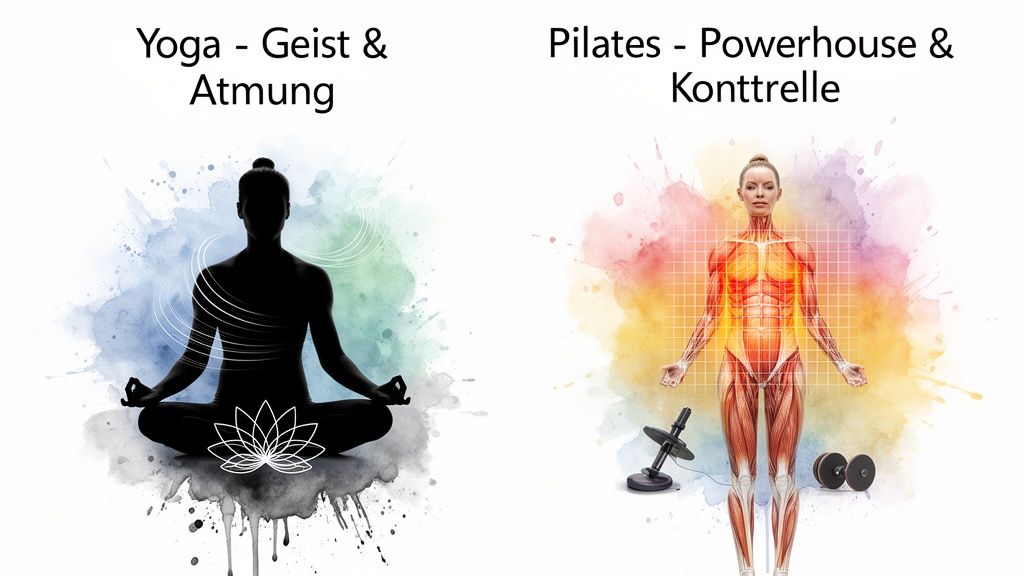
In order to really decide between Pilates and yoga, we have to start at the roots. These are exactly what characterize each individual exercise and are the reason why the two methods feel so fundamentally different. Their founding ideas come from completely different worlds.
Yoga is not just sport, but an Indian teaching that is thousands of years old. The big goal? To bring body, mind and soul into harmony. You can think of it as a holistic way of life that goes far beyond the mat.
In a typical yoga class at Templeshape you will feel exactly that. The focus is on the fluid interplay of movement, conscious breathing and mental letting go.
At its core, yoga is about connection. The physical postures that Asanas, are actually just a tool to calm your mind and arrive completely in the moment. Every single movement is consciously combined with the breath (Pranayama) synchronized.
Imagine holding a demanding position like Warrior II. Sure, your body is working at full speed, but your breathing flows calmly and deeply. In this moment, you not only strengthen your muscles, but also train your ability to remain calm under tension.
Yoga uses the body as a bridge to the mind. The physical practice serves the higher goal of finding inner peace, mindfulness and ultimately self-knowledge.
This spiritual dimension is probably the biggest difference to Pilates. While yoga allows you to look inward, Pilates directs your focus specifically outward - on absolutely precise execution and physical control. If you want to delve deeper into the quieter aspects, you can find out more in our post about Yin Yoga in Zurich.
In stark contrast to the ancient tradition of yoga is Pilates, a relatively new method developed in the early 20th century by Joseph Pilates. His original goal was to help injured dancers and athletes rehabilitate.
This therapeutic origin still shapes Pilates today. It is an analytical, precise and extremely controlled full-body workout. The focus is unmistakably on strengthening your core, the so-called “Powerhouse”.
This powerhouse is more than just your stomach. It includes:
In a Pilates class at Templeshape you will be instructed to start every movement from this strong center. Take an exercise like The Hundred: not only will you feel your abs burn, but you'll learn to rock-solidly stabilize your entire core while your arms and legs move.
What counts here is the quality of execution, not the number of repetitions. This intense focus on control and precision makes Pilates an incredibly effective workout for healthy posture and a body that is strengthened from the inside out. The mental effect? It is created here by the intense focus that leaves no room for distracting thoughts.
If you want to choose between Pilates and yoga, you need to understand how each specifically affects your body and mind. They both shape you, but in fundamentally different ways. Let's take a closer look so you know exactly what to expect.
The choice ultimately depends on what you are looking for: targeted muscle building for a strong core or holistic flexibility for your entire body. Both paths lead to the goal, but use a completely different map.
When it comes to muscles, Pilates and yoga have two completely different philosophies. You could say: Pilates is the precise sculptor for your deep muscles, while yoga builds functional strength for your entire body.
In Pilates the focus is clearly on strengthening yourself “Powerhouse” – i.e. your deep core, pelvic floor and back muscles. Every single exercise is carried out slowly, controlled and with maximum concentration in order to hit exactly these stabilizing muscles. Imagine the “leg circle”: your core remains rock solid on the ground while only your leg moves. That is Targeted strength building from the inside out.
Yoga, on the other hand, builds strength by holding positions (asanas) for several breaths. Think of the “Warrior II” or the “Plank”. Here your whole body has to work together as a unit to stabilize your posture. This kind of power is extremely functional – it makes you fit for the movements of everyday life. The muscles are not addressed in isolation, but rather learn to work as a team.
One key difference: Pilates connects your mind to the body through control, while yoga connects your mind to the body through breathing.
But sometimes the boundaries blur and exciting hybrid forms emerge. If you're curious about how you can combine the best of both worlds, take a look at our article on Fusion workout Yogalates.
Both disciplines will massively improve your posture, but they do it for different reasons and with different focuses. Pilates corrects your posture primarily by strengthening your core. Strong deep muscles automatically straighten your spine and act like an internal corset against poor posture.
Yoga, on the other hand, promotes flexibility of the entire body through dynamic stretches and long holding poses. The aim here is to loosen sticky fascia and increase the range of motion of your joints. The result is a supple, upright posture that arises from newfound mobility.
A small example from practice:
Here we come to perhaps the most profound differences. Both practices can be absolutely meditative, but their mechanisms are different. Yoga uses very specifically Pranayama (breathing techniques) and meditation to directly calm your nervous system. Conscious, deep breathing activates the parasympathetic nervous system – your “calm nerve” – which leads to immediately noticeable relaxation.
Pilates achieves a mental state of calm in a different way: through extreme concentration. Every movement requires your full attention. You pay attention to your breathing, the position of your ribs and the activation of exactly the right muscles. There is simply no room for distracting everyday thoughts. This state is often described as “moving meditation”.
Both methods help you become more present and mindful. The mental effects often include a more balanced cortisol level. If you are passionate about this topic, you can read more about it here Reduce stress naturally and find inner balance lets. The choice therefore depends on whether you are looking for relaxation through conscious breathing and spirituality or through focused body control.
The decision between Pilates and yoga rarely depends solely on the method. Rather, it's about your individual goals and what your everyday life demands of you. Both disciplines are incredibly powerful, but they show their strengths in different scenarios. Let's find out together which practice is for you now is exactly the right one.
Your body and your mind actually give you the best clues. It's just a matter of listening carefully and choosing the practice that not only gives you a good workout, but also the right answer to your current needs.
Do you sit at your desk a lot? Then you probably know all too well the feeling of tense shoulders and that nasty pulling sensation in your lower back. Right here is Pilates is often the more direct and effective solution. The reason for this lies in the core focus of the method: the targeted strengthening of your “powerhouse”.
Through precise exercises that activate your deep abdominal and back muscles, you essentially build an inner support corset. This relieves the strain on your spine and corrects poor posture that occurs when you sit for hours. Every Pilates class at Templeshape is like a reset button for your posture.
Does your head often feel full and you long for real inner peace? In this case it is Yoga, with its holistic approach, is usually the better choice. Yoga aims to actively calm your nervous system, making it a powerful tool against stress.
By consciously combining movement and deep breathing (pranayama), you activate the parasympathetic nervous system - this is the part of your nervous system that is responsible for relaxation. A regenerative Yin yoga class at Templeshape can help you release deep-seated tension and calm your mind.
Pilates calms your mind by focusing on the body. Yoga calms your mind by connecting with your breath and soul. Choose the path that feels more intuitive to you.
This infographic will help you make a quick decision based on your primary goal.
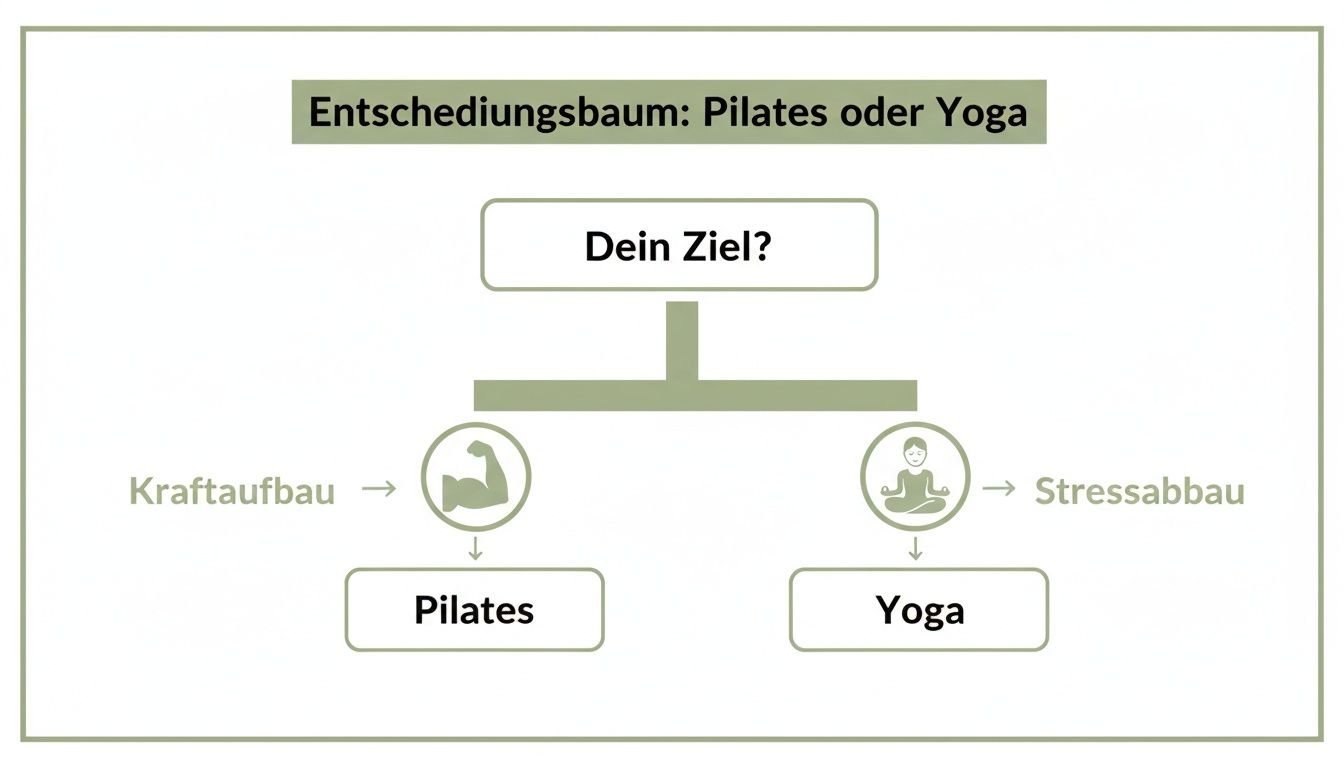
The tree illustrates the core difference: If you are primarily concerned with physical strength and stability, the path leads to Pilates. If, on the other hand, you are looking for relaxation and mental balance, yoga is often the more direct path.
Are you already active in sports, be it running, strength training or team sports? Super! Then both disciplines can serve as intelligent balancing training for you, but with different advantages:
The fitness industry in Switzerland is constantly growing, which underlines the need for such specialized training methods. The end of 2022 was already 13.2 percent of the Swiss population registered in a fitness center. This is a significant increase compared to the end of 2021, when it was 11.9 percent - with an average age of 40 years. More exciting You can find insights into the Swiss fitness industry at fitnessmanagement.de.
After pregnancy, strengthening your pelvic floor and deep core muscles is absolutely essential. Here is Pilates is the method of choice. The precise and controlled exercises are ideal for rebuilding your core safely and effectively without overtaxing your body.
Yoga can be a wonderful addition later to get you back into a gentle flow of movement and to strengthen yourself mentally. At Templeshape, we offer special courses tailored to these needs as part of our Motherhood Club. The decision between Pilates or yoga is often just a question of the right timing.
Maybe after all the information you already feel a clear tendency as to whether your heart beats more for Pilates or yoga. Super! Then now is the perfect moment to take the next step and see what your path with us in the Health Temples CITY and AIRPORT could look like.
Templeshape is not about pressure or competition. It's about feeling comfortable in your skin and anchoring exercise as something positive in your life. Our atmosphere is intentionally supportive and friendly - we give you exactly the structure and motivation you need to stick with it.
Wir wissen, dass "yoga" und "Pilates" riesige Überbegriffe sind. Deshalb haben wir ganz unterschiedliche Kursformate entwickelt, die auf verschiedene Bedürfnisse und Ziele zugeschnitten sind. So findest du garantiert den Stil, der zu deiner aktuellen Energie und Stimmung passt.
Here is a little insight into our most popular courses:
A training plan that works in the long term and is fun for you relies on variety. Your body loves new stimuli in order to develop further and stay healthy. That's exactly why you can ideally combine Pilates and yoga with our other offers at Templeshape.
This way you create a perfect balance of strength, endurance, mobility and regeneration. So you don't have to choose one or the other - just get the best of all worlds. If you're still unsure how to get started, check out our guide Trial Pilates lesson in Zurich to. He takes you by the hand.
Your body is not designed for monotony. Combining different training methods is the key to preventing injuries, breaking through plateaus and staying motivated in the long term.
For example, imagine a week in which you cover all the important building blocks for your holistic well-being.
This plan is just a suggestion, but it shows how you can cleverly link the different elements to get the most out of it.
Ein solcher Rhythmus sorgt dafür, dass du deinen Körper forderst, ohne ihn zu überfordern. Du baust Kraft auf, bleibst geschmeidig und gibst deinem Geist den Raum, den er zum Entspannen braucht. Genau das ist es, was wir bei Templeshape mit "Make Health Your Habit" meinen.
You now have a good overview of the big differences, but often it is the small, practical questions that ultimately determine the decision between Pilates or yoga. Here are the answers to what our community at Templeshape is most concerned about.
Good news: Both disciplines are fantastic for getting started. It really just depends on what you hope to get out of your first class.
Pilates is often a more logical start for you if you like a clear, fitness-focused approach. The instructions are super precise, almost like personal training. From minute one you will learn how to specifically build your strength and get a better feeling for your body.
yoga may feel gentler for you if your focus is more on mental balance and more flexibility. Classes like Hatha Yoga are ideal for beginners because they focus on basic postures and calm, conscious breathing - perfect for getting started.
A very clear one No. This is one of the biggest myths that unnecessarily discourages many from even getting started. Flexibility is not a requirement, but rather the result of your practice - whether it's Pilates or yoga.
Flexibility is like strength – it is trained. You don't just go to the gym when you're already strong. Just come exactly as you are.
In every Templeshape course, our trainers show you alternatives and modifications for each exercise. This way you can adapt everything to your current level. It's about feeling your body, not forcing it into a shape.
A little caution is required here, and a check with your doctor is always a good idea before you get started. In principle, however, there are clear tendencies:
Pilates is often recommended for rehabilitation after back injuries. The reason is simple: It specifically strengthens the deep, stabilizing muscles around your spine. A strong “powerhouse” is the best shield against many types of back pain.
yoga can also be extremely beneficial for relieving tension in the back and making the spine more mobile again. The important thing here is to choose a gentle yoga style and avoid poses that could put pressure on your lower back. An experienced yoga teacher is worth his weight in gold here and will guide you safely through the practice.
Bist du bereit, deine ganz persönliche Antwort auf die Frage "Pilates oder yoga" zu finden? Das Tolle ist: Bei Templeshape you don't have to commit yourself forever. Just try both and feel for yourself what your body and mind need right now. Visit us https://Templeshape.com and start your journey to better health and well-being.
tags
holistic training, pilates or yoga, Pilates Zurich, templeshape, yoga Zurich