Pilates is more than just a workout - it's a path to a stronger, more flexible and more conscious body. But getting to the studio isn't always easy, especially with a busy schedule in Zurich. The good news: You don't need expensive equipment or a lot of space to experience the transformative power of Pilates. With the right ones Pilates exercises at home You can transform your mat into your personal studio, train your body effectively and create mental balance.
This comprehensive guide is your key to a successful home practice. We focus on the eight most fundamental exercises that form the heart of every Pilates routine, from “The Hundred” to “Shoulder Bridge”. Not only will you receive detailed step-by-step instructions, but also practical variations for every fitness level, whether you're just starting out or want to refine your technique.
We'll also show you how you can combine these exercises into short but highly effective routines of 10 to 30 minutes that can be seamlessly integrated into your everyday life. Safety is our top priority, which is why we give you specific tips to avoid injuries and ensure correct execution. Pilates is an excellent way to strengthen your posture. In addition to the exercises presented here, there are also other effective and simple ones Exercises to improve posture, which you can also integrate into your everyday life.
Whether you are a working person looking for balance, a mother who wants to get fit again after pregnancy, or an athlete who wants to specifically strengthen your core muscles: This article gives you everything you need for successful training. Let's start together and roll out the mat.
1. The Hundred (The Hundred)
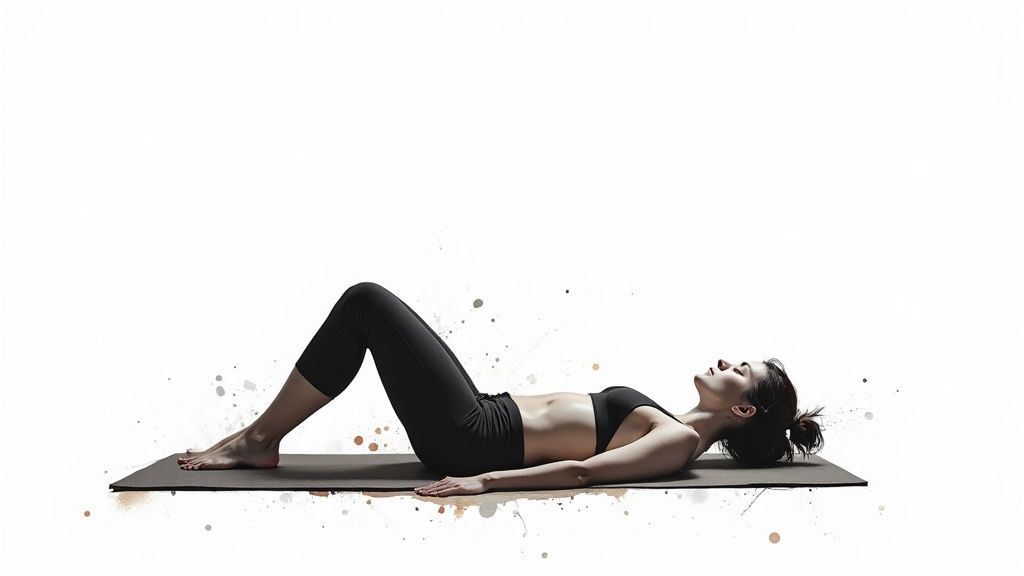
The Hundred, or 'The Hundred', is not only one of the most well-known Pilates exercises, but an absolute classic for your Pilates training at home. It serves as the perfect core warm-up, as it stimulates circulation, activates the deep abdominal muscles – the so-called powerhouse, the centerpiece of every Pilates practice – intensively and consciously activates a powerful Pilates breathing promotes. The exercise consists of 100 powerful arm movements while your Torso and your legs are stabilized, which awakens the entire body and prepares for the subsequent Pilates exercises at home prepares.
1.1. The 100: The ultimate core warm-up
The basic idea is simple, but execution requires concentration and precision (a Pilates principle). It's about not just completing 100 beats, but controlling every movement.
- Starting position (supine): You lie on your back, legs either at a 90-degree angle (tabletop) or stretched at a 45-degree angle to the ceiling. Lift your head and shoulders off the floor to activate the upper abdominal muscles.
- Arm activation: The arms are extended long beside the body and move in small, quick pumping movements from the shoulder up and down.
- The 100 breathing: At the same time, you breathe controlled: for five pump movements inhale and for five pump movements exhale. This cycle is repeated ten times, leading to the eponymous 100 arm beats leads.
1.2. Practical tips for correct execution
To get the most out of this exercise and avoid injuries, consider the following points:
- Activate powerhouse: Pull your navel firmly towards your spine to protect and keep the lower back on the mat. Imagine you are putting on tight jeans and closing the zipper – this deep tension is your powerhouse.
- Relieve neck: Keep your gaze directed towards your abdominal wall. The distance between chin and chest should be about a fist width. If you have neck tension, you can rest your head in between or place a hand on the back of your head for support.
- Breathing as the engine: The Pilates breathing controls the movement. Breathe deeply into the chest (laterally) to keep the powerhouse activated.
- Relax shoulders: Actively pull the shoulder blades away from the ears to avoid tension in the shoulder-neck area. Imagine your shoulders melting back and down on the mat.
Variations for every fitness level
The Hundred can be perfectly adapted to your current level:
- For beginners: Start with feet on the mat or with legs at a 90-degree angle in tabletop position (Tabletop). If 100 repetitions are too much at the beginning, start with 50 and gradually increase. A great alternative for beginners is also Wall Pilates, where the wall serves as support. Learn more about the basics in our guide for Pilates beginners or book a trial Pilates class in Zurich.
- For advanced: To increase intensity, lower the extended legs further towards the floor without the lower back losing connection to the mat. Another increase is the use of Pilates wrestling or light weights in your hands.
2. The Roll-Up
The Roll-Up is a fundamental Pilates exercise that impressively combines spinal flexibility and abdominal strength. It is a flowing, controlled movement in which you roll your spine up and down from the floor, vertebra by vertebra.
This exercise stretches the entire back of the body, especially the hamstrings and back, while intensely engaging the deep abdominal muscles. As one of the central Pilates exercises at home it trains body awareness and control like no other.
This is how the role works
The reel is about precision and flow, not speed. You start lying on your back with your legs straight and your arms stretched above your head. From there, bring your arms forward, lift your head and slowly and controlledly roll up, vertebra by vertebra, into a sitting position where you bend forward over your straight legs. Then roll back to the starting position in the same controlled manner.
Practical tips for correct execution
Clean technique is crucial to get the full benefit of the exercise and protect your back:
- Working vertebra by vertebra: Concentrate on consciously releasing each individual vertebra from the mat and putting it down again. Imagine your spine is a string of beads where you place each bead one at a time.
- Keep feet on the ground: Actively press your heels into the mat to prevent your legs from lifting off as you roll up.
- Breathing as guidance: Inhale to prepare for the movement. Exhale as you slowly roll up and down. Breathing supports the activation of the powerhouse.
- Shoulders remain relaxed: Be careful not to pull your shoulders toward your ears, especially in the upright and hunched over positions.
Variations for every fitness level
The role is demanding, but can be easily adapted to your personal level:
- For beginners: If your abdominal strength is not yet sufficient or the backs of your thighs are shortened, start with your knees bent and your feet planted. You can also lightly hold onto your thighs to help you roll up and down. Another help is a small pillow under the lower back.
- For advanced: To increase the challenge, you can hold a Pilates ring or thera band between your hands. This requires more stability in the upper body. The conscious connection between mind and movement is central here, a principle that also plays a major role in Somatic Pilates. Learn more about this mindful approach in our article on Somatic Pilates and the revolution of your fitness.
3. The Swan
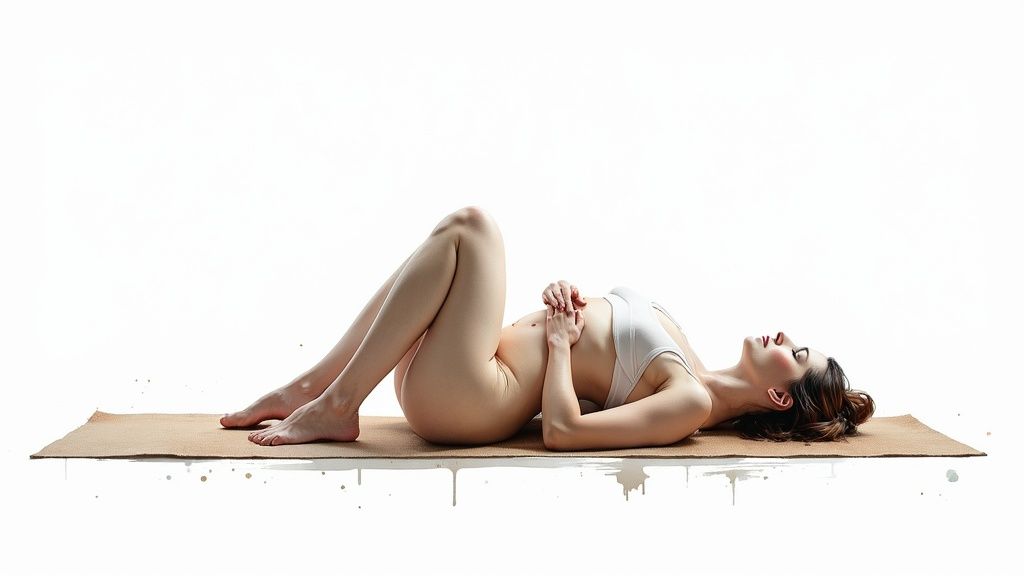
The Swan, in English 'The Swan' called, is a fundamental one Backbend in Pilates, which specifically targets the Extension of the spine promotes. As a countermovement to the many bending postures in our everyday lives (such as sitting at a desk), this exercise opens the entire front of the body. It strengthens them Back muscles and improves yours posture sustainable. The swan is one of the essential ones Pilates exercises at home, to to prevent back pain and to cultivate an upright, confident posture. The movement comes primarily from the upper back muscles, not the lower back, which is important for the Stability of the spine is crucial.
3.1. This is how The Swan works
This exercise focuses on controlling the movement of your upper body.
- Starting position (prone position): You start lying on your stomach, your forehead resting gently on the mat. The hands are placed flat next to the shoulders, the elbows close to the body. The legs are stretched.
- Sitting up (inhalation): Inhale and slowly lift your head, chest, and upper back off the mat, gently supporting yourself with your hands. The gaze moves forward without overextending the neck.
- Lowering (exhalation): As you breathe out, you return in a controlled manner Whirl by whirl return to the starting position. Make sure that you primarily move from the top Back muscles initiate.
3.2. Practical tips for correct execution
Clean technique is crucial to get the full benefit of the exercise and lower back to protect:
- Activate powerhouse: Pull that belly button firmly to the spine, around the lower back to stabilize throughout the movement. This protects your lumbar spine from overload.
- Keep your neck long: Imagine that your neck is the natural extension of your neck Spine. Avoid throwing your head back - mentally balance a book on your head so that it doesn't fall down.
- Relax shoulders: Actively pull your shoulder blades down and back, away from your ears. This creates space and prevents Tensions in the neck area.
- Breathing as guidance: Use that inhalationto lift you up and create length, and the exhalationto lower yourself again in a controlled manner.
3.3. Variations for every fitness level
The swan can be easily adapted to your individual needs and fitness level:
- For beginners (Baby Swan): Only lift your head and chest slightly and keep your forearms on the floor. Concentrate fully on getting the movement out of the upper back to initiate without putting much pressure on the hands.
- For advanced users (Swan Dive Prep): To increase intensity, fully extend your arms as you lift your upper body. Make sure your hips stay firmly on the mat and the Abdominal tension doesn't let up.
4. The scissors (Scissors): Intensive core training for your core stability
The scissors, in English 'Scissors' called, is a classic Pilates exercise, which targeted the depth abdominal muscles, especially the lower abdominal muscles. At the same time it promotes Stretching and flexibility of the Hamstrings and improves it Pelvic stability. This dynamic exercise demands control and precision and is an integral part of many Pilates exercises at home, as it can be carried out without any accessories and is highly effective. As with many exercises in matwork training, the constant Abdominal tension the key.
4.1. This is how the scissors work
The scissors is a rhythmic, scissor-like movement controlled from the powerhouse.
- Starting position (supine): You lie on your back, lifting your head and shoulders slightly off the floor. The legs are stretched towards the ceiling, the hands lightly support the upper leg.
- The scissor movement: Pull one leg towards your upper body in a controlled manner (hamstring stretch) while simultaneously lowering the other leg towards the mat.
- Rhythmic change: Continue this scissor-like movement rhythmically and alternately. The upper body remains slightly raised to keep the abdominal muscles under constant tension.
4.2. Practical tips for correct execution
To maximize the effectiveness of the scissors and ensure correct posture, pay attention to the following details:
- Abdominal tension is everything: Pull your belly button firmly toward your spine lower back (Lumbar spine) to keep stable on the mat. Important: Avoid a hollow back, especially when the leg is lowered.
- Control before speed: Carry out the movement slowly and in a controlled manner. It's not about moving your legs quickly, but rather the movement with precision powerhouse to control.
- Breathing as a pacemaker: Exhale as one leg is drawn towards the body and inhale as the legs switch. An even breathing rhythm supports flowing movement.
- Relax your neck and shoulders: Keep your head in line with your spine. If you have neck problems, you can also leave your head on the mat
4.3. Variations for every fitness level
The scissors can be easily adjusted to your personal fitness level, so everyone can benefit from this exercise:
- For beginners: Start with your knees slightly bent to... Back of thighs to relieve. Lower your bottom leg only as far as you can lower back keep it stable on the ground. Alternatively, you can place your hands under your buttocks for support.
- For advanced: To increase the challenge, lower the bottom leg deeper toward the floor without losing back contact with the mat. You can also do the exercise without supporting your hands on your legs and keeping your arms long next to your body, which provides additional support Core stability requires.
5. The Circle: Improved hip mobility and core stability
The circle, also known as 'The Circle' or 'One Leg Circle', is a seemingly simple but extremely effective Pilates exercisethat improves your mobility hip joints improved and at the same time the Core muscles intensively demanding. It aims to stretch the hip flexors thigh muscles to strengthen and stabilize the deep abdominal and back muscles. This exercise is a prime example of how Pilates combines movement and stability and is therefore one of the fundamental exercises Pilates exercises at home. The challenge lies in this Pelvic control.
5.1. This is how The Circle works
In this exercise, the leg is moved isolated from the hip joint while the torso remains firmly anchored.
- Starting position (supine): You lie on your back with one leg stretched towards the ceiling while the other is bent or stretched on the mat.
- The circular movement: The extended leg draws in a controlled manner Circles into the air, first in one direction, then in the other. The size of the circle is determined by the control of your torso.
- Torso control: The central requirement is the upper body and that pool to remain completely still and stable on the mat throughout the entire movement. Only the leg moves isolated from the hip joint out of here.
5.2. Practical tips for correct execution
To perform the exercise correctly and safely, you should pay attention to the following details:
- Stabilize torso: Activate yours powerhouseby gently pulling your belly button toward your spine. The pool should not move from side to side to avoid the Lumbar spine to protect.
- Controlled movement: Do the circles slowly and consciously. It's not about painting the largest or fastest possible circles, but rather about the movement control.
- Use breathing: Inhale as you draw the semicircle down and out, and exhale as you close the circle and bring the leg back to the center.
- Keep hips grounded: Both hip bones should remain evenly on the mat throughout the entire exercise. Imagine your hips are weighted down to hold them to the ground.
5.3. Variations for every fitness level
The circle can be ideally adapted to your individual needs:
- For beginners: Start with very small, controlled circles (like the size of a plate) to get a feel for the Stability in the core to get. You can also leave the non-working leg propped up to accommodate this lower back to give more support.
- For advanced: Gradually increase the radius of the circles, but only as far as you can Stability in the pelvis and can hold your upper body. To intensify the stretch in the back of the leg, you can actively press the leg lying on the mat into the floor.
6. The Bridge (The Bridge / Shoulder Bridge)
The Bridge, also known as Shoulder bridge, is a fundamental one Pilates exercise, which specifically strengthens the entire posterior muscle chain. It is particularly effective for strengthening gluteal muscles (Gluteus), the Hamstrings and the lower back. At the same time it mobilizes them Spine and improves stability in the core, making it an ideal exercise to to improve posture and to prevent back pain. As one of the most versatile Pilates exercises at home It promotes strength, mobility and your body awareness.
6.1. This is how the bridge works
Here is the smooth process of bringing the joints into a straight line:
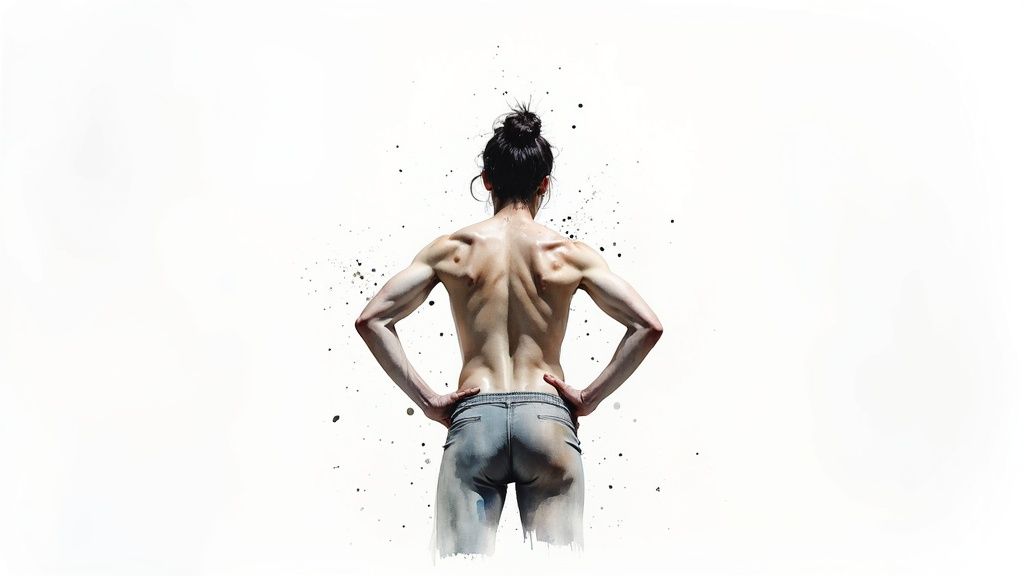
- Starting position (supine): You lie on your back with your feet hip-width apart and your knees pointing towards the ceiling. The arms lie relaxed next to the body.
- Roll up (exhale): As you exhale you tense it glutes and lift the pelvis Whirl by whirl from the floor until your body forms a straight line from shoulders to knees.
- Lowering (inhalation): At the top, hold the position briefly (focus on the tension in your buttocks) and then roll slowly and in a controlled manner while inhaling Whirl by whirl off again.
6.2. Practical tips for correct execution
Make sure you use clean technique to get the maximum benefit from the exercise and avoid stress errors:
- Initiate movement from the buttocks: Focus on that glutes tense to raise the pelvis. Avoid taking the power out of it lower back pick up.
- Articulate spine: Imagine removing each individual vertebra from the mat one by one and putting it back down again - like a Velcro fastener, which you open and close slowly.
- Keep shoulders relaxed: Keep your neck and shoulders relaxed on the floor throughout the entire exercise. The weight rests on the shoulder blades, not on the neck.
- Stable knee position: Make sure your knees remain hip-width apart and parallel throughout the movement.
6.3. Variations for every fitness level
The bridge can be easily customized to make it simpler or more challenging:
- For beginners: Start by lifting your pelvis just slightly and holding the position static for a few breaths before lowering it back down. Concentrate fully on activating the glutes.
- For advanced: In the bridge position, lift one leg straight towards the ceiling. Keep your pelvis stable and parallel to the floor. Perform small lowering and lifting movements with the pelvis (pulse). Who his Deepen your Pilates practice would like to find in ultimate guide to Pilates in Zurich further suggestions and course offerings.
7. The Side-Lying Series
The side lying series is a powerful sequence that is often underestimated, but for a holistic Core strength is essential. She specifically targets them lateral abdominal muscles, the Hip stabilizers (especially the one Gluteus medius) and the outside of the thighs. These muscle groups are crucial for good attitude, a stable pelvis and the prevention of back pain and even Knee problems. As an integral part of many Pilates exercises at home This series ensures balanced strengthening of the entire body and shapes a slim, defined waist.
7.1. This is how the side position series works
The Side Lying Series requires a stable starting position and isolated leg movements.
- Starting position (side lying): You lie stable on one side, supported on your forearm or with your head on the outstretched lower arm. Your Torso remains tense throughout the exercise and the body forms a long, straight line.
- The movements: From this stable base you perform various leg movements. Examples include the controlled raising and lowering of the upper leg (Side leg lifts), circular movements (Lay circles) or back and forth swings (Front and back kicks).
- Focus on isolation: The aim is to make the movements precise and exclusively from the hip joint to control without affecting the rest of the body - especially yours pool – tilts or moves.
Practical tips for correct execution
To achieve the maximum effect and ensure clean technique, you should pay attention to the following points:
- Keep your torso stable: Activate yours powerhouseby pulling your belly button toward your spine. Imagine there was a small gap from the mat under your waist to prevent sinking - a small mouse could pass under it.
- Quality over quantity: It's not about lifting the leg as high as possible, it's about the movement controlled from the Hip to lead. A smaller one, more precise movement is more effective than an uncontrolled swing.
- Hips on top of each other: Make sure your Hips stacked exactly on top of each other remain. Avoid tilting forward or backward as this will strain the target muscles (Gluteus medius) relieved.
- Both sides train: Perform the entire series of exercises on one side before switching to the other. An equal training of both sides is for the muscular balance essential.
Variations for every fitness level
The side position range can be easily adjusted to your personal fitness level:
- For beginners: Start with a smaller amplitude of movement. You can also bend your bottom leg to create a more stable base to accomplish. Start with 8-10 repetitions per movement per side and concentrate fully on correct execution.
- For advanced: To increase the intensity, you can Resistance band place around your thighs or ankles. Also Foot weights increase the level of difficulty significantly. Also vary the pace of the movements: do them slowly and in a controlled manner once and then do them a little more quickly in another round.
8. The abdominal rollup/criss cross
The Criss Cross, often considered the dynamic climax of an abdominal series, is a powerful exercise that goes far beyond the rectus abdominis. It combines an upper body rotation with a leg movement, similar to cycling, and targets intensely oblique abdominal muscles (Obliques) away. This exercise not only improves strength Torso, but also promotes the coordination and the Rotational stability the spine, making it one of the most effective Pilates exercises at home might. It requires clean, precise technique, controlled by you powerhouse.
8.1. This is how the Criss Cross works
This exercise requires precise coordination of the upper body and legs.
- Starting position (preparation): You lie on your back, your hands loosely behind your head, your legs in the table position (Tabletop). Lift your head and shoulders off the floor.
- The rotation: Alternate bringing one elbow to the opposite knee while extending the other leg forward. The movement is fluid and controlled.
- Drive: The rotation is caused by the force of the lateral abdominal muscles (Obliques) driven. Make sure the rotation is out of the waist and that chest comes, not by pulling on the head.
Practical tips for correct execution
To maximize the effectiveness of the Criss-Cross and protect the neck, the following points are crucial:
- Rotation from the chest: The rotation should come from the waist and chest. Imagine your shoulder moving toward your knee, not just your elbow.
- Keep the pelvis stable: The pool and the lower back remain stable and firm on the mat throughout the entire exercise. Avoid rocking back and forth.
- Maintain abdominal tension throughout: Pull that belly button firmly to the spine to ensure that powerhouse to keep it activated and protect your back.
- Keep neck neutral: The hands only serve as light support for the head. Keep your neck long and your gaze slanted upwards.
Variations for every fitness level
The Criss-Cross is demanding, but can be easily adapted to your personal fitness level:
- For beginners: Start with a slower movement to coordination to learn. Extend the leg higher towards the ceiling instead of flat on the floor to achieve the lower back to relieve.
- For advanced: To increase intensity, perform the movement even slower and more controlled to increase muscle tension. Lower your straight leg further to the floor without letting your back leave the mat. Take a short break at the end point of each rotation Rotational stability to maximize.
8 Pilates exercises in comparison
Exercise
| Implementation effort 
| Resource requirements 
| Expected results 
| Ideal use cases 
| Key Benefits 
|
|---|
The Hundred
| Low–Moderate; Breathing and neck coordination required
| Very low; Mat; short (1–2 minutes)
| Core activation, improved breath control, endurance
| Warm-up before Pilates, short core session, at home
| Effective warm-up; activate deep abdominal muscles
|
The Roll-Up
| Moderate; requires slow, controlled spinal movement
| Small amount; Mat; time-consuming, slow execution
| Improved spinal flexibility, stretching the back
| Mobility and flexibility sequences, Pilates classes
| Promotes spinal flexibility; combines stretching and strengthening
|
The Swan
| Moderate; Be careful if you have back or shoulder problems
| Small amount; Mat; Space required in prone position
| Strengthening back muscles, improving posture
| Posture correction, compensation for bent-over exercises
| back strengthening; Posture improvement
|
Scissors
| High; High body control and neck stability required
| Very low; Mat; high intensity
| Intense abdominal training, improved leg coordination
| Short-intensive core workouts, fitness training
| time saving; very effective abdominal training
|
The Circle
| Moderate; good hip control and stability required
| Small amount; Mat; optional padding
| Improved hip mobility, outer thigh strengthening
| Hip mobility, balance training, rehabilitation adjunct
| Targeted hip work; improves balance
|
The Bridge (Shoulder Bridge)
| Moderate; Correct hip and shoulder alignment is important
| Small amount; mat
| Glute and hamstring strength, increased hip stability, back relief
| Strength building for glutes/hamstrings, back pain prevention
| Strong glutes training; reduces back pain
|
Side-Lying Series
| Low–Moderate; many variations, coordination required
| Small amount; mat
| Strengthening the outer thighs, improving lateral trunk stability
| Knee pain prevention, targeted hip stability, rehabilitation
| Trains neglected muscle groups; easily modifiable
|
Abdominal rollup/criss cross
| High; strong core muscles and clean technique required
| Small amount; mat
| Intensive strengthening of the obliques, improved rotational stability
| Advanced core sessions, sport-specific rotation
| Very effective for obliques; rotational stability
|
9. Your path to a sustainable practice: This is how it continues
You now have a comprehensive insight into eight basic and effective ones Pilates exercises at home receive. From the activating power of 'Hundred' to the precise Trunk rotation des 'Criss Cross' - you now have the knowledge to create a powerful and balancing Pilates routine to establish directly in your living room. This is more than just a list of moves; it's your personal toolbox for one stronger torso, one improved posture and an increased one Body awareness.
However, the true magic of Pilates does not unfold in a single, perfect training session, but through the power of Repetition and the continuous refinement. How Joseph Pilates once said: "It's not what you do, it's how you do it." True change comes when you choose Consistency instead of choosing perfection.
9.1. Concrete steps for your home practice
The transition from theory to practice can be challenging. So that you not only stay inspired, but also take action, we have put together concrete, actionable steps for you:
- Start small but consistently: Choose only three to four of the ones presented Pilates exercises out, which feel best for you. Instead of planning a one-hour session, start with a short, realistic 15-minute routine. An example could be: 1 minute hundred, followed by 8-10 repetitions each of bridge, scissors and swan.
- Focus on quality, not quantity: Concentrate on each individual repetition on the precise execution and the activation of the deep abdominal muscles. A slowly and controlled executed roll is far more valuable than ten quick, jerky attempts. Breathe consciously and connect the Pilates breathing with the movement – this is the heart of the method.
- Create your space: Set up a small, dedicated corner in your home that you use exclusively for your Pilates practice use. A rolled-out mat can serve as a visual anchor, gently reminding you to take this valuable time for yourself.
- Listen to your body: Respect your body's signals – this is the key to a long-term injury-free practice. For holistic support of your Pilates practice is also a balanced and healthy diet essential.
9.2. FAQ - Quick answers to your Pilates home practice
Here we answer common questions related to Pilates training at home that arise, to give you maximum clarity.
Q: How often should I do Pilates exercises at home to see results?A: Consistency beats intensity. Ideally, 3–4 short sessions (15–20 minutes) per week. After just a few weeks, you will notice an improvement in your core stability and your posture notice.
Q: Do I absolutely need special Pilates equipment for home training?A: No. The presented mat exercises (Mat Pilates) require only a mat. Small equipment like a Pilates ring or a Theraband are optional for advanced users to increase intensity. Unlike reformer training, which you find in a studio, matwork is ideal for beginners.
Q: What is the difference between Pilates and Yoga for beginners?A: Both promote the mind-body connection. Pilates (also Controlology mentioned) focuses very much on the Core muscles (powerhouse) and the precise, controlled Movement, often in a set order. Yoga places more emphasis on flexibility and longer holding positions (Asanas).
9.3. Holistic success: body and mind in harmony
A sustainable fitness routine doesn't end on the mat. It is part of a holistic lifestyle that also includes regeneration and nutrition. What you fuel your body has a direct impact on your energy, concentration, and ability to build and repair muscle. For holistic support of your Pilates practice, a balanced and healthy diet essential. Consider your diet as a partner to your physical effort to achieve the best results.
Your home Pilates practice is the perfect place to start. It gives you flexibility and autonomy. But there will come a point when you want to refine your technique, overcome new challenges or simply feel the motivating energy of a group. This is exactly where professional guidance in a studio can make the difference. An experienced trainer will correct posture errors that you may not notice yourself and ensure that you achieve the full potential of each exercise.
9.4. The next level: Pilates courses in Zurich at Templeshape
Your Pilates practice at home is a perfect starting point. But there will come a point when you want to refine your technique, overcome new challenges or simply feel the motivating energy of a group. This is exactly where professional guidance in a studio can make the difference. Our experienced Pilates trainer correct posture errors that you may not notice yourself and ensure that you achieve the full potential of each exercise.
Are you ready, yours Pilates practice to take it to the next level? At Templeshape GmbH in Zurich Wiedikon we offer you professional Mat Pilates lessons and a motivating community to refine your technique and achieve your goals. Our studios (Manessestrasse 120, Zurich Wiedikon and Circle 61, Kloten Circle) are easily accessible and offer Pilates as well yoga and HIIT fitness courses.
Those presented here Pilates exercises at home are your foundation. Build on it, be patient with yourself and celebrate the small progress. Every day you step on your mat is a victory for your health and well-being.
Are you ready to take your Pilates practice to the next level? At Templeshape GmbH at Manessestrasse 120, 8045 Zurich we offer you professional guidance and a motivating community to refine your technique and achieve your goals. Discover our diverse courses and let us shape your path to more strength and well-being together. Visit our Pilates Studio Page here and book your first lesson today.