No products in the cart.
January 29

Do you often feel mentally flat or just can't concentrate even though you've actually had enough sleep? The answer could be in your gut. Yes, you heard that right. Your Nutrition controls your mental performance much more direct than most of us realize. This connection between your digestion and your thinking performance is not a coincidence, but the result of a fascinating biological communication.
Imagine a kind of biological information highway that connects your digestive system directly to your command center in your head. That's exactly what it is Gut-brain axis. It's the reason why your gut feeling is often spot on and why stress can literally hit you in the stomach. Important: This is not a one-way street. Communication flows in both directions.
Your intestines are so much more than just a digestive organ. Many experts affectionately call it the “second brain,” and there are solid reasons for this. Did you know that there are more nerve cells in your intestinal wall than in the entire spinal cord? We're talking about here 500 million nerve cells, which continuously communicate with your brain and thus significantly influence your mood, concentration and resistance to stress. The University Hospital Zurich (USZ) also has exciting insights into this.
A crucial player on this information highway is you Microbiome – the trillions of bacteria that live in your intestines. These tiny roommates are hard-working helpers: They produce important messenger substances, help regulate inflammation and send signals that directly shape your cognitive abilities. A healthy and diverse microbiome is the foundation for your mental clarity and emotional balance.
Your intestines constantly send signals that significantly influence your mood, concentration and resistance to stress. A healthy microbiome is the basis for mental clarity.
If this sensitive ecosystem becomes unbalanced - for example through unhealthy eating or constant stress - the negative signals can lead to what you know as “brain fog”, listlessness or mood swings. Incidentally, these processes are closely linked to our internal clock. If you want to go deeper, read how you can here optimize your circadian rhythm can.
When you understand this axis, you are taking the first big step toward taking control of your cognitive performance. You will learn how you can positively control the communication between your intestines and your brain through conscious decisions when eating and thus develop your full mental potential.
Have you ever heard of gut feeling? This is much more than just a figure of speech. The connection between your gut and your brain is not a vague theory, but a sophisticated, bidirectional communication that runs through four clearly defined channels.
Think of these paths like different departments in a company that constantly exchange information to keep the overall operation - i.e. you - running. When you understand these pathways, you will recognize the direct levers that your diet has on your mental performance.
This visual depicts the direct information highway from your gut to your head.
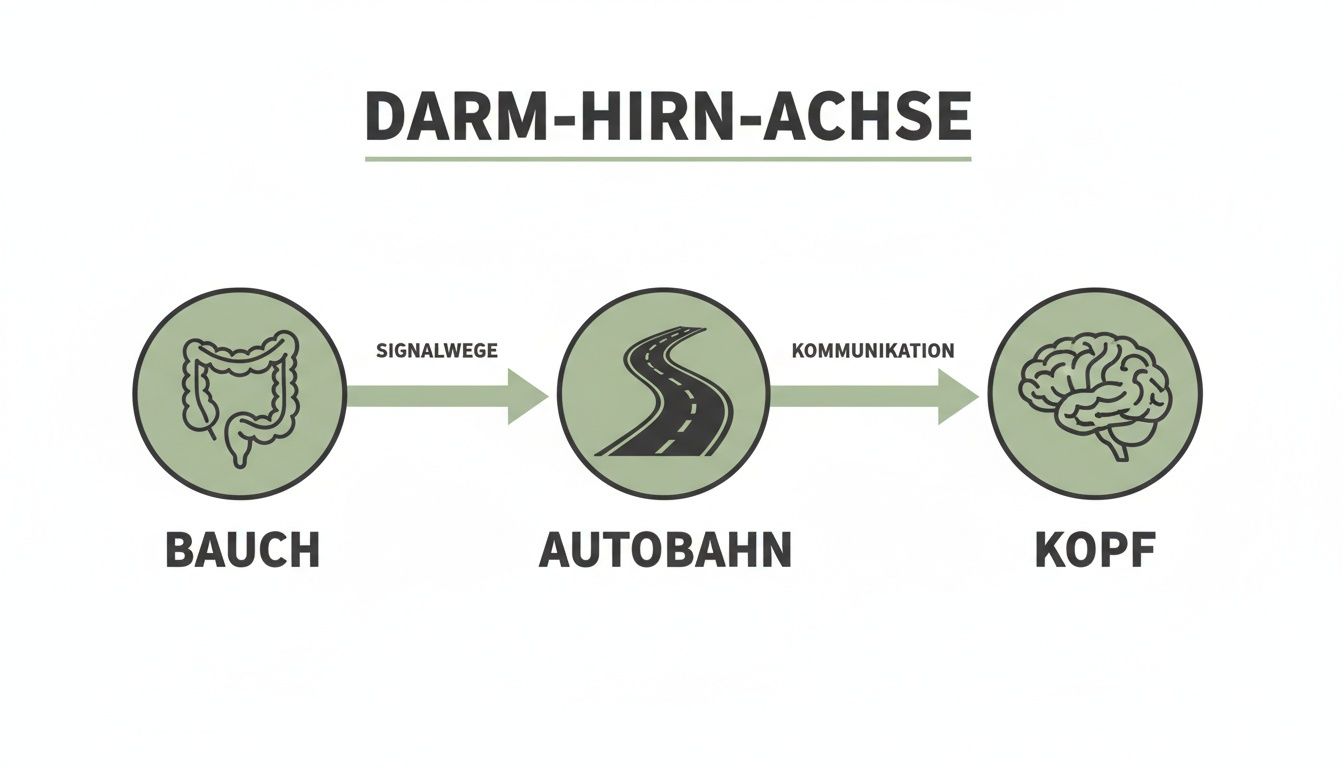
What’s important is that it’s not a one-way street. The flow of information constantly runs in both directions.
The first and fastest way of communication is vagus nerve. You can think of it as a fiber optic cable that connects your gut directly to your brain and transmits signals in milliseconds. Your intestines use this nerve to report satiety or discomfort, for example, which directly influences your mood and behavior.
The second channel overflows Neurotransmitters. An absolute game changer is the realization that over 90% of the “happiness hormone” serotonin are produced in your intestines by your intestinal bacteria. Exactly, not in the brain!
This serotonin plays a crucial role in your mood, sleep and general well-being. An unbalanced microbiome can therefore directly lead to a deficiency of these important messenger substances, which often manifests itself in listlessness or mental exhaustion.
Your gut bacteria are basically little chemical factories that produce mood regulators for your brain. Your diet provides the raw materials for this.
Thirdly, the gut and brain communicate via this immune system. This is where things get really exciting: About 70% of your immune cells sit in the intestines and closely monitor what enters your body.
Wenn deine Darmbarriere durch falsche Nutrition, Medikamente oder Stress geschwächt ist, können entzündungsfördernde Stoffe in den Blutkreislauf gelangen. Diese Entzündungssignale ("stille Entzündungen") erreichen auch dein Gehirn und können dort zu dem führen, was viele als „Brain Fog“ beschreiben – ein Gefühl von mentaler Verwirrung und Konzentrationsschwäche.
The fourth and final path is the Metabolic products your intestinal bacteria. When you eat foods rich in fiber, your good bacteria metabolize them short-chain fatty acids (SCFAs), especially butyrate.
These small molecules are real superheroes and have a dual function:
These four channels impressively show how closely your diet, your gut and your mental performance are intertwined. Every meal is a new chance to send the right signals.
This table summarizes the four main channels through which your gut and brain communicate and shows how you can positively influence them through your lifestyle.
| Way of communication | function | How you influence him positively |
|---|---|---|
| vagus nerve | Direct, rapid signal transmission between the intestine and the brain (e.g. satiety, discomfort). | Mindful eating, deep breathing before eating, yoga, meditation. |
| Neurotransmitters | Production of messenger substances such as serotonin by intestinal bacteria that regulate mood and sleep. | Prebiotic foods (fiber), probiotics (ferments), polyphenols (berries, tea). |
| immune system | Überwachung der Darmbarriere und Auslösen von Entzündungsreaktionen bei "Lecks". | Anti-inflammatory diet (omega-3), stress management, reduction of sugar & processed foods. |
| Metabolic products (SCFAs) | Production of short-chain fatty acids that serve as energy for the intestines and brain. | Diet rich in fiber (vegetables, legumes, whole grains), resistant starch (cooked, cooled potatoes). |
If you know these connections, it becomes clear: your mental clarity doesn't start in your head, but on your plate.
Okay, the theory behind the gut-brain axis is there. Now it's getting practical. Imagine that your diet is the most powerful tool you have to directly influence the conversation between your gut and your brain. Every single bite is information that you send into your system - and that determines whether you have a clear head today or not.
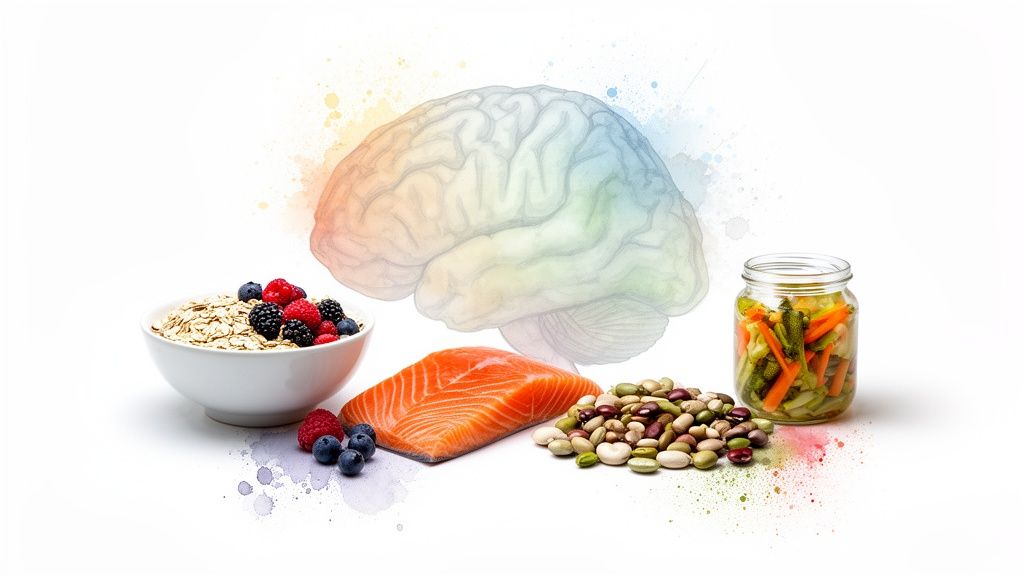
If you specifically incorporate certain nutrients into your everyday life, you will lay the foundation for an alert mind, emotional balance and concentration that will carry you through the day. You are not only feeding yourself, but above all the trillions of little helpers in your intestines. And they work tirelessly for your mental power.
fiber are the absolute superfood for your microbiome. You can think of them as your good gut bacteria's favorite food. These plant fibers arrive undigested in the large intestine and are eagerly awaited by your useful helpers. If you feed them well, they will thank you by producing short-chain fatty acids (SCFAs).
These SCFAs, like the already mentioned butyrate, are real all-rounders. They strengthen the protective barrier of your intestinal mucosa, counteract inflammation throughout the body and even provide direct energy for your brain.
Here's how to easily put more fiber on your plate:
Probiotics are living microorganisms that act as reinforcements for your intestinal team. They enrich your intestinal flora and ensure more diversity. Remember: A diverse intestinal flora is more resilient and can do its jobs – from digestion to the production of happiness hormones – much better.
You find these valuable bacteria primarily in fermented foods. These traditionally produced products are not only a relief for the intestines, but are also often easier to digest.
A diverse intestinal flora is like a strong team - the more different specialists you have, the better you can overcome challenges. Probiotics bring new experts to your team.
Good probiotic sources include natural yogurt, kefir, fresh sauerkraut, kimchi or kombucha. Incorporate small portions of it into your meals regularly to keep your gut community happy.
Silent inflammation is one of the biggest enemies of your mental performance. These chronic, often unnoticed smoldering fires in the body can lead to “brain fog”, poor concentration and low mood. Your strongest allies in the fight against this fire are Omega-3 fatty acids.
They have a strong anti-inflammatory effect and are at the same time a fundamental building block for your brain and nerve cells. You can find them primarily in fatty cold-water fish such as salmon, mackerel and herring, but also in plant sources such as flaxseeds, chia seeds and walnuts.
While fiber, probiotics and omega-3 send positive signals, sugar and highly processed foods get in the way. They are like jammers in the communication of your gut-brain axis. They feed the wrong bacteria, fuel inflammation and cause blood sugar fluctuations that mercilessly rob you of energy and focus.
Research is providing increasingly clear evidence here. A study in Basel is currently investigating how a targeted change in diet can influence the intestinal flora in such a way that depressive symptoms can be alleviated. Initial results indicate impressive results 15 percent improvement cognitive performance. You can find out more about these exciting study results here.
Now it's getting concrete! Knowing about the gut-brain axis is one thing, but how do you cleverly incorporate the whole thing into your often busy everyday life? This section is your roadmap – away from theory and straight into practice. Here I'll show you how you can noticeably increase your mental performance with targeted meals.
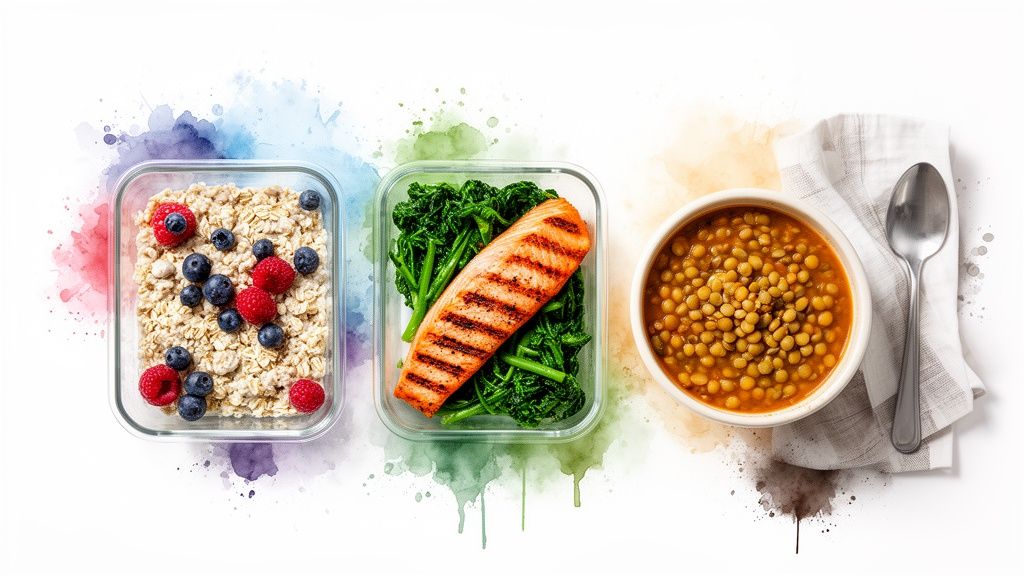
Forget complicated diets. The key is making simple but effective adjustments. It's about consciously choosing foods that feed your good gut bacteria, curb silent inflammation and give your brain exactly the energy it needs to perform at its best. This means that every meal becomes a direct investment in your concentration and well-being.
Breakfast lays the foundation for your energy and focus for hours. Many people turn to quick carbohydrates from white bread or sugary cereals - a mistake that sends your blood sugar levels on a wild rollercoaster ride and causes you to plummet later. Instead, choose options rich in fiber and protein.
A perfect start? A creamy porridge oatmeal, refined with a handful Berries (packed with antioxidants) and a few nuts or seeds for healthy fats. This combination gives you long-lasting power and is also a real superfood for your microbiome.
Do you know the classic midday low? Often it is the result of a heavy, nutrient-poor meal. Your lunch should invigorate you, not slow you down. Rely on a smart combination of high-quality protein, healthy fats and as many colorful vegetables as possible.
An ideal lunch for your head might look like this:
Think of your plate like a painter's palette. Each color represents different phytonutrients that work as a team for your gut and brain health. The more colorful, the better!
Are you looking for more ideas on how you can tailor your diet to your physical activity? Then take a look at ours Nutritional guide for yogis.
Things can be a little lighter in the evenings. A large meal keeps your digestion busy all night long and disrupts the important regeneration processes. A healthy gut and deep, restful sleep go hand in hand.
A warming lentil soup or a chickpea curry with plenty of vegetables are a fantastic choice here. Legumes are real powerhouses, rich in fiber and plant-based protein. Top it all off with a small portion fermented vegetables such as sauerkraut or kimchi - your intestinal flora will be happy about the extra portion of probiotics.
A quick grab for a chocolate bar when you're feeling low in energy? Very tempting, but unfortunately absolutely counterproductive. Sugar feeds the unfavorable gut bacteria, causes your blood sugar to crash and only leads to more cravings. Instead, choose smart alternatives that will get you through the day in a stable manner.
Here are a few examples for a little hunger in between:
When you incorporate these simple principles into your everyday life, your diet will quickly transform from a mere necessity to your most powerful tool for peak mental performance. With every meal you have a direct influence on the communication between your stomach and your head.
To make it easier for you to get started, I have put together an overview. This table shows you at a glance which foods you prefer and which you should avoid in order to specifically strengthen your gut-brain axis and improve your mental performance.
| Nutrient category | Recommended foods (examples) | Foods to avoid (examples) |
|---|---|---|
| Prebiotic fiber | Onions, garlic, leeks, asparagus, bananas, artichokes, oatmeal | Highly processed foods with little fiber |
| Probiotics | Yogurt (natural), kefir, sauerkraut, kimchi, miso, kombucha | Sweetened dairy products, pasteurized ferments without live cultures |
| Omega-3 fatty acids | Fatty fish (salmon, mackerel), flax seeds, chia seeds, walnuts | Trans fats (in fried foods, pastries), excess Omega-6 (sunflower oil) |
| Polyphenols | Berries, dark chocolate, green tea, coffee, olive oil, colorful vegetables | Foods with artificial colors and flavors |
| High quality protein | Legumes (lentils, beans), fish, poultry, tofu, eggs | Processed meat (sausage), heavily breaded meat products |
| Carbohydrates | Whole grains, quinoa, sweet potatoes, oatmeal | White flour products, sweets, sugary drinks, pastries |
Remember: It's not about perfection, it's about conscious direction. Every little step counts and helps you optimize the connection between your gut and your brain.
A smart, nutrient-rich diet is the undisputed foundation for your... Strengthen the gut-brain axis. At Templeshape, we know from experience: real mental performance only comes about when your overall package is right. Movement and targeted mindfulness are your strongest allies here. They take your nutritional strategy to a new level and can significantly improve the communication between your stomach and your head.
Your lifestyle sends just as clear signals to your microbiome as what ends up on your plate. Chronic stress, for example, can severely disrupt the diversity of your beneficial intestinal bacteria and fuel silent inflammation in the body. And that's exactly where we start to break this negative spiral.
Intense workouts are so much more than just calorie burners - they're an incredibly effective outlet for pent-up stress. In our HIIT & boot camp courses we get your cardiovascular system going properly. This specifically helps you reduce stress hormones such as cortisol, which can attack and weaken your intestinal barrier if you are constantly overloaded.
Exercise acts like a reset button for your stress system. It stimulates blood circulation throughout the body - including in the digestive tract - and thus promotes a healthy, resilient intestinal environment.
This targeted reduction of stress creates an environment in which your good intestinal bacteria feel comfortable and multiply. With every workout you indirectly but very effectively influence the composition of your microbiome and thus the signals that are sent to your brain.
Während intensive Bewegung den Stress quasi "rauspowert", lehren dich ruhigere Praktiken, dein Nervensystem aktiv selbst zu regulieren. Stell dir den Vagusnerv als die direkte Datenautobahn zwischen deinem Darm und deinem Gehirn vor. In unseren Yoga- und Breath work-Sessions lernst du, genau diesen wichtigen Nerv gezielt zu stimulieren.
Durch tiefe, bewusste Atmung und meditative Übungen schaltest du auf den parasympathischen Teil deines Nervensystems um – den "Ruhe- und Verdauungsmodus". Das Resultat spürst du sofort: mehr innere Gelassenheit, eine verbesserte Verdauung und ein schärferer Fokus im Alltag. Erfahre mehr darüber, wie du Integrate mindfulness into your life can.
Research from the University of Bern confirms how central our “gut brain” is to mental health. An anti-inflammatory diet can reduce inflammation, which can improve your mental performance by up to 25% lower, reduce. At Templeshape, we combine this approach with practices like ice bathing and functional training like Hyrox: cold exposure and exercise further strengthen your gut-brain axis. Fitness beginners here in Zurich report back after an 8-week program with a nutrition focus 80% more mental clarity. Find out more about research on the abdominal brain.
Okay, we've now uncovered a lot about the fascinating connection between your gut and your brain. You now know how strong yours Nutrition affects your mental performance. But very specific questions often arise in everyday life. Let’s clarify the most important ones so you can get started with confidence and clarity.
This is probably the question that comes up most often: When will the first successes occur? Of course, it's a little different for everyone, but many of our participants report noticeably more energy and a clearer head after just a few weeks. Your microbiome is an amazingly dynamic system and can often adapt very quickly to positive changes in your diet.
However, for truly profound, stable improvements in your gut-brain axis, you should give yourself a little more time. Think in a horizon of at least three monthsto cement sustainable effects. Consistency is really the key here. And that's exactly what we're here for at Templeshape - we help you stick with it and not lose motivation.
Clearly: no. For the vast majority of us, completely avoiding sugar or gluten is neither necessary nor sensible. It's more about developing awareness, reducing specifically and finding a healthy balance. Focus on avoiding added sugars and highly processed products as much as possible, which are exactly what increases inflammation and feeds the wrong bacteria in your gut.
Cutting out gluten completely is actually only necessary if you have a medical diagnosis such as celiac disease or proven gluten sensitivity. Learn to listen more to your body's signals again - it usually tells you exactly what's good for it.
Sport is a huge lever that is often underestimated. Regular exercise not only boosts the diversity of your good intestinal bacteria, but has also been proven to reduce stress hormones such as cortisol. Sport also improves signal transmission via the vagus nerve, the information highway between your intestines and your brain.
The combination of a gut-friendly diet and the right kind of exercise, like we teach in our Templeshape classes, is the most effective way to optimize this communication. This is how you create the basis for sustainable peak mental performance.
Probiotics in capsule form can be useful support in certain situations, for example after a course of antibiotics, to specifically rebuild your intestinal flora. But they should never replace the foundation. You can always achieve this through a varied and natural diet.
Probiotic foods like kefir, natural yogurt or fresh kimchi not only provide you with live bacterial cultures, but also a whole package of valuable nutrients. A balanced diet rich in fermented foods and fiber is and always will be the first and most important step - long before you think about supplements.
Are you ready to take your mental performance to the next level? At Templeshape GmbH We combine targeted exercise, mindfulness and nutritional know-how to optimally strengthen your gut-brain axis. Find the right course for you and make health a habit: https://Templeshape.com
tags
Gut-brain axis, intestinal health, healthy eating, mental performance, microbiome