No products in the cart.
January 29

Imagine your car sitting in the garage in the morning with a completely empty tank. You would never try to drive it to work, would you? This is exactly how your body feels when you wake up. Overnight, in fasting mode, he used up all available energy reserves to keep himself going.
This is precisely why it is so crucial to understand why you should eat when you get up: You refill your tank and give your body the fuel it urgently needs for a successful start to the day.
After a long night without food, your body's energy stores - the so-called Glycogen stores in the liver and muscles – pretty much emptied. Your body has grabbed these reserves overnight to supply vital functions such as breathing, heartbeat and countless repair processes in the cells. So when you open your eyes, your entire system is on the back burner.
If you don't get a replenishment in the form of breakfast, your blood sugar level will remain in the basement. This is often the simple reason why you feel tired, unfocused or perhaps even slightly irritable in the morning. Above all, your brain, which lives almost exclusively on glucose (i.e. sugar), simply doesn't get the power it needs for top performance.
Breakfast is basically the ignition key for your metabolism. With the first meal of the day, you give your body the signal to end the nighttime fasting phase and switch from energy-saving mode to active mode.
This process is called food-induced thermogenesis. It sounds complicated, but it just means: Your body burns calories while digesting, absorbing and processing nutrients. A balanced breakfast boosts this process significantly and ensures that your metabolism revs up for the rest of the day. It is the ultimate start signal for your entire system.
Breakfast breaks – as the English name “break-fast” suggests – the overnight fast. It provides the crucial energy to be able to hit the ground running, both physically and mentally. It's so much more than just a meal - it's your body's biological wake-up call.
If you simply skip breakfast, your blood sugar level will continue to languish. This puts your body under mild stress and releases hormones like cortisol to somehow release energy from other sources. This can quickly become a vicious circle.
By mid-morning at the latest, your body will respond with full force and scream for quick energy. The result is usually an uncontrolled craving attack in which you unerringly reach for snacks high in sugar and fat that only satisfy you for a short time. Just think of the candy bar from the vending machine that seems to save your life at 11 a.m.
A good breakfast, on the other hand, allows your blood sugar levels to rise gently and steadily. This has several advantages:
By giving your body exactly what it needs in the morning, you are laying the foundation for an energetic and productive day.
You now know why your body screams for energy in the morning. But is there a perfect time for breakfast? The answer is yes - and it's closer than you might think. Your body loves routine, especially when it comes to its internal clock.
Most experts recommend within 30 to 60 minutes after waking up to eat. It is precisely in this time window that your body is perfectly prepared to absorb nutrients and really stimulate the metabolic engine. If you wait too long, the body remains in fasting mode, which often leads to cravings later.
An early breakfast also helps your circadian rhythm to synchronize. Imagine this rhythm like the conductor of your body's orchestra. A punctual meal gives him the effort to ensure that all systems - from digestion to hormone production - function in the right rhythm.
This picture makes it very clear: your body starts with an empty tank. Breakfast fills you up and gives you full power for the day.
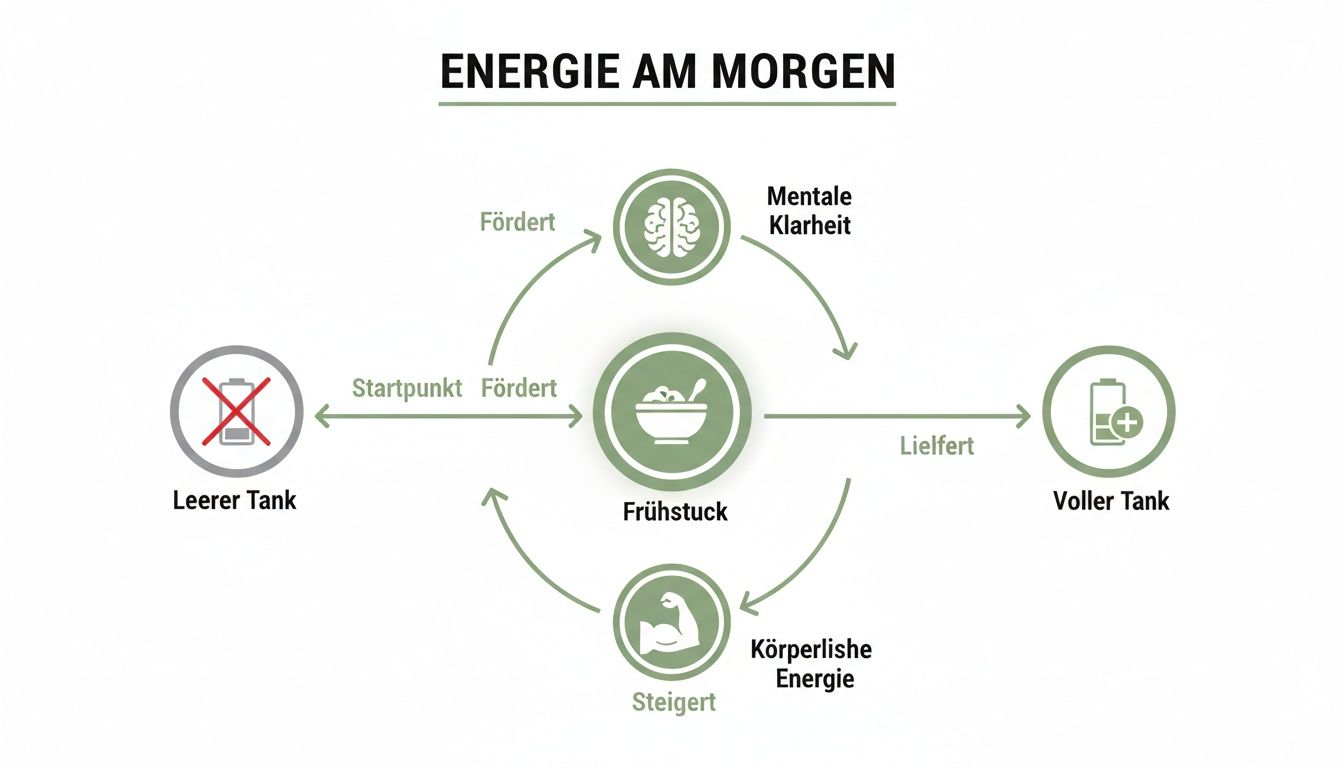
The visualization clearly shows: Breakfast is the crucial step in moving from an energy deficit to a productive state.
The timing is one thing, the composition is another. A sugary croissant from the bakery at the train station gives you a quick kick, but it wears off just as quickly. What remains is fatigue. Real, long-lasting energy comes from a balanced combination of nutrients.
Your ideal breakfast should contain these three building blocks:
A breakfast of low-fat quark with berries and a handful of nuts will provide you with energy for hours. In contrast, a croissant leads to a rapid rise in blood sugar and a subsequent drop in energy that has you reaching for the next coffee before lunch.
Postponing breakfast until late morning is not a good strategy. In Switzerland, a connection has even been found between late breakfasts and an increased risk of death, especially in older people. A long-term study found that every additional hour without breakfast after getting up statistically increased overall mortality.
When it comes to your health, the matter is clear: the sooner you give your body the energy it needs after waking up, the better you will support its long-term function and your well-being.
Many of us skip breakfast. Sometimes it's the time pressure in the morning, sometimes an old habit or simply a lack of appetite. But what are you actually signaling to your body? Basically, the message is clear: “Stay in savings mode, there is no new energy for now.” However, this condition can have far-reaching consequences that go far beyond the classic morning low.
Skipping the first meal of the day forces your body to resort to emergency plans. He releases stress hormones like Cortisol to mobilize the necessary energy from the body's own reserves. The result is often not only a lack of concentration and leaden fatigue, but also a rollercoaster blood sugar level. And that's exactly what makes you susceptible to cravings for anything that promises quick energy - usually sugar and fat.

If you regularly leave the house without breakfast, you expose your body to recurring stress. In the long term, this can lead to serious health problems. Your metabolism basically forgets how to start up efficiently in the morning, which paradoxically can even increase the risk of weight gain.
You tend to make up the missing calories throughout the day - often with larger portions and not always the healthiest food choices. This irregular energy intake can put strain on your body and increase the risk of metabolic diseases such as type 2 diabetes. It's a gradual process that often goes unnoticed, but takes its toll over the years.
Your body needs a clear signal in the morning to end the nighttime fasting phase and switch to active daytime mode. Without breakfast, this signal is missing, which can lead to a hormonal imbalance and impair your performance throughout the day.
Choosing not to eat breakfast often has a direct impact on the quality of your overall diet. This is not just a guess, but has been clearly proven in Switzerland by the national nutrition survey menuCH study. The study found that 34.8% of the Swiss population do not eat breakfast regularly, which has a measurably negative impact on the quality of their diet. This group performed significantly worse in the so-called Alternate Healthy Eating Index than regular breakfast eaters. You can find more details about this in the Results of the Swiss nutrition study.
The results show a clear pattern:
Of course, there are fasting methods in which you consciously skip breakfast. However, it is crucial to understand whether this approach really suits your individual body and lifestyle. You can find out more about different approaches in our Articles on intermittent fasting read up. However, for most people, a nutritious breakfast remains the key to sustained energy and long-term health.
Theory is all well and good, but at the end of the day what counts is what ends up on your plate. So how do you fit a healthy breakfast into an already busy routine? The good news: You don't need an hour of time or exotic ingredients. The trick lies in clever preparation and the right ideas for your individual situation.
This section is your action plan. We'll now take a closer look at how you can get the most energy out of your day with minimal effort - whether you're rushing from meeting to meeting, managing the family or preparing for a tough workout.

Your alarm clock rings and the day is scheduled from the first minute? A hearty breakfast at the table is pure utopia. No problem. With a few smart “grab-and-go” options that you prepare the evening before, the “no time” excuse will be a thing of the past. This means your brain starts with full power from the first meeting.
Here are three quick ideas to save your morning:
Getting everyone out of the house on time and full in the morning is often a logistical masterpiece. Breakfast not only has to be healthy and quick, but also has to be tasty for everyone. The focus here is clearly on uncomplicated recipes that provide enough energy for school, daycare and your own job.
A great trick: Involve your kids in the preparation. This is not only fun, but also forms healthy habits from an early age. Why not set up a “muesli bar” with various flakes, nuts, seeds and fruits where everyone can put together their own bowl. Whole-wheat pancakes are also easy to prepare and warm up in the toaster in the morning.
A good breakfast not only stabilizes your blood sugar level. It has been proven to improve your children's concentration and learning ability at school. See it as an investment in the success of the entire family.
If you train regularly - perhaps even for a demanding event like Hyrox - your breakfast is more than just a meal. It's your fuel. The right mix of nutrients determines whether you perform during training and how quickly you recover afterwards.
Your focus should be on easily digestible carbohydrates for quick energy and high-quality protein to protect your muscles. If you want to delve deeper into the topic of protein, you can find it in ours Beginner's guide to protein all important information.
Before training (approx. 60-90 minutes before):
After training (within 60 minutes):
This targeted supply of nutrients ensures that you can give your all during training and that your body then gets the building blocks it needs to repair itself.
There are some persistent rumors surrounding breakfast. You've probably heard that the first meal of the day makes you fat or that you shouldn't eat if you're not hungry. It's time to dispel these myths and replace them with solid facts.
Many of these misconceptions come from diet trends that have long been outdated or have simply been misinterpreted over time. Let's take a closer look at the most common claims and provide clarity.
Quite the opposite! A balanced breakfast really gets your metabolism going and stabilizes your blood sugar level right from the start. This is your best insurance against the dreaded mid-morning hunger pangs that cause you to quickly reach for unhealthy, high-calorie snacks.
Studies even suggest that people who eat breakfast regularly often have better control over their calorie intake throughout the day. The first meal essentially lays the foundation for more conscious eating decisions.
So it doesn't matter whether you have breakfast, but What ends up on your plate. A sugar-rich croissant naturally has a completely different effect than a protein-rich quark with fresh berries and nuts.
A black coffee may be a welcome stimulant, but it doesn't provide your body with any building blocks. It contains practically no calories, proteins, fats or fiber - exactly the nutrients that your body urgently needs after the long fasting phase at night to repair cells and recharge your batteries.
While coffee may suppress your appetite in the short term, it doesn't solve your body's fundamental energy problem. Most of the time the hunger comes back even more violently later.
See coffee for what it is: a luxury food and a beautiful ritual that gets your circulation going. However, it does not replace a full meal. It is the spark, but breakfast is the real fuel.
That sounds logical at first glance, but it ignores a crucial point: many of us have simply trained ourselves off morning hunger over the years. If your body doesn't get any food in the morning for a long time, it simply stops producing hunger signals for that time of day.
But that doesn't mean your body doesn't need energy. As soon as you start eating breakfast regularly again, your body will get used to the new routine and the hunger signals will return.
Finally, I would like to address a few of the most burning questions that I keep coming up with in connection with breakfast. Here are short, sweet answers so you have all the puzzle pieces to find your perfect morning routine.
We'll now clarify what you can do if you're just not hungry in the morning, how the whole thing fits in with intermittent fasting and how you can best plan your breakfast around your training.
The feeling of not being able to eat a single bite in the morning is something that a surprising number of people know. Often this is simply a trained habit because your body has forgotten how to ask for energy early in the day over the years. The trick is to reacquaint him gently and patiently.
Start really small. A small yogurt, a handful of nuts or a simple protein shake can be the perfect way to start without feeling overwhelmed.
The most important thing is regularity: Eat a little something at about the same time every day, even if it's just a few spoonfuls. You will quickly notice how your body adapts and will soon start sending you hunger signals again. A large glass of water with lemon immediately after getting up can really support this process and gently awaken your appetite.
Intermittent fasting can definitely have its health benefits, no question about it. But it is not a universal solution that suits everyone and every situation. The key is always to honestly listen to your own body's signals.
If you notice that skipping breakfast makes you tired, unfocused or irritable and you experience cravings later in the day, then this method is probably not right for you. Eating breakfast in the morning stabilizes your blood sugar levels and can reduce the release of stress hormones such as cortisol.
Especially for women of childbearing age or people with a stressful everyday life, a regular breakfast can be crucial in keeping the hormone levels in balance and stabilizing the entire system.
This decision depends largely on the intensity of your training and your personal digestion. There is no general answer, but there are clear guidelines that you can follow.
For an intense workout like a HIIT workout or a Hyrox session, it is absolutely advisable, for example 60 to 90 minutes beforehand to eat a little something. Preferably something easy to digest that consists mostly of carbohydrates with a small amount of protein. A banana with a spoonful of nut butter is a classic and replenishes your energy stores perfectly.
After training, the meal is at least as important. Your goals are clear here:
A full meal within 60 minutes of your workout that is rich in protein and complex carbohydrates is ideal. A great combination would be, for example, a protein shake immediately after training and a little later a real breakfast like scrambled eggs with whole grain bread.
Are you ready to make your health a habit and start your day full of energy? At Templeshape GmbH you'll find the courses, the community and the motivation you need to achieve your goals - whether it's a sweaty boot camp or a focused Pilates class. Find the perfect course for you now https://Templeshape.com and discover how good it feels to be strong and balanced.
tags
Nutrition tips, breakfast when you get up, have a healthy breakfast, eat in the morning, stimulate your metabolism