March 18
Workout fitness for a stronger everyday life
0 comments

Imagine you have noticeably more energy in your daily life, can handle stress much better, and simply feel good in your own skin. That’s exactly what a good work out fitness program is about – it’s not a short-term torture, but a sustainable investment in your quality of life.

Maybe you know this: The day is packed, the battery is low, and the thought of exercising feels like another insurmountable hurdle. But that’s exactly where the crux lies. Regular, well-thought-out training is so much more than just physical exertion. It’s a powerful tool to sharpen your mental focus and approach daily challenges with new calmness.
By the way, with this desire to get fitter, you are in excellent company. The fitness industry in Switzerland is currently experiencing a huge boom. The number of active gym members has reached a new record with 1.37 million people. This means that already 15.2 percent of all Swiss people are actively training in a studio – a clear sign of how important health and exercise have become for us.
The key factor for long-term success? Finding an activity that you truly enjoy. It’s not about torturing yourself with a program you hate. It’s about finding a routine that feels good and seamlessly fits into your life.
Here are a few prompts that can make it easier for you to get started:
The first step is often the hardest, but also the most important. It’s not about perfection, but simply about starting and sticking with it. Find your rhythm, and you’ll soon notice how positively movement affects your whole life.
Especially at the beginning, a supportive atmosphere is worth its weight in gold to transform initial motivation into a solid habit. With us, you’ll find exactly that: a community that welcomes you and cheers you on, no matter where you stand in your journey. We help you find the right exercises for your goals while having fun in the process.
To make your start even easier, check out our guide on how to decipher the fitness secret with 100 healthy routines – the perfect companion for your journey.
A truly strong Work out is far more than just a random sequence of exercises. It’s a well-thought-out system. A good training plan follows a clear structure that optimally prepares your body, challenges it properly, and then helps it recover. By internalizing these phases, you’ll not only get the most out of your training but also minimize the risk of injury.
Every effective training, no matter what goal you pursue, can be divided into four essential components. Each individual part has its fixed place and contributes significantly to overall success.
The following table gives you a quick overview of the four phases that each of your workouts should have. It summarizes how long each phase lasts and what specific benefits it has for your body – from warming up to recovery.
| Phase | Duration (approx.) | Goals & Benefits |
|---|---|---|
| Dynamic Warm-up | 5–10 minutes | Activate circulation, raise body temperature, prepare joints and muscles for exertion, injury prevention. |
| Strength training or HIIT | 20–45 minutes | Muscle building (strength), maximum fat burning, and endurance enhancement (HIIT), setting the crucial training stimulus. |
| Cool-down | 5–10 minutes | Slowly lower heart rate, initiate transition to recovery, support lactate breakdown, prevent muscle soreness. |
| Mobility & Stretching | 5–10 minutes | Improve flexibility, relieve muscle tension, promote long-term joint health. |
Each of these phases is a puzzle piece that makes your training complete and sustainably successful. Let’s take a closer look at each step now.
Forget the old image of static stretching before sports, where you hold a position for minutes. A modern, smart warm-up is dynamic, active, and gets you going. The goal is to get the circulation going, slightly raise body core temperature, and specifically prepare your muscles and joints for what’s to come.
Imagine it like the engine of your car on a cold morning – you wouldn’t just start off at full throttle, would you?
This targeted start ensures that your body is ready for the actual effort and that your muscles can work more efficiently.
Now it’s time to get serious. In the main part of your workout, you’ll be applying the crucial stimuli that bring you closer to your goal. Here, you generally have two major options: classic strength training for muscle growth and definition or a sharp High-Intensity Interval Training (HIIT) for maximum fat burning and top endurance.
Strength training focuses on controlled movements against resistance. This could be weights, but also your own body weight. This specifically strengthens your muscles, which not only leads to an athletic figure but also increases your basal metabolic rate. Meaning: You burn more calories even at rest. Bodyweight exercises are ideal, especially for beginners. In our guide to Full-Body Workout with Bodyweight you’ll find plenty of inspiration and suitable exercises for it.
HIIT is the exact opposite: short but brutally intense. You alternate between maximum effort (e.g., 30 seconds sprints) and very short recovery phases (e.g., 15 seconds rest). This skyrockets your metabolism and creates a massive afterburn effect – so you continue burning extra calories even hours after the workout.
After you’ve given it your all, it’s extremely important to signal your body: ‘Okay, now you can cool down.’ A targeted cool-down helps you slowly lower your heart rate and transition gently from full action to recovery.
Unfortunately, this phase is often skipped due to a lack of time, yet it is invaluable for your recovery.
A conscious conclusion to your workout helps not only to reduce muscle soreness. It ensures that you remain flexible, agile, and capable over the long term.
The best training theory is worthless if it cannot be implemented in your real life. That’s why we’ll now look at how to perfectly integrate your work out fitness program into your everyday life – no matter how packed it may be. A good plan is flexible, motivating, and above all: doable.
The key to success lies in finding a structure that adapts to you, not the other way around. It’s not about planning your life around training, but cleverly incorporating training into your existing life.
The following infographic helps you with the first, basic decision: What main goal are you currently pursuing with your workout?
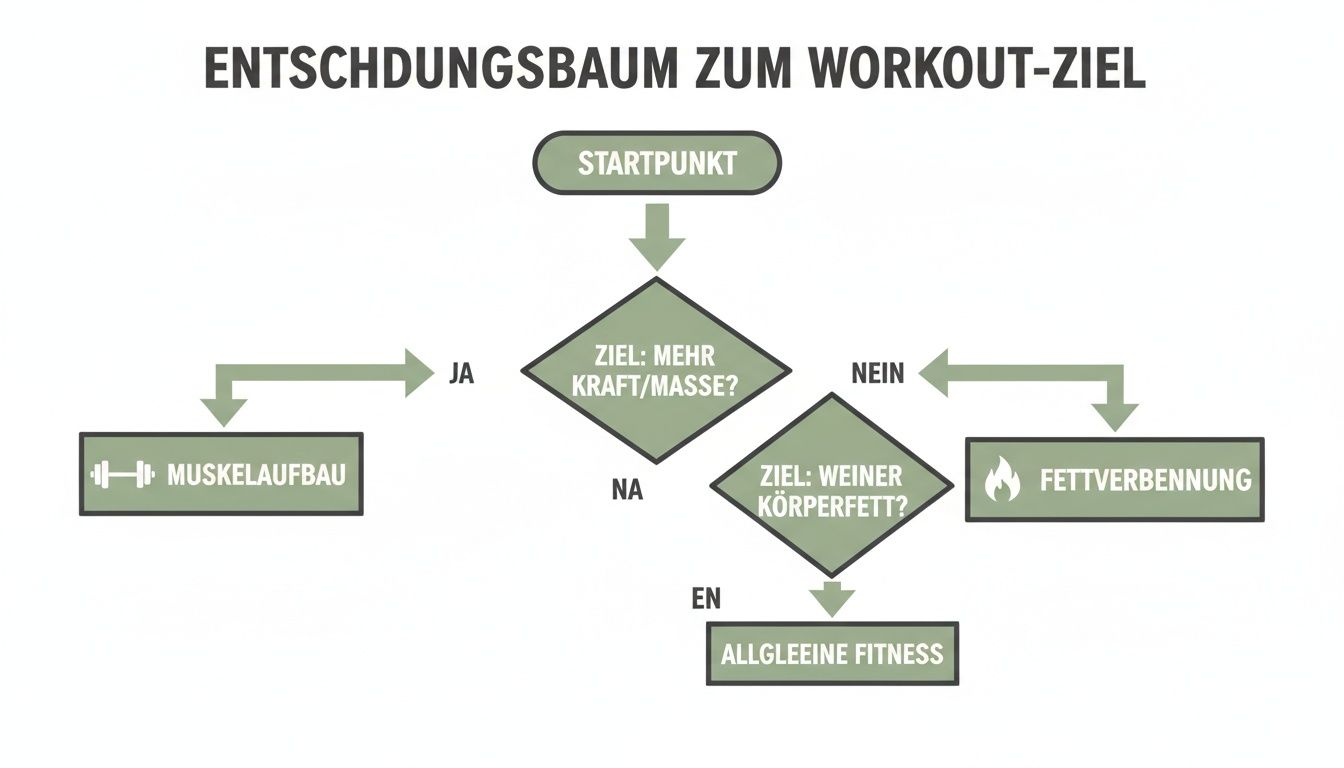
As you can see, different paths lead to different results. Your decision for muscle building, fat burning, or general fitness lays the foundation for the type and intensity of your training plan.
Is your calendar bursting at the seams and time is your most valuable asset? Then this plan is just for you. We focus on short, punchy sessions that deliver maximum results in minimal time.
The key factor in this plan is intensity. If time is short, you need to give it your all in these minutes. This way, you rev up your metabolism and benefit from the afterburn effect for hours afterward.
As a mother, you need primarily two things: flexibility and exercises that specifically strengthen your body after pregnancy and childbirth. This plan can be easily adapted to the unpredictable daily life with children.
It’s about doing something good for yourself without creating additional stress. Every movement counts.
You’ve been training for a while and want to break through plateaus? This plan combines heavy strength and intense endurance sessions to elevate your performance to the next level.
If you’re looking for even more structure and fresh ideas, get inspiration from a well-thought-out gym class schedule. There you often find new approaches and can be inspired by the energy of the group.
Consider these plans as templates. Feel free to adjust them to your needs, your energy, and your week. The most important thing is to listen to your body and find a rhythm that works for you in the long run.
The beginning is done, the first routine is in place. But what happens when the initial enthusiasm fades and your inner critic becomes louder? This is where the wheat separates from the chaff. Staying consistent over the long term and continuously improving is the true key to your success in workout fitness. Because without new stimuli, your body becomes accustomed to the load, and progress stalls.
The magic word is progressive overload. Sounds technical, but it’s quite simple: You need to make your training a little bit more challenging over time. Only then do you give your muscles a reason to keep growing and improve your endurance.
The art lies in increasing the load so that you challenge your body but do not overstrain it. Stagnation is the biggest motivation killer. As soon as you notice that an exercise is too easy for you, it’s time for the next step.
Here are three simple ways to immediately increase intensity:
Your body is an adaptation artist. Give it a reason to change by regularly pulling it out of its comfort zone. Small, but constant adjustments are much more effective than sudden, huge leaps that just throw you off track.
What you don’t measure, you cannot improve. Sounds cliché, but it’s 100% true. Documenting your progress is one of the strongest motivators of all. It makes your success tangible and shows you in black and white how far you’ve come—especially on days when you might not feel so strong.
A simple notebook or an app on your phone is perfectly sufficient. Write down after each training session: which exercise, which weight, how many repetitions. This way, you can immediately see where you’ve improved and where your next small goal lies.
Fighting alone is damn hard. Growing together is not only easier but also a lot more fun. A good community can make the difference between getting back up after a low or throwing in the towel. Find people who share your goals and cheer you on instead of holding you back.
Training together in a positive atmosphere where it’s about support instead of competition ignites an incredible dynamic. When you see others pushing their limits, it motivates you to do the same. Celebrate your successes together and help each other through the tough phases. This social connection is often the missing puzzle piece for sustainable success.

A strenuous workout is done, you feel good—but the work is far from over. Many believe that muscles grow during training. But the real magic, the actual progress, happens only afterwards: in the recovery phase.
Think of it this way: In training, you apply stimuli. You challenge your muscles and cause tiny tears in the tissue. This is completely normal and intended. You will only get stronger when your body repairs these ‘damages’ during the subsequent rest and rebuilds the muscle fibers thicker and more resilient.
Recovery is not passive waiting or even a sign of weakness. It is an active process and the crucial component that enables you to build performance long-term and remain injury-free.
This process is called supercompensation. If you do not give your body the necessary time for it, you not only stagnate but also risk overtraining and injuries.
The undisputed champion of recovery is and remains good sleep. At night, your body releases growth hormones that are essential for the repair processes in the muscles.Seven to nine hours per night should be your absolute minimum.
Here are a few simple but effective tips for better sleep:
Even small changes can massively improve your recovery—and thus your performance in the next workout.
Recovery does not mean you should not move at all. On the contrary: Light activity on rest days, the so-called active recovery, can even accelerate the process.
Gentle movement stimulates circulation. This helps to transport metabolic waste products like lactate faster and at the same time facilitates the transport of important nutrients for repair into the muscle cells.
Here’s what your active recovery can look like:
Don’t forget the role of nutrition. Right after training, your body needs a mix of proteins (for muscle repair) and carbohydrates (to refill energy stores). A quark with fruits or a protein shake with a banana is perfect for this. When you use these components strategically, you give your body exactly what it needs to come back stronger than before.
Healthy, motivated employees are undoubtedly the foundation of every successful company. Fitness is no longer just a private matter—it has become a central building block for a modern, productive corporate culture. A well-thought-out workout fitness program for the team is an investment that pays off in multiple ways.
It’s about so much more than just physical fitness. Joint sports activities bond a team, visibly reduce stress, and can even lower sick leave in the company.
When you sweat together as a team, push your limits, and have fun at the same time, a whole new kind of connection develops. A weekly team boot camp or a joint yoga session during lunch breaks breaks down the usual hierarchies and strengthens trust in a very direct, human way.
These positive effects seep directly into everyday work:
Corporate health programs are therefore not just pure cost factors. They are rather strategic tools to enhance performance and satisfaction throughout the company.
The growing focus on health is also reflected in the numbers. The Swiss fitness industry has reached a remarkable economic size and is continuously growing. The industry recently generated a revenue of 1.30 billion Swiss francs, which corresponds to an impressive increase of 7.6 percentcompared to the previous year. These figures demonstrate how deeply health consciousness is rooted in society. You can read more about the developments in the fitness industry in the DACH countrieshere.
Investing in the health of one’s employees is one of the smartest decisions a company can make for its future. The result is not only healthier and happier people but also a measurably more successful business.
Imagine a joint boot camp: Here, colleagues get to know each other in a completely new environment, cheer each other on, and overcome hurdles together. This kind of experience bonds a team and creates a positive dynamic that extends far beyond the training. Fitness in the workplace is a classic win-win situation.
Do you want to take the health and cohesion of your team to the next level? Templeshape GmbHoffers tailored corporate health programs that are precisely designed to meet the needs of your company. Discover how we can empower your team with energy and motivation: https://templeshape.com
Tags