March 18
Why Women Should Train Differently: Female Physiology – Your Guide
0 comments

March 18
0 comments
You put everything into your training, follow your plan, but the successes you hoped for are not materializing? That’s frustrating, but you are not alone in this. The cause often lies in the fact that most training plans are designed for men and completely ignore the unique female physiology. It’s time to understand: You should train differently because your body – shaped by hormonal cycles and specific biomechanics – responds and benefits from stress in a completely different way.
Have you ever wondered why a training program that works wonders for your male training partner just doesn’t click for you? The answer is as simple as it is crucial: Your body is not just a smaller male body. Sports science has focused almost exclusively on male subjects for decades. The result is a huge "Gender Data Gap.
” This gap leads to generic training recommendations that overlook the specifics of female physiology. Your hormonal fluctuations, muscle structure, and energy metabolism follow their own rules. A rigid program that ignores these works against your body instead of with it.
Your training success directly depends on how well you understand the signals from your body and adjust your training accordingly. It’s not about training less intensely or less frequently – on the contrary. It’s about training smarter.
A training program that takes these points into account not only leads to better results but also enhances your well-being and protects you from injuries. In fact, you benefit much more from regular movement in Switzerland. A study showed that women can reduce their risk of death by 24% with just 140 minutes of moderate exercise per week. Men need almost double the time for that! This is just one of the exciting findings of gender medicine.
Comprehensive knowledge about your body is the foundation for effective training. It allows you to achieve your fitness goals without feeling burned out or overwhelmed.
To capture the most important differences at a glance, I have created this table. It shows why a "one-size-fits-all" approach to training simply cannot work.
This table summarizes the most important physiological differences and their concrete effects on training for women and men.
| Aspect | Characteristics in women | Characteristics in men |
|---|---|---|
| Hormones | Cyclical fluctuations of estrogen and progesterone affect energy, strength, and recovery. | Relatively stable testosterone levels that continuously support muscle building. |
| Metabolism | Utilize fat more efficiently as an energy source, especially during prolonged endurance exertion. | Rely more on carbohydrates (glycogen) as the primary energy source. |
| Muscles | Higher proportion of type I muscle fibers (fatigue resistant), which is advantageous for endurance and higher volume. | Higher proportion of type II muscle fibers (fast-twitch), which helps with explosive strength performances. |
| Biomechanics | Wider pelvis (Q-angle) increases the risk of knee injuries; requires focus on hip and trunk stability. | Lower Q-angle leads to more direct force transmission and lower knee injury risk. |
| Recovery | Can often recover faster from training sessions, allowing for higher training frequencies. | Tend to require longer recovery times between high-intensity sessions. |
These differences are not disadvantages, but simply that – differences. The key is to recognize and utilize the unique advantages of your physiology. To fully understand why you should train differently, it is essential to Understand women’s healthand interpret the signals from your body correctly. This guide is your first step to redefining your training and finally seeing the results you desire.
Imagine your menstrual cycle not as a nuisance but as your own personal training compass. It’s like a built-in manual that tells you exactly when your body is ready for peak performance and when it calls for recovery and gentler sessions. Understanding your female physiologyand its cycles is the key to making your training more effective, safer, and simply more enjoyable.
The idea of adjusting your training to your cycle is not rocket science. It’s a totally logical step to finally work in harmony with your body instead of against it. Instead of torturing yourself through energyless days or leaving phases with huge potential for strength unused, you can learn to ride these hormonal waves for your benefit. This way, you maximize your progress while simultaneously reducing the risk of overload and injuries.
This infographic beautifully shows you which life phases of female physiology influence our training – starting from the menstrual cycle.
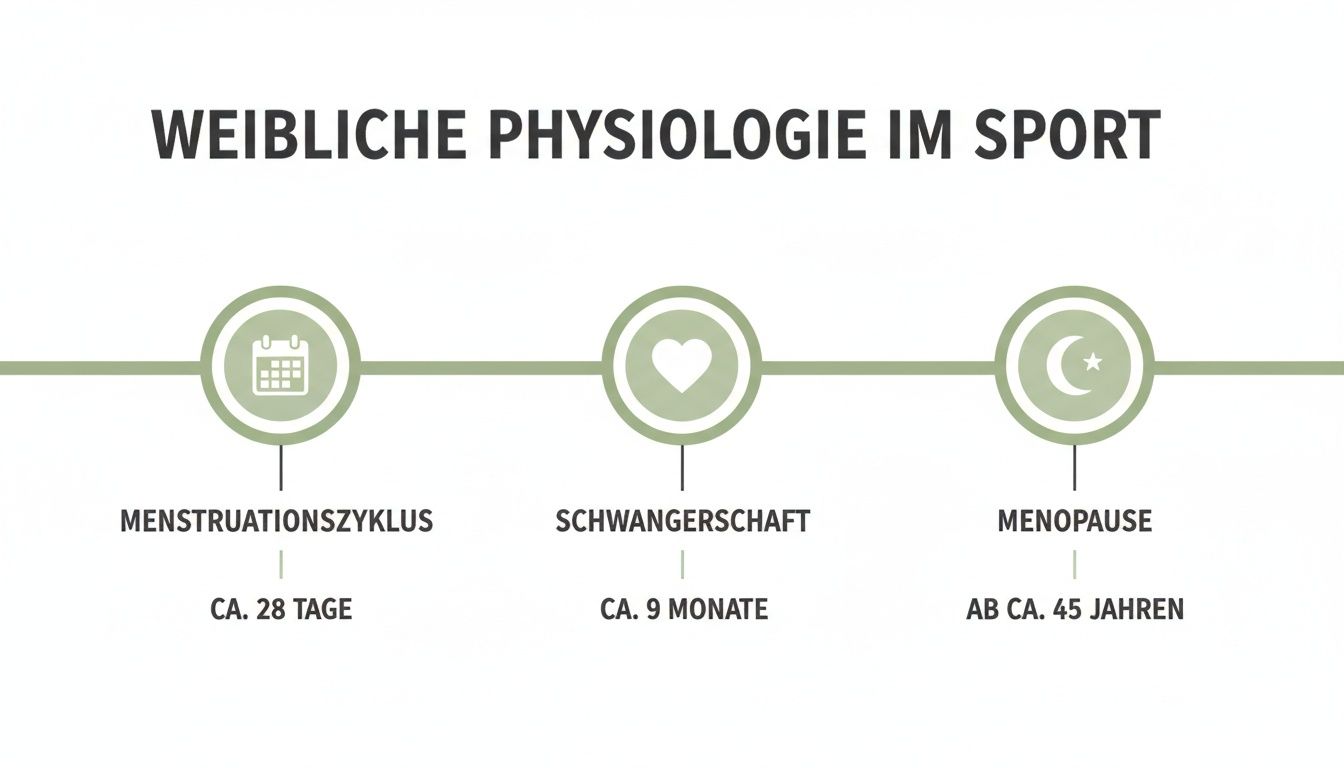
You can clearly see here that the cycle is the starting point for a lifelong, adapted training that then simply evolves during phases like pregnancy and menopause.
Your cycle is roughly divided into two halves, which create completely different hormonal conditions for your training. When you know these phases, you can strategically plan your workouts.
It is precisely these hormonal fluctuations that are the reason why on some days you can lift weights effortlessly, while on others, a relaxed yoga session is the only right choice.
Your cycle is not a flaw in the system, but a damn intelligent rhythm. Utilizing it means recognizing your female physiology as a superpower and adapting your training accordingly.
The first half of the cycle is your absolute golden window for intense workouts and new personal records. Your body is programmed for performance and muscle building.
What is ideal now:
By the way, this is not just a feeling, but scientifically proven. According to the Swiss Federal Institute of Sports and Movement (EHSM), a higher frequency in strength training in the first half of the cycle can increase muscle mass and strength by up to20 percentmore effectively. In the luteal phase, however, performance often decreases by5-10 percent, which requires a smart adjustment of intensity.
In the second half of the cycle, the focus shifts clearly. Your body is less tolerant to stress, and your energy level is lower. This is the perfect time to reduce volume and focus on clean technique, mobility, and recovery.
What feels good for you now:
When you start applying these simple principles, you’ll quickly notice what it feels like to work with your body instead of constantly against it. You can find a deeper understanding in our guide on the topic ofCycle Syncing and how to adjust your training to your cycle.
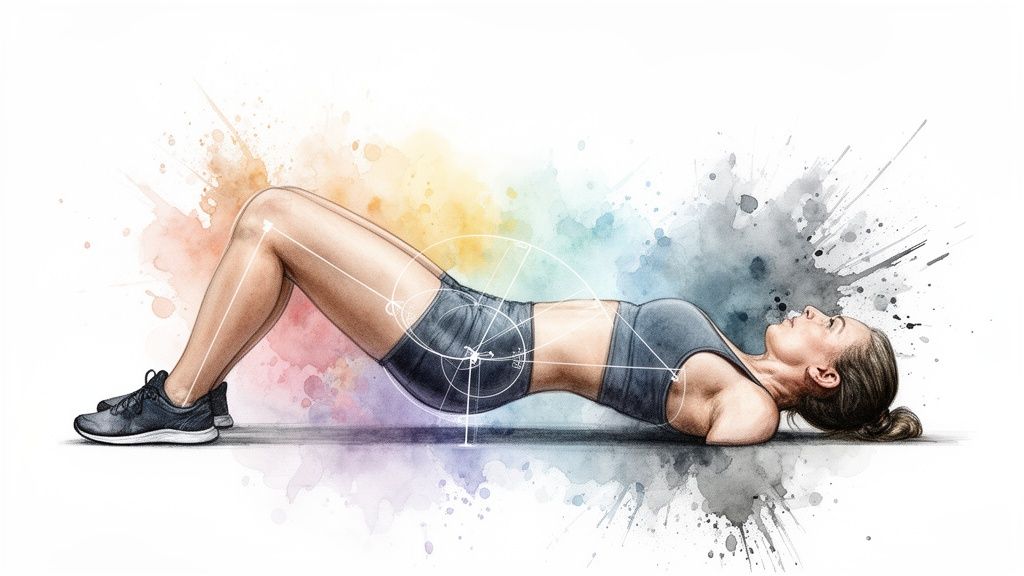
Did you know that your female body structure carries some special strengths but also a few anatomical peculiarities? Understanding your anatomy and biomechanics is the key to not only training harder but also smarter and safer. Thefemale physiologyhas different rules than the male – and you should be aware of them.
It’s absolutely not about being afraid of movement. Quite the contrary: Knowledge is your most powerful tool in the gym. When you understand how your body works and moves, you can strategically outsmart injuries and build an indestructible foundation for any athletic challenge.
A crucial difference lies in the so-calledQ angle (Quadriceps angle). Don’t worry, this is quickly explained: This angle describes the line that runs from your hip to your knee. Because women naturally have a wider pelvis, this angle is often larger in us.
Imagine a line from the front hip bone down to the kneecap and a second line from the kneecap to the shinbone. The Q angle lies exactly in between. A larger angle means that with every movement – running, jumping, squatting – stronger forces act on your kneecap.
This can slightly increase the risk of knee issues, especially at the anterior cruciate ligament. But don’t see this as a fate but as valuable insider information for your training planning.
Dein breiteres Becken ist ein Meisterwerk der Natur, perfekt für eine Geburt. Im Training bedeutet das nur, dass du deinen Hüften und deinem Rumpf etwas mehr Liebe schenken musst, um deine Knie optimal zu entlasten.
Der nächste grosse Player ist dein Bindegewebe. Weibliche Hormone, allen voran das Östrogen, machen Bänder und Sehnen von Natur aus elastischer und nachgiebiger. Einerseits ist diese Flexibilität in vielen Sportarten ein riesiger Vorteil. Andererseits macht sie uns aber auch etwas anfälliger für Überdehnungen oder instabile Gelenke.
Diese hormonellen Einflüsse sind alles andere als statisch. Sie tanzen im Rhythmus deines Zyklus. Besonders rund um den Eisprung, wenn der Östrogenspiegel sein absolutes Hoch erreicht, kann dein Bindegewebe noch lockerer sein. Genau deshalb solltest du in dieser Phase penibel auf eine saubere Technik und kontrollierte Bewegungen achten.
Die Kombination aus dem grösseren Q-Winkel und den hormonell bedingt flexibleren Bändern ist der Hauptgrund, warum Frauen ein 2- bis 8-mal höheres Risiko für Kreuzbandverletzungen haben, wie Mobilesport.ch berichtet. Das nachgiebigere Gewebe begünstigt Risse, wobei bis zu 70 Prozent dieser Verletzungen bei Sportlerinnen ganz ohne Fremdeinwirkung passieren. Wenn du tiefer in die Materie eintauchen willst, findest du auf ihrer umfassenden Seite zur weiblichen Anatomie und Physiologie noch mehr spannende Hintergründe.
Jetzt kennst du die potenziellen «Schwachstellen» – und hier kommt die gute Nachricht: Du hast es komplett in der Hand, sie zu stärken und dein Verletzungsrisiko drastisch zu senken. Deine stärksten Verbündeten in dieser Mission sind deine Gesässmuskeln (Glutes) und dein Rumpf (Core).
Eine kräftige Hüfte stabilisiert dein Becken und verhindert, dass deine Knie bei Belastung nach innen kippen (die gefürchtete X-Bein-Stellung). Ein starker Core wirkt wie ein inneres Korsett: Er schützt deine Wirbelsäule und sorgt dafür, dass die Kraft effizient von oben nach unten fliesst.
Diese Übungen sollten deine besten Freunde werden:
Integriere diese Übungen fest in deinen Trainingsplan und bau dir ein bombensicheres Fundament. Du schützt damit nicht nur deine Gelenke, sondern wirst auch in allen anderen Sportarten stärker und leistungsfähiger. Clever trainieren heisst, die Einzigartigkeit deines Körpers zu feiern und ihn gezielt zu unterstützen.
Der Mythos, dass du durch Krafttraining "bullig" wirst, hält sich leider immer noch hartnäckig. Aber ganz ehrlich: Es ist Zeit, mit diesen alten Vorurteilen aufzuräumen. Die Wissenschaft hat das längst widerlegt. Deine weibliche Physiologie ist nämlich der Schlüssel zu einem straffen, starken und leistungsfähigen Körper – nicht zu unkontrollierter Masse.
Der entscheidende Unterschied zwischen den Geschlechtern liegt im Testosteronspiegel. Männer haben davon deutlich mehr, was ihnen einen schnelleren und massiveren Muskelaufbau ermöglicht. Frauen produzieren nur einen Bruchteil dieses anabolen Hormons.
Genau das ist der Grund, warum du dir keine Sorgen um übermässige Muskelberge machen musst. Krafttraining wird bei dir vielmehr zu definierten, straffen Muskeln führen, die deine Figur formen und deine Gesundheit nachhaltig verbessern.
Stell dir jedes zusätzliche Kilo Muskelmasse wie ein kleines Kraftwerk in deinem Körper vor. Muskeln sind metabolisch aktiv, was bedeutet, dass sie ständig Energie verbrauchen – sogar, wenn du gar nichts tust. Je mehr Muskelmasse du hast, desto höher ist dein Grundumsatz, also die Kalorienmenge, die dein Körper in absoluter Ruhe verbrennt.
Ganz praktisch heisst das: Mehr Muskeln verbrennen rund um die Uhr mehr Kalorien. Ja, auch während du auf der Couch liegst oder schläfst.
Deine Muskeln sind wie ein Motor. Je grösser und stärker dieser Motor ist, desto mehr Treibstoff (Kalorien) verbraucht er, selbst im Leerlauf. Krafttraining ist das effektivste Tuning für diesen Motor.
Dein Körper wird durch diesen erhöhten Grundumsatz zu einer viel effizienteren Fettverbrennungsmaschine. Es ist oft nachhaltiger, den Stoffwechsel durch Muskelaufbau auf Touren zu bringen, als stundenlang auf dem Crosstrainer Kalorien zu verbrennen.
Wusstest du, dass Frauen und Männer Energie oft unterschiedlich nutzen? Während Männer bei intensiver Belastung eher auf ihre schnellen Kohlenhydratspeicher (Glykogen) zurückgreifen, ist der weibliche Körper ein wahrer Meister der Fettverbrennung.
Dein Körper kann bei längeren Ausdauereinheiten mit moderater Intensität extrem effizient Fettreserven als Energiequelle anzapfen. Das ist ein riesiger Vorteil, denn Fett liefert über einen viel längeren Zeitraum Energie als die begrenzten Glykogenspeicher.
Das bedeutet aber nicht, dass du jetzt nur noch Ausdauersport machen solltest. Ganz im Gegenteil: Die clevere Kombination aus beidem ist dein Schlüssel zum Erfolg.
Eine smarte Trainingsplanung nutzt die natürlichen Stärken deines Körpers. Indem du beides integrierst, profitierst du vom angekurbelten Stoffwechsel durch Muskelaufbau und von der verbesserten Fettverbrennung im Ausdauertraining.
Hier ein paar simple Tipps für deine Trainingswoche:
But never forget the crucial role of recovery and nutrition. Muscles do not grow during training, but in the breaks afterward. Sufficient sleep and a protein-rich diet are essential to provide your muscles with the building blocks they need for repair and growth. If you want to dive deeper into the topic, read our Beginner’s Guide to Protein, to understand the basics.
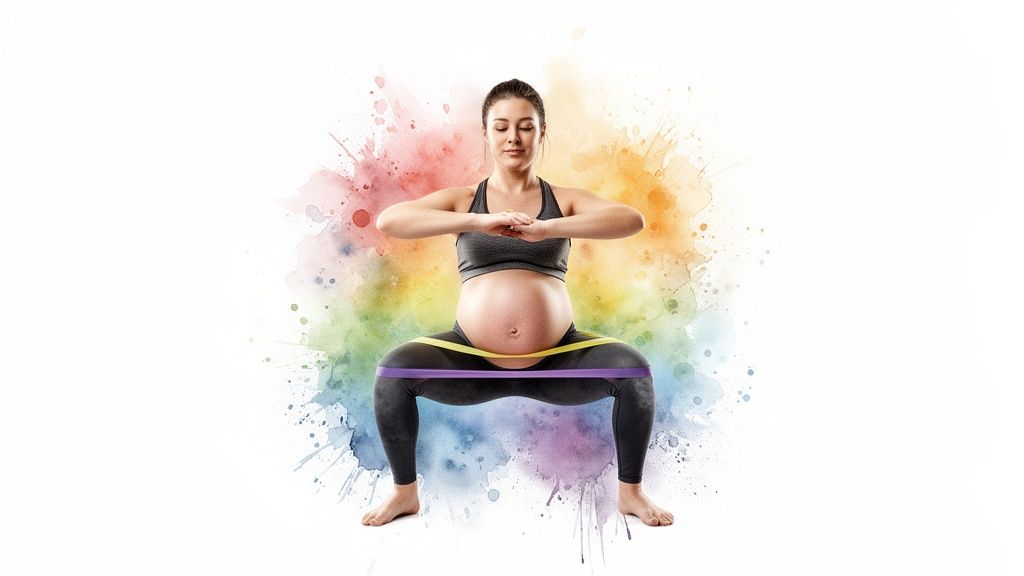
Pregnancy and the time after birth are absolute exceptions, during which your body changes fundamentally. Your training takes on a completely new role: it’s no longer about pushing your limits, but about supporting and strengthening you. Your body achieves incredible things during this time, and your fitness routine should reflect that.
It is crucial to understand the unique demands of these phases and to tailor your training accordingly. This way, you not only protect yourself and your baby but also lay the foundation for healthy recovery and long-term well-being.
Exercise is not only permitted during pregnancy but – as long as there are no medical contraindications – even explicitly recommended. Regular, adapted training can alleviate typical complaints like back pain, lift your mood, and prepare you optimally for the strains of childbirth.
Your female physiology is undergoing massive hormonal and structural changes now. The hormone relaxin loosens your connective tissue and ligaments to make room for your growing child. At the same time, your center of gravity shifts, presenting new challenges to your balance and posture.
You should pay special attention to the following now:
Two areas of your body deserve special attention during pregnancy and afterward: your pelvic floor and core muscles. They form the supporting foundation of your body and must bear a tremendous load.
A strong yet elastic pelvic floor is invaluable for childbirth and prevents later incontinence. Your deep core muscles, especially the transversus abdominis, act like a natural corset. They stabilize your spine and support the growing belly.
Imagine your pelvic floor and core as the ultimate support team for your pregnancy. Targeted training of these muscles is like an investment in an easier birth and a quicker, healthier recovery.
Examples of supporting exercises:
After childbirth, your body needs one thing above all: time. Recovery is a process that requires patience and a gentle, gradual approach. Only resume training when you get the green light from your doctor or midwife.
The focus initially is clearly on healing and reactivating the deep muscles. Start with gentle pelvic floor exercises and consciously feel into your deep abdominal muscles. Only when this foundation is stable again can you slowly and controlled increase the intensity.
Many women also experience hormonal changes after childbirth that can resemble perimenopause. Learn more about how to strengthen your base during such phases through targeted training under Strength training in perimenopause protection through muscles.Be gentle with yourself and celebrate every small progress on your way back to your strength – after all, your body has accomplished a miracle.
Okay, now you have the tools to take your training to a whole new level. It’s about taking all that knowledge about the female physiology and turning it into a plan that truly fits you and your everyday life. Your body is constantly sending you signals – the key to success is finally understanding these and responding to them.
This path means no longer viewing training as a tedious obligation but as your most powerful tool for greater well-being. Instead of rigidly sticking to a plan that exhausts you on some days, you’ll learn to manage your energy wisely and in line with your cycle. The goal? A sustainable routine that strengthens you without burning you out.
The first step is indeed the most important: Start observing your body and your cycle closely. You don’t need complicated tools or expensive gadgets for this. A simple note-taking app on your phone or a classic calendar is more than enough. Just note how you feel, what your energy level is, and how your training went that day.
After just a few weeks, you will recognize clear patterns. You will suddenly see when your absolute power phases are and when your body simply needs more rest and gentler movement. With this knowledge, you can plan your week super easily and flexibly.
Here’s what your cycle-based approach could look like:
Your body is not a clock that functions the same every day. A holistic training approach means accepting these natural fluctuations and using them as your personal superpower.
You certainly don’t have to walk this path alone. An environment that understands and supports you is invaluable. Look for coaches who are truly knowledgeable about female physiology and can give you individual advice. They will help you put theory into practice and continually adjust your plan.
A community of like-minded people can also make a huge difference. The exchange with other women who have similar experiences is incredibly motivating and gives you the feeling of truly being understood. With us in the Motherhood Club or in our courses, you will find exactly this support.
Always remember: Every good training plan requires phases of stress and relief. By learning to live this rhythm in your training, you finally work with your body instead of against it. That is the core of a training regimen that makes you strong, healthy, and satisfied in the long run.
Here we clarify the typical questions that keep coming up in training practice. These practical answers should give you more clarity and confidence so that you can tailor your training perfectly to your body and avoid classic mistakes.
It really depends on your goals, your current cycle phase, and your recovery ability. As a solid base, two to three strength training sessions per week have proven effective. This way, you give your muscles the necessary stimulus to grow while also allowing your body enough time for recovery.
Much more important than a rigid number is the regularity and how you adjust your training. In the follicular phase, when you’re bursting with energy, three intense sessions might feel just right. In the luteal phase, however, often two moderate workouts, complemented by a relaxing yoga session, are the smarter choice.
If your clear goal is muscle building, the answer is: Cardio is best after strength training or scheduled on a separate day. Why? Simply put: You want to save your full power for the heavy weights and not disturb your body’s important muscle-building signals with a preceding endurance workout.
A short warm-up of 5-10 minutes on the bike or treadmill is, of course, always a great idea to get your circulation going. However, you should consciously separate longer cardio sessions from strength training – this way each training form gets the attention it deserves.
This is probably the most stubborn myth of all, and the answer is a very clear: No. Due to your naturally much lower testosterone levels compared to men, it is practically impossible to build excessive muscle mass through natural means.
What you will get instead is exactly what most women desire:
So you build strong, functional, and lean muscles that not only make you look great but also support you in daily life.
Strength training is your best tool to shape your body and get your metabolism going. It makes you strong and defined – not bulky.
The absolute foundation is adequate protein intake. Protein provides the building blocks that your muscles desperately need for repair and growth after training. Aim for about 1.6 to 2.0 grams of protein per kilogram of body weight per day, preferably spread over several meals. For example, you could drink a protein shake after training, eat chicken breast for lunch, and choose quark as a snack in the evening.
Equally important: Eat enough! Your hormonal system reacts extremely sensitively to overly large calorie deficits. Ensure a balanced mix of complex carbohydrates for energy and healthy fats that are essential for your hormone production. The right timing can also make a difference: A protein-rich meal or shake shortly after the workout can optimally kickstart recovery.
Are you ready to shape your training so that it truly fits you and your body? At Templeshape GmbH you will find the courses, coaches, and the community that support you in making your health a habit – completely in harmony with your physiology. Discover our offerings now and find your course!
Tags