March 18
Stimulate the vagus nerve: 3 exercises against stress in everyday life – Calm down instantly
0 comments

March 18
0 comments
Do you often feel overwhelmed, tense, or just ‘off track’? Modern life places high demands on you. Between meetings, family, and the desire to stay fit, your nervous system can quickly get out of balance. The good news: you have a built-in reset button – the vagus nerve. It is the main player in your parasympathetic nervous system, responsible for calm, recovery, and digestion.
When you learn to activate it deliberately, you can not only cope with stress but also sustainably strengthen your resilience. This nerve functions as a direct communication line between your brain and many vital organs, such as the heart and the gut. Targeted stimulation sends a signal to your body to switch from fight-or-flight mode to a relaxation state.
In this article, we will show you not only why the vagus nerve is so crucial for your well-being, but also provide you with three scientifically grounded and instantly applicable exercises. Forget complicated theories; this is about practical tools that will help you stimulate the vagus nerve and effectively reduce stress in everyday life. These techniques can be easily integrated whether at the office, at home, or as part of your training. Are you ready to take back control?
Alternate nostril breathing, also known as Nadi Shodhana, is a powerful yet gentle breathing technique from the yoga tradition. Its main goal is to balance your nervous system and calm your mind. By alternately breathing through the left and right nostrils, you directly stimulate the vagus nerve. This rhythmic and controlled breathing sends calming signals to your brain, activates the parasympathetic nervous system (your ‘rest and digestion system’), and helps you step out of stress mode within minutes.
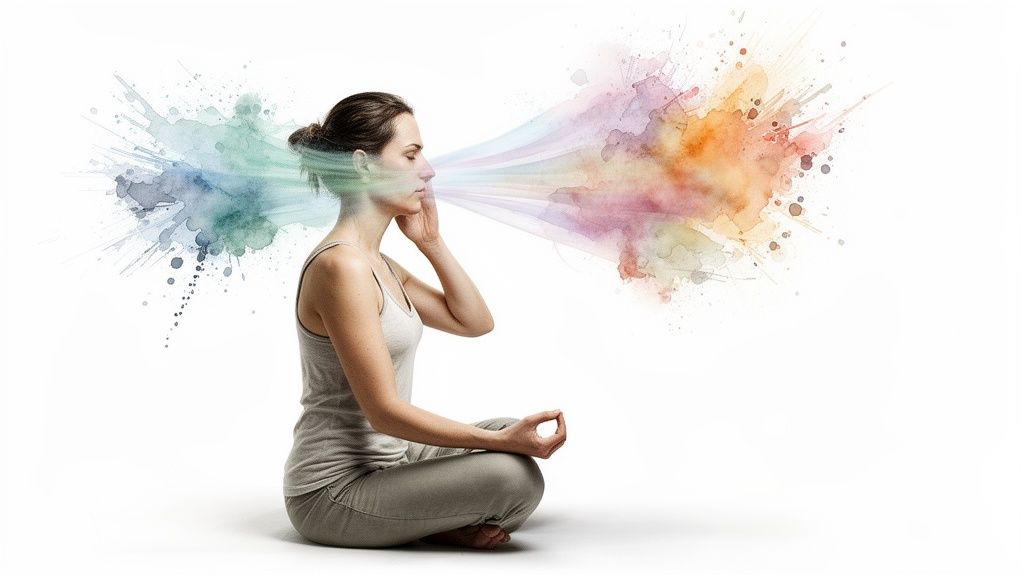
Alternate nostril breathing is a central exercise for stimulating the vagus nerve and effectively reducing stress in everyday life. It is so effective because it harmonizes your two brain hemispheres and balances the sympathetic (activating) and parasympathetic (calming) nervous systems. After just a few minutes, you’ll feel a noticeable relaxation and mental clarity.
Find a comfortable seated position, for example, in a cross-legged position (Sukhasana) on the floor or on a chair with a straight back. Your left hand rests relaxed on your left knee.
This completes one full round. Repeat this cycle for 5 to 10 rounds and feel your mind calming down.
Alternate nostril breathing can easily be integrated into your daily routine and requires no special equipment.
At Templeshape, Nadi Shodhana is an integral part of many yoga classes and breathwork sessions. In our corporate health programs, we use 5-minute sessions to provide teams with an effective recovery opportunity during lunch breaks. Many of our clients report noticeable reductions in stress levels after just two weeks of regular practice. If you want to learn more about how to master specialized breathing techniques under professional guidance, you can find a Comparison of Breathwork Studios in Zurich and Home Offers.
The extended exhale is one of the simplest yet most effective methods to deliberately stimulate your vagus nerve. The principle is simple: you exhale longer than you inhale. This altered breathing pattern, for example, inhaling for four seconds and exhaling for eight seconds, signals immediate safety and relaxation to your nervous system. The technique directly activates the parasympathetic nervous system, your counterpart to the stress system, and has been shown to slow down your heart rate.
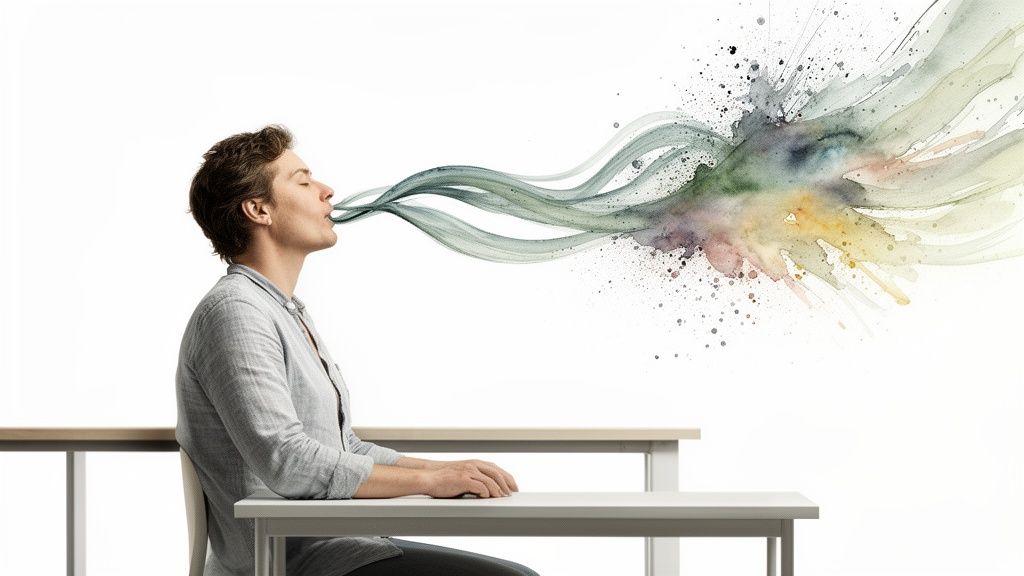
This exercise is a fundamental technique for stimulating the vagus nerve and reducing stress in everyday life. Its effectiveness has been popularized by leading neuroscientists like Dr. Andrew Huberman and is deeply rooted in Dr. Stephen Porges’ polyvagal theory. The mechanical stretch of your diaphragm during long exhales stimulates the so-called baroreceptors (pressure sensors in your blood vessels), signaling to your brain that it’s time to slow down.
You can perform this exercise anywhere, sitting, standing, or lying down. It’s important that you can focus on your breathing for a few moments.
Das Verhältnis von 1:2 (z.B. 4 Sekunden ein, 8 Sekunden aus) ist ein idealer Startpunkt. Du kannst es an dein eigenes Gefühl anpassen, solange die Ausatmung deutlich länger als die Einatmung bleibt.
Die verlängerte Ausatmung ist dein Soforthilfe-Werkzeug für akute Stressmomente, lässt sich aber auch präventiv einsetzen.
Bei Templeshape ist die verlängerte Ausatmung ein zentrales Element in verschiedensten Kursen. In unseren HIIT-Bootcamps nutzen wir sie in den Erholungsphasen, um den Puls schnell zu senken. In den Mama Workouts hilft sie Müttern, im oft hektischen Alltag Momente der Ruhe zu finden. Sogar beim Eisbaden ist sie entscheidend, um den Körper vor und nach dem Kälteschock zu beruhigen und zu zentrieren.
Der Sprung ins kalte Wasser, auch bekannt als Eisbaden oder Cold Water Immersion, ist eine der kraftvollsten Methoden, um den Vagusnerv direkt und intensiv zu stimulieren. Der anfängliche Kälteschock (durch Wasser zwischen 0 und 15 °C) löst eine kontrollierte Stressreaktion in deinem Körper aus. Genau dieser thermische Reiz aktiviert den Vagusnerv schlagartig, was zu einer schnellen Verlangsamung der Herzfrequenz und einer Vertiefung der Atmung führt. Langfristig trainierst du so die Fähigkeit deines Körpers, vom Stress- in den Entspannungsmodus zu wechseln.
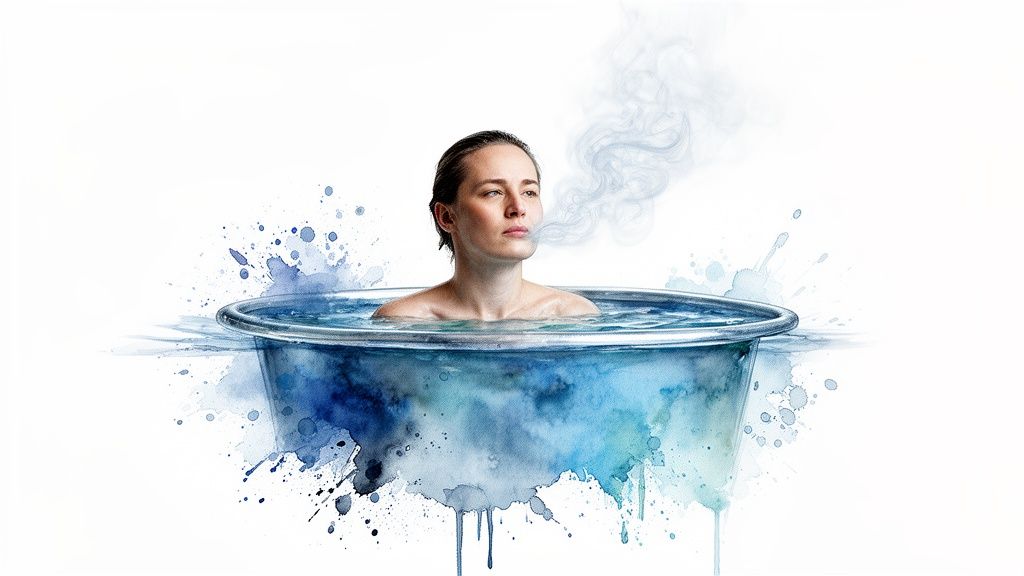
Eisbaden ist eine hocheffektive Übung, um den Vagusnerv zu stimulieren und deine Stressresilienz nachhaltig zu stärken. Durch die regelmässige, kurzzeitige Konfrontation mit Kälte verbessert sich dein vagaler Tonus. Dein Körper lernt, schneller und effizienter auf Stressoren zu reagieren, indem er die parasympathische "Bremse" aktiviert. Pioniere wie Wim Hof und Wissenschaftler wie Andrew Huberman haben diese Methode populär gemacht und ihre positiven Effekte auf das Nervensystem und die allgemeine Gesundheit hervorgehoben.
Ein sicherer und kontrollierter Einstieg ist entscheidend, um die positiven Effekte zu nutzen und deinen Körper nicht zu überfordern. Beginne niemals allein und höre immer auf deine körperlichen Signale.
Wiederhole diese Praxis regelmässig, um die besten Ergebnisse zu erzielen und deine Anpassungsfähigkeit zu steigern.
The integration of cold exposure doesn’t always have to be a full ice bath. Even small habits can make a big difference.
At Templeshape, ice bathing is a central component of our holistic approach to strengthening body and mind. In our studios Templeshape AIRPORT and Templeshape CITY we regularly offer guided ice bathing sessions that create a safe and motivating environment. Many of our corporate teams use ice bathing as a unique team-building experience, and participants report a noticeably higher stress resilience in their professional lives after just six weeks of regular practice. If you want to dive deeper into the topic, you can learn more on our page about what’s behind the ice bathing trend in Zurich.
Gargling is an often-overlooked, but scientifically supported and surprisingly simple method to stimulate the vagus nerve. This technique directly targets the muscles in your throat, which are closely connected to the vagus nerve. The gargle reflex activates both sensory and motor nerve fibers and sends a strong signal to your brain to activate the parasympathetic system – your body’s natural relaxation system.
The targeted stimulation through gargling is an effective exercise to stimulate the vagus nerve and reduce stress in everyday life. By creating vibrations and muscle contractions in the throat, you clinically lower your heart rate and promote a state of calm. This quick and uncomplicated method can be effortlessly integrated into your daily routine and acts as an instant reset button for your nervous system.
For this exercise, you only need a glass of water. Saltwater can enhance the effect, but regular tap water is also effective.
Repeat this process one to three times daily to achieve a sustainable effect and train your vagus nerve.
Gargling is one of the easiest techniques to stimulate the vagus nerve and can be seamlessly integrated into your daily routine.
At Templeshape, we often recommend gargling as a complementary technique in our breathwork and corporate health programs. It’s a ‘quick win’ that helps employees quickly ground themselves and focus. Singers also use this method to warm up their vocal cords while simultaneously reducing stage fright. This exercise powerfully demonstrates how simple and effective vagus nerve stimulation can be.
The vagus nerve massage is a direct, manual technique to specifically calm your nervous system. Through gentle pressure and massaging movements at specific points on the neck, particularly along your large neck muscle (Musculus sternocleidomastoideus) and near the carotid sinus, your vagus nerve is mechanically stimulated. This targeted touch activates important baroreceptors that regulate your blood pressure and signal your brain to switch into relaxation mode. This activates the parasympathetic system and produces an immediate calming effect.
This method is particularly effective because it combines the principles of acupressure with modern anatomical knowledge. It is one of the fastest ways to stimulate the vagus nerve and reduce stress in everyday life. Just two to three minutes of this self-massage can be enough to create a feeling of deep calm and serenity.
Find a comfortable position sitting or standing, where your neck and shoulder muscles are relaxed. Breathe deeply a few times before you begin.
Be sure to breathe deeply and calmly throughout the exercise to enhance the relaxing effect.
The vagus nerve massage is a discreet and highly effective exercise you can do anywhere.
At Templeshape, we strategically integrate such manual relaxation techniques into our offerings. In personal training sessions, we use the vagus massage as part of the cool-down phase to accelerate recovery. We also employ neck massages in our yoga classes to deepen the final relaxation. These simple yet effective methods are a cornerstone of our philosophy. Learn more about how you can find your inner balance through such techniques in our guide on Mindfulness in Everyday Life.
| Technique | 🔄 Implementation complexity | ⚡ Resources / Effort | ⭐ Expected effectiveness | 📊 Results & timeframe | 💡 Ideal application / Benefits |
|---|---|---|---|---|---|
| Alternate nostril breathing (Nadi Shodhana) – Pranayama breathing technique | Low–medium; initial exercise/instruction recommended | No equipment; 5–15 min/day | ⭐⭐⭐⭐ Calming, improves hemispheric balance & focus | Immediate calming (5–10 min); cumulative stress reduction after 2–3 weeks | Brief breaks, meetings, yoga and breathwork integration; free, low side effects |
| Extended exhale breath ratio technique | Very low; easy to learn | No equipment; 1–5 min/application | ⭐⭐⭐⭐⭐ Quickest acute stress relief | Acts in 2–3 breaths; regular practice for lasting effects | Before meetings/training, sleep preparation, on the go; immediately applicable |
| Cold water / ice bathing (Cold Water Immersion) – Thermogenic vagal stimulation | High; requires guidance, caution with pre-existing conditions | Access to ice bath or cold water, 30s–3min sessions, build-up over weeks | ⭐⭐⭐⭐⭐ Long-term strongest vagal toning and resilience | Immediate cold shock; tolerance & physiological adjustment in 4–6 weeks | Recovery, retreats, team building, athletic target groups; transformative but challenging |
| Gargling – Parasympathetic muscle activation | Very low; easily applicable everywhere | Water or saltwater; 30–60 seconds per application | ⭐⭐⭐ Short-term, reliable vagus activation | Immediate HRV improvement; effect lasts about 3–4 hours, repetition needed | Office quick wins, singers, busy professionals; discreet, low-risk use |
| Vagus nerve massage (neck massage & carotid point) – Manual stimulation | Medium–high; anatomical know-how recommended | No devices; guidance/partner recommended; 2–3 min per side | ⭐⭐⭐⭐ Targeted mechanical stimulation, reduces tension | Quick local relaxation; cumulative benefits with regular use | Personal training, cool-downs, partner workshops; pairs well with breathing techniques |
In this article, you have learned three simple yet highly effective exercises to stimulate your vagus nerve and actively respond to stress in everyday life. From balancing alternate breathing to focused, prolonged exhalation to manual neck massage – each of these techniques provides you with direct access to your parasympathetic nervous system, your body’s own “calm oasis.”
However, the true power of these methods unfolds not through a one-time attempt but through consistent repetition. Regularity is the key to sustainably recalibrating your nervous system and strengthening your resilience against the challenges of everyday life. It’s about turning an exercise into a habit.
The thought of establishing a new routine can feel overwhelming. But the trick is to start small. Instead of committing to practice for 30 minutes every day from now on, start with a realistic goal.
These small, conscious breaks are an investment in your long-term health. They not only help you relieve acute stress but also train your ability to respond more calmly to future stressors.
The targeted stimulation of the vagus nerve is a powerful tool. However, for sustainable serenity, it is equally crucial to identify and minimize unnecessary sources of stress in your life. Often, it’s the small, everyday burdens that accumulate and overwhelm your system. Learn how to reduce stress from unnecessary paperworkto create more mental space for yourself.
Ultimately, caring for your nervous system is an act of self-care. By consciously taking the time to pause, breathe, and listen to your body, you send a clear message: Your well-being is a priority.Start today by incorporating these simple exercises into your personal routine. Your future, more relaxed self will thank you.
Are you ready to dive deeper into the world of conscious relaxation and make stress management a firm habit? At Templeshape GmbHin Zurich, we will guide you on this path with professionally led courses such as breathwork, yoga, and ice bathing. Discover in our community how to bring body and mind into harmony, and find the right offer for you at Templeshape GmbH.
Tags