March 19
Mitochondria: The cellular powerhouse against chronic fatigue – More energy every day
0 comments

March 19
0 comments
Do you know that feeling? You actually slept well, but you still feel like you’re going through the day with the handbrake pulled? This feeling of inexplicable exhaustion often has a deeper cause, at a cellular level. The key to your energy lies in your mitochondria – the tiny powerhouses of your cells. When their performance decreases, you feel it as chronic fatigue, which can practically paralyze your daily life.

Imagine your body like a vast bustling city. Each cell is a building that needs electricity to function. And in each of these buildings? Thousands of tiny energy powerhouses are running at full capacity – these are your mitochondria. Their role is to convert the nutrients in your diet into the universal energy currency of our body: adenosine triphosphate (ATP).
Without enough ATP, your muscles can’t function properly, your brain can’t think clearly, and your immune system weakens. You don’t just feel tired; you feel deeply and fundamentally exhausted.
Our modern lifestyle is often the greatest enemy of our mitochondria. There are a multitude of factors that disrupt their functioning and hinder the crucial production of ATP. The result is felt directly as a lack of energy.
Some of the most common energy thieves include:
All these burdens mean that your cellular batteries are no longer fully charged. The result is a heavy fatigue that simply cannot be dispelled by a single night of sleep.
Here’s the crucial point:Chronic fatigue is rarely just a feeling. It is often a direct biological signal showing you that your cells can no longer produce the energy your body needs for an active daily life.
If you constantly feel powerless, you are part of a growing group. The CSS 2025 health study revealed that last year, a shocking 69 percent of Swiss aged 18 to 35 experienced burnout and fatigue. One of the main reasons: when mitochondria are slowed down by stress or nutritional deficiencies, ATP production dramatically drops – and that explains the debilitating fatigue. You can learn more about the study’s findings in the article on The health of young adults on css.ch.
The good news is: you can take back control of your cellular energy. You are not powerless against these empty batteries. By understanding the causes and applying targeted strategies, you can get your mitochondria back in shape and renew your baseline energy. This article shows you how to recognize the warning signs and activate your cellular power against chronic fatigue.

Chronic fatigue is much more than just tiredness after a short night. It’s a devouring exhaustion that envelops your daily life like a heavy cloak and holds you in its grip. When your mitochondria, your tiny cellular powerhouses, are no longer operating at full capacity, your body sends you very clear warning signals.
The key is not to ignore these signals, but to interpret them correctly. You need to learn to distinguish normal, temporary fatigue from a deeper cellular problem. Because only when you truly understand the language of your body can you take targeted countermeasures and reactivate your cellular power.
Do you know this? You do what seems to be a small effort – a walk, a focused meeting – and you feel like you’ve been crushed by a truck for days afterward. This phenomenon is not a product of your imagination; it has a name: Post-exertional malaise (PEM). It is probably the clearest sign that your mitochondria are seriously out of sync.
Imagine your body reacting to climbing stairs as if you had just run a marathon. That’s how PEM feels. It’s a massive, often delayed deterioration of your condition after physical, mental, or emotional exertion. This extreme reaction is not imaginary but has a solid biological cause.
PEM is the revealing symptom indicating that your cells can no longer meet the energy demand after exertion. Your mitochondria simply cannot produce new ATP quickly enough. The result is a complete energy collapse.
Unfortunately, this symptom is more common than one might think. In Switzerland, experts estimate that between 17,000 and 34,000 people are affected by chronic fatigue syndrome (CFS), where mitochondrial dysfunction is often at the root of the problem. The exhaustion over several days observed with PEM can be attributed to a reduction in ATP production of up to 50%in the mitochondria. You can read more about this epidemic in the Blick article on chronic fatigue.
In addition to PEM, several other signs often occur together and indicate weakened mitochondria. They affect not only your body but also your mind.
Listen to yourself and see if the following feels familiar:
If these signs seem all too familiar and significantly limit your daily life, it’s time to take a closer look. These are undeniable calls for help from your body, indicating that your cellular energy reserves are depleted – and that it’s time to seek professional assistance.
Exercise is likely the most powerful lever you have to improve the quantity and performance of your mitochondria. However, this is where many make a critical mistake: with chronic fatigue, it is not about exhausting yourself completely. It’s about providing the right smart stimuli that encourage the growth of your cellular power plants, rather than overloading them.
Once you understand this mechanism, exercise transforms from a tedious obligation into your best ally against fatigue. Some training methods signal your cells to build new, more efficient mitochondria – a process known asmitochondrial biogenesis. .
One of the most effective approaches to stimulating this regeneration process ishigh-intensity interval training (HIIT).The concept is brilliantly simple: you alternate between very short bursts of extreme effort and very brief moments of rest.
Imagine giving it your all for 30 seconds – whether sprinting, cycling, or doing basic bodyweight exercises. Right after, you allow yourself a short break. This sudden change from maximum effort to recovery sends an urgent signal to your muscle cells indicating an acute lack of energy.
Your cells interpret this brief, intense stress as an alarm signal. Their response is a pure survival strategy: they begin to produce more efficient mitochondria to be better prepared for the next challenge.
This targeted training stress is precisely the opposite of chronic daily stress. While constant stress deteriorates your mitochondria, HIIT activates them in a way that strengthens them. You literally force your body to improve its energy infrastructure. You can learn more about this in our article thatpresents you with 10 compelling reasons why high-intensity training will transform your life..
A typical HIIT session, as we do at Templeshape, might look like this:
Just a few sessions of this type per week can significantly increase the amount of your mitochondria and thus raise your baseline energy levels.
But it’s not always necessary to push to the max. While HIIT increases thenumberof your mitochondria, gentler practices like yoga can significantly improve theirefficiency.Especially in cases of chronic fatigue, a balanced approach that integrates both is often the key to success.
Yoga works at a completely different, yet equally vital, level for the health of your cells:
A smart plan, as we advocate at Templeshape, merges these two areas. For example, you could participate in a demanding HIIT or Bootcamp training twice a week to stimulate new mitochondria generation. On the other days, you support your body with a restorative yoga session to relieve stress and optimize the efficiency of your existing energy hubs.
This combination ensures that you challenge your body but never overload it. This is precisely what makes the difference: you harness positive training stress to become stronger and avoid the harmful chronic stress that drains you. Thus, you completely restore your energy, cell by cell.
Movement is a powerful lever for your cellular power plants. However, there are other equally effective methods to energize your mitochondria and renew your vitality in a targeted way. Your cells react extremely sensitively to positive and targeted stress signals – and two of the most powerful tools for this are conscious breathing and cold exposure.
These techniques may initially seem intense, but they act as a reboot for your entire cellular system. They help you reduce stress at the deepest level and revitalize energy production directly at the source.
Breathing is much more than just inhaling air. It’s your direct switch to regulate your nervous system and flood your cells with energy. Through targeted breathing techniques, also known asbreath work,you can consciously improve the oxygen saturation in your blood. Why is this so crucial? Oxygen is the essential fuel for your mitochondria.
Imagine that you provide your cells exactly what they need most for ATP production. Techniques like Wim-Hof breathing – a type of controlled hyperventilation followed by breath-holding phases – create short, intense physiological stress. This stimulus trains your cells to use oxygen much more efficiently and to become overall more resilient.
By breathing consciously, you take active control of processes that normally happen entirely automatically. You give your mitochondria exactly the kick they need to recover from an energy dip and significantly improve their performance.
Just like breathing, targeted cold also acts as a powerful positive stimulus for your cells. A brief immersion in icy water triggers a powerful biological reaction known asHormesis.In simple terms: a short, intense stress stimulus forces your body to adapt – and thus makes it stronger and more resilient.
As soon as your body is exposed to cold, your mitochondria respond immediately. They are prompted to increase heat production, improving their efficiency. More importantly, this cold stimulus stimulates the previously mentioned mitochondrial biogenesis. Your body thus begins to create new, healthy, functional mitochondria.
This chart clearly illustrates how targeted stimuli like HIIT or yoga directly influence your cellular power plants.
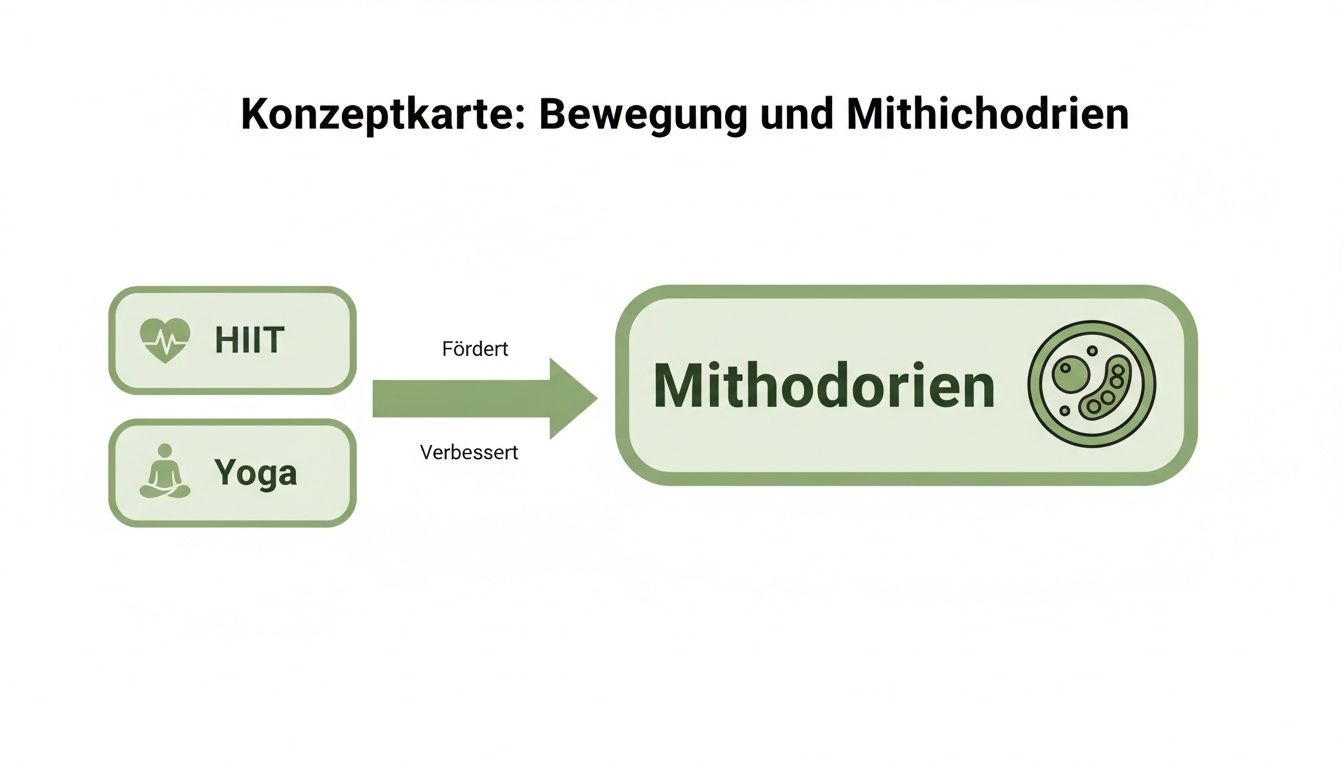
It is clear that a mix of intense and regenerative methods is necessary to holistically promote mitochondrial health.
The feeling after a session in an ice bath is hard to put into words: a wave of clarity, focus, and pure energy washes over your body. You feel awake, alive, and incredibly powerful. This is the direct result of activating your mitochondria and releasing neurotransmitters like norepinephrine. You will learn more about this unbeatable combination in ourFire & Ice at Templeshape..
The combination of breathing and cold exposure is an extremely effective strategy for sustainably recharging your cellular batteries. You learn to create targeted stimuli that not only do not fatigue your body, but encourage it to improve its own energy infrastructure. This is how you tackle chronic fatigue directly at its source – in the powerhouses of your cells.
Knowing the best strategies for your cellular power plants is the first crucial step. But the real magic happens only when you integrate this knowledge into your often chaotic daily life. The best plans are useless if they do not fit your work, family, and all your other obligations.
This is precisely where we come in. This section is your practical guide for implementation. It is not about radical changes overnight, but rather small, realistic steps. These integrate perfectly into your schedule and, altogether, make a huge difference for your energy levels.
Is your workday in Zurich organized in such a way that there is little room for you? We understand this all too well. But it is precisely in these moments that small islands of energy are absolutely crucial to support your mitochondria and prevent burnout.
Here are a few simple but extremely effective strategies for your work life:
These small habits take little time but constantly send this signal to your body: regeneration and energy production take priority.
It is about making health a habit, not another boring task on your to-do list. A smoothie in the morning, a short stretch before the first call – these micro-habits add up to create a powerful routine.
As a mother, you juggle countless tasks, and your personal energy often suffers. But you are precisely the one who needs fully charged batteries. The key lies in creating small conscious rituals for yourself while the kids are busy or sleeping.
Here are some concrete tips that really work:
In addition to these lifestyle adjustments, you can also support energy production in your cells by using certain specific nutrients. If you want to learn more about how certain coenzymes enhance your mitochondrial function, read ourdetailed guide on NMN (Nicotinamide Mononucleotide).This is how you create the best conditions for your body to regain its strength.
Okay, now you understand the big picture: Your energy is directly linked to the health of your tiny cellular factories, the mitochondria. You know which warning signals from your body to monitor and you’re familiar with clever methods – from HIIT to yoga, breathing work, and cold exposure – to recharge your cellular batteries. Now, comes the most important part of the whole journey: the first step.
And don’t worry, this path doesn’t have to be complicated. At Templeshape, we’ve designed everything to make your entry as simple and enjoyable as possible. We meet you exactly where you are and guide you step by step towards more power and joy in life – without performance pressure.
We know that no two days are alike. That’s why you can find us at two central locations in Zurich that perfectly fit into your day. Each location has its own character, allowing you to find exactly what you need at that moment.
Whatever location you choose, you’ll always land in a community that motivates and supports you. With us, there’s no competition, just the common goal of living healthier and more energetically.
What’s the best way to know if our approach works for you? Just try it. We want you to get to know us and our classes before you commit.
Your journey to more energy is not a sprint, but a marathon, where every step counts. The most important is the first – and we help you take it with joy and confidence. Your cellular energy is just waiting to be awakened by you.
Are you ready to recharge your batteries? Then start now simply with a trial workout. Discover which class and location suit you best and feel for yourself what’s possible.
Book your trial workout at Templeshape now and begin your journey to new energy today!
As you embark on the path to regain your energy and leave chronic fatigue behind, questions naturally arise. That’s a good sign! It means you’re starting to understand your body on a much deeper, cellular level.
To give you a bit more clarity and security on this path, we’ve addressed the most common questions here. They are designed to help you avoid typical pitfalls and ensure that your efforts to activate themitochondria as cellular power against chronic fatigueare truly rewarded.
This is probably the question on everyone’s mind. The honest answer: It’s very individual and depends a lot on your current situation and consistency. Your mitochondria are not switches that you can simply turn on. Their regeneration is a biological process that simply takes time.
Some people notice a slight improvement after just one to two weeks of consistent changes – that is, with an adjusted diet and targeted movement. However, truly visible and especially stable results generally appear only afterfour to twelve weeks.Give your body that time. It needs to build new, stronger mitochondria and repair damaged cells.
Always remember: You’re working to reverse a condition that has often developed over years. Patience is your strongest muscle here. Every small step today is an investment in your energy for tomorrow.
Oh yes, absolutely! Especially when you’re chronically exhausted, it’s one of the biggest traps. Short, targeted stimuli like HIIT can stimulate the formation of new mitochondria, but too much stress does exactly the opposite. If you overload your body before it has had a chance to recover, you create massive oxidative stress.
This stress harms your mitochondria instead of strengthening them and can plunge you even deeper into exhaustion. Pay attention to the signals from your body, especially to what is calledpost-exertional malaise (PEM).This is heavy and delayed fatigue that can occur hours or even days after exertion. Always adjust your training according to your daily shape and plan fixed recovery days – they are just as important as the training itself.
Think of your mitochondria as tiny engines. For them to work properly, they need the right ‘fuels.’ If these essential micronutrients are lacking, the entire apparatus weakens.
Here are some of the most important aids for your cellular factories:
The basis is always a balanced diet, rich in vegetables, healthy fats, and high-quality proteins. The need for targeted supplementation to fill gaps should be discussed with your doctor.
Are you ready to systematically recharge your cellular batteries? AtTempleshape, we accompany you with the perfect mix of activating workouts, regenerative classes, and a community that understands and supports you. Learn to make your health a habit – cell by cell. Discover more and start your journey athttps://templeshape.com.
Tags