March 18
Sugar Myth: Why Natural Carbs Support Your Thyroid – Myth Debunked
0 comments

March 18
0 comments
Do you often feel tired and unmotivated or struggle with your weight, even though you think you are eating ‘healthy’? You’ve likely heard countless times that sugar and carbohydrates are the real villains that sabotage your metabolism. Yet this widespread sugar mythoverlooks a crucial truth: High-quality, natural carbohydrates are not an enemy, but the essential fuel for your thyroid.
The constant panic about carbohydrates has led many of us to lump all carbs together. For your hormonal balance, this can be a fatal mistake. Imagine your thyroid – this small, butterfly-shaped gland in your neck – as the powerhouse of your body. It controls how quickly you burn energy, and has its fingers in the pie when it comes to your mood, digestion, and even your body temperature.
To get this important job done, it needs the right fuel. And that is natural carbohydrates.
Think of your body as a high-performance car built for optimal power. What happens when you fill the tank with cheap, dirty gas? The engine stutters, loses power, and just doesn’t run smoothly. The same thing happens when your diet mainly consists of refined sugar – that is, sweets, pastries, and sugary drinks.
This ‘cheap gas’ causes rollercoaster rides of your blood sugar, fuels inflammation, and stresses your entire system, including your thyroid.
High-quality, natural carbs, on the other hand, are like premium fuel. You can find them in:
These complex carbohydrates provide your body with steady and long-lasting energy. They also bring important fibers, vitamins, and minerals that your thyroid urgently needs for smooth hormone production. The indiscriminate demonization of carbohydrates therefore robs your body of this crucial fuel. Learn more about what the the problem with modern dietsreally is and why radical abstinence is often the wrong way.
To make this more tangible, here is a little comparison:
This table contrasts common myths about carbohydrates with scientific facts, showing you at a glance what your thyroid really needs.
| The myth | The scientific reality | What this means for you |
|---|---|---|
| “All carbohydrates are bad and make you fat.” | Refined sugar and complex carbs act completely differently. Natural, fiber-rich carbohydrates stabilize blood sugar and provide sustainable energy. | Clearly differentiate between a sweet potato and a piece of cake. One is fuel, the other is a short-term kick with consequences. |
| “A low-carb diet is the best way to lose weight and rev up metabolism.” | Your thyroid needs glucose (from carbohydrates) and insulin to convert the inactive hormone T4 into the active T3. A deficiency can slow down this process. | If you are constantly tired and not losing weight, a too strict low-carb diet may be hampering your thyroid. |
| “Sugar is poison for the body.” | Refined sugar in excess promotes inflammation and stresses the body. Natural sugar from fruits comes packaged with vitamins, minerals, and fibers that slow down absorption. | Enjoy fruits without guilt! They provide essential nutrients that your thyroid loves. Instead, reduce added sugars. |
As you can see, it’s about quality and not just category. The right choice makes the difference.
A look into the past shows impressively how crucial proper nutrient supply is. Imagine Switzerland at the beginning of the 20th century. In many regions, especially in the alpine valleys, people suffered from huge swellings in the neck – the so-called goiter. This image was common, and the cause was a massive iodine deficiency. According to historical records, in some cantons like Bern or Graubünden, up to 50 percent of the populationwere affected.
This story teaches us an important lesson: A single missing nutrient can incapacitate an entire system.
Today, we are largely managing iodine deficiency thanks to iodized salt. But the principle remains the same: Your thyroid relies on a constant supply of very specific nutrients.
The modern ‘goiter’ may no longer be visibly swollen, but it manifests in symptoms like chronic fatigue, weight gain, and lack of motivation. The cause often lies not in abstinence but in the wrong selection of foods.
So it’s not about completely cutting out carbohydrates. It’s about choosing the right ones. The combination of nutrient-rich, natural carbs and essential trace elements makes your thyroid a true super organ – for more energy and joy in your everyday life.
Did you know that your thyroid cannot function properly without an adequate intake of carbohydrates? It is the engine of your metabolism and needs the right fuel to provide you with energy. When this fuel is lacking, your body switches to a sort of emergency mode – and the result is often fatigue and unexplained weight gain.
The fascinating mechanism behind this is hormone conversion. Your thyroid mainly produces the hormone thyroxine, better known as T4.The problem is: T4 is mostly inactive. You can think of it like a key that doesn’t quite fit in the lock.
For this hormone to unleash its full effect, your body must first convert it into the highly active hormone triiodothyronine, or T3, to convert. T3 is the actual power hormone that signals your cells to burn energy and kickstart the metabolism. And this is where natural carbohydrates come into play.
This crucial conversion step takes place mainly in your liver and kidneys. The entire process relies on a specific enzyme whose function directly depends on whether enough glucose is available. Glucose is the simplest form of sugar that your body derives from carbohydrates.
Without enough glucose in the blood, this process slows down drastically. Your body interprets a lack of carbohydrates as an emergency signal, a kind of famine or stress situation. Its logical response? Save energy. It reduces the conversion of T4 into the active T3 to slow down the metabolism and conserve valuable resources.
Imagine your metabolism like the heating system in your house. The inactive T4 is the fuel stored in the basement. Natural carbohydrates provide the power (glucose) to pump this fuel up and turn on the heating (your active T3). Without the power, the fuel remains unused in the basement and the house gets cold.
This concept map shows the difference between good and bad fuel for your thyroid.
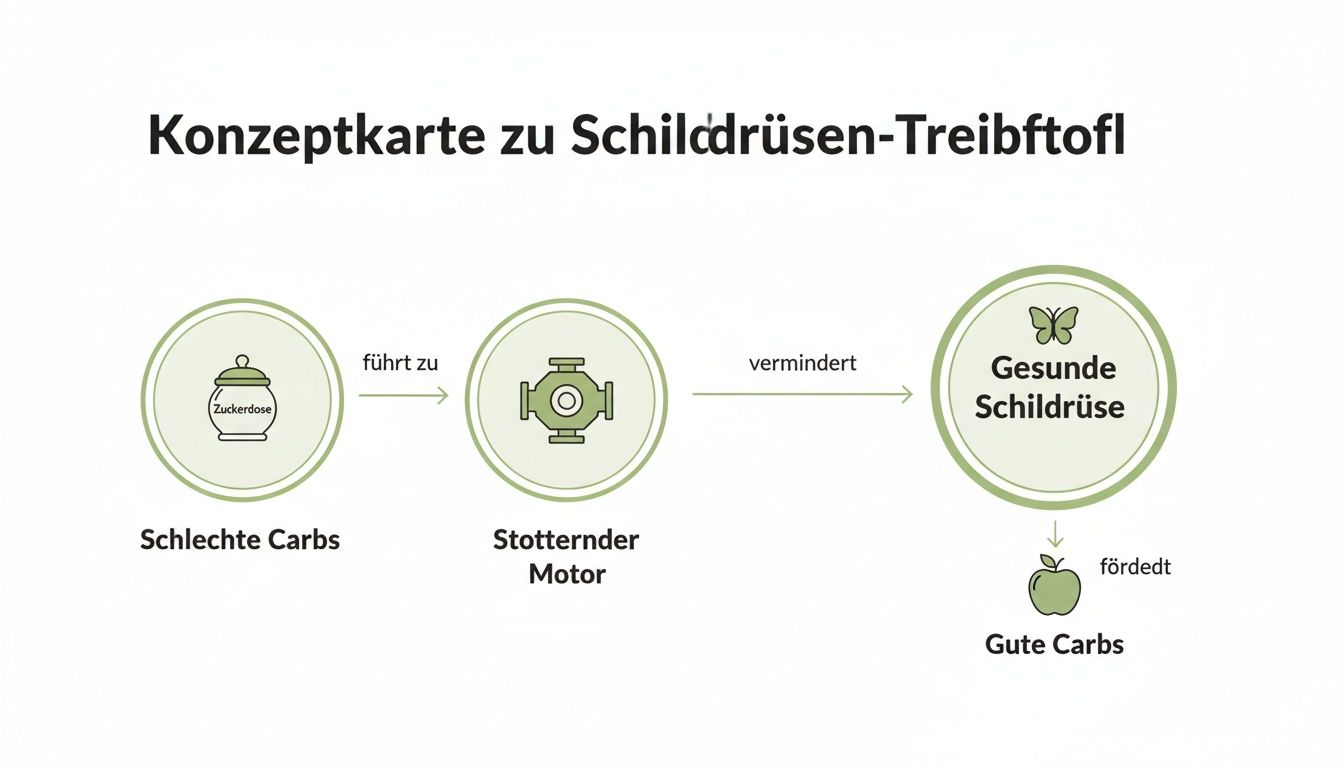
As you can see, bad carbohydrates like refined sugar lead to a stuttering metabolic engine, while good carbohydrates from natural sources make your thyroid bloom like a butterfly.
You may be wondering how insulin fits into this picture. After all, insulin often has a bad reputation because it’s associated with sugar spikes. But once again, the quality of the carbohydrates makes all the difference. Insulin is a hormone that your body releases after eating carbohydrates to shuttle glucose from the blood into the cells.
For your thyroid, it plays a supportive role. A moderate and stable insulin level, as seen after consuming complex carbohydrates, signals safety and energy availability to the body. This signal is an important co-factor for the smooth conversion of T4 to T3.
It only becomes problematic with constant and high insulin spikes caused by refined sugar and white flour products. These lead to blood sugar fluctuations and can promote inflammation in the body long-term – putting extra stress on your thyroid.
Here you see why the choice of your carbs is so important:
Refined carbs (e.g., white bread, sweets):
Natural, complex carbs (e.g., whole grains, legumes, sweet potatoes):
A diet rich in whole grains, lentils, quinoa, and starchy vegetables nourishes your thyroid instead of stressing it. It provides the necessary fuel for hormone activation and creates a stable environment in which your metabolism can run optimally.
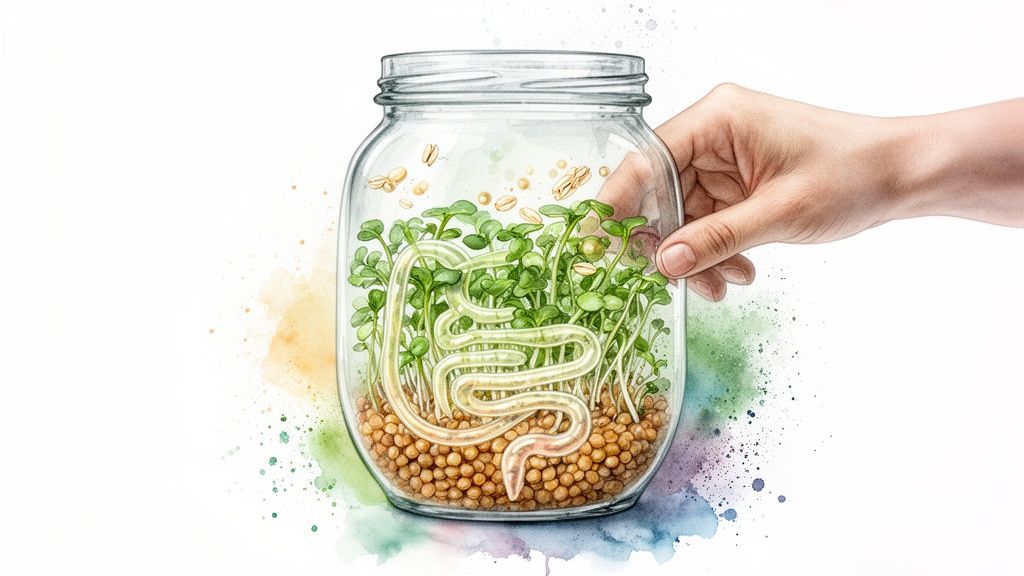
Did you know that your thyroid has a close ally that is far too often overlooked? This ally is your gut. It is so much more than just a digestive organ – it is a real command center that communicates directly with your thyroid and significantly influences its function.
This communication occurs through a fascinating community of trillions of microorganisms: your gut microbiome. These beneficial bacteria are absolutely essential for your health. One of their most important tasks is to support your thyroid hormones. In fact, around 20% of the conversion from inactive T4 to the active power hormone T3 takes place directly in your gut.
A healthy microbiome is like a diligent team of helpers ensuring that the final, crucial step of hormone activation runs smoothly. But of course, this team also needs the right food to stay efficient.
Imagine your gut like a blooming garden. The good bacteria are the useful plants that bear fruit and keep the weeds at bay. Harmful bacteria are the weeds that overgrow everything if given the chance. The food you give this garden decides what grows.
The absolute favorite food of your good gut bacteria is fiber, also known as dietary fibers. These indigestible carbohydrates from plant foods are a true feast for your microbiome. When the bacteria ferment these fibers, they produce short-chain fatty acids like butyrate as a thank you. These have anti-inflammatory effects and strengthen your gut lining.
A diet high in refined sugar and processed foods does the exact opposite. It feeds the harmful bacteria and leads to an imbalance that experts refer to as dysbiosis.
A dysbiosis in the gut is like a smoldering fire in the body. It promotes silent inflammation, which not only impairs your digestion but also directly disrupts the delicate thyroid function and can block the important hormone conversion.
The quality of your carbohydrates is therefore the key to a healthy gut and thus to a happy thyroid.
In Switzerland, people eat a lot of carbohydrates. On average, we consume between 350 and 385 grams daily. However, the problem lies not in the quantity but in the quality, which additionally fuels the sugar myth. Alarmingly, 84 percent of this intake comes from grains and added sugars, while the crucial dietary fibers are clearly falling short at only 22-26 grams per day. At the same time, an estimated 15 to 20 percent of the Swiss population has thyroid problems. You can find more details on the consumption of carbohydrates in Switzerland here.
These figures clearly illustrate how important it is to shift the focus from pure quantity to the quality of the carbs in order to optimally support the thyroid.
Dein Mikrobiom zu stärken, ist einfacher, als du vielleicht denkst. Es geht nicht um komplizierte Diäten, sondern darum, bewusst nährstoff- und ballaststoffreiche Lebensmittel in deinen Alltag zu integrieren. Hier sind ein paar einfache Beispiele:
Indem du deinen Darm bewusst mit diesen natürlichen, ballaststoffreichen Kohlenhydraten nährst, schaffst du die ideale Umgebung für eine gesunde Hormonumwandlung. Du unterstützt also nicht nur deine Verdauung, sondern stärkst aktiv die verborgene Verbindung zu deiner Schilddrüse und legst damit den Grundstein für mehr Energie und Wohlbefinden.
Die Theorie klingt ja ganz gut, aber die eigentliche Herausforderung beginnt im Supermarkt und in deiner Küche, stimmt’s? Dein Alltag ist wahrscheinlich schon vollgepackt. Wie also schaffst du es, dieses Wissen umzusetzen, ohne dass gesunde Ernährung zum nächsten grossen Stressfaktor wird?
Keine Sorge, es geht nicht darum, dein Leben von heute auf morgen komplett umzukrempeln. Es geht um kleine, bewusste Anpassungen, die einen riesigen Unterschied für deine Schilddrüse und dein Energielevel machen. Sieh diesen Abschnitt als deinen praktischen Leitfaden, massgeschneidert für ganz unterschiedliche Lebenssituationen.
Als Berufstätige in Zürich kennst du das sicher: lange Arbeitstage, schnelle Mittagspausen und das gefürchtete Nachmittagstief, das dich direkt zum nächsten schnellen Zucker greifen lässt. Aber genau hier kannst du ansetzen und deine Schilddrüse gezielt unterstützen. Dein Ziel ist es, deinen Blutzucker stabil zu halten, damit du konstant Energie hast.
Ein konkretes Beispiel:
Die Zeit während und nach der Schwangerschaft ist hormonell eine absolute Ausnahmesituation. Dein Körper leistet Unglaubliches, und dein Energiebedarf schiesst in die Höhe. Gleichzeitig bleibt oft kaum Zeit für aufwendige Mahlzeiten. Schnelle, nährstoffreiche Snacks und einfache Gerichte sind hier Gold wert.
Dein Körper braucht jetzt vor allem eines: konstanten, hochwertigen Treibstoff. Natürliche Kohlenhydrate sind dabei kein Luxus, sondern eine Notwendigkeit, um deine Energiereserven aufzufüllen und deine Schilddrüse in dieser sensiblen Phase zu unterstützen.
Hier ein paar simple Beispiele:
Der Jodstatus in der Schweiz ist dank jodiertem Salz zwar generell gut, aber gerade in stressigen Lebensphasen ist die richtige Nährstoffkombination entscheidend. Ein Bericht des Bundesamtes für Lebensmittelsicherheit und Veterinärwesen (BLV) zeigte 2019, dass Brot und Fertigprodukte eine der Hauptquellen für Jod sind. Umso wichtiger ist es, auf hochwertige, natürliche Kohlenhydrate mit einem niedrigen glykämischen Index zu setzen. Vollkornprodukte, Gemüse und Hülsenfrüchte helfen, Blutzuckerspitzen zu vermeiden, die Entzündungen fördern und deine Schilddrüse unnötig stressen können. Wenn du mehr über die Ernährungssituation in der Schweiz erfahren möchtest, findest du hier den umfassenden Bericht.
Als Sportlerin weisst du, wie entscheidend Energie für deine Leistung und Regeneration ist. Das richtige Timing deiner Kohlenhydrataufnahme kann da den Unterschied ausmachen. Carbs sind nun mal der wichtigste Treibstoff für deine Muskeln während intensiver Trainingseinheiten.
Vor dem Training (ca. 1-2 Stunden vorher):
Dein Ziel ist es, die Glykogenspeicher deiner Muskeln aufzufüllen. Eine leicht verdauliche Mahlzeit mit komplexen Kohlenhydraten ist dafür ideal.
Nach dem Training (innerhalb von 1-2 Stunden):
Jetzt geht es darum, die verbrauchte Energie schnell wieder aufzufüllen. Damit leitest du die Regeneration ein und kannst Muskelkater reduzieren.
Indem du deine Kohlenhydratzufuhr strategisch planst, optimierst du nicht nur deine sportliche Leistung, sondern unterstützt auch aktiv deine Schilddrüsenfunktion und deinen gesamten Hormonhaushalt. Ein fundiertes Wissen über den Wandel vom Ur-Getreide zur Massenvermahlung kann dir dabei helfen, die besten Quellen für deine Ernährung auszuwählen. So wird deine Ernährung zur Grundlage für Kraft, Ausdauer und Wohlbefinden.
A smart diet with natural carbohydrates is an incredibly powerful tool to support your thyroid and simply feel better. But – and this is really important to emphasize – while diet is the foundation, it never replaces a professional medical diagnosis. This section should help you recognize when self-optimization reaches its limits and it’s time to consult a professional.
Your body often sends quite clear signals when something is out of balance. You should not take these signs lightly, especially if they persist. Be sure to visit a doctor if you notice one or more of the following symptoms.
Both hypothyroidism and hyperthyroidism can manifest through a variety of symptoms. Be particularly attentive to these warning signals:
If this sounds familiar, it is really time for a medical evaluation. A targeted blood test will quickly bring clarity.
A professional diagnosis is crucial for getting to the bottom of your symptoms and starting the right treatment. Your doctor will usually check specific blood values for this.
The most important parameters are:
A medical evaluation is not only important for acute symptoms. In certain life stages, you should also think about preventive measures. This is especially true for aexisting desire to have childrenor if you have already been diagnosed with anautoimmune diseasesuch as Hashimoto’s thyroiditis.
Our goal at Templeshape is to empower you to make smart and responsible decisions about your health. This means harnessing the full power of nutrition, but also knowing when to rely on medical expertise. A goodpreparation for a nutritional consultationcan help you gather your observations and have a more focused conversation with professionals.

After all this information, you probably still have a few specific questions on your mind. Great! That shows us that you are truly engaged with your health. To clear up any final uncertainties, we have compiled the most common questions about carbohydrates, the sugar myth, and your thyroid.
The most important thing first: We must clearly distinguish betweenrefined sugarandnatural sugarin fruits or whole grain products. Industrially added sugar is a real stress factor. It can fuel inflammation in the body and cause blood sugar levels to fluctuate wildly – both of which indirectly stress your thyroid.
A radical abstention is usually not necessary. It is much more effective to consciously reduce sweets, sugary drinks, and heavily processed foods. Instead, focus on the complex carbohydrates that your thyroid urgently needs for hormone conversion. Always remember: An apple is in a completely different league than a chocolate bar.
There are countless fantastic options, but these three are true powerhouses that you can easily integrate into your daily life:
The key lies in diversity. Consider these three as your cornerstones and complement them with many other nutrient-rich foods such as lentils, whole grain rice, pumpkin, and berries. This ensures that your thyroid really gets everything it needs.
Yes, it can actually. A very strict low-carb or ketogenic diet can noticeably reduce thyroid function. Your body needs glucose – that is, energy from carbohydrates – to convert the inactive thyroid hormone T4 into the active T3 form. Without carbohydrates, this important process slows down. The result can be typical symptoms of an underactive thyroid, such as fatigue or unexplained weight gain.
Especially for you as a woman, an adequate amount of natural carbohydrates is essential to maintain hormonal balance and ensure your menstrual cycle remains stable. A moderate carbohydrate intake focused on quality is, for most people, a much more sustainable and healthier strategy for their thyroid health.
Are you ready to regain your energy and make your health a habit? At Templeshape GmbH you will find the support and motivation you need – from energizing courses to relaxing yoga and inspiring retreats. Discover our offerings and become part of our community. Find your course now at templeshape.com.
Tags