March 17
Pilates or Yoga: What is better for your goals?
0 comments

Are you also facing the big question: Pilates or Yoga? Let me tell you right away: The answer is probably simpler than you think.
If you want to specifically build your muscles, shape a rock-solid core, and improve your posture from the ground up, then Pilates is your way. On the other hand, if you are looking for a holistic approach that focuses on flexibility, stress relief and the deep connection of body and mind, then yoga will be your anchor.
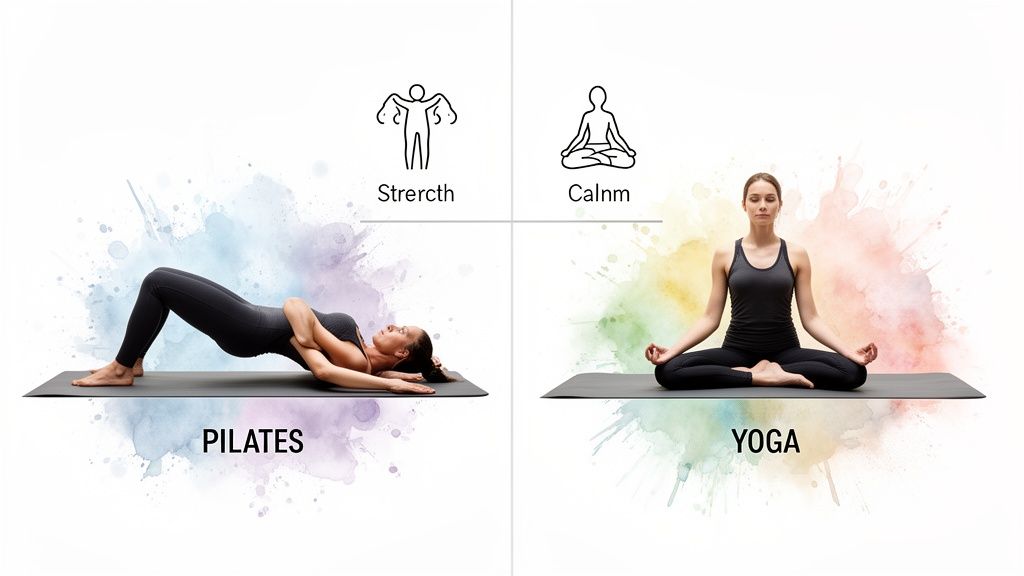
You are definitely not alone with this question. What once started as a niche trend has firmly established itself in the health and fitness world. Both disciplines promise you strength, mobility, and mental balance – yet the paths to achieve them couldn’t be more different.
This guide is meant to be your personal compass. I will take you by the hand and show you the fine, but crucial differences and also the commonalities. Thus, you will ultimately find the method that fits not only your body but also your lifestyle and your unique goals.
Mindful movement methods are booming. Not without reason: By 2035, a market share of 27 percent is forecasted for the European market for Pilates and yoga studios. This enormous growth shows how much we are searching for holistic approaches in modern society – especially in Switzerland.
Given that over 150 million people in Europe struggle with mental burdens, and the fact that more than half of the population is overweight, practices like those at Templeshape offer real solutions. They help you relieve stress and promote sustainable health. Learn more about the market development of Pilates and yoga at researchnester.com.
So you can get started right away, I have summarized the key points for you in a clear overview.
This table shows you the most important differences between Pilates and yoga, so you can quickly and easily compare the two methods. It is the perfect starting point to get a feel for which direction might be the right one for you.
| Feature | Pilates | Yoga |
|---|---|---|
| Main focus | Strengthening the deep muscles (core), precise movement control, improving posture. | Connection of body, mind, and breath; flexibility, balance, and inner peace. |
| Origin | Developed in the early 20th century by Joseph Pilates for rehabilitation and strengthening. | Ancient Indian teaching with philosophical and spiritual roots. |
| Breathing technique | Lateral chest breathing to stabilize the torso during exertion. | Conscious, deep belly breathing (Pranayama) to calm the nervous system and direct energy. |
| Flow of movement | Controlled, often repetitive movements that target the activation of specific muscles. | Flowing transitions between held poses (Asanas) that involve the entire body. |
| Typical equipment | Mat, reformer, Cadillac, Pilates ring, and other small equipment for support or resistance. | Primarily the mat; blocks, straps, and cushions are used to support the poses. |
| Spiritual aspect | Generally focused solely on physical and functional fitness, but can have a meditative effect. | Often associated with meditation, mantras, and philosophical teachings to promote mental well-being. |
As you can see, the devil is in the details. Pilates is more like a precise workout for your body, while yoga is a practice that addresses both your body and mind equally. But that’s just the tip of the iceberg. Let’s dive deeper.
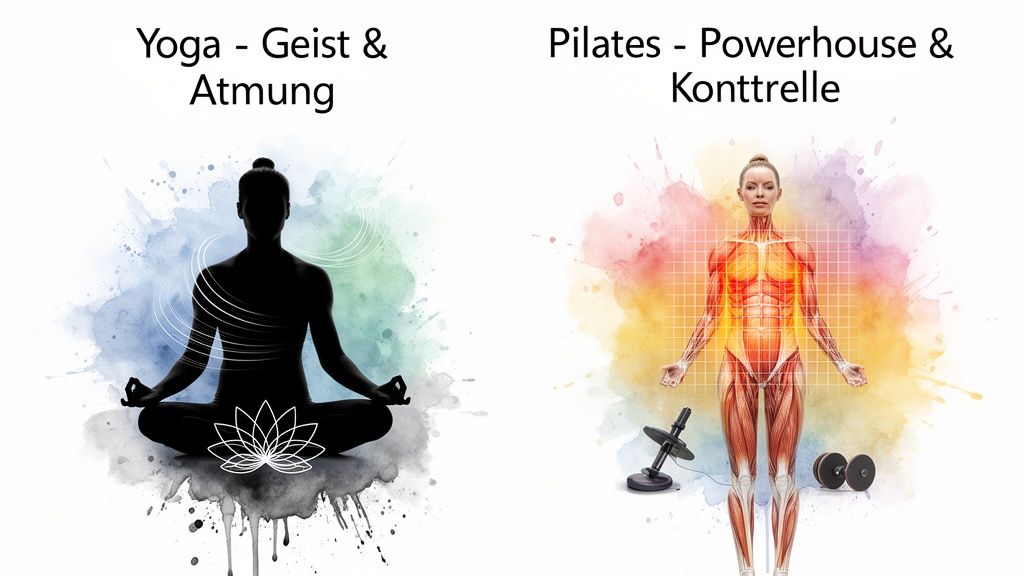
To really decide between Pilates and yoga, we need to start at the roots. Those roots shape each individual exercise and are the reason why the two methods feel so fundamentally different. Their foundational thoughts come from completely different worlds.
Yoga is not just a sport, but an ancient Indian teaching. The big goal? To harmonize body, mind, and soul. You can think of it as a holistic way of life that goes far beyond the mat.
In a typical yoga class at Templeshape, you can really feel that. The focus is on the flowing interplay of movement, conscious breathing, and mental release.
At its core, yoga is about connection. The physical postures that Asanas, are actually just a tool to quiet your mind and fully arrive in the moment. Each movement is consciously synchronized with the breath (Pranayama).
Imagine holding a demanding position like Warrior II. Sure, your body is working at full speed, but your breath flows calm and deep. In that moment, you are not only strengthening your muscles, but also training your ability to remain composed under tension.
Yoga uses the body as a bridge to the mind. The physical practice serves the higher goal of finding inner peace, mindfulness, and ultimately self-awareness.
This spiritual dimension is probably the biggest difference from Pilates. While yoga directs your gaze inward, Pilates focuses your attention outward – on the absolutely precise execution and physical control. If you want to dive deeper into the calmer aspects, you can learn more in our contribution about Yin Yoga in Zurich.
In stark contrast to the ancient tradition of yoga stands Pilates, a relatively young method developed in the early 20th century by Joseph Pilates. His original goal was to help injured dancers and athletes with rehabilitation.
This therapeutic origin still shapes Pilates today. It is an analytical, precise, and extremely controlled full-body workout. The focus is unmistakably on strengthening your core, the so-called “Powerhouse”.
This powerhouse is more than just your abdomen. It includes:
In a Pilates class at Templeshape, you will be guided to start every movement from this strong center. Take an exercise like “The Hundred”: You not only feel your abdominal muscles burning, but you also learn to stabilize your entire torso firmly while your arms and legs move.
Here, the quality of execution counts, not the number of repetitions. This intense focus on control and precision makes Pilates an incredibly effective workout for a healthy posture and a body strengthened from within. The mental effect? It arises here through the intense focus that leaves no room for distracting thoughts.
If you want to decide between Pilates and yoga, you need to understand how both concretely affect your body and mind. Both shape you, but in fundamentally different ways. Let’s take a closer look so you know exactly what to expect.
The choice ultimately depends on what you are looking for: targeted muscle development for a strong core or holistic flexibility for your entire body. Both paths lead to the goal but use a completely different map.
When it comes to muscles, Pilates and yoga pursue two completely different philosophies. You could say: Pilates is the precise sculptor for your deep muscles, while yoga builds functional strength for your whole body.
In Pilates, the focus is crystal clear on strengthening your “Powerhouse” – that is, your deep core, pelvic floor, and back muscles. Each exercise is performed slowly, controlled, and with maximum concentration to specifically target these stabilizing muscles. Imagine the “Leg Circle”: Your core stays rock solid on the ground while only your leg moves. That is targeted strength building from the inside out.
Yoga, on the other hand, builds strength by holding positions (asanas) for multiple breaths. Think of Warrior II or Plank. Here, your entire body must work together as a unit to stabilize the posture. This type of strength is extremely functional – it prepares you for the movements of everyday life. The muscles are not isolated but learn to work as a team.
A central difference: Pilates connects your mind with the body through control, while yoga connects your mind with the body through breath.
Sometimes the boundaries blur, giving rise to exciting hybrid forms. If you’re curious about how to combine the best of both worlds, take a look at our contribution to Fusion Workout Yogalates.
Both disciplines will massively improve your posture, but they do so for different reasons and with different focuses. Pilates corrects your posture mainly through strengthening your core. A strong deep musculature automatically aligns your spine and acts like an inner corset against poor postures.
Yoga, in contrast, promotes the flexibility of the entire body through dynamic stretches and prolonged holding of poses. It’s about releasing stuck fascia and increasing the range of motion of your joints. The result is a supple, upright posture that arises from newly gained mobility.
A little example from practice:
Here we come to perhaps the most profound differences. Both practices can be absolutely meditative, but their mechanisms are different. Yoga specifically utilizes Pranayama (breathing techniques) and meditation to directly soothe your nervous system. The conscious, deep breathing activates the parasympathetic nervous system – your “rest nerve” – leading to an immediately noticeable relaxation.
Pilates achieves a state of mental tranquility in a different way: through extreme concentration. Every movement demands your full attention. You focus on your breathing, the position of your ribs, and the activation of the exact right muscles. There is simply no room for distracting everyday thoughts. This state is often described as ‘moving meditation’.
Both methods help you become more present and mindful. The mental effects often include a more balanced cortisol level. If this topic interests you greatly, you can read more here about how to naturally reduce stress and find inner balance. The choice therefore depends on whether you seek relaxation through conscious breathing and spirituality or through focused body control.
The decision between Pilates and yoga rarely depends solely on the method. Rather, it is about your individual goals and what your everyday life currently demands from you. Both disciplines are incredibly powerful, but they showcase their strengths in different scenarios. Let’s find out together which practice is right for you now.
Your body and mind are actually already giving you the best hints. It’s just a matter of listening closely and choosing the practice that not only provides a good workout but also the appropriate response to your current needs.
Do you spend a lot of time at your desk? Then you probably know the feeling of tense shoulders and that nasty pulling in your lower back all too well. Right here, Pilates is often the more direct and effective solution. The reason lies in the core focus of the method: the targeted strengthening of your ‘powerhouse’.
Through precise exercises that activate your deep abdominal and back muscles, you’re essentially building an inner support corset. This relieves your spine and corrects creeping postural issues that arise from hours of sitting. Each Pilates session at Templeshape is like a reset button for your posture.
Does your head often feel full and do you long for true inner peace? In this case, yoga with its holistic approach is usually the better choice. Yoga aims to actively calm your nervous system, making it a powerful tool against stress.
Through the conscious connection of movement and deep breathing (Pranayama), you activate the parasympathetic nervous system – the part of your nervous system responsible for relaxation. A restorative Yin Yoga session at Templeshape can help you release deeply seated tensions and calm your mind.
Pilates calms your mind by concentrating on the body. Yoga calms your mind by connecting with your breath and soul. Choose the path that feels more intuitive to you.
This infographic helps you make a quick decision based on your primary goal.
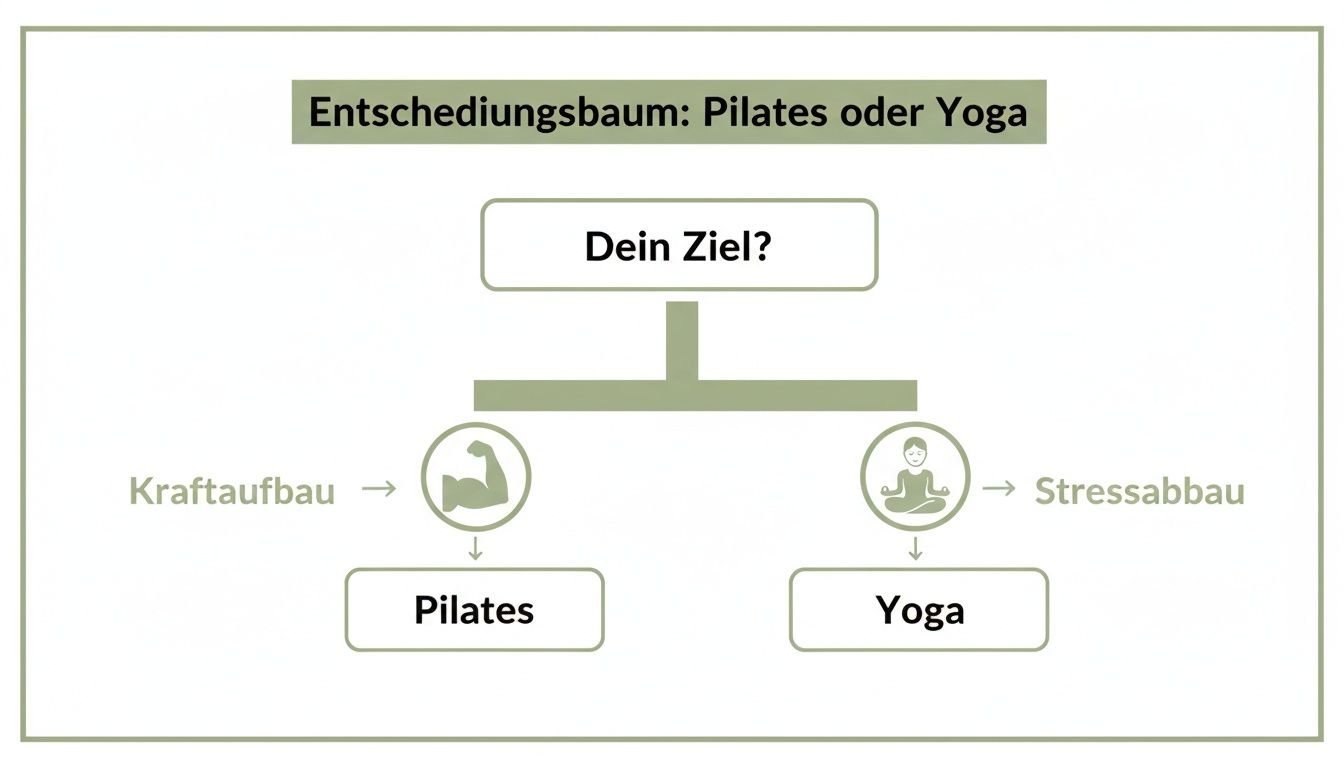
The tree illustrates the core difference: If you primarily seek physical strength and stability, the path leads to Pilates. If, however, you are looking for relaxation and mental balance, yoga is often the more direct path.
Are you already active in sports, whether it’s running, strength training, or team sports? Great! Then both disciplines can serve as intelligent cross-training for you, but with different benefits:
The fitness industry in Switzerland is steadily growing, underscoring the demand for such specialized training methods. By the end of 2022, 13.2 percent of the Swiss population were registered at a fitness center. This is a significant increase compared to the end of 2021, when it was still 11.9 percent – with an average age of 40 years. You can find more exciting insights into the Swiss fitness industry on fitnessmanagement.de..
After childbirth, strengthening your pelvic floor and deep core muscles is absolutely essential. Here, Pilates is the method of choice. The precise and controlled exercises are ideal for safely and effectively rebuilding your center without overloading your body.
Yoga can later be a wonderful complement to get back into a gentle flow of movement and strengthen yourself mentally. At Templeshape, we offer special courses as part of our Motherhood Club that are tailored to these needs. The decision between Pilates or yoga is often just a matter of the right timing.
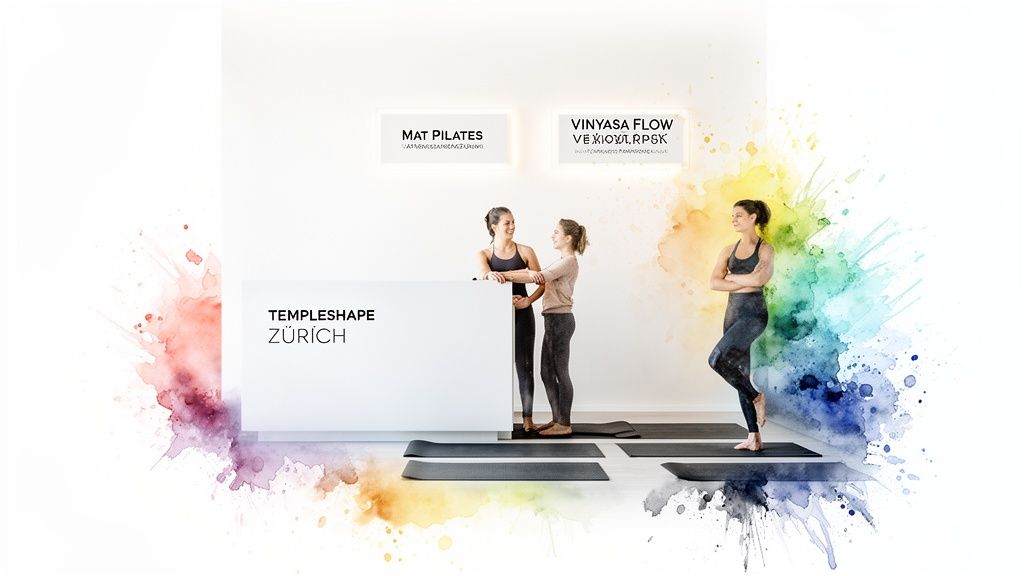
Perhaps after all this information, you already feel a clear tendency towards whether your heart beats more for Pilates or yoga. Great! Then now is the perfect moment to take the next step and see what your journey could look like with us at the Health Temples CITY and AIRPORT.
At Templeshape, it’s not about pressure or competition. It’s about feeling comfortable in your skin and anchoring movement as something positive in your life. Our atmosphere is deliberately supportive and friendly – we provide you with exactly the structure and motivation you need to stay on track.
We know that ‘yoga’ and ‘Pilates’ are huge umbrella terms. That’s why we have developed various course formats tailored to different needs and goals. This way, you are guaranteed to find the style that fits your current energy and mood.
Here’s a little insight into our most popular courses:
A training plan that works in the long run and is fun for you thrives on variety. Your body loves new stimuli to develop further and stay healthy. That’s exactly why you can ideally combine Templeshape Pilates and Yoga with our other offerings.
This way, you create a perfect balance of strength, endurance, flexibility, and regeneration. You don’t have to choose one or the other – just get the best of all worlds. If you are still unsure of how to start, check out our guide toTrial class Pilates in Zurich. It takes you by the hand.
Your body is not made for monotony. The combination of different training methods is the key to preventing injuries, breaking through plateaus, and staying motivated in the long term.
Imagine, for example, a week in which you cover all the important building blocks for your overall well-being.
This plan is just a suggestion, but it shows how you can cleverly link the different elements to get the most out of it.
Such a rhythm ensures that you challenge your body without overwhelming it. You build strength, stay supple, and give your mind the space it needs to relax. This is exactly what we mean at Templeshape with ‘Make Health Your Habit’.
You now have a good overview of the major differences, but often it is the small, practical questions that ultimately determine the choice between Pilates or Yoga. Here are the answers to what concerns our Templeshape community the most.
Good news: Both disciplines are fantastic for your entry. It really just depends on what you hope for from your first class.
Pilatesis often a more logical start for you if you like a clear, fitness-oriented approach. The instructions are super precise, almost like personal training. You learn from minute one to specifically build your strength and get a better sense of your body.
Yogamay feel gentler for you if your focus is more on mental balance and increased flexibility. Classes like Hatha Yoga are ideal for beginners, as they focus on basic postures and calm, conscious breathing – perfect for settling in.
A very clearNo.This is one of the biggest myths that unnecessarily prevents many from starting at all. Flexibility is not the prerequisite; rather, it is the result of your practice – whether in Pilates or Yoga.
Flexibility is like strength – it is trained. You don’t wait until you are strong to go to the gym. Just come exactly as you are.
In every Templeshape class, our trainers show you alternatives and modifications for each exercise. This way, you can adapt everything to your current level. It’s about feeling your body, not forcing it into a shape.
Here, a little caution is advised, and checking with your doctor is always a good idea before you get started. However, there are clear trends:
Pilatesis often recommended for rehabilitation after back injuries. The reason is simple: it specifically strengthens the deep stabilizing muscles around your spine. A strong ‘powerhouse’ is the best shield against many types of back pain.
Yogacan also be extremely beneficial for relieving tension in the back and making the spine more flexible again. It’s important to choose a gentle yoga style and to avoid poses that could put pressure on your lower back. An experienced yoga teacher is invaluable here and will guide you safely through the practice.
Are you ready to find your personal answer to the question ‘Pilates or Yoga’? The great thing is: atTempleshapeyou don’t have to commit forever. Just try both and feel what your body and mind need right now. Visit us athttps://templeshape.comand start your journey to more health and well-being.
Tags