March 18
Mental Health at Work: Corporate Wellness for Zurich Companies – Reducing Stress
0 comments

March 18
0 comments
Mental Health at Work is the key to a resilient, productive, and innovative team.Mental Health at Work is more than just a buzzword – it is the key to a resilient, productive, and innovative team in Zurich. Corporate wellness is also not just a cost factor, but a strategic investment in your most valuable asset: your employees. An investment that directly impacts the success of your company.
Are you wondering why the topic of mental health has suddenly appeared everywhere? In the dynamic and often demanding work environment of Zurich, it is much more than a short-lived trend. It has become a harsh economic necessity. The mental health of your employees is now a key factor in the future viability of your company.
Just imagine your team not only being present but actually engaged, motivated, and full of creative ideas. This does not happen by chance. It is the direct result of a well-thought-out corporate wellness strategy. It’s about creating an environment where people feel valued and are equipped with the tools to manage stress and pressure healthily.
The numbers for the Zurich economic area tell a very clear story and show how urgent the issue is. Workplace stress has noticeably intensified in recent years.
According to a survey by the Office for Economic Affairs of the Canton of Zurich, the number of health-related absences has significantly increased: A full-time employee was absent on average for 8.0 days. For comparison: in 2010 it was still 6.1 days. More details can be found in the official findings on health at the workplace.
In the Canton of Zurich, today more than every second new disability pension (58 percent) is granted due to a mental illness. The resulting productivity losses cost the Zurich economy over 2 billion francs.
annually. This statistic shows clearly: Turning a blind eye is no longer an option. Proactive action is not only ethically right but also strategically extremely smart.
In a competitive market like Zurich, companies are constantly looking for ways to gain an advantage. Just like the digitization for companies as a clear competitive advantageis, so is investing in the mental health of the workforce a key lever for long-term success.
A strong corporate wellness program directly impacts important business metrics:
Ultimately, it’s about setting a positive spiral in motion. Healthy employees lead to a healthy company – and that is the most stable basis for sustainable growth in the demanding Zurich business world.
Investing in your team’s mental health is not a luxury and certainly not just a cost item. It is a clever, strategic move with a clearly measurable return on investment (ROI). Corporate wellness is one of the best investments you can make for the future viability of your company in Zurich.
Let’s set the fruit basket aside for a moment and talk about hard numbers. The benefits go far beyond fewer sick days. They directly impact your company’s results by reducing two often invisible but costly factors: Absenteeism and Presenteeism.
Absenteeism is easy to measure – employees are absent because they are sick. Presenteeism is more subtle but often much costlier: Employees may show up for work but are hardly productive due to stress, overwhelm, or mental exhaustion. They merely go through the motions, are unfocused, and make more mistakes. And this is where an effective corporate wellness program comes in.
When you invest in your team’s well-being, you are directly investing in the performance of your entire company. Healthy, mentally fit employees are more creative, engaged, and simply more resilient to daily challenges.
Imagine your company as a high-performance sports team. You would never send your athletes into an important game without recovery, targeted training, and mental preparation. That’s exactly what corporate wellness does – it prepares your team for the demanding workday.
The following infographic clearly shows the direct economic impacts of mental stress in the Zurich area.
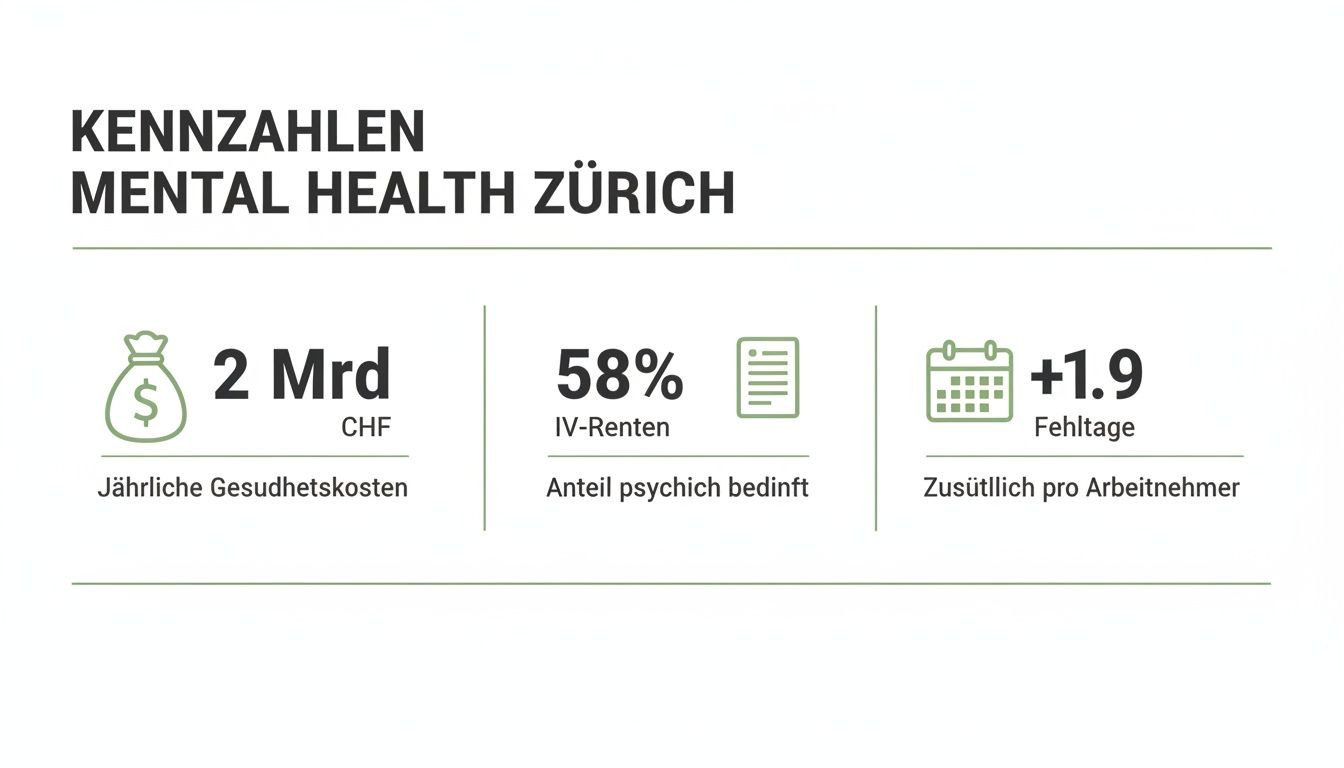
These numbers tell a clear story: Mental stress not only causes individual suffering but also enormous macroeconomic damage that directly affects your company.
At the national level, the financial impacts of mental stress are enormous. It is estimated that the costs due to productivity losses in Switzerland amount to 17.3 billion francs per year. That’s about 2 percent of GDP. At the same time, established mental health policies in companies can reduce the share of employees with mental health problems by half, from 16 to 8 percent. More on these economic potentials can be found at promentesana.ch.
This underscores that promoting Mental Health in the Workplace is not just a matter of social responsibility for Zurich companies. It is an economic necessity to remain successful in the long term.
What does this concretely mean for your company? Investing in Corporate Wellness pays off on multiple levels and can be measured in tangible metrics.
Every franc invested in Corporate Wellness pays back multiple times – in the form of increased efficiency, reduced costs, and a stronger, more resilient corporate culture.
A genuine program for mental health in the workplace is much more than just the obligatory fruit basket or a sporadic yoga voucher. To anchor Mental Health in the Workplace sustainably, it requires a well-thought-out system – one that is tailored to the needs of your team in Zurich. Think of it like building a sturdy house: It needs a solid foundation and four supporting walls to withstand any storm.
This foundation is your corporate culture. The walls are the four pillars of an effective program: Prevention, Intervention, Support, and Culture. Only when all these elements interact can you create a work environment where your people not only function but truly thrive.
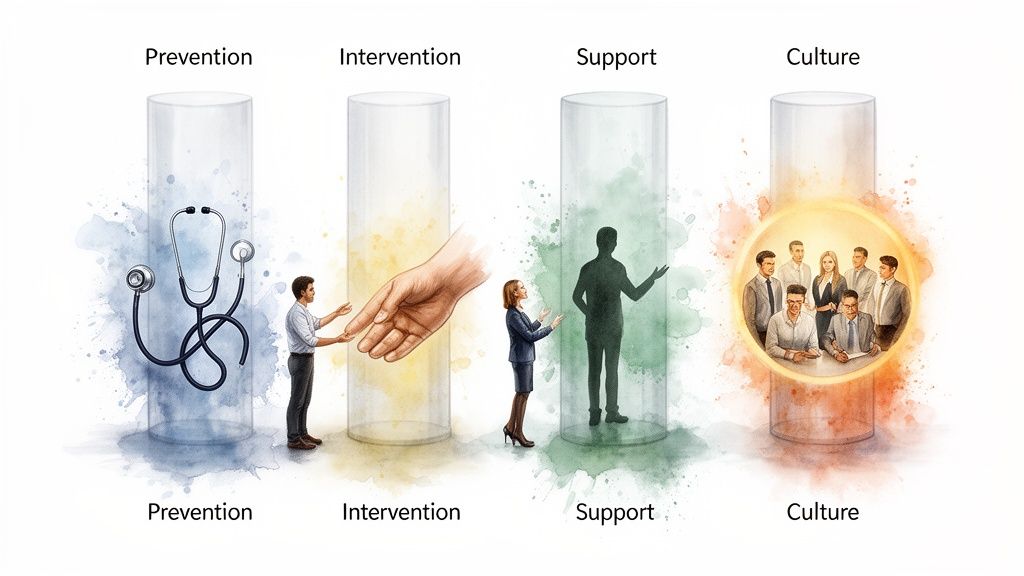
A holistic approach built on these four pillars is not a ‘nice-to-have’, but a strategic necessity. The following table gives you an overview of the building blocks and shows how you can fill them with concrete measures.
| Pillar | Goal | Example measures for your company |
|---|---|---|
| 1. Prevention | Proactively identify and reduce stressors before they become problems. | • Workshops on stress management and resilience • Clear rules for working hours & availability • Ergonomic workstations & break rooms |
| 2. Intervention | Provide quick and uncomplicated help in acute crisis situations. | • External psychological counseling program (EAP) • Trained first responders for mental health • Direct line to crisis hotlines |
| 3. Support | Long-term strengthening of individual resilience. | • Regular yoga, meditation, or breathwork courses • Access to coaching & personal development • Offers to promote work-life balance |
| 4. Culture | Create an open, safe, and supportive environment. | • Leaders as role models (open approach to mental health) • Establishing a culture of psychological safety • Regular, anonymous surveys on wellbeing |
Each pillar is important on its own, but only in combination do they unleash their full power and create a work atmosphere where people feel valued and secure.
The best way to deal with problems? To ensure they don’t arise in the first place. That is the essence of prevention. It is about proactively identifying and mitigating stress factors in the workplace before they become a serious burden on your employees. Prevention is essentially the preventive maintenance for your team’s mental health.
Think of the typical meeting marathon in a Zurich consulting firm. A preventive measure would be to implement clear rules for efficient meetings, establish fixed breaks, or promote ‘Walk and Talk’ meetings outdoors. It’s about designing the work environment to protect health rather than jeopardizing it.
Concrete preventive measures include, for example:
Despite the best prevention efforts, it can happen that employees fall into an acute crisis. This is where the second pillar comes into play: the Intervention.This means offering help quickly, specifically, and absolutely confidentially when someone needs it. It is crucial to keep the barriers to accessing this help as low as possible.
A classic example is an employee showing early signs of burnout. An interventionist approach here would involve the leader seeking a conversation and facilitating access to an external psychological counseling service (EAP). This quick response can prevent the situation from worsening and leading to months of absence.
Intervention means not turning a blind eye but taking action. It is the safety net that catches your team when they stumble.
While the intervention targets acute cases, the Support focuses on the long-term strengthening of individual resilience – also known as resilience. This pillar provides continuous offerings that allow your employees to actively build and maintain their mental resources.
This concerns very concrete tools and practices that help in everyday life. This includes regular offerings such as yoga classes for relaxation, coaching for personal development, or targeted breathing exercises. If you’re curious about how effective such techniques can be, check out our article on Breathwork in Zurich These measures empower your team to better tackle future challenges.
The fourth pillar is the element that holds everything together: an open and supportive corporate culture.Without it, the other three pillars dissipate as isolated measures without lasting impact. A positive culture creates an environment where it is normal and safe to talk about mental health.
It starts at the top with the leadership level. When leaders openly deal with their own challenges and destigmatize the issue, employees tend to follow this example. It also means celebrating successes in the team, viewing mistakes as learning opportunities, and creating an atmosphere of trust and psychological safety.
A strong culture of mental health is the foundation on which your entire corporate wellness program stands. It is the key to running not only a successful but above all a humane company in Zurich.
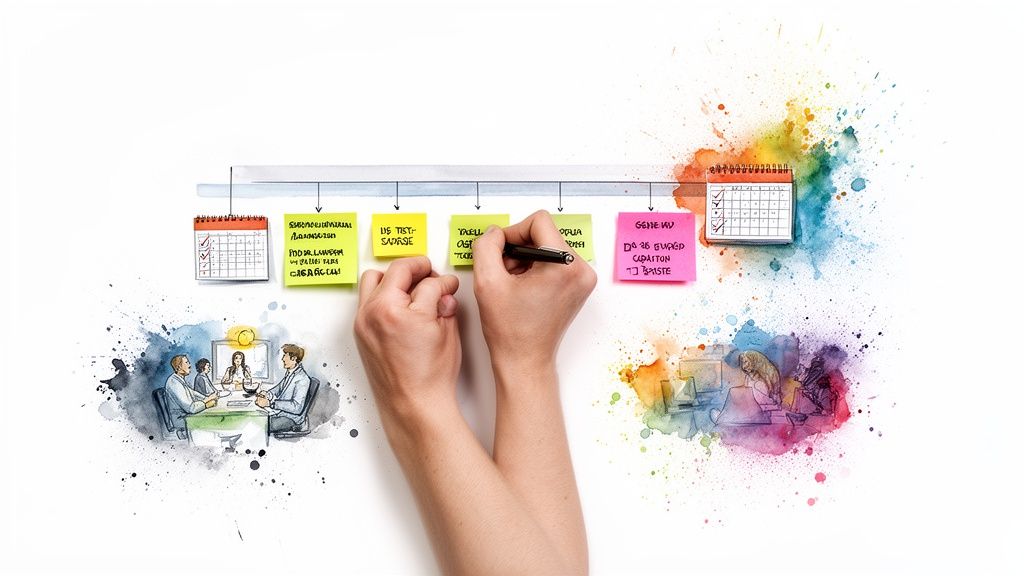
The decision for more Mental Health at Work has been made – great! But how do we get started now? Don’t worry, this section is your practical roadmap. Implementing a corporate wellness program is a bit like launching a new software: without a clear strategy, good onboarding, and a success review, it simply won’t be used.
Exactly for this reason, we will now guide you step by step through the five crucial phases. This ensures that your program exists not just on paper but also truly reaches your team in Zurich and makes a difference.
Before you plan any measures, you need to know what your team actually needs. A shot in the dark helps no one. The key to success lies in listening closely and understanding the real needs.
The best way to do this is through an anonymous employee survey.Only by this means can you get honest and unfiltered feedback. Ask targeted questions about the biggest stress factors in daily life, the wishes for supportive offerings, and the overall satisfaction.
With the results from the analysis in hand, you can now define clear and measurable goals. General resolutions like “We want to improve well-being” are too vague and lead nowhere. Instead, formulate specific, achievable goals, preferably according to the SMART method.
Example of a SMART goal: “We want to reduce sick days due to mental strain by 15 % within the next 12 months. To do this, we will introduce weekly yoga classes and a workshop on stress management.”
Such goals give your program a clear direction and make success measurable later. By the way, this is also crucial to convince management of the value of your initiative.
Now it gets creative! Based on your analysis and the set goals, you design a program that perfectly fits your company in Zurich. Remember: a good mix of preventive and supportive measures is ideal.
A tech startup has very different needs than a law firm. Perhaps flexible online courses are perfect for your team, while another company benefits much more from fixed on-site appointments.
Possible components for your program:
The best program is useless if no one knows about it or doesn’t understand its purpose. Open and transparent communication is the engine that keeps your initiative running.
Involve management from the start. If the leadership visibly supports the program and perhaps even participates, it sends an enormous signal. Also a good idea are “Wellness Ambassadors” in the team – engaged colleagues who serve as points of contact and promote the offerings.
After a specified time, for example six or twelve months, it’s time for an honest assessment. Check if you have achieved the goals you set at the beginning. It’s best to repeat the employee survey to directly measure changes in well-being.
This data is worth its weight in gold. It not only shows whether your program is successful but also provides crucial insights on where you can adjust and further improve the offering. Especially in Swiss SMEs, where stress-related absenteeism is increasing, this evidence is critical. The AXA Labor Market Study of 2023 shows that the proportion of affected SMEs has risen from 21 to 26 percent, even though around 85 percent are already pursuing preventive measures. This underscores how important targeted and evaluated programs are. Read more here Insights into the AXA study on mental health.
Theory is all well and good, but in the end, what matters is what resonates in practice. Corporate wellness is not a one-size-fits-all solution that can simply be imposed on any company. The key lies in a tailored program that addresses the culture and specific stresses of your team.
To make it more tangible, let’s take a look at three typical scenarios for Zurich companies. You will see: The right measures in the right place can make a huge difference.

In a Zurich tech startup, daily life is often hectic. High pressure, tight deadlines, and intensive project phases dictate the rhythm. The biggest challenges? Clearly the stress from constant performance pressure and the risk that team cohesion falls by the wayside in turbulent times. Unfortunately, high turnover is often a consequence.
A suitable program must primarily achieve two things: enable quick stress relief and strengthen the sense of community.
Let’s consider a law firm in the Zurich banking district. Here, long working days, high concentration, and enormous responsibility are the order of the day. The mental strain is consistently high, which can quickly lead to concentration problems and mental exhaustion.
Here, targeted offerings are needed that sharpen focus and provide genuine mental regeneration.
Corporate wellness for law firms means providing tools for mental clarity and endurance. It’s about sustainably securing the peak performance of employees instead of burning them out.
In a larger service provider with many different departments, the challenges are often more complex. An impersonal atmosphere, lack of communication across departmental boundaries, and the feeling of isolation in the home office can strain the workplace climate.
Here, a broad program makes the most sense, covering various needs and promoting social interaction in a targeted way. The variety of corporate benefits in the field of fitness and yoga plays a central role in reaching as many employees as possible.
You now know what it takes for a strong corporate wellness program. But theory is one thing – implementation is another. The crucial step is to have the right partner by your side. Someone who truly understands the Zurich work environment and its specific needs. And this is where we, at Templeshape, come into play.
Our philosophy is actually quite simple: Make Health Your Habit. We do not chase short-term trends, but firmly believe in the power of sustainable habits. Our goal? To integrate health and movement into your team’s daily routine so seamlessly that it becomes a positive routine that no one wants to miss.
The work environment in Zurich is demanding. Stress, mental pressure, and the feeling of always needing to be available are part of everyday life for many. A pure fitness program falls far short. That’s why we think holistically and combine intense workouts with targeted, mindful practices.
We combine the best of both worlds:
This mix hits the nerve of the times. It strengthens the body, calms the mind, and fosters a form of mental health that really makes a difference at work.
We know how valuable time is. That’s why our corporate offerings are structured to seamlessly fit into your company’s daily operations. We bring health directly to you.
We are more than just a gym. We are a community that motivates, connects, and ensures that your team not only functions but thrives.
Whether it’s a weekly yoga class in your offices, a brisk bootcamp session in the park around the corner, or an exclusive class just for your team in one of our centrally located studios – we find the solution that fits you.
A strong team feeling is the foundation of a healthy work climate. That’s why we go beyond regular courses and organize special team events. Imagine your team overcoming its limits during a joint ice bath and experiencing a moment that resonates long after.
Such experiences bond people together, build trust, and create a positive dynamic that is felt in the office. At Templeshape, you’ll find the partner who makes your team in Zurich fit, healthier, stronger, and more connected.
In discussions with HR managers and executives from Zurich companies, the same questions keep coming up. Here, we provide you with clear, practical answers that help you plan the next steps and sustainably anchor mental health in your company.
Costs are flexible and depend entirely on what you want to achieve. Don’t see it just as a cost item but as an investment in your most valuable asset: your employees. Often, small, targeted measures like a weekly yoga class can make a huge difference.
At Templeshape, we work with modular packages that can be tailored to the size and budget of your company. The return on investment (ROI) often becomes apparent surprisingly quickly – through fewer absences, increased productivity, and noticeably more motivated teams.
Best with hard facts and a crystal-clear business case. Use the figures from this article: Point out the enormous costs alone in Zurich caused by mental health-related absences.
Calculate what a single day of illness costs your company. Then compare this amount with the manageable costs of a targeted prevention measure. Emphasize strategic advantages such as increased productivity and stronger employee retention – especially in the competitive Zurich labor market, an invaluable advantage.
This approach takes the topic out of the pure ‘feel-good corner’ and makes it a wise business decision. In this way, the investment in corporate wellness becomes tangible and comprehensible.
The best idea is worthless if no one takes it up. The key to success is a smart combination of three things: offerings that are truly needed, easy access, and communication that creates enthusiasm.
If you keep these three points in mind, you’ll create the best conditions for your program on mental health at worknot only to exist but to be actively lived and to unfold its full effect.
Are you prepared to elevate the mental health and performance of your team? At the Templeshape GmbH, we create customized corporate wellness solutions that perfectly align with the needs of your Zurich company. Let’s collaborate on a program that truly makes an impact.
Tags