March 18
Journaling for athletes: mental clarity for better performance
0 comments

You train like a beast, giving everything in the gym or on the track – and yet it feels like an invisible brake is holding you back? Often, this brake lies not in the muscles, but in the mind. Mental strength is not a nice extra, but the foundation for real top performance.And journaling is one of the most direct ways to achieve this mental clarity and take your performance to the next level.
You definitely know this feeling: An important competition is coming up and your nerves are fluttering. A training session goes completely wrong, and frustration gnaws at you. Or performance pressure blocks you just when it matters.
These mental states are more than just fleeting thoughts. They have real, measurable effects on your body. Your reaction time slows down, your muscles tense up, and your endurance collapses.
The connection between mind and body is not an esoteric whim, but a lived reality in sports. Imagine a football player thinking about his last missed penalty during a penalty kick – the likelihood of failing again increases dramatically. Or think of a grueling HIIT session at Templeshape, where halfway through, you think: "I can’t do this anymore." That thought alone can sabotage your actual physical performance, even though your muscles still have power.
This is where a simple but extremely effective tool comes into play, which professional athletes have been using for a long time: writing down your own thoughts. It’s not about conducting deep psychological analyses, but about creating a conscious ritual that helps you recognize and break destructive thought patterns.
By putting your thoughts, fears, and goals on paper, you give them form. You shift the inner chaos outside, thereby creating the necessary space for focus, self-confidence, and mental clarity.
This ritual helps you understand your mental processes and finally control them actively, instead of being controlled by them. It is the first crucial step to releasing that invisible brake and unlocking your full potential. Additional mental tools, like the targeted distinction between breathwork and meditation, can further enhance this process.
More and more people are recognizing that mental fitness is just as important as physical fitness. Particularly in Switzerland, the willingness to optimize personal performance holistically is higher than ever. The proportion of people aged 15 and older who exercise several times a week rose from 30 percent in 1994 to an impressive 57 percent in 2020.This trend clearly shows: A large part of the population is already investing in sports activity and is open to methods like journaling. You can learn more about this exciting development in the Report ‘Sport Switzerland 2020’.
The biggest hurdle at the start? Often, the blank sheet of paper or the blinking cursor on the screen. But don’t worry, getting into journaling is much easier than you might think. Forget rigid rules – it’s about finding a way that feels right for you and your everyday life.
The goal is to take away the hesitation and make writing a valuable part of your routine in just five minutes a day.You don’t have to write deeply profound analyses right away.
Whether you prefer to work traditionally with pen and paper or prefer a digital solution is a very personal decision. Both methods have their own charm:
In Switzerland, there is a clear trend toward self-observation through technology. According to a study, over 50 percent of the population already use fitness trackers and health apps; among those under 40, it’s even around 70 percent. This high willingness to collect data is an ideal prerequisite to discover journaling as a complementary tool for mental clarity. If you want to know more, you’ll find exciting insights about digital health monitoring in Switzerland.
Use this direct comparison to find out which method best fits your sporting everyday life and preferences.
| Aspect | Handwritten journaling | Digital journaling |
|---|---|---|
| Feeling & Ritual | Creates a conscious, slowed-down ritual. The tactile experience enhances the connection to one’s thoughts. | Practical, fast, and always available. Ideal for short notes between training and everyday life. |
| Flexibility | Less flexible. You need a pen and notebook. Editing entries afterwards is difficult. | Extremely flexible. You can write anywhere and anytime, easily edit entries, and add photos. |
| Focus | Enhances concentration. Without digital distractions, it’s easier to dive deep into your own thoughts. | Can be distracting. Push notifications and other apps are just a click away. |
| Organization | Entries are chronological, but searching for specific topics can be time-consuming. | Simple organization. Thanks to the search function, tags, and categories, you can immediately find old entries. |
| Safety | Private and secure as long as you keep your notebook in a safe place. | Depends on the app and privacy settings. Cloud backups are convenient but also a potential risk. |
Ultimately, there is no right or wrong here. Just try both! You might find that you prefer an app for quick training notes, but favor the good old notebook for deeper weekly reflections.
Just start. You don’t need to write novels. A few bullet points or short sentences are enough to get the ball rolling.
A simple first entry could look like this: “Today’s training: HIIT class. Felt strong during the burpees, but tired during the lunges. Thought that distracted me: the long to-do list for tomorrow. Goal for the next training: focus on breathing during strenuous exercises.”
It can be that simple. You reflected on your training, identified a distracting thought, and set a small, achievable goal. That’s exactly what it’s about. Your journal is a tool that helps you recognize patterns and make conscious adjustments. It’s also important to pay attention to your recovery – small breaks are crucial for long-term performance.Learn how you canreduce your burnout risk with micro-breaks.
The following graphic helps you better understand the origins of mental blocks in sports and find initial solutions.
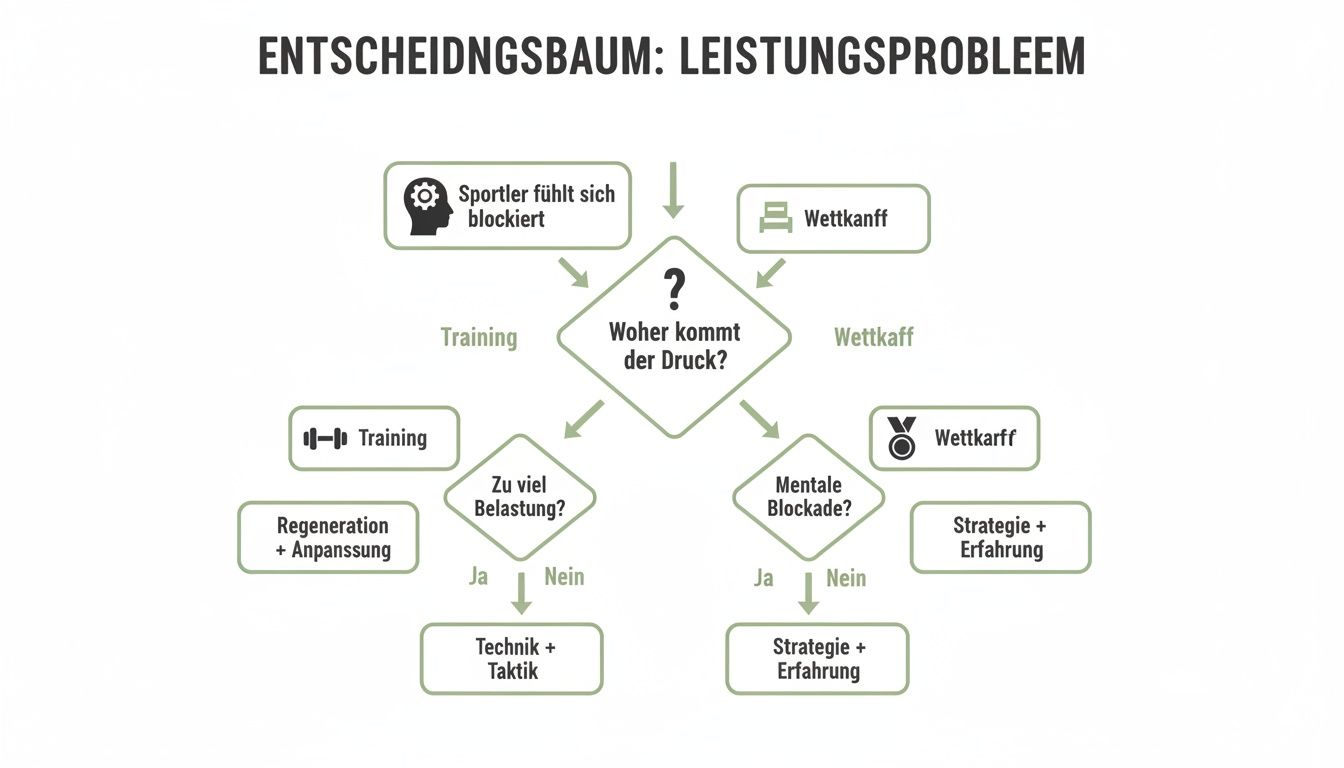
It shows how you can determine through targeted questions whether the pressure comes more from the training itself or from the competitive context. A great tool for your first analytical attempts.
What exactly are you writing in your journal to make it truly worthwhile? A blank page can be quite intimidating, I know that too. Therefore, this section is your personal list of questions that turn your notebook from a simple diary into a true, strategic training partner.
Instead of general phrases, you’ll get specific writing prompts tailored to the needs of athletes like you. These questions help you look beyond the training plan and piece together the mental puzzle of your performance. They are the key to deepermental clarity for enhanced performance..

Every training session, whether it went well or was an absolute disaster, holds valuable lessons. With the right questions, you learn to evaluate your performance objectively and recognize patterns. You’ll be surprised how often mental factors influence your physical condition.
Here’s how you turn observations into solid insights:
This targeted reflection helps you get the most out of each session. You learn to train not only your body but also your mind.
Your journal is your personal coach that tells you the unvarnished truth. It shows you your strengths but ruthlessly unveils your mental weaknesses – and that’s the first step to improvement.
Real performance doesn’t just happen in the gym, but especially during the breaks in between. Your recovery and energy management are the unsung heroes of consistent progress. Use your journal to listen to the often quiet signals from your body.
Uncover energy thieves and optimize your recovery with these questions:
By recording these aspects, you develop a keen sense of your body’s needs. You recognize much earlier when you need to take it down a notch to remain capable in the long run.
Your inner attitude often determines victory or defeat, achieving a goal or giving up prematurely. Journaling is an incredibly powerful tool to consciously shape your mindset, draw motivation, and make your goals truly tangible.
Sharpen your mental focus with these prompts:
Dein innerer Dialog hat einen massiven Einfluss auf deine Leistung. Studien zeigen, dass Athleten, die bewusst positives Selbstgespräch nutzen, eine verbesserte Konzentration und weniger Angst im Wettkampf erleben. Dein Journal hilft dir dabei, diesen inneren Kritiker in einen echten Verbündeten zu verwandeln.
Du hast die richtigen Fragen, du weisst, was du schreiben willst – doch die beste Methode nützt nichts, wenn sie nicht zur Gewohnheit wird. Gerade für uns Sportler ist Konsistenz der Schlüssel zum Erfolg, sowohl im Training als auch bei der mentalen Arbeit. Hier zeige ich dir ein paar praxiserprobte Strategien, wie du Journaling für Sportler mühelos in deinen vollen Terminkalender integrierst, ohne dass es sich wie eine weitere lästige Pflicht anfühlt.
Die grösste Hürde ist oft der Gedanke, dass du dafür ewig viel Zeit brauchst. Aber das Gegenteil ist der Fall: Es geht nicht um lange Essays, sondern um kurze, fokussierte Momente der Reflexion.

Stell dir vor, du kommst von einem intensiven Bootcamp bei Templeshape nach Hause. Dein Kopf ist noch voller Eindrücke, die Muskeln sind müde. Statt direkt zum Handy zu greifen oder den Fernseher einzuschalten, nimmst du dir genau fünf Minuten für dein Journal.
Dieser kurze Moment hilft dir, den Tag bewusst abzuschliessen und wertvolle Erkenntnisse für dein nächstes Training zu sichern.
Diese simple Routine verhindert, dass wertvolle Lektionen im Alltagsstress untergehen, und fördert die so wichtige Regeneration.
Der Morgen ist die perfekte Zeit, um dich mental auf deine Ziele auszurichten. Eine 10-minütige Journaling-Session, vielleicht bei deiner ersten Tasse Kaffee, kann den Ton für den ganzen Tag angeben und dir die nötige mentale Klarheit für mehr Leistung verschaffen.
Fokussiere dich auf das, was kommt, und auf deine Absichten:
Diese kurze, aber kraftvolle Übung ist wie ein mentales Warm-up. Du programmierst deinen Geist auf Erfolg und Fokus, bevor der Tag überhaupt richtig begonnen hat.
Gerade in unsicheren Zeiten hat sich gezeigt, wie wichtig stabile Routinen sind. Der Bericht «Sport Schweiz light» 2022 hat aufgezeigt, dass sich die COVID-19-Pandemie bei 34 Prozent der Schweizer Bevölkerung negativ auf das Sportverhalten ausgewirkt hat. Das unterstreicht, wie entscheidend mentale Anker wie das Journaling sein können, um auch in schwierigen Phasen die Motivation hochzuhalten.
Eine neue Gewohnheit aufzubauen, braucht mehr als nur Willenskraft – es braucht clevere Systeme. Versuche mal, das Journaling in deine bestehenden Abläufe zu integrieren:
So wird das Schreiben zu einem selbstverständlichen Teil deines Tages. Wenn du tiefer in die Mechanismen der Gewohnheitsbildung eintauchen möchtest, findest du in unserem umfassenden Guide zum Aufbau neuer Gewohnheiten noch mehr wertvolle Tipps. Fang klein an, bleib dran, und du wirst schnell merken, wie dieses Ritual deine sportliche und mentale Entwicklung vorantreibt.
Mental strength is not a solitary battle. The energy that arises when you surround yourself with like-minded people is an incredibly powerful driver for your personal development. This is precisely the strength we harness at Templeshape to elevate your journaling practice and enhance your mental clarity for better performance.
It’s about exchanging, learning from one another, and becoming stronger together – this is exactly what defines the atmosphere at Templeshape.
A short conversation after an intense bootcamp or a shared moment of reflection after a yoga session can often have more impact than hours of solitary thinking. It is in these moments that you realize: you are not alone in facing your mental obstacles.
That’s why we plan at Templeshape to integrate journaling in a targeted manner into our programs and workshops. This will allow us to create a safe space where we can not only train our bodies, but also our minds.
One of the most effective ways to stay motivated is to find a commitment partner.Look for someone in the community with whom you can regularly and unpressured exchange your journaling progress and challenges.
Exchanging with a partner helps you sort your thoughts and reinforce your discoveries. It’s not about control, but mutual inspiration and support at the same level.
Imagine sharing a discovery from your journal about a performance plateau and your partner responds: “I totally understand you! It helped me refocus my attention.” These moments are invaluable and significantly boost your motivation.
The Templeshape community is a huge treasure of experiences and knowledge. Take advantage of this space to inspire one another – not just in training. You can exchange mental strategies or mutually recommend a suitable gift idea for athleteswhen a loved one’s birthday is approaching.
Collective growth is at the heart of our approach. Talk openly about what concerns you. You might discover new journaling questions together or motivate each other to stick to your activities even on days when motivation is lacking. This connection is key to establishing sustainable habits and developing the mental strength essential for high-level performance.
Are you considering starting to journal, but have a few questions still circling in your mind? Perfect. Here, we clarify typical uncertainties so you can get started without hesitation and find the mental clarity that will really advance your training.
Good news: Forget the pressure of having to write multi-page novels. Just five to ten minutes a daymakes a huge difference and brings you the mental clarity you’re seeking.
What matters is consistency, not duration. Think of it like brushing your teeth – a solid little habit. Some days, thoughts may come easily, other days, you may just jot down three points about your state. Both are valuable.
Is the blank page staring at you? We all know that feeling. When you don’t know what to write, just take one of the targeted questions from the previous sections. Choose the one that worries you the most and write without evaluating the outcome.
Another technique that almost always works is what is called “Freewriting”:
This method is a true game changer for unlocking and finding your writing flow.
There is no absolute “better” here, only a “better for you.” My advice: Just try both and see what fits best into your daily routine.
In the morning, writing can help you mentally prepare for your training and the goals of the day. It’s like a brief briefing with yourself.
In the evening, however, it’s the perfect ritual to clear your head, process the lessons from training, and set the stage for a restorative night’s sleep.
Straightforward: No. Your journal is your personal, protected space. Here, you can and must be 100% honest with yourself.
Your journal is a confidential dialogue with yourself. This confidentiality is crucial for you to reflect and grow without filter.
However, it can sometimes be incredibly helpful to share selected discoveries.Suppose you realize that a particular exercise often generates mental blocks for you. Discussing this with your coach at Templeshape or a training partner can do wonders. This targeted exchange advances your training without you having to reveal your innermost thoughts.
Do you want to leverage the strength of the community to achieve your mental and physical goals? At Templeshapeyou will not only find workouts that make you sweat, but also a supportive community and the right coaching to sustainably transform your habits. Discover our courses and find out how we can support you on your journey: https://templeshape.com
Tags