March 18
Hormonal Balance through Yoga: Flows for the Luteal Phase – Gentle PMS Relief
0 comments

March 18
0 comments
Ja, mit dem richtigen Yoga-Flow kannst du deine Hormone in der Lutealphase wunderbar ausbalancieren und typische Symptome wie PMS spürbar lindern. Durch gezielte, erdende Asanas und eine bewusste Atmung gibst du deinem Körper in dieser oft sensiblen Zyklushälfte genau das, was er braucht: ein Signal zum Entspannen und Loslassen von Spannungen.
Die zweite Hälfte deines Zyklus, die sogenannte Lutealphase, ist eine Zeit des inneren Wandels und der Vorbereitung. Dein Körper leistet jetzt echte Schwerstarbeit. Nach dem Eisprung steigt dein Progesteronspiegel an, um eine mögliche Schwangerschaft vorzubereiten, während das Östrogen langsam wieder sinkt. Dieses hormonelle Auf und Ab spüren viele von uns deutlich.
Vielleicht kennst du das auch: Die Energie sinkt, die Zündschnur wird kürzer, der Bauch zwickt oder der Heisshunger meldet sich. Das ist absolut normal! Dein Körper verbraucht in dieser Phase mehr Energie und dein Stoffwechsel läuft anders. Statt dich also zu einem HIIT-Workout zu zwingen, ist es viel schlauer, mit deinem Körper zu arbeiten. Gib ihm, wonach er sich sehnt – Ruhe und sanfte Bewegung.
Dein Nervensystem ist der Dirigent deines Hormonorchesters. Sobald Stress ins Spiel kommt, egal ob durch einen vollen Terminkalender oder ein hartes Training, schüttet dein Körper Cortisol aus. Ein dauerhaft erhöhter Cortisolspiegel kann aber die Produktion von Progesteron stören, was wiederum die klassischen PMS-Symptome noch verstärken kann. Stell dir zum Beispiel vor, du hattest eine stressige Arbeitswoche – es ist sehr wahrscheinlich, dass du das in der darauffolgenden Lutealphase körperlich spüren wirst.
Genau hier setzt Yoga für die Lutealphase an. Es geht darum, ganz bewusst vom "Kampf-oder-Flucht"-Modus (dem sympathischen Nervensystem) in den "Ruhe-und-Verdauungs"-Modus (das parasympathische Nervensystem) umzuschalten.
Sanfte, erdende Yoga-Flows sind wie eine liebevolle Nachricht an deinen Körper. Sie signalisieren ihm: Du bist sicher, du darfst entspannen, du musst nicht gegen innere oder äussere Stressoren ankämpfen.
Besonders in Städten wie Zürich spüren viele Frauen den Druck des Alltags, was die Symptome in der Lutealphase zusätzlich verschärfen kann. Eine Studie zeigt, dass in der Schweiz rund 64 Prozent der sexuell aktiven Frauen zwischen 15 und 19 Jahren hormonelle Verhütungsmittel nutzen. Das kann zu hormonellen Dysbalancen beitragen, die sich im Zyklusverlauf bemerkbar machen. Mehr Einblicke dazu findest du in der Studie zur hormonellen Gesundheit von Frauen in der Schweiz.
Yoga bietet dir einen wunderbar natürlichen Weg, diesen Herausforderungen zu begegnen. Du lernst, deinen Körper wieder besser zu spüren und ihm genau das zu geben, was er braucht. Es geht nicht um Leistung, sondern um pure Selbstfürsorge.
Wenn du tiefer einsteigen möchtest, wie du dein Training generell an deinen Zyklus anpassen kannst, schau dir unseren Leitfaden zum Cycle Syncing an.
So, und jetzt rollen wir gemeinsam die Matte aus. Dieser Flow ist ganz bewusst so gestaltet, dass er dich in der Lutealphase erdet, festsitzende Spannungen löst und dein Hormonsystem ganz sanft ausbalanciert. Hier geht es nicht um die perfekte Haltung, sondern darum, dir selbst mit ganz viel Mitgefühl zu begegnen und wirklich in deinen Körper hineinzufühlen.
Wir konzentrieren uns auf erdende Positionen, sanfte Hüftöffnungen und eine achtsame Verbindung von Atem und Bewegung. Diese Kombination hilft, unser oft überaktives sympathisches Nervensystem zu beruhigen und stattdessen den Parasympathikus zu aktivieren – das ist der Teil, der für Entspannung zuständig ist. Das kann wiederum die Produktion von Stresshormonen wie Cortisol senken.
Die folgende Infografik zeigt dir nochmal, was hormonell in dieser Phase passiert: Das Progesteron steigt an, während das Östrogen abfällt, was oft zu den typischen PMS-Symptomen führt.
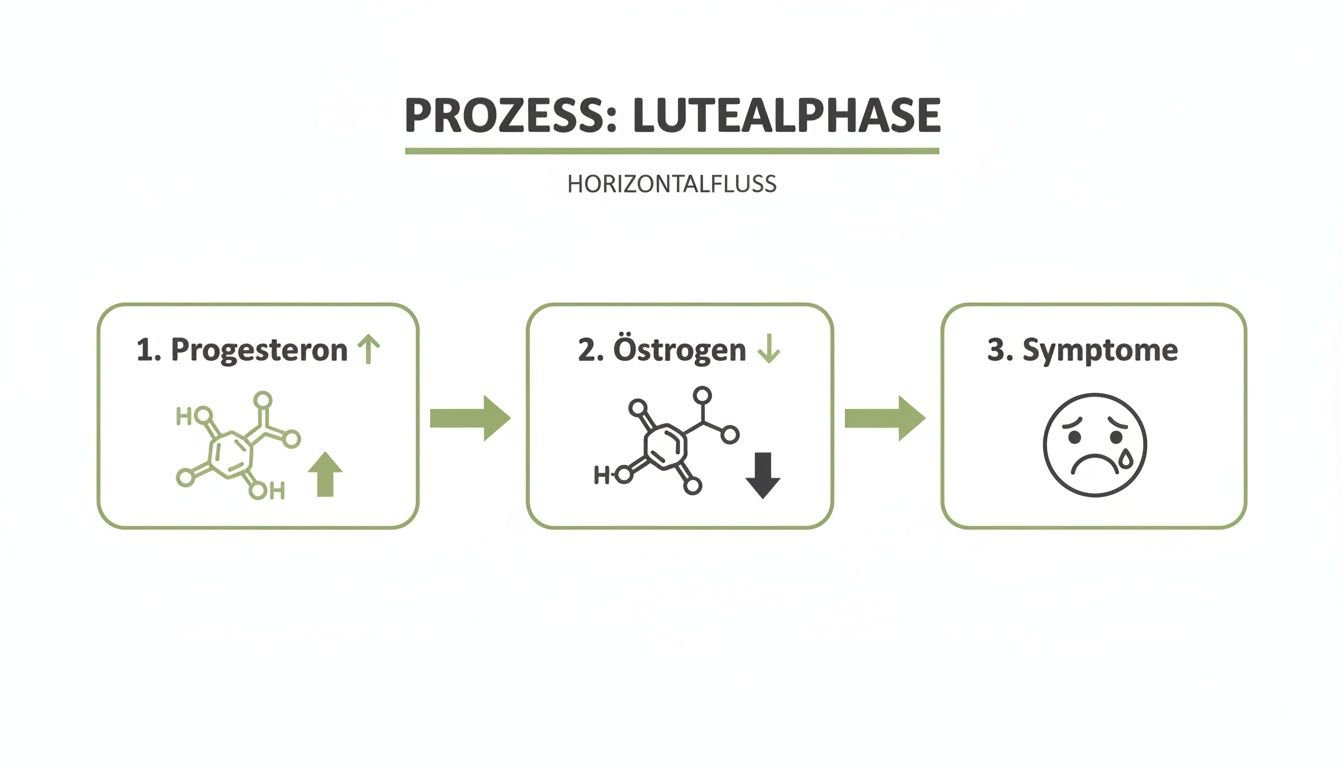
Du siehst hier ziemlich gut, warum dein Körper in dieser Zeit nach mehr Ruhe und sanfter Unterstützung verlangt und nicht nach noch mehr Belastung.
Starte im Fersensitz (Vajrasana) oder in einem für dich bequemen Schneidersitz. Leg die Hände ganz locker auf deine Oberschenkel, schliess die Augen und nimm erst mal ein paar tiefe, bewusste Atemzüge. Spür, wie du mit jeder Ausatmung ein bisschen mehr auf deiner Matte ankommst.
Dann beginne, deine Schultern sanft nach hinten und unten zu rollen, um den Nackenbereich zu lockern. Kreise deinen Kopf langsam, erst in die eine, dann in die andere Richtung. Es geht nur darum, erste Verspannungen zu lösen, bevor du in die fliessenden Bewegungen startest.
Komm aus dem Fersensitz in den Vierfüsslerstand (Bharmanasana). Schau kurz, dass deine Hände direkt unter den Schultern und die Knie unter den Hüften platziert sind. Dein Rücken ist lang und gerade.
Wiederhole diese fliessende Bewegung 5 bis 8 Mal, ganz im Rhythmus deines eigenen Atems. Diese Asana mobilisiert die Wirbelsäule, massiert die Bauchorgane und kann leichte Krämpfe im unteren Rücken lindern. Sie fördert ausserdem die Durchblutung im Beckenbereich, was für die Hormonbalance super wichtig ist.
Aus der Katze-Kuh-Bewegung schiebst du dein Gesäss langsam zurück auf deine Fersen und legst die Stirn auf der Matte ab. Deine Knie können dabei zusammenbleiben oder sich mattenbreit öffnen – schau einfach, was sich für deinen Bauch gerade angenehmer anfühlt. Die Arme kannst du entweder entspannt nach vorne strecken oder neben deinem Körper ablegen.
Die Haltung des Kindes (Balasana) ist wirklich eine der wichtigsten Posen in der Lutealphase.
Balasana signalisiert deinem Nervensystem ein Gefühl von Sicherheit und Geborgenheit. Sie beruhigt den Geist, dehnt sanft den unteren Rücken und hilft dir, nach innen zu schauen und vollständig loszulassen.
Bleibe hier für mindestens 5 tiefe Atemzüge. Atme ganz bewusst in deinen unteren Rücken und den Bauchraum und stell dir vor, wie sich mit jeder Ausatmung ein bisschen mehr Anspannung löst.
Rolle dich aus der Kindeshaltung langsam Wirbel für Wirbel auf und komm dann in eine liegende Position auf deinem Rücken. Stell deine Füsse erstmal mattenbreit auf und lass die Knie locker aneinanderfallen, die Hände kannst du auf deinem Bauch ablegen. Nimm dir hier einen Moment Zeit, um nachzuspüren.
Bring your soles of the feet together and let your knees gently sink outwards, into the position of the lying butterfly (Supta Baddha Konasana). If the stretch in your hips is too strong, place cushions or blocks under your thighs. Make yourself comfortable!
This regenerative position is worth its weight in gold for releasing tension in the pelvic and hip area, where emotional stress often settles. It improves blood circulation in the ovaries and the uterus. Stay here for 2 to 5 minutes and just breathe deeply into your belly.
Adjustment for your energy level:
End the flow by pulling your knees to your chest, gently rocking side to side, and then stretching out in Shavasana (final relaxation) for a few minutes. Give your body time to integrate and soak in the practice.
Some days in the luteal phase just feel heavy as lead. Your body is tired, your mind is racing, and deep inner restlessness sets in. That’s exactly why I created this restorative yoga flow – a loving invitation to let go of everything and dive deep into regeneration.
This flow is less about dynamic movements and more about allowing your body to rest in supportive positions. So grab whatever cushions, blankets, or bolsters you can find. Let’s make ourselves really cozy.
We start sitting with extended legs. Take a large cushion or bolster and place it lengthwise over your thighs. Inhale deeply to lengthen your back, and as you exhale, gently bend forward. Let your upper body just land on the cushion.
Your arms can rest loosely beside the cushion, your forehead or one cheek finds space on it. Close your eyes and let the entire weight of your upper body rest on the cushion. This supported version of Paschimottanasana gently stretches your hamstrings and relieves the often tense lower back without applying pressure.
Stay here for 3 to 5 minutes and breathe deeply into your belly and back.
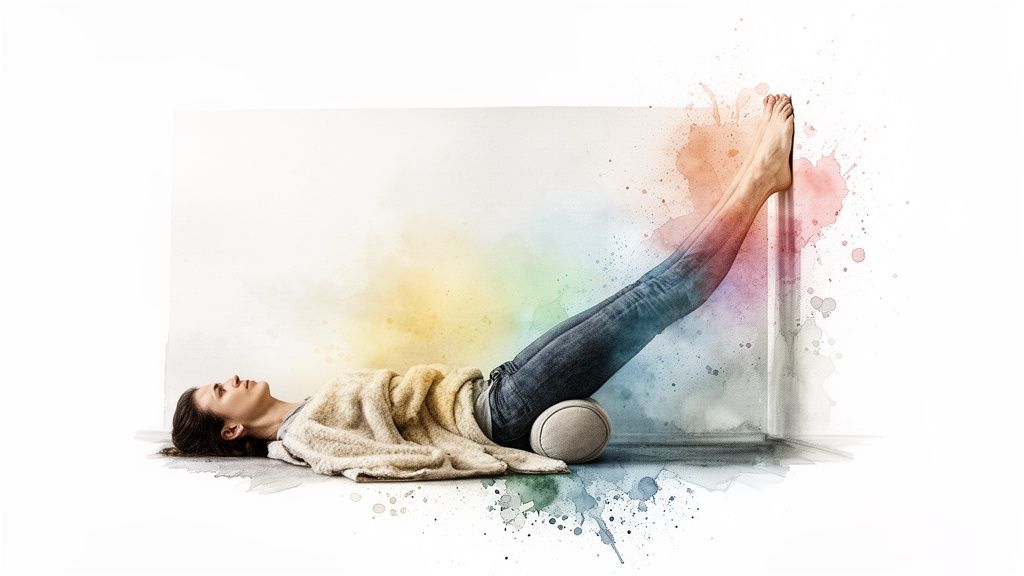
The position “legs up the wall” (Viparita Karani) is a true gift for your nervous system and circulation. Sit sideways as close as possible to a free wall. From there, lie on your back and swing your legs up the wall at the same time.
Your buttocks should be as close to the wall as possible, but only to the point where it doesn’t feel uncomfortable. You can also place a folded blanket under your lower back. Your arms lie relaxed beside you, palms facing up.
This simple inversion has an enormous effect:
Consider this position as a reset button for body and mind. It allows you to literally take the weight of the day off your shoulders – and feet.
Stay in this position for 5 to 10 minutes and simply enjoy the silence. To deepen your relaxation, you can combine your practice with a guided meditation. Take a look at our comprehensive guide to Yoga Nidra in German.
When you are ready, slowly roll out of Viparita Karani onto one side and come back to lying on your back. Pull both knees to your chest and hug them briefly. Then spread your arms out to the sides at shoulder height.
Now, exhale and gently let both knees sink to the right side, while your gaze softly follows to the left. If you like, place a cushion under your knees to make the position even softer. Breathe deeply into your left side and feel the gentle stretch in your spine.
Hold the twist for about 2 minutes and then gently switch to the other side. Supta Matsyendrasana massages the abdominal organs, which can support digestion, and releases deep-seated tension in the trunk.
The effects of such targeted, gentle practices are well documented. A study from the University of Innsbruck showed that women experienced a significant improvement in their well-being, reduced stress perception, and better sleep quality after just 10 weeks of hormone yoga. In our Templeshape studios in Zurich, we integrate exactly such restorative poses, combined with soothing Ujjayi breathing, to support hormonal balance in the luteal phase. Such exercises can even reduce hot flashes by up to 30 percent. More exciting details about this study can be found at Research results on hormone yoga.
Your breath is the direct line to your nervous system. Especially in the often emotionally turbulent luteal phase, conscious breathing – in yoga, Pranayamareferred to – one of the most effective tools to quickly find your center again. The best part? You only need yourself and a few minutes of time for this.
We focus here on two essential techniques: the balancing alternate nostril breathing and the centering Ujjayi breathing.
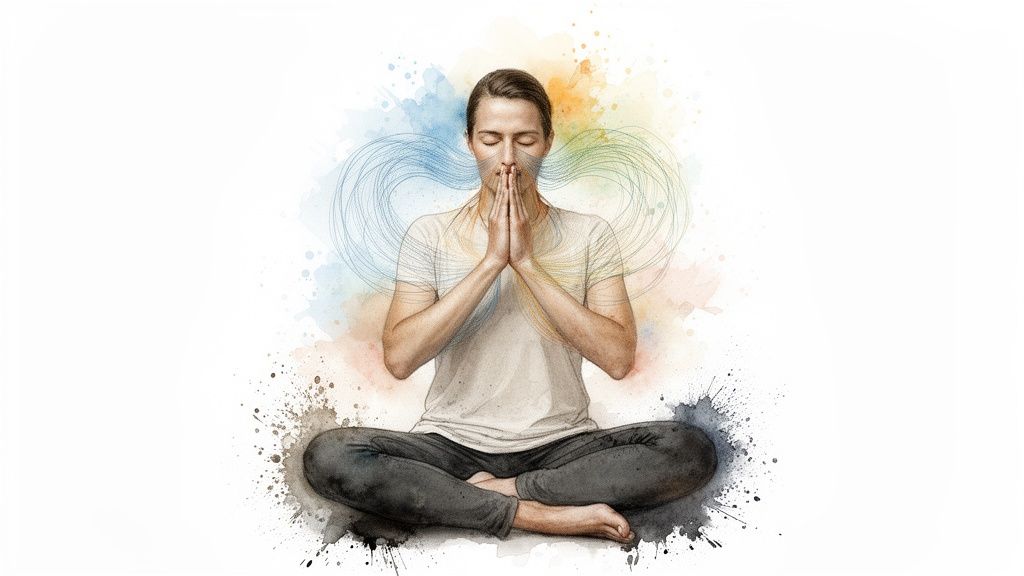
When the emotions are once again on a roller coaster during the luteal phase, Nadi Shodhana is your anchor. This technique harmonizes the left (creative-emotional) and right (logical-analytical) hemispheres of the brain and has a noticeably calming effect on the entire system.
And it’s that simple:
That was one round. Repeat this cycle for five to ten rounds.You will notice how your mind becomes clearer and calmer with each round.
Ujjayi breathing, often referred to as ‘victorious breath’, is your faithful companion during yoga practice. The gentle sound that arises in your throat helps you focus inward, creates a soothing warmth, and keeps you fully present in the moment.
Imagine you are breathing against a mirror to fog it up – but with your mouth closed. You create this soft, rushing sound by gently narrowing the vocal cords. Your breath will naturally slow down and deepen.
Try to maintain this breathing rhythm during your yoga flows. It will become a meditative anchor that connects every movement with your breath and helps you stay fully present.
Both techniques can actually be wonderfully integrated into daily life. A few rounds of Nadi Shodhana before an important appointment can work wonders. And Ujjayi breathing? You can even practice it unnoticed in a crowded subway to ground yourself immediately.
If you want to dive even deeper into the fascinating world of breathing techniques, you’ll find more valuable insights and guidance in our guide to Breathwork in Zurich.
Knowing about the perfect yoga flows is one thing. Actually integrating them into daily life when time is tight and energy is low – that is the real challenge. But that’s exactly what it’s about: Your practice should support you and not become just another item on your to-do list. Even very short, conscious sessions can make a huge difference for your Hormone balance through yoga in the luteal phase.
It’s about finding a flexible routine that adapts to your life, not the other way around. Maybe that’s ten minutes of conscious breathing in the morning and a restorative pose in the evening, instead of a full hour on the mat. The key lies in being loving with yourself and listening to the subtle signals of your body.
To make it easier for you to get started, I’ve created a sample weekly plan. Think of it as inspiration, not as a rigid rule. You can move, shorten, or adjust the sessions according to your energy level as you like. On some days, more movement may feel right, on others perhaps just one pose before bed.
A flexible sample plan showing you how to effortlessly integrate yoga flows and breathing techniques into a typical work week.
| Day | Morning (5-10 Min.) | Evening (20-30 Min.) | Focus |
|---|---|---|---|
| Monday | 3 rounds of cat-cow | Gentle, grounding yoga flow | Arriving in the week, releasing tension in the back |
| Tuesday | 5 Min. Ujjayi Breathing | Legs Up the Wall (Viparita Karani) | Calm the nervous system, relieve heavy legs |
| Wednesday | Gentle neck & shoulder circles | Restorative flow (focus on forward bends) | Deep relaxation, emotional release |
| Thursday | 5-10 rounds of alternate nostril breathing | Reclining butterfly with a pillow | Finding mental balance, gently opening hips |
| Friday | Short seated meditation | Gentle twist lying down | Stimulate digestion, ease out the week |
| Saturday | Intuitive stretching | Your favorite flow or walk | Movement according to feeling and joy |
| Sunday | No plan – just feeling | Child’s pose (Balasana) | Regeneration and preparation for the new week |
This plan is meant to show you how little it takes to care for yourself. The most important thing is that you stay connected and develop a routine that feels good for you.
Just as important as the right exercises is knowing what you should avoid. Your body is simply more sensitive during the luteal phase and reacts differently to strain.
Therefore avoid:
Your yoga practice is not a competition. It’s about building a loving connection with yourself and giving your body exactly what it needs in that moment.
In conclusion, I would like to address a few questions that I am repeatedly asked in my classes. I hope this gives you even more security and clarity for your own practice on the mat.
Not necessarily, but the devil is in the details – or rather, in the modifications. A quick, powerful vinyasa that pushes you to your limits can quickly overwhelm your body in this sensitive phase and have the opposite effect of what you actually want.
Instead, imagine a ‘slow flow’: You consciously slow down the pace, hold each pose a few breaths longer, and skip jumps or intense crunches. The most important thing is that you honestly tune in to yourself every single day. On days when you are bursting with energy, a gentle flow is great. If you feel sluggish and tired, the restorative flow from this guide is definitely the better choice for you.
This is, of course, very individual, but many women report to me that they notice a noticeable change after the first one to two cycles. Maybe you notice that you get through the days before your period in a more emotionally balanced way or that the typical cramps are less intense.
The key really lies in consistency. It’s not about having one perfect yoga session, but about making yoga and conscious breathing a loving habit. Just 10 minutes a day can make a huge difference.
Yes, absolutely! Especially if your cycle is irregular, yoga can help you regain a much finer awareness of your body and its signals. You learn to perceive the subtle nuances instead of just relying on the calendar.
And in perimenopause, a time of strong hormonal fluctuations, grounding and restorative exercises are pure gold. They help calm the nervous system and can noticeably alleviate symptoms like inner restlessness, sleep disturbances, or hot flashes.
There is a good reason why hormone yoga is so popular in Switzerland. Many women practice three to five times a week at home. Especially for professionals in Zurich, it becomes clear that fixed class times combined with breathwork reduce perceived stress by up to 40 percent can reduce. If you want to dive deeper, you can find an exciting article here about the effects of yoga on hormonal balance.
Are you ready to find your balance and make your health a regular habit? At Templeshape GmbH in Zurich, we accompany you on your journey. In our supportive community, you will find a variety of courses – from gentle yoga to energizing breathwork. Discover our offerings and find your flow at https://templeshape.com.
Tags