March 18
Your gym class schedule that really works
0 comments

A well-thought-out gym class schedule is more than just a list of appointments – it is your personal roadmap to your fitness goals. It ensures that you stay on track, remain motivated, and see real progress. A plan transforms random gym visits into targeted training that challenges you but doesn’t overwhelm you.

Does this sound familiar? You start off full of energy at the gym, but choose your classes rather spontaneously based on your mood. Today an intense HIIT, maybe tomorrow yoga, because the other class was already fully booked. Even though you go regularly, you feel like you’re not really making progress.
Exactly at this point, a smart gym class schedule makes the crucial difference. It is your personal roadmap to success, not just another calendar entry.
Just imagine two people. Both want to get fitter but approach it in very different ways.
Person A (the spontaneous one): Goes to the gym three times a week. On Mondays, she throws herself into a bootcamp class with full energy. On Tuesdays, although she still feels tired from the day before, she goes to spinning anyway. Friday is tight on time, so she opts for a short abdominal express class. What’s the result? Her body doesn’t receive clear signals, and more importantly, no time for recovery. Progress stalls, and motivation diminishes.
Person B (the planner): Sticks to a structured class schedule. Monday is strength day with Bodypump. Tuesday is reserved for active recovery, for example with a stretching class. On Thursday, she challenges her cardiovascular system with a HIIT workout. The result? Every training session builds meaningfully on the previous one, the muscles can recover, and performance noticeably and continuously improves.
A good plan brings continuity and balance to your training. It protects you from overexertion, prevents injuries, and makes your successes measurable. Exactly that is the key to enjoying movement in the long term.
This necessity for a clear structure is, by the way, not only crucial in sports. Even in business, the creation of a roadmap is often the deciding factor for success. Your class schedule is essentially your very own fitness roadmap.
With a fixed structure, the eternal question of what you should train today also disappears. This saves mental energy and increases the likelihood that you will stick to your training – even on days when the sofa calls louder than the gym bag.
Before you enter a single class in your calendar, it takes a moment of honest self-reflection. Ask yourself quite directly: What do I actually want to achieve? The answer to this question is the foundation upon which your entire class schedule is built. Without a clear goal, you just stumble from class to class, investing time and energy without really making progress.
Do you want noticeably more strength for everyday life? Should your endurance finally be good enough for you to master the stairs to the subway without gasping for breath? Or are you just looking for a mental balance to a stressful job that helps you clear your mind?
Your goals determine the selection of your classes – not the other way around. A plan tailored to you personally is the best way to stay motivated and see real results.
Every gym has its own way of naming classes, but the basic principles are usually the same. Learn to read between the lines a little.
Terms like "Power", "HIIT", or "Bootcamp" practically scream high intensity, endurance, and fat burning. Names like "Bodypump", "Functional Strength", or "Kettlebell" signal very clearly: This is about strength training. And classes like yoga, pilates, or stretching target your flexibility, posture, and mental focus.
It’s no wonder that class schedules are becoming fuller and more diverse. The fitness industry in Switzerland is booming, and with it, demands are also growing. By the end of 2024, the industry surpassed the mark of 1.37 million members – a significant increase of 4,7 % compared to the previous year. This development forces gyms to broaden their offerings to better cover interests like health courses or functional training.
To make your selection a little easier, we have a small guide for you here. Use this table to find the most effective classes for your individual fitness goals.
| Your goal | Recommended class types | This is why it works |
|---|---|---|
| Strength building & muscle definition | Bodypump, Functional Training, Kettlebell, TRX | These classes rely on resistance training, which specifically encourages your muscles to grow and shapes your body. |
| Increase endurance & lose weight | HIIT, Bootcamp, Spinning, Running Club | Short, intense phases of exertion raise your heart rate and maximize your metabolism. |
| Flexibility & mental balance | Yoga, Pilates, Mobility & Stretching | Here, controlled movements, conscious breathing, and the connection between body and mind are the focus. |
| Holistic fitness | Hyrox, Circuit Training, Crossfit-like classes | These formats combine strength, endurance, and mobility elements for a complete workout. |
This table gives you a good first direction. But sometimes it’s not so easy to clearly define your own goals or find the right starting point.
If you’re unsure, a professional assessment can be worth its weight in gold. Don’t hesitate to seek support. Find out how a personal trainer in Zurich can help you find your perfect path.
Theory is one thing, but a good plan must be one thing above all: practical for everyday life. So let’s take a look at how you can effectively gym course plan integrate into your life without becoming a burden.
A plan that works doesn’t feel like another obligation. Instead, it’s a solid appointment with yourself – one that gives you energy rather than draining it. That’s exactly why we’ve developed four realistic weekly plans tailored to different life situations.
Is your calendar full? Then every minute counts. Your training plan needs to be short, snappy, and maximally efficient. Quick results are the key here to staying engaged and keeping up motivation.
The focus is clearly on high-intensity sessions that make a significant impact in a short time. Combined with targeted recovery, you simultaneously relieve stress.
Everyday life with children is often a balancing act and rarely can be planned. Therefore, your course plan needs flexibility above all and should give you more energy than it costs you. It’s about finding fixed, but realistic time slots that are just for you.
A good course plan for parents is like a building block set. It has fixed elements but can be adjusted as needed without collapsing the whole structure.
This plan cleverly utilizes morning and weekend courses and focuses on a healthy mix of strength and mental balance.
Two to three fixed appointments per week are often enough to establish a routine. An interesting statistic shows that the average training frequency in Swiss gyms is about 1.3 visits per member per week. This makes it clear why a flexible plan with one or two solid anchor points works so well. You can find more exciting insights in the study results on the Swiss fitness industry at swissactive.ch..
This simple 3-step method helps you select your courses to create the perfect plan for you.
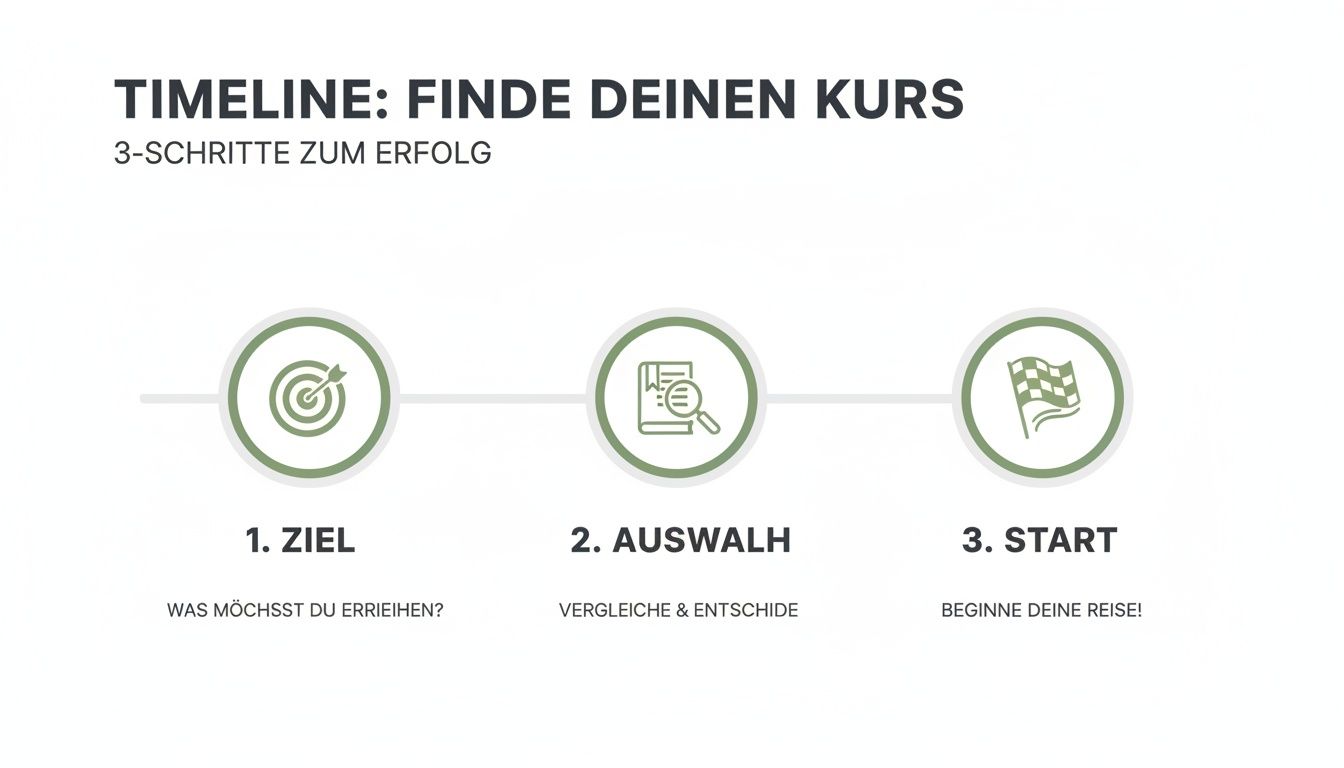
The graphic captures it perfectly: The path to the right course plan always begins with your personal goal, followed by targeted selection and a motivated start.
Are you new to the fitness game? Welcome! The most important thing now is to build a positive routine and find joy in movement. Your plan should not overwhelm you but gradually introduce you to the load and provide you with success experiences.
Do you train regularly and want to push your limits? Very good! Then your plan needs targeted stimuli, variety, and a smart combination of load and recovery to break through plateaus.
These examples are of course only suggestions. Consider them as inspiration, adapt them to your preferences, and find the rhythm that works best for you and your life.
Your body is a true marvel of adaptation. What challenged you at the beginning becomes a relaxed routine after a few weeks. For this reason, a static gym training plan, which you follow for months without adjustments, eventually loses its effectiveness. Suddenly, your progress stagnates – you have reached a classic training plateau.
But don’t worry, this isn’t a setback, but rather a great sign! It means that your body has become stronger and now simply needs new stimuli to continue developing. So, it’s the perfect moment to give your plan a little upgrade.
But how do you know that you should tweak your plan? Your body sends quite clear signals. Pay attention to these signs:
Does this sound familiar? Then it’s high time to adjust a few control knobs on your plan.
An adjustment doesn’t mean you need to throw everything out the window immediately. Usually, it’s the small, targeted changes that make the biggest difference. The key to success lies in the principle of progressive overload. This means gradually and controlled increasing the load.
Your goal should be to strategically leave your comfort zone without overloading yourself. Intelligent progression is more important than mindlessly exhausting yourself.
Imagine you regularly attend a functional training class. Instead of just carrying on as you have been, you could intentionally increase the intensity.
Here are a few concrete examples for increasing intensity:
Equally important is to listen to your body. If you notice that you are constantly tired or your recovery takes longer, you need to stay flexible. Swap an intense session for a relaxing mobility class or simply take an additional rest day. A good gym training plan is not a rigid corset but a dynamic companion on your journey.

You have perfectly tailored your gym training plan to your goals and give it your all in every workout. Great! But do you know when the real magic happens? Not while you are sweating, but in the time afterward.
Your body needs breaks to become stronger, faster, and fitter. The phases between workouts are the real growth phases. Here, your body repairs the stressed muscle fibers and rebuilds them stronger. Those who ignore this will get stuck.
A rest day is not wasted training time but an absolutely smart investment in your performance. Without sufficient recovery, you risk not only a performance plateau but also an increased risk of injuries. Always remember: Consistency outweighs even the highest intensity in the long run.
Recovery is not a passive state but an active process. Sleep, nutrition, and conscious relaxation are your tools to help your body adapt and grow optimally.
Good sleep is your strongest ally in this. During sleep, the body releases growth hormones that are essential for the repair processes. Seven to nine hours per night should be your goal.
What you eat has a direct impact on how well you recover and what energy you have for your next class. But don’t worry, a balanced diet doesn’t have to be complicated. Focus on a few simple basics that make a huge difference.
Before the workout: A light, carbohydrate-rich snack like a banana or a small bar fills up your energy stores. This way, you have the necessary power for your session.
After the workout: Now your body is crying out for building blocks! It needs proteins for muscle repair and carbohydrates to replenish the empty glycogen stores. A shake, quark with fruits, or a wholesome meal are ideal now.
Especially after training, adequate protein intake is crucial to really kickstart recovery. If you want to dive deeper into this topic, check out our Beginner’s Guide to Protein.
The Swiss fitness market is booming, and for good reason. The importance of professional supervision, which also covers nutrition and recovery topics, is steadily growing. In 2023, around 28,300 peoplebusy. This shows how important qualified personnel is for success.
If you take recovery and nutrition as seriously as your training itself, you lay the foundation for sustainable success and, above all, for lasting joy in movement.
In the studio routine, the same questions keep coming up when it comes to the perfect class schedule. Here I’ve collected the most important answers for you – as a little shortcut to clear typical stumbling blocks out of the way and elevate your training to the next level.
A good rule of thumb is to take a closer look at your plan every four to six weeks. But that doesn’t mean you have to throw everything out the window. Most of the time, it’s enough to just swap out one course, increase the intensity, or simply distribute training days differently to set new impulses.
The most important signal comes from your body anyway. Do you feel that progress is stagnating or motivation is slowly fading? Then it’s definitely time for a fresh stimulus in your plan.
A classic that is annoying but absolutely solvable. Most studios offer online pre-registration – use it consistently. It’s best to set a reminder on your phone to be able to book in time. This little trick often secures you the crucial head start.
Another tip: Talk directly to the trainers. They sometimes keep waiting lists or know a great alternative with a similar focus that you might not have thought of at all.
See it as an opportunity, not an obstacle. Maybe your new favorite class is waiting exactly where you least expect it. Sometimes it’s this unplanned change that rekindles your enthusiasm and gives your goals a surprising boost.
In short: Yes, you can get really fit with just group classes! A cleverly assembled mix of strength, endurance, and flexibility courses covers all important fitness areas seamlessly and ensures truly holistic development.
Courses like Functional Training or Bodypump are particularly effective for muscle building. They challenge your body in a complex way that is just as effective as training with equipment.
Equipment training is of course a great addition if you want to focus on specific weaknesses or challenge individual muscle groups in isolation. However, for comprehensive success, it is absolutely not a must with a smart class schedule.
Ideally, you place strength and endurance units on separate days. This way, your body has full power for each training session and can completely focus on the respective load.
If your schedule simply doesn’t allow for that, a simple rule applies: Your main goal comes first.
No matter how you schedule your classes, don’t forget the most important thing: Give your body at least one full rest day per week. This recovery phase is where the real magic happens – this is where you get stronger.
Your perfect class schedule is already waiting for you! At Templeshape, you will find a huge selection of courses that motivate you and bring you closer to your goals – from sweat-inducing HIIT to grounding yoga. Discover our class schedule now and find the energy and community you need to make health your habit.Find your class at Templeshape
Tags