March 17
Yoga in Old Age: Discover Safe Exercises for Your Mobility & Strength
0 comments

March 17
0 comments
Fragst du dich, ob Yoga im Alter wirklich noch einen Unterschied machen kann? Die Antwort ist ein klares und herzliches Ja. Hier geht es nicht um komplizierte Verrenkungen, sondern darum, durch sanfte, bewusste Bewegungen deine Lebensqualität nachhaltig zu verbessern und eine tiefere, positivere Verbindung zu deinem Körper aufzubauen.
Vielleicht denkst du bei Yoga an junge, extrem bewegliche Menschen in komplizierten Haltungen. Das ist ein Bild, das viele im Kopf haben. Doch die wahre Stärke von Yoga liegt in seiner unglaublichen Anpassungsfähigkeit.
Gerade im Alter wird es zu einem kraftvollen Werkzeug, das dir hilft, vital, sicher und selbstbestimmt zu bleiben – und das alles ganz ohne Leistungsdruck.
Es ist eine Praxis, die mit dir wächst und sich an deine aktuellen Bedürfnisse anpasst. Stell dir zum Beispiel vor, wie du deine Wirbelsäule mit sanften Drehungen mobilisierst oder deine Beinmuskulatur mit einer einfachen Stehhaltung stärkst, während du dich sicher an einem Stuhl festhältst. Genau das ist Yoga im Alter: funktionale Bewegung, die dir im Alltag direkt zugutekommt.
Yoga ist so viel mehr als nur Stretching. Es ist ein ganzheitliches Training, das Körper und Geist gleichermassen anspricht. Regelmässige Praxis kräftigt gezielt die Muskelgruppen, die für eine aufrechte Haltung und einen stabilen Gang entscheidend sind. Das Resultat? Du fühlst dich stärker und sicherer bei ganz normalen Bewegungen wie Treppensteigen oder dem Tragen der Einkäufe.
Zudem fördert Yoga die Durchblutung und hält deine Gelenke geschmeidig, was typischen Altersbeschwerden wie Steifheit entgegenwirken kann. Und dann ist da noch die Atmung: Eine ruhige, bewusste Atmung während der Übungen hilft, Stress abzubauen, den Blutdruck zu regulieren und kann sogar deine Schlafqualität deutlich verbessern.
Yoga ist keine Frage des Alters, sondern eine Frage der Haltung. Es lehrt dich, die Grenzen deines Körpers liebevoll zu respektieren und gleichzeitig dein volles Potenzial für Wohlbefinden zu entfalten.
Diese Infografik fasst einige der wichtigsten Vorteile zusammen, die regelmässiges Yoga für deine Gesundheit und Sicherheit haben kann.
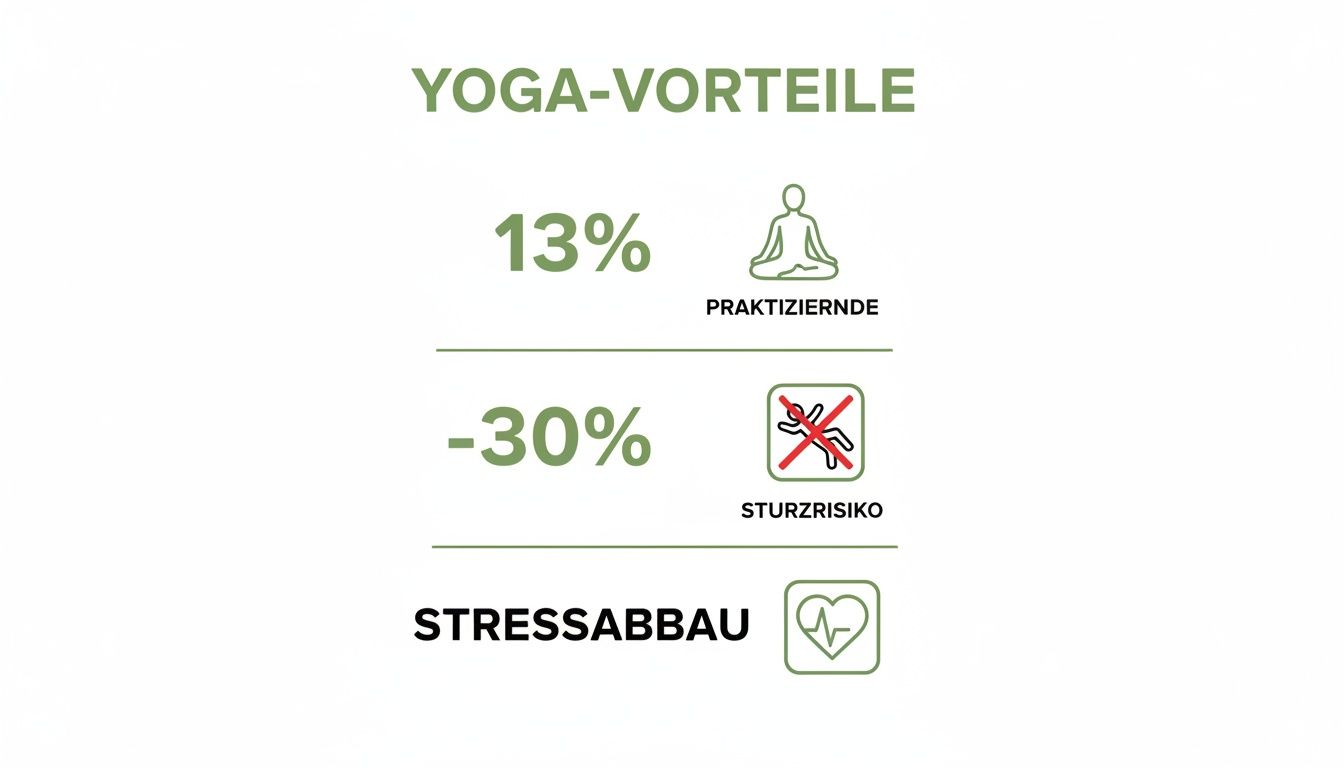
Die Zahlen zeigen eindrücklich, wie Yoga gezielt das Sturzrisiko senkt – ein entscheidender Faktor, um im Alter lange selbstständig zu bleiben.
Die folgende Tabelle fasst die wichtigsten Vorteile zusammen und zeigt dir, welche konkreten positiven Effekte du von einer regelmässigen Yogapraxis erwarten kannst.
| Nutzen für den Körper | Nutzen für den Geist | Nutzen für den Alltag |
|---|---|---|
| Verbesserte Flexibilität und Gelenkgesundheit | Stressabbau und innere Ruhe | Sicherer Gang und bessere Koordination |
| Gesteigerte Muskelkraft, besonders in Beinen und Rumpf | Förderung der Konzentration und des Fokus | Leichteres Bücken, Heben und Treppensteigen |
| Stärkung des Gleichgewichts zur Sturzprävention | Bessere Schlafqualität | Mehr Energie und allgemeines Wohlbefinden |
| Regulierung von Blutdruck und Kreislauf | Steigerung des Selbstbewusstseins | Schmerzlinderung bei chronischen Beschwerden (z.B. Rücken) |
Wie du siehst, wirkt sich Yoga auf alle Bereiche deines Lebens positiv aus und schenkt dir ein Stück Unabhängigkeit zurück.
One of the most important effects of yoga in older age is the improvement of balance. Over the years, this often declines, which increases uncertainty in daily life. Yoga targets your balance specifically through poses that sharpen your concentration and body awareness. Every exercise where you need to stand stable is direct training for more security.
In Switzerland, yoga has gained enormous popularity in recent years, as the numbers indicate. According to the study ‘Sport Switzerland 2020’, already 13 percent of the Swiss population practices yoga. Specifically for the elderly aged 60 and over, research shows measurable benefits: Regular practice can reduce the risk of falling by up to 30 percent, as it specifically strengthens balance and muscle strength. You can read more about the health aspects of yoga in Switzerland in this article.
This holistic approach to longevity is a central theme that you can also explore in our Guide to the Art of Long Life.
Every beginning can be easy when you know how. This section is your very practical compass for a motivating and safe start to yoga in older age. It’s mainly about creating an environment where you feel comfortable and supported from the very first minute.
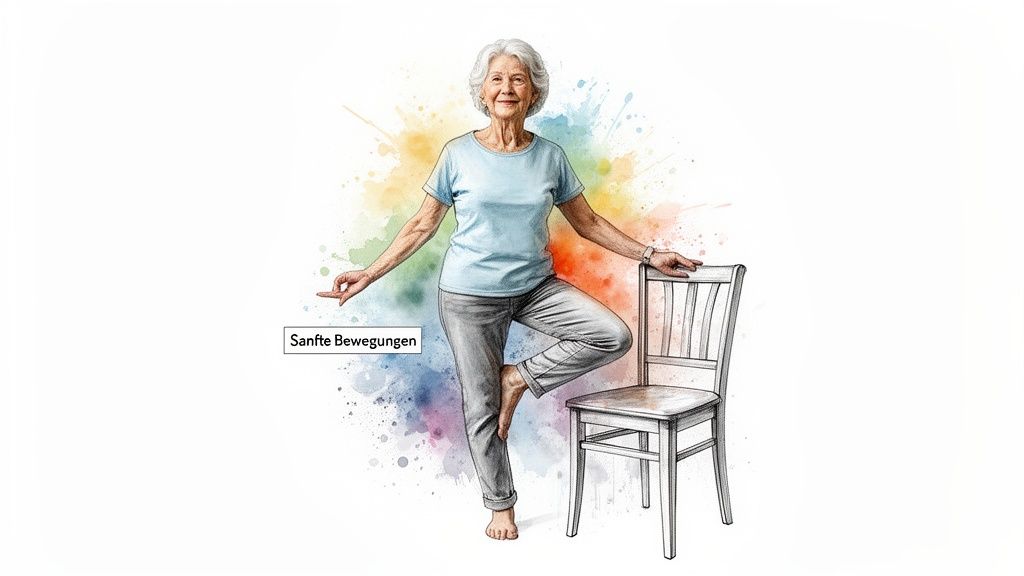
The first step is incredibly simple: Find a place where you are undisturbed and have enough space to stretch your arms out to the sides. A non-slip yoga mat is great, but for starters, a carpet will do just fine.
Put on comfortable clothing that allows you full freedom of movement. It doesn’t have to be special yoga clothing – loose pants and a T-shirt are perfect. The main thing is that nothing pinches or constricts you.
Before you begin the first movement, take a moment to just breathe. This conscious breath, known in yoga as Pranayama, is truly the heart of the practice. It calms your nervous system and supplies your body with fresh energy.
A simple technique for starting is abdominal breathing. Place one hand on your belly and breathe deeply in through your nose. Consciously feel how your abdomen rises. As you exhale through your nose, it lowers again. Repeat this a few times and simply observe how you become calmer.
You can incorporate this little trick into your daily life anytime you need a moment of calm.
Especially in older age, a good warm-up is essential. It lubricates the joints and gently prepares the muscles for movement. It’s not about great effort, but rather gentle mobilization.
Start with simple exercises to wake up your body:
These small movements make a huge difference and help to prevent injuries.
Your body constantly sends you signals. Learn to listen to them. A stretch should feel good, never painful. This is the most important principle in yoga for older adults.
You don’t have to be an acrobat to practice yoga. Props are fantastic supporters that make every pose accessible to you. They are not ‘crutches’, but simply intelligent tools for a safe practice.
For example, imagine you want to touch your toes in a forward bend, but your back feels a bit stiff. A yoga strap can become an extension of your arms here. Or a yoga block under your hands in a standing pose gives you exactly the height and stability you need.
But perhaps the most versatile helper is a regular chair. You can use it for balance exercises, lean on it, or even perform entire yoga sequences while sitting. It makes yoga possible for every body and every daily form.
If you pay attention to these simple basics, you’ll create the best conditions for a joyful and sustainable yoga practice. You build trust in your body and its capabilities from the very beginning – and that’s what it’s all about.
So now it’s getting practical – it’s time to get on the mat or the chair. I’m going to introduce you to a few basic yoga exercises, the asanas, that are perfect for getting started. The focus here is clearly on promoting your stability, gently strengthening the muscles, and maintaining your mobility. So exactly what you need for more security and well-being in everyday life.
I will explain each pose step by step and without complex yoga jargon. The best part: For each exercise, you will find adapted variants. This way, you can be sure that the practice always fits your daily form and your personal needs.
This flowing movement is a true blessing for the spine. It is perfect for getting going in the morning or to relieve tension in the back after a long day. You can do the exercise comfortably on a stable chair without armrests.
This simple sequence is not only fantastic for your back; it also helps you deepen and become more aware of your breathing.
The Mountain Pose (Tadasana) may look unremarkable, but don’t be fooled. It is an incredibly powerful exercise for maintaining an upright posture and good balance – the absolute foundation for almost all standing positions in yoga.
Tip from practice: If you feel a bit wobbly at first, that’s perfectly normal. Just stand with your back against a wall or hold onto the back of a chair. This will give you security and allow you to fully focus on proper alignment.
The Warrior II (Virabhadrasana II) is a pose full of power. It strengthens your legs and core while gently opening the hips. The chair variation provides you with the necessary security and support.
Regular practice has been shown to have a positive impact on health. More and more older Swiss people are discovering Yoga in Older Age as a key to increased vitality. Among those over 60, the yoga participation rate is already over 15 percent. It’s no wonder, as yoga is gentle on the joints while simultaneously strengthening mental resilience. Especially women over 50, who make up 77 percent of practitioners, often report a significant reduction in pain, for example in the back. More interesting facts on this can be found in the study Sport Switzerland 2020.
A gentle yoga practice can be a true blessing, especially for chronic tension. If you’d like to know more about it, take a look at our article Yoga for Back Pain with these safe and effective exercises, you now have a wonderful foundation to start your personal yoga journey.
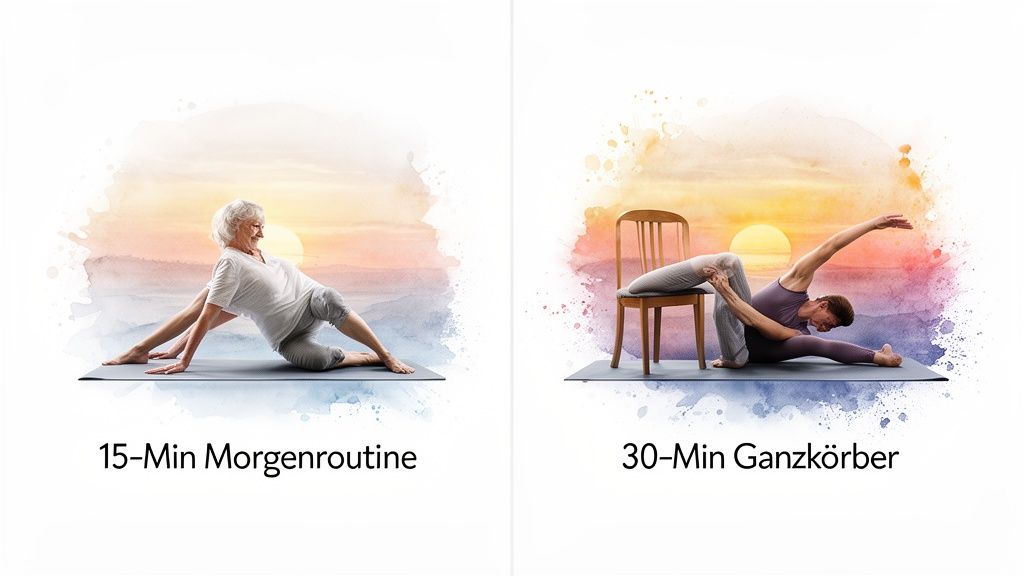
Okay, you now know the individual exercises. But how do you put it all together into a coherent whole? That’s exactly what we’re looking at now. I have put together two complete yoga flows that you can try out right away.
The first is a short, punchy morning routine that gently wakens your body. The second is a slightly longer session that focuses entirely on strength and balance. Consider these flows as a kind of blueprint – you can adapt them to your daily condition at any time or swap out individual exercises.
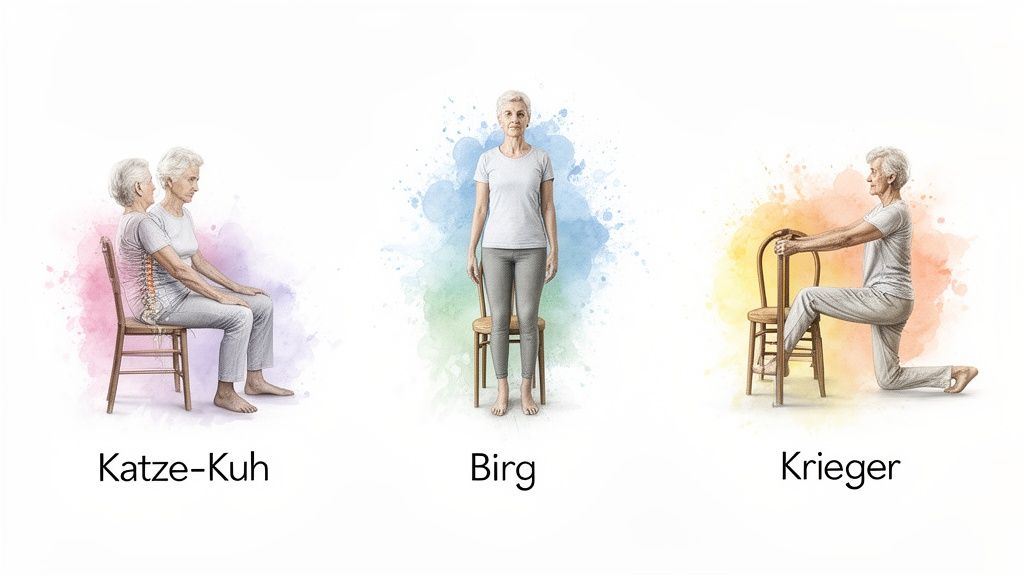
This sequence is invaluable for driving away morning stiffness and starting the day with a good feeling. All you need is a stable chair.
Arrival (1 minute): Sit up straight on the front edge of your chair. If you like, close your eyes for a moment and take three deep, conscious breaths. Feel the solid contact of your feet with the ground.
Gentle Warm-up (3 minutes):Start with relaxed shoulder circles, first forwards, then backwards. Let your head gently roll from one shoulder to the other. Also move your feet and wrists in circular motions, in both directions.
Cat-Cow sitting (3 minutes):Place your hands loosely on your thighs. Inhale to open your heart and come into a gentle backbend – that’s the Cow. Exhale to round your back, drawing your chin to your chest – the Cat. Repeat this flowing transition8-10 timesin the rhythm of your breath.
Seated twist (2 minutes):Inhale and lengthen your spine. As you exhale, gently twist your upper body to the right. Your left hand comes to the outside of your right knee, the right hand reaches behind you to the chair back. Hold for three breaths, then switch sides.
Leg lifts for strengthening (3 minutes):Hold onto the seat to stay stable. With the exhale, extend your right leg straight out in front and engage your thigh. Inhale to lower it back down in a controlled manner. Repeat this8 timesper side.
Conclusion (3 minutes):Finish your short practice with theMountain pose standing (Tadasana).Simply stand behind your chair and use the backrest for support. Find a firm stance, stand tall, and breathe deeply and calmly for a few moments.
This little session mobilizes your spine, awakens the leg muscles, and provides mental clarity for everything the day brings.
Always remember: Every movement should feel good. If something pinches or hurts, make a smaller movement or pause briefly. Your body is your best teacher.
This longer practice builds on the morning routine but takes it a step further. Here we integrate additional exercises that specifically promote your strength and balance. At the end, a well-deserved relaxation awaits.
Warm-up (5 minutes):Start just like in the morning routine. Take your time to settle in while sitting, warm up your joints, and flow through a few rounds of Cat-Cow.
Strength building while standing (10 minutes):Your chair is once again your reliable partner.
Balance and stretch (10 minutes):
Relaxation (5 minutes):Sit comfortably and upright. Close your eyes, rest your hands softly in your lap, and let your breath flow naturally. Reflect on the practice and enjoy the soothing silence for a few minutes.
Sometimes in the morning you have little time, on other days you want to do something good for yourself. This table helps you quickly decide which yoga session best fits your time and needs today.
| Feature | 15-Minute Morning Routine | 30-Minute Full Body Session |
|---|---|---|
| Focus | Gentle Awakening, Mobilization | Strength Building, Balance, Stretching |
| Intensity | Low | Moderate |
| Duration | 15 minutes | 30 minutes |
| Best time | Right after waking up | Anytime, e.g. in the morning/afternoon |
| Equipment | Just a chair | Just a chair |
| Ideal for | A quick, energetic start to the day. | Days when you have more time for yourself. |
No matter which option you choose, the most important thing is consistency. Even a short daily practice can make a huge difference to your well-being. Listen to your body and choose what feels right today.
Exercising together is often much more fun. Practicing in a group can be incredibly motivating and creates a valuable sense of connection. But how do you recognize a good course for Yoga in Aging, where you feel safe and well taken care of?
The key is clearly the qualification of the instructor. They should not only be certified but also ideally have practical experience teaching older adults or in senior yoga. A good instructor will always ask you about any physical limitations and will naturally offer you variations and the use of props.
Search for a suitable offer and pay special attention to an atmosphere that speaks to you. It’s about finding a place where you feel welcome – completely without performance pressure.
Here are a few concrete pointers that can help you make your decision:
A supportive community is at least as important as the exercises themselves. It gives you support, motivation, and makes your yoga practice a fixed and joyful part of your life.
At Templeshape in Zurich, we place the utmost importance on cultivating exactly this supportive and friendly atmosphere. Our courses are designed so that everyone feels comfortable, whether you are starting anew or returning after a break. If you are curious, here is an overview of our Yoga classes in Zurich.
Statistics from Switzerland highlight the value of yoga for prevention and quality of life in old age. Especially in cities like Zurich, many people use yoga specifically for stress reduction. There are even insightful Study results on yoga in Germany, which provide interesting insights for us in Switzerland as well.
Whether online, in a local senior group, or in a studio like ours – find the place that feels right for you.
Are you considering starting yoga, but a few questions are swirling in your head? That’s absolutely understandable and a great sign. It shows that you are consciously and mindfully engaging with your health. Let’s address the most common concerns together so that you can step onto the mat with confidence and a good feeling.
This is probably the biggest myth of all and unfortunately keeps so many people from discovering the wonderful benefits of yoga. The clear answer is: Not at all! Yoga is not acrobatics. It’s not about getting your feet behind your head, but about mindfully listening to your own body.
Every single exercise can be adapted – with props like a chair, blocks, or a strap, anyone can experience the positive effects. Remember: It is never too late to start.Flexibility comes naturally over time, we promise.
The basic principles – breathing, movement, mindfulness – naturally remain the same. The big difference lies in the focus: Senior yoga is specifically designed for safety, stability, and gentle mobilization of the joints. The pace is usually significantly slower, giving you more time to explore a pose calmly and feel the correct alignment.
Additionally, aids are used much more often to perfectly adapt the exercises to the needs of older age. The focus is on everyday relevant topics such as balance, strength, and maintaining healthy joints – not the spectacular pose for Instagram.
Yoga in old age doesn’t mean ‘less’ yoga, but ‘smarter’ yoga. It is a practice that meets you exactly where you are today and supports you in staying strong and independent.
Here it is clear: Regularity beats length. Even if you manage to get on the mat once or twice a week, you will quickly notice a positive change in your body awareness and mobility.
Many of our members swear by a short daily routine of just 10-15 minutes.This could be a small sequence in the morning to get your circulation going, or a few relaxing exercises in the evening to unwind. Just find a rhythm that integrates well into your daily life, without any pressure.
We hope this little guide has shown you how enriching and accessible yoga in old age can be. At Templeshape, it is our heartfelt mission to accompany you on your way to more well-being and joy in life. Come and visit us and find the course that perfectly suits you.
Tags
 DE
DE FR
FR EN
EN