March 17
What is Hatha Yoga and how this style enriches your life
0 comments

Imagine you are looking for a yoga style that grounds you, gives you strength, and simultaneously creates an oasis of calm in your daily life. That is exactly what Hatha Yoga is: the original form of yoga, which combines postures (asanas), breathing techniques (pranayama), and meditation into a profound, balancing practice. It is the foundation upon which many modern yoga styles are built today.
Have you ever wondered what the name “Hatha” signifies? The answer lies in the ancient Sanskrit, the language of yoga. “Ha” stands for the sun – the active, warming, male energy within us. “Tha” symbolizes the moon – the passive, cooling, female energy.
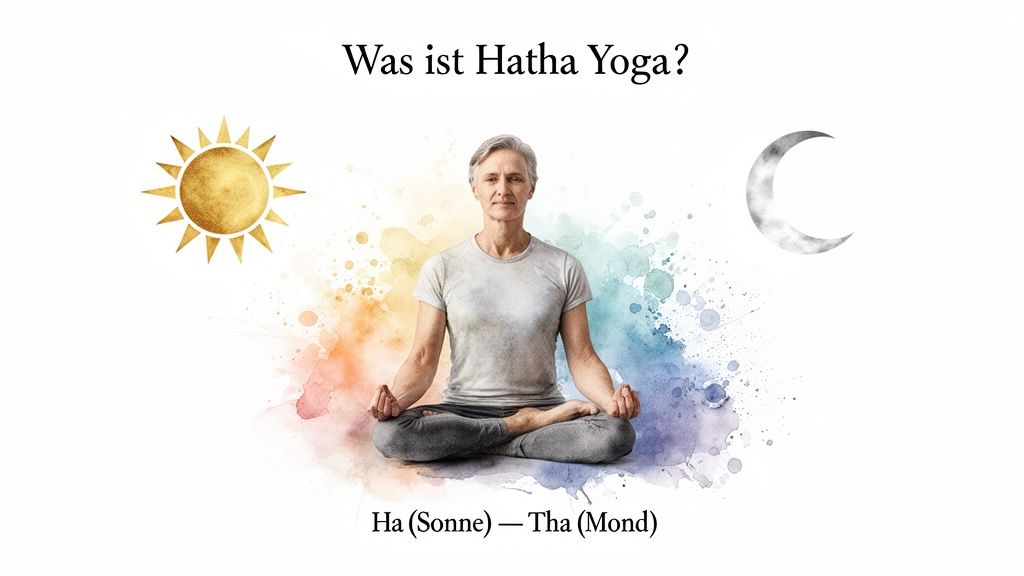
Hatha Yoga is therefore the art of uniting these two opposites within you and thus finding an inner balance. It is not about bending yourself into complicated poses. Rather, Hatha Yoga invites you to be fully aware of and feel your body.
In contrast to dynamic styles like Vinyasa, where movements flow into each other, you usually hold poses in Hatha Yoga for several breaths. A good example is the “Tree” pose (Vrksasana): Instead of quickly switching from one leg to the other, you take your time to find balance on one leg, breathe deeply, and feel the stability within you.
Hatha Yoga is an invitation to pause and consciously feel the connection between body, breath, and mind. It creates an anchor of calm in your often hectic daily life.
This focus on mindfully holding the poses gives you the time to find the correct alignment, breathe deeply into the stretch, and truly arrive at yourself. You learn to let go of tension while simultaneously building strength.
Here you will find a summary of the central elements that define Hatha Yoga and their significance for your practice.
| Element | What it means for you |
|---|---|
| Asanas (body postures) | Held poses that promote your strength, flexibility, and body awareness. |
| Pranayama (breath control) | Conscious breathing techniques that calm your nervous system and focus the mind. |
| Meditation & relaxation | Moments of silence that help you reduce stress and find mental clarity. |
It is this combination of strength, calmness, and conscious breathing that makes Hatha Yoga the perfect starting point for your personal yoga journey.
To truly understand Hatha Yoga, we must take a little journey back in time. Forget for a moment the modern gym or the fancy yoga mat. Hatha Yoga is not an invention of our time but a millennia-old practice from ancient India.
The original goal had little to do with achieving the perfect beach body. It was about strengthening and cleansing the body so that it could remain in meditation for hours.
The ancient yogis saw the body as the temple of the soul.Every posture (asana) and every breathing exercise (pranayama) was a tool for caring for this temple. For example, imagine a simple forward bend: Originally, it was not just a stretch for the back of the legs, but a gesture of devotion to calm the mind and allow life energy – the prana – to flow freely again.
At the core of the Hatha philosophy is the idea of preparation. Through physical exercises, the mind becomes calm. This may sound paradoxical, but it is quite logical: An uneasy, aching body constantly distracts you. In contrast, a strong, flexible body becomes a quiet partner on the path to inner reflection.
Hatha Yoga teaches you that your body is not your enemy, but your ally. With every conscious movement, you prepare it to allow the mind to come to rest.
This ancient wisdom is more relevant today than ever. Hatha Yoga, which originated in Shaivite Tantrism, has evolved into a globally practiced discipline. In Germany alone, the percentage of yoga practitioners increased from only 5 percent in 2018 to an impressive 20 percent by 2023.This trend is also reflected globally: The yoga market reached a value of 105.9 billion USD in 2022.If you want to delve deeper into this fascinating story, you can find more insights into the development of Hatha Yoga on Wikipedia..
This historical foundation gives your practice a whole new depth. So the next time you stand on your mat, remember: You are part of a long tradition that honors the body in order to free the mind.
Imagine a typical Hatha Yoga class as a stable, harmonious building. It stands firmly on three fundamental pillars. Each of these elements has its own unique role, but only in perfect synergy do they unleash their full power for your body and mind.
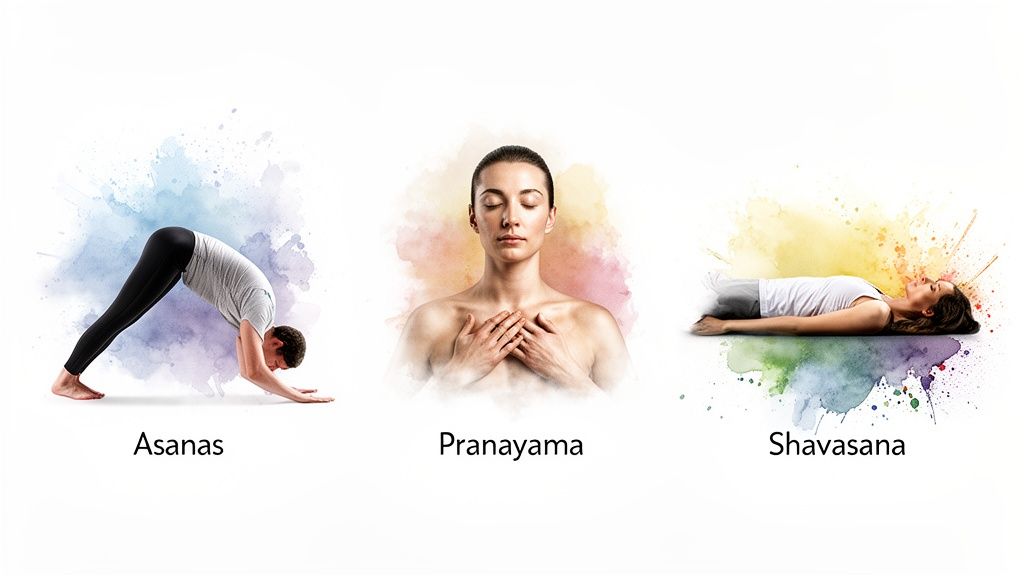
These three pillars are the building blocks that help you build inner strength, find deep calm, and firmly anchor the positive effects of the practice within you.
The heart of your physical practice consists of the asanas.The major difference compared to more dynamic yoga styles is that in Hatha Yoga you hold individual poses for several breaths. This gives you valuable time to consciously align your body, grow into the pose, and truly feel its effects.
Two absolute classics that you will surely encounter are:
The second, equally important pillar is Pranayama, the art of conscious breath control. Your breath is an incredibly powerful tool that allows you to directly influence your nervous system and calm your often restless mind.
Through simple but highly effective breathing exercises, you learn to actively transition from a stressed, rushed state to a calm and relaxed one. A simple example is alternate nostril breathing (Nadi Shodhana), where you breathe alternately through the left and right nostrils to balance your nervous system. These techniques are a central part of what makes Hatha Yoga so special. If you want to dive deeper, you can find more exciting techniques in our guide to Breathwork in Zurich. The practice of Hatha Yoga is based on various pillars, including body postures, breathing techniques, and meditative elements, which also include specific mindfulness exercises to promote inner strength and focus.
In the silence between the inhalation and exhalation, you find the space where your mind can quiet down. Pranayama is the key to this space.
The third pillar is often underestimated but may be the most important of all: Shavasana, the final relaxation. At the end of each session, you lie comfortably on your back and do… seemingly nothing.
Yet it is precisely in this moment that the real magic happens. Your body integrates the effects of the asanas, your nervous system calms down and regulates itself, and your mind gets the chance to process what has been experienced. This phase is absolutely crucial for finding the balance between tension and relaxation and leaving the session feeling revitalized.
"I’m just too inflexible for yoga." I hear this phrase over and over again. Perhaps you also think that yoga is only for extremely flexible people or that you simply lack the energy in your stressful everyday life.
Good news: Hatha Yoga is here to dispel exactly these prejudices. It is one of the most accessible styles out there – and probably just what you need right now.
Hatha Yoga meets you exactly where you are today. Forget complicated contortions or a pace that leaves you breathless. It’s about slow, consciously executed movements.
Each pose, also called an asana, is held for several breaths. This gives you the time to tune into your body, find the right alignment, and develop a sense of the basics. All without pressure or performance expectations.
Especially when your job demands a lot from you – as is often the case here in Zurich – Hatha Yoga can become a lifesaver. The combination of conscious breathing and the interplay of tension and relaxation helps you stop the carousel of thoughts and shed mental baggage.
In Hatha Yoga, there is no competition. It’s not about executing a pose perfectly, but rather about experiencing the moment consciously. A skill that often eludes us in everyday life.
This calming effect, by the way, is more than just a feeling. A representative study from 2014 showed that 89.7 percent of yoga practitioners reported positive effects. Specifically, 58.8 percent felt more balanced in their everyday life. It’s also interesting that Hatha Yoga is particularly popular among people in large cities and freelancers – exactly the groups that are often under high pressure. If you want to dive deeper, you can find more details on Yoga research.
here. The practice not only dissolves mental blockages but also the typical tension in the neck and shoulder area caused by long hours sitting at a desk. You learn to breathe deeply again and simply recharge.
Vinyasa, Ashtanga, Yin Yoga – the world of yoga is vast and can seem pretty overwhelming at first. To help you maintain perspective and find the right style for you, let’s take a look at what distinguishes Hatha Yoga from the other major styles.
One could imagine Hatha Yoga as the solid foundation of a house. The practice is rather calm and methodical, with a clear focus on holding the individual poses. This gives you the necessary time to find the correct alignment and truly tune into your body.
In stark contrast is the dynamic Vinyasa Yoga. Here everything flows. Imagine it like a dance where you seamlessly connect each movement with your breath. An example is the Sun Salutation: In Vinyasa Yoga, you flow dynamically from one position to the next, whereas in Hatha Yoga, you could hold each individual pose of the salute longer. The transitions are fluid and often creative, so you’re constantly in motion. This makes Vinyasa physically demanding and often also more sweaty. While Hatha grounds you, Vinyasa brings you into the flow.
Ashtanga Yoga takes it up a notch. This style is extremely disciplined and physically demanding, as it is based on a fixed, unchanging series of postures. It’s like a structured training program that focuses on strength, endurance, and mental discipline.
Hatha Yoga is your anchor point – slow and mindful. Vinyasa is the flow – dynamic and creative. Ashtanga is the discipline – powerful and structured.
At the other end of the spectrum lies the deeply relaxing Yin Yoga. While Hatha actively addresses and strengthens your muscles, Yin targets deeper layers: your connective tissue, fascia, and joints. The poses are completely passive for several minutesheld to the ground. A typical example is the "Caterpillar" (a seated forward bend), where you simply give in to gravity instead of actively pulling into the stretch. It’s all about pure letting go and a gentle, yet intense stretch.
So, if you are looking for a deeply relaxing practice that passively enhances your flexibility, our courses for Yin Yoga in Zurich could be a wonderful addition for you.

To make your decision even easier, here’s an overview. This table shows you the main differences in pace, focus, and intensity between the most popular yoga styles.
| Feature | Hatha Yoga | Vinyasa Yoga | Yin Yoga |
|---|---|---|---|
| Pace | Slow, static | Flowing, dynamic | Very slow, passive |
| Focus | Correct alignment, body awareness | Breath-movement synchronization, flow | Deep connective tissue, joints, letting go |
| Intensity | Low to medium, good for beginners | Medium to high, physically demanding | Gentle, but mentally intense |
| Goal | Strength, flexibility, inner peace | Strength, endurance, cardiovascular | Deep stretching, relaxation, flexibility |
With this knowledge, you can now better assess which style and which course at Templeshape in Zurich currently best suits your needs.
You now have a good picture of what Hatha Yoga is and what it can do for you. The next step? To experience it on the mat yourself. Your introduction should feel good and uncomplicated. This is exactly what we make possible for you at Templeshape.
For your first class with us, you only need comfortable clothing that allows you to move freely. We take care of everything else. Yoga mats and all necessary accessories are ready for you in our studios.
Our philosophy is simple: It’s about you and your well-being, not about acrobatic feats. Our experienced teachers guide you through the asanas without pressure and with a lot of empathy. You learn to listen to the signals of your body and to lovingly accept your limits.
With us, it’s not about the perfect pose, but about the perfect moment for you. A moment of calm, strength and conscious arrival in the here and now.
Many people start their yoga practice at home – statistics show that 74 percentof yogis mainly practice at home. That’s a great start! But a studio like Templeshape offers an invaluable added value: You receive professional guidance, are part of a motivating community, and give yourself a conscious break from everyday life. If you’re interested in the latest developments in the yoga world, you can read more insights into yoga trends here.
Ready to start your journey? We look forward to seeing you in our studios Health Temple CITY or AIRPORT. Simply book your Yoga trial class in Zurich and feel for yourself how good Hatha Yoga feels.
Finally, we want to clarify a few questions that are often asked in our Zurich Templeshape studios. Perhaps yours is among them? This way, we clear the last doubts out of the way and make it even easier for you to get started on the mat.
No, absolutely not! This is probably the biggest misunderstanding that circulates about yoga. Flexibility is not a ticket, but a wonderful result of your practice.
Hatha Yoga is ideal for gently and step-by-step building your flexibility. Our experienced teachers at Templeshape show you different variations for each exercise. This way, you can always adapt them to your current level and meet your body exactly where it stands – completely without performance pressure.
Even just one hour per week can make a noticeable difference for your body awareness, your posture, and your inner calm. In yoga, it is clear: Regularity beats intensity.
Many of our members in Zurich attend classes once or twice a week and tell us how this leads to less stress and more energy in their daily lives. Just find a rhythm that fits well into your life.
While Hatha Yoga is not an intense cardio workout, it can be an incredibly valuable companion on your journey to your feel-good weight. On one hand, it strengthens the muscles, which slightly increases your basal metabolic rate.
However, the mental aspect is much more crucial: Yoga sharpens your awareness of your own body and helps reduce stress. And this stress is often the trigger for unhealthy eating behaviors. Hatha Yoga supports you on a much deeper, holistic level.
Are you curious and want to experience the balancing power of Hatha Yoga yourself? At Templeshape you’ll find the perfect place to get started in a supportive atmosphere and make health your new habit.
Discover our Courses in Zurich and sign up for a trial class. We look forward to seeing you.
Tags
 DE
DE FR
FR EN
EN