March 17
Pelvic floor exercises after childbirth for a strong core
0 comments

Congratulations, your baby is here! A very special time begins now, and the right support for your body is crucial. Gentlepelvic floor exercises after childbirthare your key to reconnecting with your core and laying the foundation for a strong recovery.

The postpartum period is a phase of enormous changes. Your body has accomplished incredible things. Especially your pelvic floor was heavily strained and stretched during pregnancy and childbirth. It is therefore completely normal if this area feels foreign, perhaps even numb or simply weak now.
That is exactly why targeted, but above all gentle exercises are so incredibly important right now. And it is about much more than just being able to exercise again at some point. A functional pelvic floor is the basis for your entire body stability.
Imagine your pelvic floor best as an elastic hammock. It supports your organs, controls the openings of your body, and stabilizes your spine. After childbirth, this “hammock” is quite stretched out and needs time and the right impulses to regain its former elasticity.
Before you even think about more complex exercises, there is a completely different task at hand: you need to learn to consciously feel your pelvic floor again. This is often the biggest challenge for many women at first, as the nerve connections can be temporarily disrupted after childbirth.
This is not yet about strength, but purely about perception. It is about interpreting the subtle signals of your body and activating the right muscles – without using your gluteal or abdominal muscles for support. Give yourself time for this; it is a process that requires patience.
These first gentle perception exercises are the A and O. They reactivate the muscle-nerve connections and prepare your body for the more intense training in the postpartum course. Consider it as the foundation on which your entire further training is built. Without this foundation, you risk training ineffectively or even incorrectly.
If you focus on your pelvic floor shortly after childbirth, you are not only doing something for recovery but also preventing long-term problems. Many women find it uncomfortable to talk about issues such as incontinence, but the numbers show how widespread this challenge is.
In fact, in Switzerland after a vaginal birth,up to 11% of womensuffer from urinary or fecal incontinence. This unintentional loss can occur spontaneously or be caused by birth injuries and often increases with the number of births. More background information can be found in theSGGG informational brochure 2022..
Give yourself and your body time. Recovery is not a race but a journey back to your strength. Every small step, every conscious contraction, and every release is a great success.
This statistic makes it clear why your pelvic floor is not a trivial matter but a central aspect of your health after childbirth. Through early and correct exercises, you can actively secure your continence and minimize the risk of later prolapse of the uterus or bladder.
The key to success lies in the perfect combination of tension, relaxation, and your breathing. A very common mistake is to focus only on tensing. Just as important is to be able to completely relax the pelvic floor again. A permanently tense pelvic floor is just as problematic as one that is too weak.
Your breathing is your most important partner in this. Try from the beginning to combine the activation with your exhalation:
This synchronization helps you specifically target the deeper muscles while avoiding tension. Your firstpelvic floor exercises after childbirthare therefore primarily breathing and perception exercises that can be done comfortably while lying down.
The big question that almost every new mom has is: “When can I finally do something again?” Especially thepelvic floor exercises after childbirthare high on the list. However, the answer is as individual as your birth and you. There is no one-size-fits-all starting signal, but there is indeed a clear roadmap that you can follow.
Your body has accomplished an enormous feat and now needs primarily one thing: time to heal. But that doesn’t mean you should put your feet up for weeks and do nothing. Quite the opposite – you can gently support recovery from the very beginning.
Just a few days after childbirth, you may and should start with very gentle perception and breathing exercises – of course, only if you feel like it. This is not about strength yet but about rebuilding a connection to your core, your pelvic floor.
This can look very simple: Lie comfortably on your back, place your feet hip-width apart, and rest your hands on your lower abdomen. Breathe deeply and relaxed into your belly, feel how the abdominal wall rises. While exhaling, let it sink gently back down. Just this conscious breathing stimulates circulation and supports healing.
Your body gives you very clear signals. A slight pulling sensation, uncomfortable pressure downwards, or even pain are unmistakable stop signs. Listen carefully and give yourself a break.
These very first exercises are so gentle that they do not disturb the wound healing but even promote it. They help your uterus recover and can positively influence the postpartum discharge.
How your path back to strength looks depends greatly on your birth experience. The healing process varies, and so does the timing for more intensive exercises.
No matter how you gave birth, the first six to eight weeks are all about settling in and fundamental recovery.
The crucial milestone is your gynecological follow-up examination, which usually takes placesix to eight weeks after birth.Here, it will be checked if everything is healing well and if the recovery process is proceeding as it should.
If your gynecologist gives you the green light, you can start a structured postpartum recovery course. Only from this point on will you focus on actual strength building. All exercises that go beyond pure awareness and gentle activation should only be approached after this medical approval.
This appointment marks the transition from gently rediscovering your body to targeted training. Those who want too much too soon risk disrupting the healing process and acquiring long-term issues such as prolapse or incontinence. Give your body the time it rightly deserves.
Now it gets practical. Your body has already done quite a bit of regeneration work in the first few weeks. Now it’s about purposefully rebuilding and strengthening the connection to your pelvic floor. The following Pelvic floor exercises after childbirthare specifically designed for this early phase – they are gentle, safe, and incredibly effective when done correctly.
Everything starts with the correct activation. Push aside thoughts of strength or great effort for now. Your main goal is to feel all three layers of your pelvic floor and to connect their movement with your breathing. This is and remains the basis for everything that is yet to come.
Your pelvic floor is not a simple muscle plate, but a clever network of three layers stacked on top of each other. To directly activate them, inner images often work much better than dry, technical instructions. Your brain loves such imagery and then sends exactly the right impulses to the muscles.
Just try out which of these images works best for you:
Such visual instructions help you engage the fine, deep muscles instead of accidentally cheating with the larger, outer muscles like the glutes or thighs.
The very best exercises for beginners are those where you can work without pressure and in a relaxed position. Lying on your back is perfect for this, as your pelvic floor doesn’t have to fight against gravity.
1. The pelvic swing while lying down
This exercise gently mobilizes your pelvis and simultaneously awakens your deep abdominal and pelvic floor muscles.
2. The bridge with focus
Almost everyone knows the bridge, but with the right focus, it becomes a brilliant exercise for the pelvic floor.
These two exercises are a perfect start. You can easily integrate them into your daily routine, for example, in the morning right after waking up still in bed or in the evening to unwind.
The following process shows you how to safely increase your training over time.
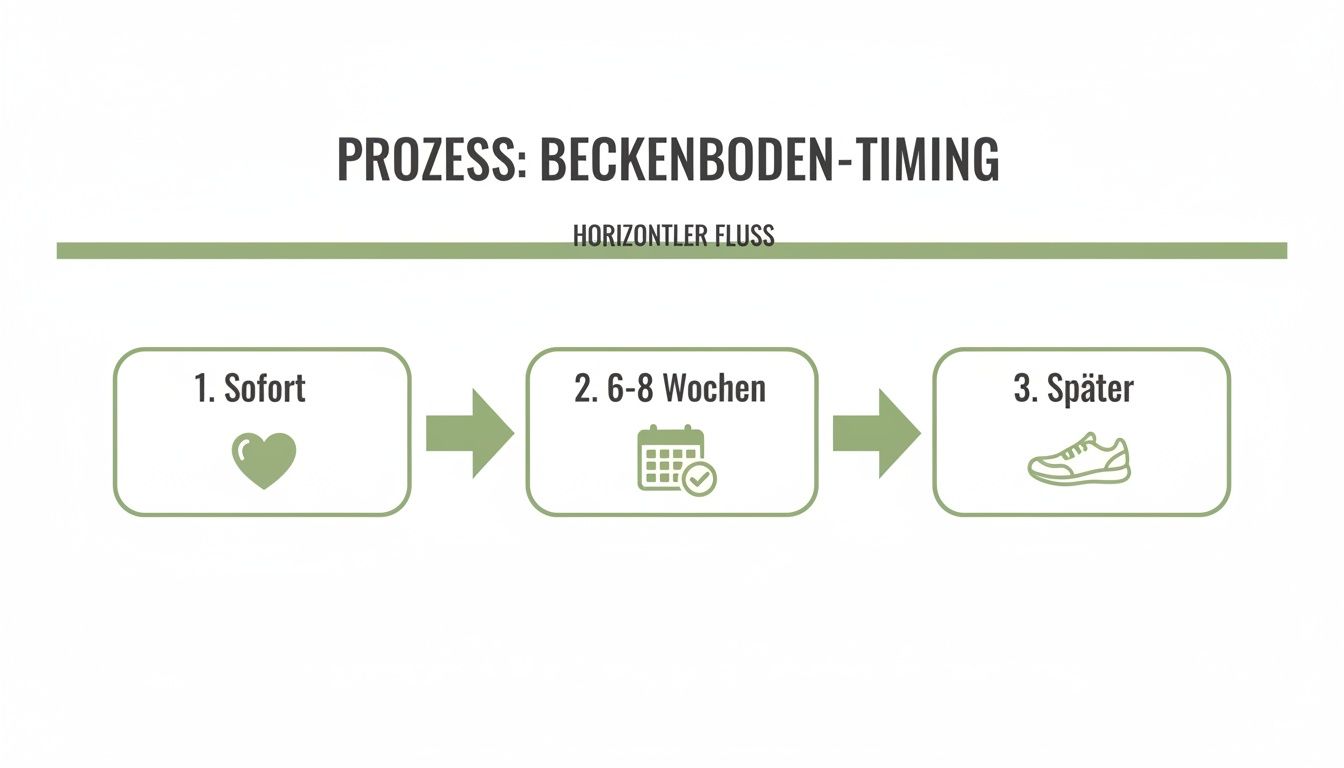
The graphic illustrates nicely: postpartum recovery is a journey in stages. It starts with gentle awareness right after childbirth, progresses to structured training after the doctor’s approval, and eventually leads you safely back to more demanding sports.
Once you feel secure in lying down, it’s time to bring gravity into play. Exercises in sitting or standing challenge your pelvic floor more, as it now actively has to support the weight of your organs.
You can do these short activations unnoticed anywhere – while waiting at the supermarket checkout, brushing your teeth, or while cradling your baby in your arms.
Important: It’s not about how long you train at a time, but how often you consciously engage your pelvic floor throughout the day. Regularity beats intensity, especially at the beginning.
In Switzerland, pelvic floor training is strongly recommended for all women after childbirth, as it has been proven to reduce the risk of urinary incontinence. Studies show an impressive risk reduction of at least 60 %. Ein gezieltes Training hilft also auch Frauen, die (noch) keine Probleme haben, diese in Zukunft zu vermeiden. Mehr zu den wissenschaftlichen Hintergründen findest du im Expertenbrief der SGGG zum Thema Beckenboden.
Dein Körper wird schnell stärker. Deshalb ist es wichtig, dass du die Intensität deines Trainings langsam mit ihm wachsen lässt. Das nennt man Progression.
Genauso wichtig ist es aber, eine Übung anzupassen (modifizieren), wenn sie sich noch zu schwer anfühlt. Wenn du bei der Brücke merkst, dass du die Spannung nicht halten kannst, hebe dein Becken einfach nicht ganz so hoch. Fühlt sich das Training im Stehen noch komisch an? Dann geh einen Schritt zurück zu den Übungen im Sitzen.
Dein Körper gibt das Tempo vor. Ein gutes Training baut immer auf einem soliden Fundament auf. Wenn du spürst, dass du bereit für mehr bist und dir die Gemeinschaft mit anderen Müttern guttun würde, könnte ein Kurs wie Pilates mit Baby der perfekte nächste Schritt für dich sein. Dort kannst du unter professioneller Anleitung sicher an deiner Kraft weiterarbeiten.
Endlich! Du spürst wieder eine Verbindung zu deinem Beckenboden und bist voll motiviert, mit den Beckenboden Übungen nach der Geburt richtig loszulegen. Das ist fantastisch! Aber Achtung, gerade am Anfang lauern ein paar typische Stolpersteine, die deinen Fortschritt ausbremsen oder dir im schlimmsten Fall sogar schaden können.
Beim Beckenbodentraining gilt definitiv: Weniger ist oft mehr, solange die Qualität stimmt. Es geht nämlich nicht darum, mit roher Kraft zu pressen. Das Geheimnis liegt darin, die richtigen Muskeln ganz gezielt und im Einklang mit deiner Atmung zu aktivieren.
Das ist der Klassiker unter den Fehlern. Statt die feinen, tief liegenden Beckenbodenmuskeln anzusteuern, gibst du unbewusst mit den grossen, äusseren Muskelgruppen Gas – also mit Po und Oberschenkeln. Das Ergebnis? Du trainierst alles Mögliche, nur eben nicht das, worauf es wirklich ankommt.
Wie sich das anfühlt: Du kneifst automatisch die Gesässbacken fest zusammen. Vielleicht spürst du auch, wie deine Oberschenkelinnenseiten hart werden oder du den Bauch so stark einziehst, als würdest du in eine viel zu enge Jeans schlüpfen wollen.
Die Korrektur: Leg deine Hände beim Üben mal ganz locker auf deinen Po und deine Oberschenkel. Bleiben sie weich und entspannt? Super! Konzentrier dich voll und ganz auf die innere Vorstellung, deine Sitzbeinhöcker sanft zueinander und nach oben zu ziehen, ohne dass man von aussen eine Bewegung sieht.
Ein super Trick ist, die Übung im Sitzen auf einem weichen Ball oder einem zusammengerollten Handtuch zu machen. So solltest du einen leichten Druck spüren, der nach innen und oben zieht – und eben kein Festkrallen der Pomuskeln.
Viele von uns neigen dazu, bei Anstrengung reflexartig die Luft anzuhalten. Beim Beckenbodentraining ist das aber absolut kontraproduktiv. Wenn du die Luft anhältst und nach unten presst, erzeugst du einen massiven Druck im Bauchraum. Dieser Druck lastet direkt auf deinem ohnehin schon geschwächten Beckenboden. Du arbeitest also gegen ihn, statt ihn zu stärken.
Woran du das erkennst: Dein Kopf wird rot, vielleicht treten sogar die Adern am Hals hervor und dein Atem stockt, sobald du anspannst. Du spürst einen deutlichen Druck nach unten, statt eines sanften Lifts nach oben.
So geht’s richtig: Koppel die Anspannung immer an deine Ausatmung. Atme ganz ruhig und hörbar aus, zum Beispiel mit einem leisen „Pfff“ oder „Ssss“-Laut. Das Ausatmen aktiviert ganz automatisch deine tiefen Bauchmuskeln, die deinen Beckenboden unterstützen, und verhindert das gefährliche Pressen.
Beckenbodentraining ist kein Cardio-Workout. Schnelle, ruckartige Wiederholungen bringen hier absolut nichts. Dein Beckenboden besteht zu einem grossen Teil aus Muskelfasern, die auf langsame, bewusste und gehaltene Anspannungen am besten reagieren.
Es kommt also viel mehr auf die Qualität jeder einzelnen Wiederholung an, als einfach nur eine bestimmte Anzahl "abzuarbeiten".
Die Entspannungsphase ist mindestens genauso wichtig wie die Anspannung selbst. Nur ein Beckenboden, der auch komplett loslassen kann, ist wirklich gesund und funktionsfähig. Zu viel Ehrgeiz kann hier schnell zu einer Überlastung führen. In unserem Artikel über die Anzeichen von Übertraining erfährst du mehr darüber, wie du die Warnsignale deines Körpers richtig deutest.
Dein Körper sendet dir klare Signale – du musst nur lernen, zuzuhören. Bei bestimmten Anzeichen solltest du dein Training sofort unterbrechen und im Zweifel lieber einmal zu viel als einmal zu wenig professionellen Rat einholen.
Achte auf diese Warnsignale:
Wenn eines dieser Symptome auftritt, schalte sofort einen Gang zurück. Pausiere ein, zwei Tage und probiere es dann mit einer einfacheren Übung oder deutlich weniger Wiederholungen. Sollten die Probleme anhalten, zögere bitte nicht, eine auf den Beckenboden spezialisierte Physiotherapeutin oder deine Hebamme zu kontaktieren. Sie können durch Tasten prüfen, ob du die richtigen Muskeln ansteuerst und dir ein massgeschneidertes Programm zusammenstellen.

Der Alltag mit einem Neugeborenen stellt die eigene Zeitplanung erst mal komplett auf den Kopf. Feste Termine für ein einstündiges Workout? Für die meisten frischgebackenen Mamas klingt das wie Science-Fiction. Aber hier kommt die wirklich gute Nachricht: Dein Beckenboden profitiert viel mehr von kurzen, regelmässigen Impulsen als von seltenen, langen Trainingseinheiten.
Der grösste Erfolg liegt in der Kontinuität. Der Schlüssel ist, deine Beckenboden Übungen nach der Geburt so geschickt in deinen Alltag einzubauen, dass sie zur reinen Gewohnheit werden – ganz ohne zusätzlichen Zeitaufwand.
Dein Tag ist voller Gelegenheiten für ein unsichtbares Mini-Workout. Du musst nur lernen, diese Momente zu erkennen und für dich zu nutzen. Am besten klappt das, wenn du neue Routinen an bestehende Gewohnheiten koppelst.
Hier sind ein paar konkrete Beispiele aus der Praxis:
Diese kleinen "Trainings-Snacks" summieren sich über den Tag und machen einen riesigen Unterschied für deine Stabilität und dein Körpergefühl.
Neben der aktiven Kräftigung ist es mindestens genauso wichtig, deinen Beckenboden vor unnötigem Druck zu bewahren. Bestimmte Alltagssituationen wirken wie eine starke Belastung von oben – hier kannst du lernen, aktiv gegenzuhalten.
Dein Beckenboden ist dein innerer Trampolin-Held. Er fängt Stösse ab und reagiert blitzschnell. Gib ihm die Chance, seinen Job zu machen, indem du ihn vorausschauend aktivierst.
Dieses Prinzip nennt sich "Gegenhalten" oder präventive Anspannung. Du spannst deinen Beckenboden also kurz bevor eine Belastung kommt, an. Das trainiert seine Reflexe und schützt vor Überlastung.
Übe das Gegenhalten ganz gezielt bei diesen Aktionen:
Indem du diese bewusste Aktivierung zur Gewohnheit machst, schaffst du ein Schutzschild für deine Körpermitte. Das ist gelebte Rückbildung, die weit über isolierte Übungen hinausgeht.
Auch wenn das Training im Alltag die Basis ist, kann ein strukturierter Kurs wahre Wunder wirken. Unter professioneller Anleitung lernst du nicht nur die korrekte Technik, sondern bleibst auch motiviert. Ausserdem ist der Austausch mit anderen Müttern Gold wert – du merkst schnell: Du bist mit deinen Herausforderungen nicht allein.
Wenn du bereit für den nächsten Schritt bist und die Kräftigung deiner Körpermitte mit anderen Übungen kombinieren möchtest, kann ein speziell darauf ausgerichteter Kurs genau das Richtige sein. Schau dir doch mal unseren Leitfaden zu Fitness mit Baby und Kleinkind an, um die perfekte Option für dich und deine Bedürfnisse zu finden. So wird dein Beckenboden ganz selbstverständlich Teil deines neuen, aktiven Lebens als Mama.
Nach der Geburt steht die Welt erst einmal kopf, und dein eigener Körper fühlt sich oft fremd an. Es tauchen unzählige Fragen auf, besonders wenn es um die Rückbildung und den Beckenboden geht. Keine Sorge, das ist völlig normal! Ich habe hier die wichtigsten Antworten für dich gesammelt, damit du dich sicher und gut informiert fühlst.
Here it is clear: Regularity beats length. Your pelvic floor benefits much more from being activated multiple times a day briefly than from powering through a long training session once a week. It’s about creating a new habit and refreshing the connection between your mind and muscles again and again.
A great starting point is three times a day for about five minutes of training. The great thing about it? You can easily incorporate these mini-sessions into your mom routine. For example, imagine you do one while brushing your teeth, one while breastfeeding or feeding your baby, and maybe one just before falling asleep. This way, you build a strong connection to your core without overwhelming yourself.
These terms are often thrown around together, but they do not mean the same thing. Think of it this way: Pelvic floor training is the absolutely crucial foundation for your entire recovery process. Without a strong foundation, the whole house is wobbly.
In short: Your pelvic floor training is the first and most important building block upon which everything else is built.
First of all: take a deep breath. You are absolutely not alone with this feeling! After the enormous stress and stretching of childbirth, it is completely normal for the area to feel numb or somehow ‘disconnected’. The nerve connections need time to regenerate. The most important thing now is to be patient with yourself and your body.
Work with inner images to slowly regain your perception. For example, envision that you want to gently pick up a small marble with your vagina and pull it upwards inside. Or try to gently move your sit bones towards each other. If after a few weeks you still don’t feel anything at all, don’t hesitate to seek professional help. A pelvic floor-specialized physiotherapist can assess from the outside whether you are engaging the right muscles and can specifically guide you.
Patience is your most important training partner. The feeling for your pelvic floor will return – sometimes it just takes a bit more time and focused support.
I completely understand the desire to finally slip back into your running shoes and get started. But especially with high-impact sports like jogging, skipping rope, or even classic sit-ups, caution is advised. Every jump generates enormous downward pressure – a load for which your pelvic floor must be fit again.
As a rule of thumb: Earliest three to five months after giving birth and only after completing a postnatal course should you slowly start to get back into it. The basic requirement is that your pelvic floor is ‘shockproof’. This means you don’t lose any urine when jumping and don’t feel any pressure or foreign body sensation downwards. A professional pelvic floor check by a specialist gives you the green light and the confidence you need for your return.
The time after giving birth is a phase of great changes, not just physically. Often, professional questions are also at stake. It can be very relieving to gather early information on important information about pregnancy in the workplace to be well prepared.
Are you ready to strengthen your core under professional guidance and connect with other mothers? At Templeshape GmbH you’ll find specialized courses like our Mama Workouts that safely and effectively accompany you on your journey. Find the right course for you now at https://templeshape.com.
Tags
 DE
DE FR
FR EN
EN