March 17
Fitness with sauna for maximum success and recovery
0 comments

Imagine you just finished a really tough workout. You are exhausted, but in a good way. What if you could not only take that feeling home but also transform it into pure relaxation while elevating your recovery to a whole new level? This is where the clever combination of fitness and sauna comes into play. It is much more than just a nice way to finish your workout – it’s a proven strategy to massively accelerate your recovery and secure your long-term success.
The idea of combining physical exertion with targeted relaxation through heat is anything but new. Rather, it is a conscious decision for a body that is not only stronger but also more resilient. When you time sweat and recovery correctly, a powerful synergy emerges. Your training provides the crucial stimuli for muscle growth and increased endurance, while the sauna kicks off the subsequent recovery process.
You can imagine your body after exercise like a construction site. The workout has practically torn apart the old structures to make room for something stronger, something new. The sauna then acts as the specialized team that arrives to accelerate the cleanup, deliver the building materials quickly to the right place, and ensure a smooth repair.
This holistic approach is also gaining more and more traction in this country. The fitness industry in Switzerland is booming, and the demand for concepts that connect training and health is noticeably increasing. A key data study shows: One in six adults is now registered at a fitness center. Interestingly, around 35 percent of providersalready consider themselves health centers and have wellness offerings like a sauna firmly integrated. This clearly shows how much awareness is growing regarding the enormous importance of recovery. You can find more about the developments in the Swiss fitness market on leistungslust.de.
The combination of fitness and sauna is not a luxury but a strategic tool. You are utilizing the physiological effects of heat to specifically support the adaptation processes initiated by the training in your body.
This guide is your roadmap for optimizing these two worlds for yourself. You will learn how to safely and effectively incorporate this method into your everyday life to achieve your goals – whether you are aiming for more muscle strength, better endurance, or simply a better body feeling. Let’s discover together how you can get the most out of your training and recovery.
As soon as you step into the soothing heat of the sauna after a tough workout, a whole cascade of impressive reactions begins in your body. This is far more than just simple sweating – it’s an active physiological process that specifically promotes your recovery.
Imagine your cardiovascular system as a clever transport system. The heat causes your blood vessels to dilate. This process is called vasodilation. Your blood pressure temporarily drops, and your heart has to pump a bit faster to keep the circulation going. Basically, this is a light, passive cardiovascular workout while you simply sit and relax.
This dilation of the vessels is the key to the recovery of your muscles.
After the workout, your muscles are tired and hungry. They urgently need nutrients to repair themselves. The significantly boosted blood circulation now delivers oxygen, glucose, and amino acids much faster and more efficiently to the stressed muscle cells.
The whole process also works in the other direction: Metabolic waste products like lactate, which accumulate in the tissues during exercise, are transported away much more quickly. This helps alleviate the feeling of heavy, tired muscles and gets the entire recovery process truly underway.
The following graphic illustrates this simple but incredibly effective cycle.
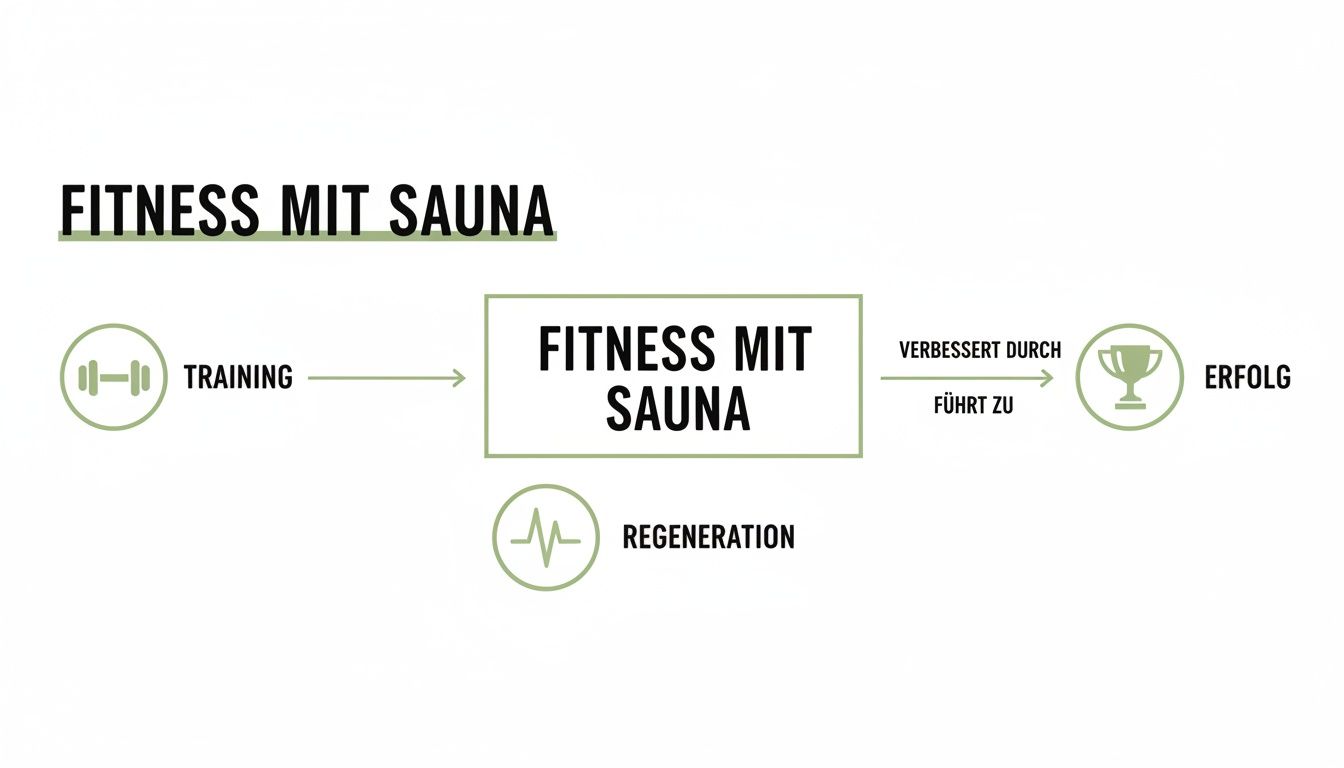
As you can see, recovery is not an optional extra but the crucial piece of the puzzle that transforms your training into real, measurable success.
The heat is a form of mild, controlled stress for your body. Its clever response? It produces what are known as heat shock proteins (HSPs). Think of these proteins as a specialized repair crew at the cellular level. They help fix and stabilize the protein structures in your muscles that have been damaged during training – a crucial process for muscle growth and recovery.
But it’s not just about what happens on a physical level. Visiting the sauna also stimulates the release of endorphins.
Endorphins are natural messenger substances in the body that we often refer to as ‘happiness hormones.’ They act as pain relievers and provide that deep feeling of well-being and relaxation.
This very feeling makes using the sauna after exercise so incredibly pleasant and helps you switch off mentally as well. This psychological effect cannot be underestimated, as mental stress can massively hinder physical recovery.
The following table summarizes the direct physical changes from sauna use after exercise for you.
This table shows you the direct physiological changes in your body from a sauna session after training compared to the state before.
| Body function | State directly after training | State after sauna session |
|---|---|---|
| Circulation | Increased in the stressed muscles | Strongly increased throughout the body |
| Heart rate | Still elevated from training | Slightly elevated (passive training) |
| Blood pressure | May be elevated | Tends to be lower due to vasodilation |
| Muscle tension | High, often with micro-injuries | Significantly reduced, more relaxed |
| Metabolism | Active, lactate accumulation | Accelerated transport of lactate |
| Hormone levels | Stress hormones (cortisol) increased | Endorphin release, well-being |
| Cellular level | Onset of inflammatory processes | Activation of heat shock proteins (HSPs) |
As you can see, visiting the sauna acts like a catalyst, enhancing and accelerating the positive adaptation processes after training.
One last important point: the fluid loss. Due to strong sweating, you not only lose water but also valuable electrolytes. This loss of water is, by the way, the only reason why the scale shows less right after the sauna – a transient effect that has nothing to do with fat loss. If you want to dive deeper into the topic, our guide on Water retention after sports & training covers everything you need to know.
In short: The combination of fitness with sauna is biologically brilliant. It optimizes nutrient supply, accelerates the removal of ‘muscle waste’, supports cell repair, and provides deep mental relaxation – a real power package for your recovery.
The big question you might be asking yourself is: sauna before or after training? The answer is quite clear and directly depends on your goals. For you and most people, the sauna visit after exercise is the much smarter and more effective choice.
A short sauna visit before training might sound tempting to warm up the muscles. However, this apparent advantage has a few decisive drawbacks. Even a short foray into the heat leads to fluid loss and can disturb your electrolyte balance.
The result? You start your workout slightly dehydrated, which noticeably reduces your performance. Imagine wanting to give your all in training but your body is already busy compensating for the heat load. It’s like starting a race with the handbrake on.
After training, the sauna shows its true strengths and becomes a powerful tool for your recovery. Your body is already warmed up, your circulation is revving up – ideal conditions to fully exploit the positive effects of heat.
The heat boosts blood flow to the finest muscle fibers. This not only accelerates the removal of metabolic products like lactate but also ensures that nutrients and oxygen reach where they are needed for repair more quickly.
The sauna after training is not a passive luxury, but an active part of your recovery strategy. You actively help your body recover faster, become stronger, and prepare for the next challenge.
This targeted use helps reduce muscle soreness and initiates a deep relaxation phase. Your nervous system switches from the ‘fight-or-flight’ mode of training to the ‘repair-and-relax’ mode – a crucial factor for sustainable success.
Depending on what you want to achieve in training, the ideal timing and the nature of your sauna visit can vary slightly. Here are a few concrete examples to help you find the perfect routine.
For the strength athlete after a hard leg workout:
For the endurance athlete after a long run:
For the yoga practitioner after an intense Vinyasa session:
Zusammengefasst gilt auch hier das alte Sprichwort: «Erst die Arbeit, dann das Vergnügen.» Erst forderst du deinen Körper im Training, dann belohnst du ihn mit der regenerativen Wärme der Sauna. So wird die Kombination aus Fitness und Sauna zu einem echten Erfolgsfaktor für deine Gesundheit.
Um die Vorteile aus der Kombi Fitness und Sauna voll auszuschöpfen und Risiken zu umgehen, kommt es auf das richtige Vorgehen an. Dieser Abschnitt ist dein praktischer Guide, mit dem du sicherstellst, dass jeder Saunabesuch zu einem maximal regenerativen Erlebnis wird.
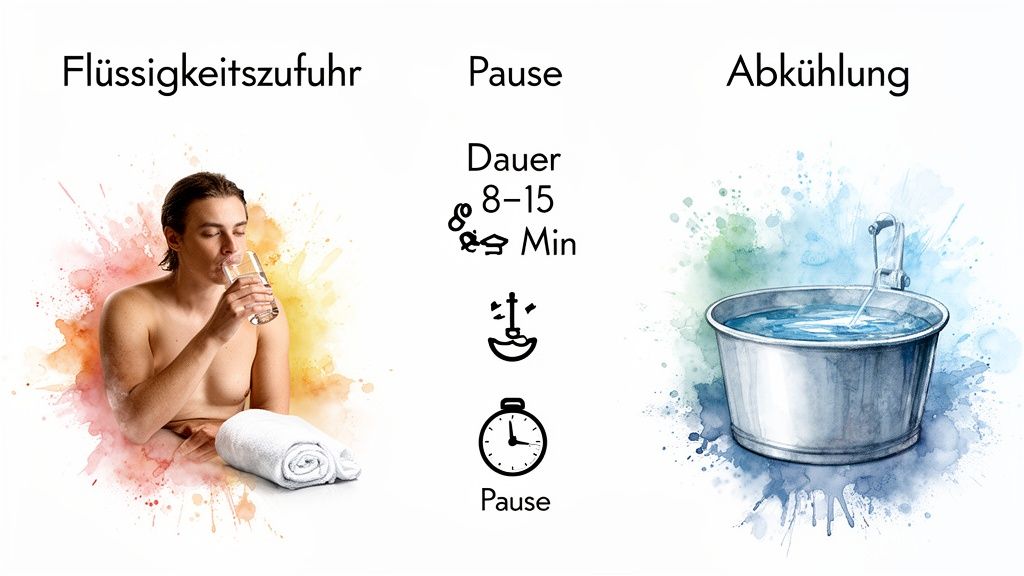
Der absolut wichtigste Punkt, bevor du auch nur einen Fuss in die Sauna setzt, ist die Hydration. Dein Körper hat schon beim Training durch Schwitzen ordentlich Flüssigkeit verloren. Die intensive Hitze in der Sauna treibt diesen Verlust noch weiter an – du kannst locker bis zu einem Liter Schweiss pro Saunagang verlieren.
Stell dir deinen Körper wie einen Motor vor. Ohne genug Kühlflüssigkeit überhitzt er und nimmt Schaden. Genau das passiert, wenn du dehydriert in die Hitze gehst: Dein Kreislauf wird massiv belastet und die positiven Effekte kehren sich ins Gegenteil um.
Trink deshalb nach dem Training und vor dem ersten Saunagang mindestens einen halben bis ganzen Liter Wasser oder ungesüssten Tee. Finger weg von zuckerhaltigen Getränken oder Alkohol, die deinem Körper nur noch mehr Wasser entziehen. Auch zwischen den einzelnen Gängen ist ein Glas Wasser Pflicht, um die Speicher wieder aufzufüllen.
Weniger ist oft mehr – diese Regel gilt ganz besonders für die Sauna nach dem Sport. Dein Körper ist vom Training sowieso schon gefordert. Es geht hier nicht darum, Hitzerekorde zu brechen, sondern die Regeneration gezielt anzukurbeln.
Ein typischer Fehler: zu lange drin bleiben oder zu viele Gänge machen. Das stresst deinen Körper unnötig und kann die Erholung sogar behindern, statt sie zu fördern.
Für den Anfang und gerade nach einem intensiven Workout sind zwei bis drei Saunagänge völlig ausreichend. Die ideale Dauer hängt von deiner Erfahrung und der Temperatur ab.
Am Ende ist entscheidend, was sich für dich gut anfühlt. Sobald du dich unwohl fühlst oder dein Herz zu stark pocht, ist es Zeit zu gehen – egal, was die Sanduhr sagt.
Die Phasen zwischen den Saunagängen sind mindestens genauso wichtig wie die Zeit in der Hitze selbst. In diesen Pausen gibst du deinem Körper die Chance, sich zu regulieren und auf den nächsten Hitzereiz vorzubereiten. Eine einfache Faustregel: Die Pause sollte mindestens so lang sein wie der Saunagang davor.
Der wichtigste Teil der Pause ist die richtige Abkühlung. Das ist weit mehr als nur ein kurzer Frischekick. Durch den gezielten Kältereiz ziehen sich die zuvor geweiteten Blutgefässe schlagartig wieder zusammen. Das trainiert ihre Elastizität und stabilisiert deinen Kreislauf – ein echtes Workout für deine Adern.
So kühlst du richtig ab:
Diese Abkühlphase ist nicht nur für deinen Kreislauf, sondern auch für die Regeneration entscheidend. Wenn du mehr darüber wissen willst, wie Kälte gezielt für den Muskelaufbau eingesetzt werden kann, schau dir unseren Artikel über die Vorteile von kalten Duschen für deine Regeneration an.
Nach der Abkühlung folgt die Ruhephase. Wickle dich in einen Bademantel, leg die Füsse hoch und entspanne für mindestens 15 Minuten, bevor du den nächsten Gang startest. Nur so kann dein Körper die positiven Effekte der Sauna nach dem Sport wirklich verarbeiten.
Theory is one thing, but how does all this fit into your already full schedule? The good news is: The combination of fitness with sauna is much more flexible than you might think. It’s not about flipping your life upside down. It’s about finding a smart routine that seamlessly fits into your daily life and gives you energy instead of draining it.
Don’t view this new habit as another obligation, but rather as a firmly planned ritual for yourself. This is your time to de-stress, strengthen your body, and clear your mind. With the right strategy, this combination will quickly become a solid anchor in your week.
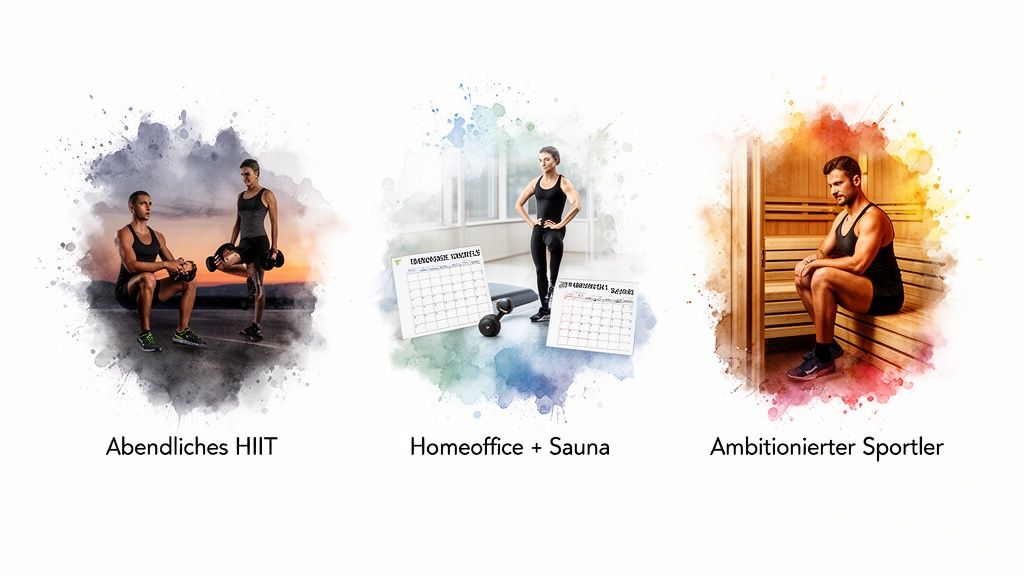
Every daily routine looks different. That’s why we’ve developed three practical scenarios that can serve as inspiration for you. See which type resonates most with you, and simply adjust the plan to meet your needs.
Scenario 1: The working person
Your day is packed with meetings and deadlines. In the evening, you often feel mentally drained and need a clear cut-off to really unwind.
Scenario 2: The parent working from home
You are juggling work, household, and family. Time for yourself is a scarce resource and needs to be perfectly timed. Long drives to the gym are usually just not feasible.
If you train with performance in mind, recovery is not a luxury but a crucial factor for your success. In this case, the sauna is no longer just a wellness extra but a strategic tool.
For you, it’s about deliberately integrating the sauna into your training cycle. This way, you maximize your body’s adaptation processes and shorten recovery times between intense sessions.
Your strategic use:
The combination of targeted heat and cold, such as through a subsequent ice bath, can even enhance the regenerative effects. If you are captivated by the topic of cold application, you can find exciting insights in our article about the benefits of ice bathing in Zurich.
That this approach resonates with many Swiss is also shown by current data. A wellness study proves that sauna visits are the third most common offering in spas, with 36 percent. Particularly people under 40 make frequent use of the sauna (46 percent). With 48 percent of respondents considered ‘active wellness users’ who visit a spa several times a year, it becomes clear: The connection between fitness and conscious recovery is a key component of a healthy lifestyle for many.
As great as the combination of fitness and sauna is – it is not a cure-all. In some situations, it can even backfire. Your health always comes first, so consider this section as your personal safety check. This way, you can make the most of it without harming your body.
The intense heat is a real challenge for your circulatory system. If your body is already fighting on another front, the sauna visit can tip the scales. There are clear scenarios in which you should avoid the sauna altogether or at least ask your doctor first.
Sometimes your body gives you crystal-clear signals. Don’t ignore them; it can have serious consequences. In these cases, the sauna is absolutely taboo:
These rules are non-negotiable. It’s about giving your body the rest it urgently needs in such phases.
Imagine the sauna as an amplifier. It intensifies what is already happening in your body. If your initial condition is poor (e.g., an infection), it amplifies the negative. If it’s good (e.g., after a healthy workout), it amplifies the positive.
For some people, the sauna is not per se prohibited, but it requires special attention and often a consultation with a doctor. You know your body best, but sometimes professional advice is worth its weight in gold.
Special attention is needed for:
Always listen to your body. Do you feel uncomfortable, dizzy, or short of breath? Then get out of the sauna, and do so immediately. The combination of fitness with sauna is meant to do you good and promote your health – and that only works if you know and respect the rules of the game.
There are many opinions surrounding the topic of sauna and sports. Here we shed light on the darkness and answer the questions that may be burning on your mind – clear, direct, and straightforward.
Short-term yes, long-term no. The number on the scale right after the sauna is indeed lower, but that is purely water loss from sweating. Once you quench your thirst, the weight comes back.
The heat does slightly boost your metabolism, but it is not a substitute for a solid calorie deficit. Real fat loss can only be achieved through the proven combination of training and a balanced diet. Think of the sauna as what it is: a fantastic tool for your recovery, not for fat burning.
The "perfect" sauna doesn’t exist – it entirely depends on you, your heat sensitivity, and your goal. Here are the most common types at a glance:
Finnish sauna: The classic. With its hot 80–100 °C and dry air, it really gets your circulation going. Ideal for intense regeneration and to deeply relax your muscles.
Bio sauna: The gentle alternative. At milder 50–60 °C and more humidity, it is perfect for you as a beginner or for days when you want to take it easy. The relaxing effect is still top-notch.
Infrared cabin: Here, the heat penetrates directly into your muscles through infrared rays. A great option if you want to specifically relieve tension and achieve a deeper warming effect without extreme strain on your circulation.
At the end of the day, it’s about what feels good for you. It’s not a competition of who can withstand the heat the longest. Try out what helps your body best to unwind and recover after training.
Give your body a moment to breathe. A break of 15 to 30 minutes between the end of your workout and the first sauna session is ideal. This gives your pulse time to calm down and keeps your circulation from being overwhelmed.
Use this time wisely: Rinse off the sweat and drink a large glass of water or unsweetened tea. This way, you replenish your initial fluid reserves. The most important principle is: Never go into the heat completely exhausted and with a racing heart. A short cool-down is a must.
Yes, with light to moderate muscle soreness, the heat can work wonders. It promotes circulation, which can support the healing process of tiny muscle fiber tears and alleviate tension.
But be cautious with really intense muscle soreness. This is a sign of greater microtraumas in the muscle. If the heat feels uncomfortable or even intensifies the pain, listen to your body. It’s better to shorten the sauna visit or reschedule it for another day.
Are you ready to take your fitness routine to the next level with targeted regeneration? At Templeshape GmbH, we combine sweat-inducing workouts with mindful practices that help you become sustainably healthy and strong. Discover our courses in Zurich and find the perfect balance between tension and relaxation.Visit us at templeshape.com and make health your habit.
Tags
 DE
DE FR
FR EN
EN