March 18
Find the best yoga training Zurich for you
0 comments

You dream of becoming a yoga teacher, but you are slightly overwhelmed by the huge selection in Zurich? Don’t worry, that is completely normal. The search for the right yoga training in Zurich is the very first, important step on an incredibly exciting journey. It’s about making a decision that feels right – for your goals, but most importantly for your life.
Deciding on a yoga training is a bit like planning a big journey. Before you start, you need a good map to orient yourself. Zurich offers an impressive variety, from intensive full-time courses to flexible models that you can do alongside your job. So the first step is to get a clear overview of the fundamental options available.
Before diving into the details of various yoga styles or schools, you should ask yourself three central questions:
One of the most important decisions is the question of the time model. Both formats have their own advantages and disadvantages, and what works for you strongly depends on your personal life situation.
An intensive course is like a leap into cold water – in the best sense. You immerse yourself completely in the world of yoga for a limited time, often four to six weeks, in this format. This is perfect if you want to focus entirely on the learning process and quickly hold your certificate in your hands.
In contrast, a part-time model is much easier to integrate into everyday life. The modules usually take place on weekends or on certain evenings. This gives you the freedom to continue working and allows the learning to settle and be truly internalized over a longer period.
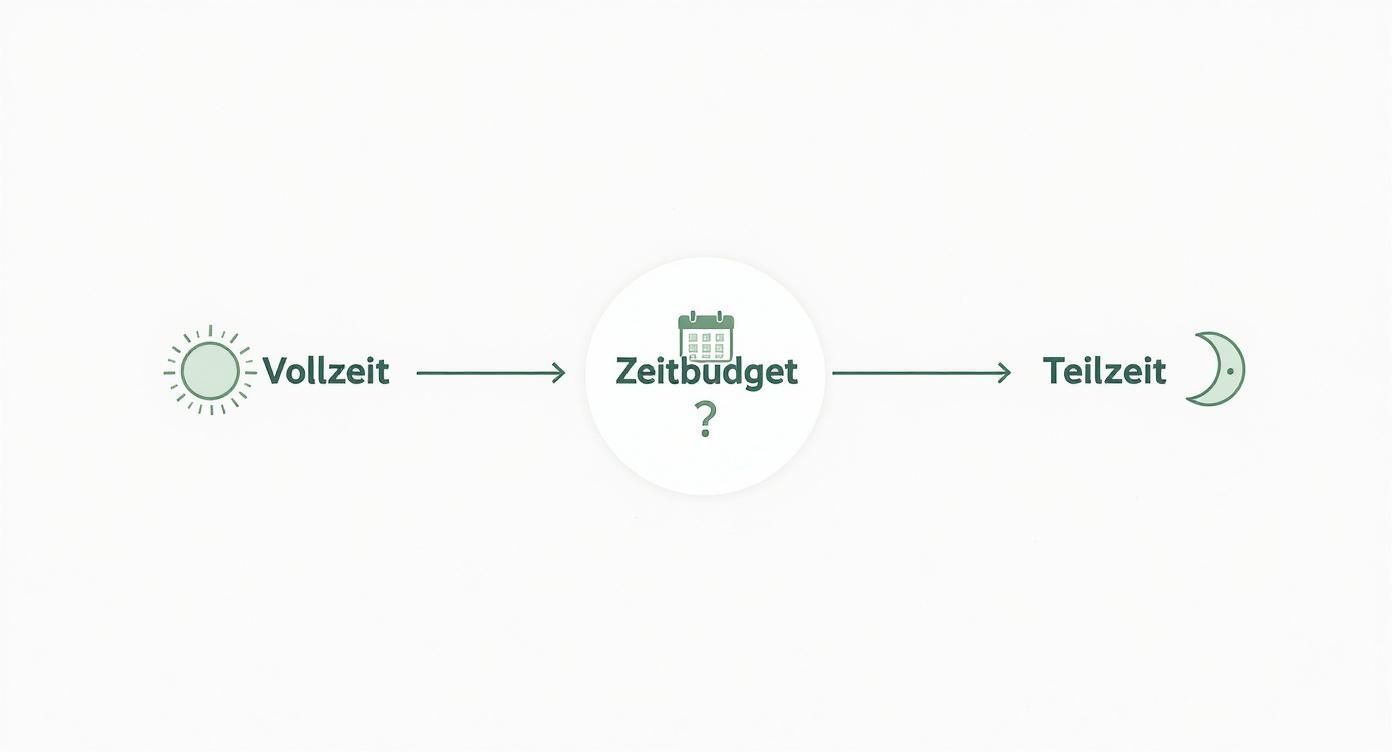
As you can see, the central question regarding your available time directly leads to the two main paths: full-time (intensive) or part-time (working alongside your job). This first decision creates a solid foundation.
Next, we will take a closer look at the various training formats in Zurich to make your choice even easier.
This table helps you find the right format for your life situation by comparing the key features.
| Feature | Intensive training (full-time) | Part-time training (working alongside your job) | Online or hybrid model |
|---|---|---|---|
| Duration | Compact: 4–6 weeks | Extended: 6–12 months or longer | Flexible, often self-directed |
| Time commitment | Daily, full days (Mon–Fri/Sat) | Weekends, evenings | Own time management, fixed online dates |
| Ideal for… | People in a career break, on sabbatical, or with full time flexibility. | Professionals, parents, students – all with a busy schedule. | People who are location-independent or need maximum flexibility. |
| Learning process | Very intensive, rapid knowledge acquisition, strong group focus. | Learned material can be processed between modules and integrated into daily life. | High self-discipline required, less direct exchange with the group. |
| Integration | Less time for integrating the learned material into daily life during training. | Continuous application and reflection over a longer period possible. | Integration largely depends on one’s own initiative. |
Each of these models has its own charm and its justification. There is no “better” or “worse” – only what works best for you and your current life phase.
With this basic orientation in your backpack, you can now dive much more targeted into the details of the content and certifications that really matter for your Yoga teacher training in Zurich.
Choosing the right yoga style for your training is a bit like searching for the right musical instrument. Each style has its own melody, its own rhythm, and speaks to a different string within you. So before you plunge into the adventure of a Yoga teacher training in Zurich, it is crucial to find the style that truly resonates with your personality and your goals.
This decision lays the foundation for your entire journey as a yoga teacher. It not only determines which asanas (postures) you master but also shapes the philosophy behind it, the teaching methodology, and the energy that you will later pass on in your own classes.

Imagine a dance-like, flowing movement where each breath initiates a new posture – that is the essence of Vinyasa Yoga. Often referred to as Flow Yoga, it is a dynamic, athletic style in which the asanas are connected creatively and without a rigid sequence.
A Vinyasa training is just your thing if you:
The focus in a Vinyasa training is clearly on sequencing, the art of logically and harmoniously structuring a class. You will learn how to safely guide movements and create transitions so fluidly that a powerful yet meditative experience emerges.
Hatha Yoga is basically the mother of many modern yoga styles. Things are a bit slower and calmer here; individual postures are held longer. This gives you time to explore deeply into each posture, refine your alignment, and consciously experience the connection between body and mind.
A Hatha training could be your path if you:
Compared to Vinyasa, a Hatha training is often more philosophical and traditional. A modern approach that you often find is Alignment Yoga. Here the focus is even more on individual anatomy and correct alignment to prevent injuries.
While Vinyasa and Hatha primarily address the muscles (the Yang tissue), Yin Yoga focuses on the deeper connective tissues such as fascia, ligaments, and joints. The postures are passive, usually taken sitting or lying down, and held for three to five minutes or even longer. It is a very quiet, meditative practice that invites deep relaxation and regeneration.
A Yin Yoga training is perfect for you if you:
The training landscape in Zurich has become enormously professionalized since the early 2000s. A good example of this is AIRYOGA, which has been around since 2005as a Registered Yoga School (RYS) delivering training according to internationally recognized standards. With a 200-hour foundational program and an advanced 300-hour training, they are among theleading training centers at AIRYOGAin Switzerland. This shows how important a solid, recognized education has become.
Ultimately, the choice of style is a deeply personal decision. Listen to your gut feeling, attend different classes, and speak with the teachers. Find out which “melody” touches you the most – because this very passion will be the engine for your authentic journey as a yoga teacher.
A high-qualityyoga training in Zurichis so much more than just a sequence of postures. It is an in-depth study that allows you to grow on all levels. Imagine your training as the construction of a house: you need a solid foundation, load-bearing walls, and a protective roof so that everything is stable and coherent in the end.
Here we lift the curtain and show you which building blocks you can really expect in the curriculum of a 200 or 300-hour training. This knowledge is your most important tool to closely examine the quality of various providers in Zurich.
The first and perhaps most important building block is theanatomy.Without a deep understanding of the human body, safe and responsible teaching is simply impossible. It is the foundation on which your entire work as a teacher is built.
You will learn not only where each muscle is located. Much more important is how joints work, which movements are safe, and how to adapt postures to different bodies. Because every person is unique – what is a beneficial stretch for one can be a real risk of injury for another.
A good education teaches you to “read” your students’ bodies. You recognize why someone cannot assume a posture and offer meaningful alternatives instead of forcing everyone into the same shape.
Take the knee as an example. In a top-notch training, you will learn exactly how the knee joint is structured and why a wrong alignment in Warrior II or Lotus position can lead to pain. With this knowledge, you actively protect your future students.
Yoga is not just gymnastics; it is an ancient philosophy that gives depth and meaning to life. Engaging with these roots gives your teaching a soul and elevates it above a mere workout.
The most important pillars are often:
These ancient wisdoms are anything but dry theory. They become alive when you learn to weave them into your classes. Instead of just saying “breathe in, breathe out”, you can, for example, pick up the concept of “Ahimsa” (non-violence) and encourage your students to treat their bodies lovingly and without force.
The final major building block is theteaching methodology– the roof that holds everything together. Here you learn the tools to competently and inspiringly pass on your knowledge. It is the bridge between your own understanding and your students’ experiences.
This part of your training focuses on very practical skills:
These three building blocks – anatomy, philosophy, and teaching methodology – are the core of any serious training. When you look at the curricula of various schools in Zurich, pay attention to how these areas are weighted and interconnected. Explore, for example, the details of our comprehensive curriculum to get a feel for how astructured yoga teacher training at Templeshapemight look.
A yoga training is a huge investment – not only in your finances but primarily in yourself and your future. But before you dive into the adventure with enthusiasm, we should take a look at the hard facts. What does a solidyoga training in Zurichactually cost? And what does the certificate at the end mean for your path as a yoga teacher?
For a 200-hour foundational training in Zurich, you should expect costs betweenCHF 3’500 and CHF 5’000That sounds like a large sum at first, but it’s worth taking a close look at what you get for it. A transparent school makes it clear what is included in the price.

A good training is so much more than just the pure teaching hours. To avoid nasty surprises and unexpected extra costs, make sure that these points are included in the overall package:
However, costs often lurk in the fine print or outside of the program. So better plan for a small additional budget for specialized books, possible travel or accommodation costs, and maybe a new, high-quality yoga mat.
Almost every yoga school advertises with the seal of the Yoga Alliance®.But what exactly is behind it? The Yoga Alliance is a U.S. organization that establishes globally recognized minimum standards for training. Important to know: it is not a government agency, but a voluntary registry.
Imagine a certificate from a school registered with the Yoga Alliance (RYS – Registered Yoga School) as your international passport to the world of yoga. It signals studios and students worldwide that your training meets a verified quality standard.
So, if you dream of teaching one day perhaps in Bali, Berlin, or Barcelona, an RYT certification (Registered Yoga Teacher) is practically essential. The most well-known levels are the RYT 200 for basic training and the RYT 500 for advanced trainings.
Are you planning to teach mainly in Switzerland and want to give your students the opportunity to cover costs through their supplementary insurance? Then it gets a bit more complicated. Here, Swiss quality labels play the main role, and the Yoga Alliance alone is usually not sufficient.
Two institutions are particularly important here:
To obtain these recognitions, you often need more than just a yoga training (often over 300 hours). Usually, proof of basic medical knowledge of about 150 hours is also required. So check very carefully which certifications a school offers if this career path is a possibility for you.
The demand for well-trained yoga teachers in Zurich is definitely there and growing. A study on sports behavior in the Canton of Zurich has shown that the number of physically active people increased significantly in the six years leading up to 2020. This growing health awareness fuels the yoga market and makes a solid, recognized education more valuable than ever. You can find more about this in the report on the Development of Sports Behavior in the Canton of Zurich.
The thought of fitting an intensive training alongside work, family, and everything else going on? Phew, that can take your breath away at first. But take a deep breath: it is absolutely doable. It’s not about loading you up even more. Rather, view the training as an enriching island in your daily life – a space that belongs solely to you.
The real question is: How do you manage that without running on empty? The key lies in two things: the right time model and clever planning. Your Yoga training in Zurich should nourish you, not exhaust you.
Think of it like learning a language. Some book a four-week intensive course abroad and immerse themselves completely. Others attend classes every Saturday for a year. Both paths lead to the goal, but they feel completely different. It’s the same with your yoga training.
Basically, there are two common models:
Listen to yourself and be completely honest: Which pace really fits your life and your energy right now?
Once the decision for a model has been made, your time management becomes your best friend. It’s about consciously deciding what you spend your time on and where your priorities lie.
A practical example: Anna, one of our graduates, has a full-time job in marketing and two small children. She opted for a weekend model. Her secret? She not only blocked the training weekends in the calendar but also set fixed study times during the week – twice a week for 90 minutes, after the kids were in bed. These fixed rituals helped her stay on track without feeling like she was constantly falling behind.
Time management doesn’t mean doing more. It means doing what really matters and consciously making space for it.
The training is a time for learning and self-care. To navigate this demanding journey well, not only is practice on the mat important. Here you can find more tips for a healthy lifestyle, which can additionally support you.
You don’t have to go this path alone. One of the most common reasons for feeling overwhelmed is the attempt to do everything by yourself. Speak openly with your partner, family, and friends. Explain to them why this training means so much to you and what it represents.
This is how you can specifically ask for support:
Establishing new, supportive routines is a process. It’s about creating healthy habits that will sustain you through your training and beyond. If you want to dive deeper into how to sustainably change habits, our Guide to Establishing New Habits provides valuable insights.
With the right attitude, a suitable time model, and a strong network by your side, your training will become one of the most enriching experiences of your life—a journey that perfectly integrates into your daily routine instead of disrupting it.
You hold your certificate in your hands—a huge milestone, congratulations! But what comes next after the applause has faded? Consider this section your personal career compass for the time after the Yoga Training in Zurich. The journey has just begun.
Forget the notion that your path must lead directly to a gym. The possibilities are as varied as yoga itself. Zurich is a vibrant market for exceptionally trained yoga teachers who have found their own authentic voice.
The first step towards a successful career is often to specialize. Instead of trying to offer everything for everyone, find the niche that truly makes your heart race. This not only makes you unique but also incredibly valuable to a specific target audience.
Consider these directions:
Maybe you even dream of opening your own small studio. That’s a significant step that requires careful planning—from choosing a location to marketing. Start small, perhaps with classes in a rented space or outside in the park during the summer to gain initial experience. Many successful studios in Zurich started just that way.
Your authenticity is your greatest asset. Teaching is so much more than pure technique—it’s about sharing your passion. Discover what moves you and build your career on that.
The demand for qualified yoga teachers is still high throughout the German-speaking area, including Zurich. A study from 2023 shows a remarkable trend: The percentage of yoga practitioners in Germany jumped from just 5% in 2018 to an impressive 20% in 2023. It’s also exciting that 74 %practice at home, which further increases the need for excellently trained teachers for high-quality instruction. You can find more on this in the current developments in the yoga market 2023.
Your 200-hour training is a fantastic foundation, but it’s not the end of learning. The world of yoga is constantly evolving. Regular continuing education is crucial to deepen your knowledge, gather new inspiration, and stand out from the crowd.
Think about which areas particularly captivate you. Perhaps a 300-hour advanced training to obtain your RYT 500 certification? Or specialized workshops on topics such as advanced anatomy, yin yoga, or trauma-informed yoga? Each continuing education opportunity makes you a more competent and versatile teacher. If you’re curious about where you can practice in Zurich, check out our Guide to Yoga in Zurich Wiedikon (District 3).
What you can earn in Zurich depends heavily on your experience, specialization, and business model. As an employed teacher in a studio, you can expect a fixed hourly rate.
The step into self-employment certainly offers you more freedom and potential but also requires entrepreneurial thinking. You are then not only a yoga teacher but also your own manager for marketing, accounting, and client acquisition. Successful self-employed teachers often establish multiple sources of income: regular classes, workshops, private sessions, and increasingly online offerings. This way, your passion can sustainably turn into a truly fulfilling profession.
If you’re on the verge of deciding on a Yoga Training in Zurich, a few specific questions are probably still swirling in your mind. That’s completely normal! This section is here to clear up any last uncertainties. We provide you with honest, clear answers so that you can embark on your adventure with a truly good feeling.
We hear this concern quite often—and can reassure you immediately. No, you don’t have to be an acrobat to become a yoga teacher. Training is a journey, not a sports competition. What really matters is your curiosity and the desire to dive deep into the world of yoga. This is so much more important than the ability to wrap your feet behind your head.
Most schools in Zurich prefer that you have been practicing yoga regularly for a while, usually around a year. This simply ensures that you are familiar with the basics. But it’s never about being perfect, it’s about wanting to grow.
This question is crucial for your further path. Think of it best as a Bachelor’s and Master’s degree in yoga.
200-Hour Training: This is your foundation. Here you will learn everything you need to teach yoga safely and competently. We pack everything in: anatomy, philosophy, the asana practice, and of course, how to structure and lead a class. With this certificate in hand, you are officially qualified to get started.
300-Hour Training: This is the deepening for those who already have a 200-hour base (Advanced Training). Here you can specialize and dive much deeper into specific topics. Together, both trainings yield the internationally highly regarded500-Hour Certification.
Yes, absolutely! The certificate of your 200-hour training is your formal qualification to lead yoga classes. You have learned the necessary tools to conduct your first classes safely and structured.
Your certificate is essentially your license to teach. The courage to truly step in front of a group grows with each class you give. Just start, gain experience, and you will see how your self-confidence grows.
Many of our graduates start out gently. They first teach in their circle of friends and family, offer small courses, or cover classes in their favorite studio. This gradual entry is perfect for gaining practical experience and finding your unique voice as a teacher.
Ready to take your passion for yoga to a new level? AtTempleshape we accompany you on your journey with a solid training in a community that supports and inspires you. Check out our offerings now and find the course that suits you perfectly.Discover your training at Templeshape.com.
Tags