March 17
Yoga in Old Age: Discover Safe Exercises for Your Flexibility & Strength
0 comments

March 17
0 comments
Fragst du dich, ob Yoga im Alter wirklich noch einen Unterschied machen kann? Die Antwort ist ein klares und herzliches Ja. Hier geht es nicht um komplizierte Verrenkungen, sondern darum, durch sanfte, bewusste Bewegungen deine Lebensqualität nachhaltig zu verbessern und eine tiefere, positivere Verbindung zu deinem Körper aufzubauen.
Vielleicht denkst du bei Yoga an junge, extrem bewegliche Menschen in komplizierten Haltungen. Das ist ein Bild, das viele im Kopf haben. Doch die wahre Stärke von Yoga liegt in seiner unglaublichen Anpassungsfähigkeit.
Gerade im Alter wird es zu einem kraftvollen Werkzeug, das dir hilft, vital, sicher und selbstbestimmt zu bleiben – und das alles ganz ohne Leistungsdruck.
Es ist eine Praxis, die mit dir wächst und sich an deine aktuellen Bedürfnisse anpasst. Stell dir zum Beispiel vor, wie du deine Wirbelsäule mit sanften Drehungen mobilisierst oder deine Beinmuskulatur mit einer einfachen Stehhaltung stärkst, während du dich sicher an einem Stuhl festhältst. Genau das ist Yoga im Alter: funktionale Bewegung, die dir im Alltag direkt zugutekommt.
Yoga ist so viel mehr als nur Stretching. Es ist ein ganzheitliches Training, das Körper und Geist gleichermassen anspricht. Regelmässige Praxis kräftigt gezielt die Muskelgruppen, die für eine aufrechte Haltung und einen stabilen Gang entscheidend sind. Das Resultat? Du fühlst dich stärker und sicherer bei ganz normalen Bewegungen wie Treppensteigen oder dem Tragen der Einkäufe.
Zudem fördert Yoga die Durchblutung und hält deine Gelenke geschmeidig, was typischen Altersbeschwerden wie Steifheit entgegenwirken kann. Und dann ist da noch die Atmung: Eine ruhige, bewusste Atmung während der Übungen hilft, Stress abzubauen, den Blutdruck zu regulieren und kann sogar deine Schlafqualität deutlich verbessern.
Yoga ist keine Frage des Alters, sondern eine Frage der Haltung. Es lehrt dich, die Grenzen deines Körpers liebevoll zu respektieren und gleichzeitig dein volles Potenzial für Wohlbefinden zu entfalten.
Diese Infografik fasst einige der wichtigsten Vorteile zusammen, die regelmässiges Yoga für deine Gesundheit und Sicherheit haben kann.
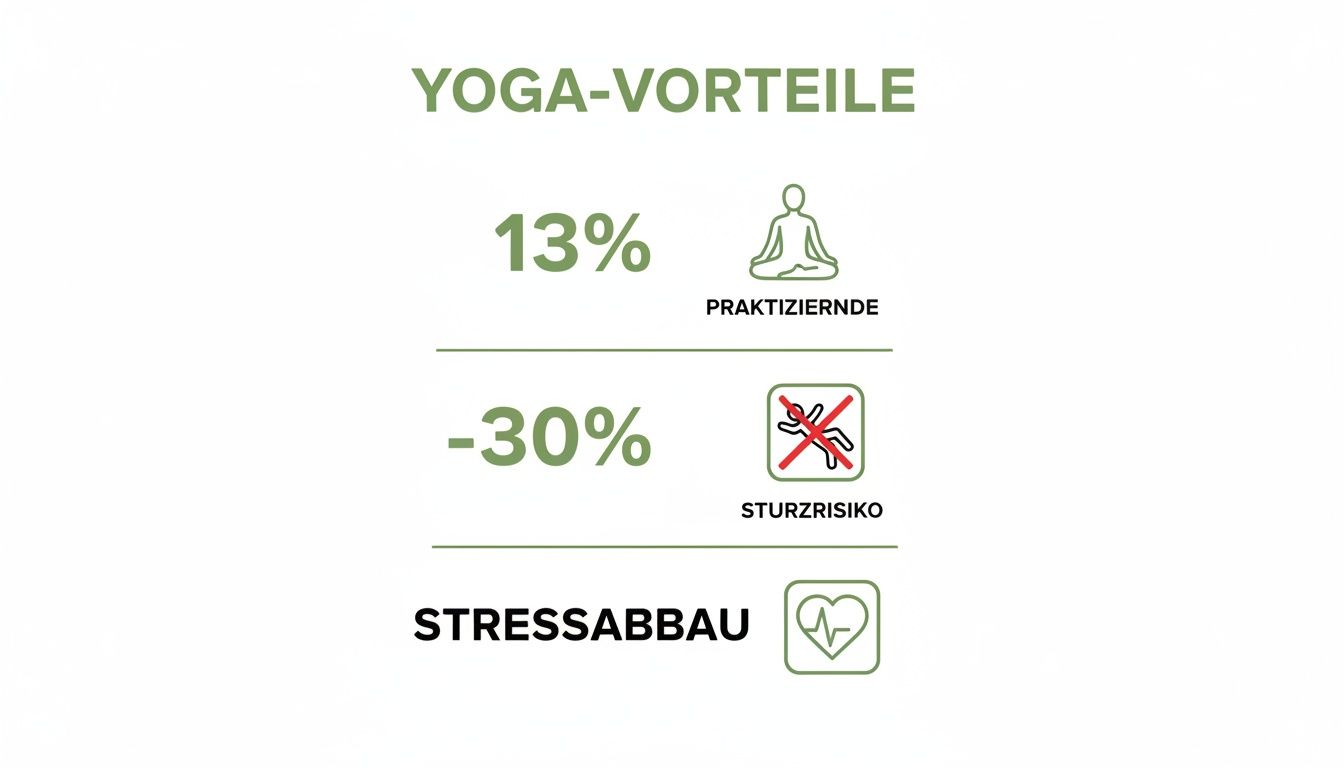
Die Zahlen zeigen eindrücklich, wie Yoga gezielt das Sturzrisiko senkt – ein entscheidender Faktor, um im Alter lange selbstständig zu bleiben.
Die folgende Tabelle fasst die wichtigsten Vorteile zusammen und zeigt dir, welche konkreten positiven Effekte du von einer regelmässigen Yogapraxis erwarten kannst.
| Nutzen für den Körper | Nutzen für den Geist | Nutzen für den Alltag |
|---|---|---|
| Verbesserte Flexibilität und Gelenkgesundheit | Stressabbau und innere Ruhe | Sicherer Gang und bessere Koordination |
| Gesteigerte Muskelkraft, besonders in Beinen und Rumpf | Förderung der Konzentration und des Fokus | Leichteres Bücken, Heben und Treppensteigen |
| Stärkung des Gleichgewichts zur Sturzprävention | Bessere Schlafqualität | Mehr Energie und allgemeines Wohlbefinden |
| Regulierung von Blutdruck und Kreislauf | Steigerung des Selbstbewusstseins | Schmerzlinderung bei chronischen Beschwerden (z.B. Rücken) |
Wie du siehst, wirkt sich Yoga auf alle Bereiche deines Lebens positiv aus und schenkt dir ein Stück Unabhängigkeit zurück.
Einer der wichtigsten Effekte von Yoga im Alter ist die Verbesserung des Gleichgewichtssinns. Mit den Jahren lässt dieser oft nach, was die Unsicherheit im Alltag erhöht. Yoga trainiert dein Gleichgewicht ganz gezielt durch Haltungen, die deine Konzentration und Körperwahrnehmung schärfen. Jede Übung, bei der du stabil stehen musst, ist ein direktes Training für mehr Sicherheit.
In der Schweiz hat Yoga in den letzten Jahren enorm an Popularität gewonnen, was die Zahlen belegen. Laut der Studie «Sport Schweiz 2020» praktizieren bereits 13 Prozent der Schweizer Bevölkerung Yoga. Speziell für Ältere ab 60 Jahren zeigt die Forschung messbare Vorteile: Regelmässige Praxis kann das Sturzrisiko um bis zu 30 Prozent senken, da sie gezielt Gleichgewicht und Muskelkraft stärkt. Mehr über die gesundheitlichen Aspekte von Yoga in der Schweiz kannst du in diesem Artikel nachlesen.
Dieser ganzheitliche Ansatz zur Langlebigkeit ist ein zentrales Thema, das du auch in unserem Guide über die Kunst des langen Lebens vertiefen kannst.
Jeder Anfang kann leicht sein, wenn man weiss, wie. Dieser Abschnitt ist dein ganz praktischer Kompass für einen motivierenden und sicheren Start ins Yoga im Alter. Es geht vor allem darum, eine Umgebung zu schaffen, in der du dich von der ersten Minute an wohl und unterstützt fühlst.
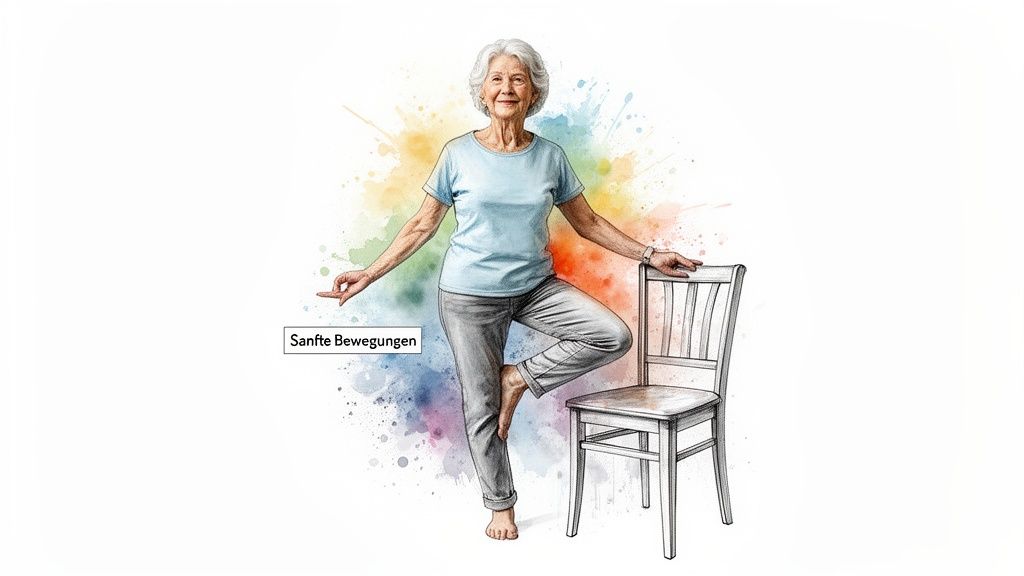
Der erste Schritt ist denkbar einfach: Such dir einen Ort, an dem du ungestört bist und genug Platz hast, um deine Arme locker zur Seite auszustrecken. Eine rutschfeste Yogamatte ist super, aber für den Anfang tut es auch ein Teppichboden.
Zieh dir bequeme Kleidung an, die dir volle Bewegungsfreiheit schenkt. Das muss keine spezielle Yogakleidung sein – eine lockere Hose und ein T-Shirt sind perfekt. Hauptsache, es zwickt nichts und engt dich nicht ein.
Bevor du mit der ersten Bewegung beginnst, nimm dir einen Moment Zeit, um einfach nur zu atmen. Dieser bewusste Atem, im Yoga Pranayama genannt, ist wirklich das Herzstück der Praxis. Er beruhigt dein Nervensystem und versorgt deinen Körper mit frischer Energie.
Eine simple Technik für den Start ist die Bauchatmung. Leg eine Hand auf deinen Bauch und atme tief durch die Nase ein. Spür ganz bewusst, wie sich deine Bauchdecke hebt. Beim Ausatmen durch die Nase senkt sie sich wieder. Wiederhole das ein paar Mal und beobachte einfach, wie du ruhiger wirst.
Diesen kleinen Trick kannst du übrigens jederzeit in deinen Alltag einbauen, wenn du einen Moment der Ruhe brauchst.
Gerade im Alter ist ein gutes Aufwärmen das A und O. Es schmiert die Gelenke und bereitet die Muskeln sanft auf die Bewegung vor. Hier geht es nicht um grosse Anstrengung, sondern um eine behutsame Mobilisation.
Starte mit einfachen Übungen, um deinen Körper aufzuwecken:
Diese kleinen Bewegungen machen einen riesigen Unterschied und helfen, Verletzungen vorzubeugen.
Dein Körper sendet dir ständig Signale. Lerne, auf sie zu hören. Eine Dehnung sollte sich gut anfühlen, niemals schmerzhaft sein. Das ist der wichtigste Grundsatz beim Yoga im Alter.
Du musst kein Akrobat sein, um Yoga zu praktizieren. Hilfsmittel, auch Props genannt, sind fantastische Unterstützer, die dir jede Haltung zugänglich machen. Sie sind keine «Krücken», sondern einfach nur intelligente Werkzeuge für eine sichere Praxis.
Stell dir zum Beispiel vor, du möchtest in einer Vorbeuge deine Zehen berühren, aber der Rücken fühlt sich etwas steif an. Ein Yogagurt kann hier zur Verlängerung deiner Arme werden. Oder ein Yogablock unter deinen Händen in einer stehenden Haltung gibt dir genau die Höhe und Stabilität, die du brauchst.
Der vielleicht vielseitigste Helfer ist aber ein ganz normaler Stuhl. Du kannst ihn für Balance-Übungen nutzen, dich darauf abstützen oder sogar ganze Yoga-Sequenzen im Sitzen durchführen. Er macht Yoga für jeden Körper und jede Tagesform möglich.
Wenn du diese einfachen Grundlagen beachtest, schaffst du die besten Voraussetzungen für eine freudvolle und nachhaltige Yoga-Praxis. Du baust von Anfang an Vertrauen in deinen Körper und seine Fähigkeiten auf – und genau darum geht es.
So, jetzt wird's praktisch – es geht auf die Matte oder den Stuhl. Ich stelle dir jetzt ein paar grundlegende Yoga-Übungen, die Asanas, vor, die sich perfekt für den Einstieg eignen. Der Fokus liegt hier ganz klar darauf, deine Stabilität zu fördern, die Muskeln sanft zu kräftigen und deine Beweglichkeit zu erhalten. Also genau das, was du für mehr Sicherheit und Wohlbefinden im Alltag brauchst.
Ich erkläre dir jede Haltung Schritt für Schritt und ganz ohne kompliziertes Yoga-Kauderwelsch. Das Beste daran: Du findest für jede Übung angepasste Varianten. So kannst du sicher sein, dass die Praxis immer zu deiner Tagesform und deinen persönlichen Bedürfnissen passt.
Diese fliessende Bewegung ist eine echte Wohltat für die Wirbelsäule. Sie ist perfekt, um morgens in die Gänge zu kommen oder um Verspannungen im Rücken nach einem langen Tag zu lösen. Du kannst die Übung ganz entspannt auf einem stabilen Stuhl ohne Armlehnen machen.
This simple sequence is not only fantastic for the back, but it also helps you deepen and become more aware of your breathing.
The Mountain Pose (Tadasana) may look unremarkable, but don’t be fooled. It is an incredibly powerful exercise for an upright posture and good balance – the absolute foundation for almost all standing positions in yoga.
Tip from practice: If you feel a bit wobbly at first, that’s completely normal. Just stand with your back against a wall or hold onto the back of a chair. This way, you gain confidence and can fully concentrate on the correct alignment.
Warrior II (Virabhadrasana II) is a pose full of strength. It strengthens your legs and torso while gently opening the hips. The variation with the chair provides you with the necessary safety and support.
Regular practice has been shown to have a positive effect on health. More and more older Swiss individuals are discovering Yoga in old age as a key to more vitality. Among those over 60, the yoga participation rate is already over 15 percent. No wonder, because yoga is gentle on the joints and at the same time strengthens mental resilience. Especially women over 50, who make up 77 percent of practitioners, often report significant relief from pain, for example in the back. More interesting facts about this can be found in the study Sports Switzerland 2020..
A gentle yoga practice can be a true blessing, especially for chronic tension. If you want to know more about it, check out our article Yoga for back pain. With these safe and effective exercises, you now have a wonderful foundation to begin your personal yoga journey.
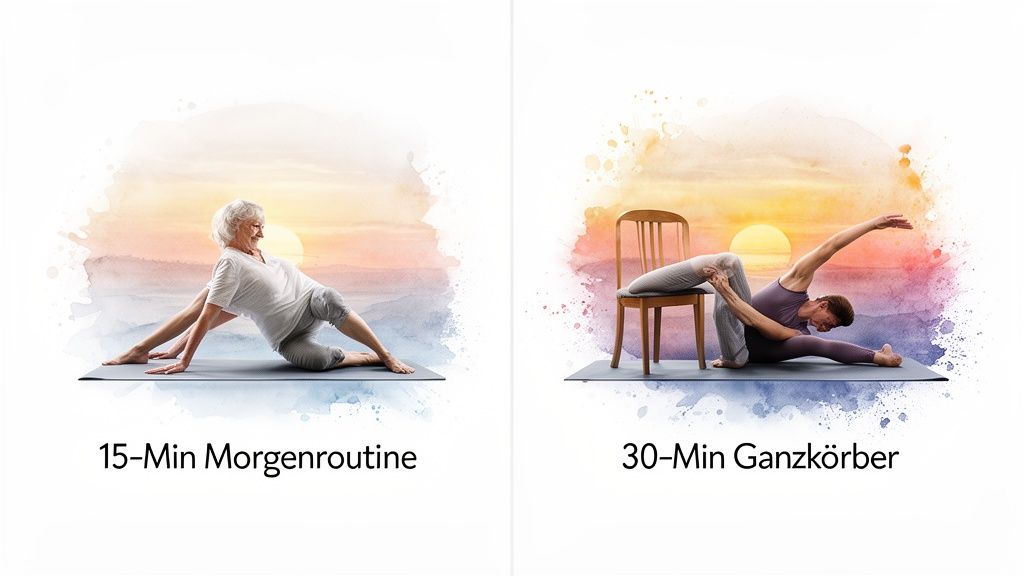
Okay, you now know the individual exercises. But how do you put it all together into a cohesive whole? That’s what we’re going to look at now. I’ve compiled two complete yoga sequences that you can try right away.
The first is a short, snappy morning routine that gently awakens your body. The second is a slightly longer session that focuses entirely on strength and balance. Consider these sequences as a kind of blueprint – you can adapt them to your daily condition or swap out individual exercises at any time.
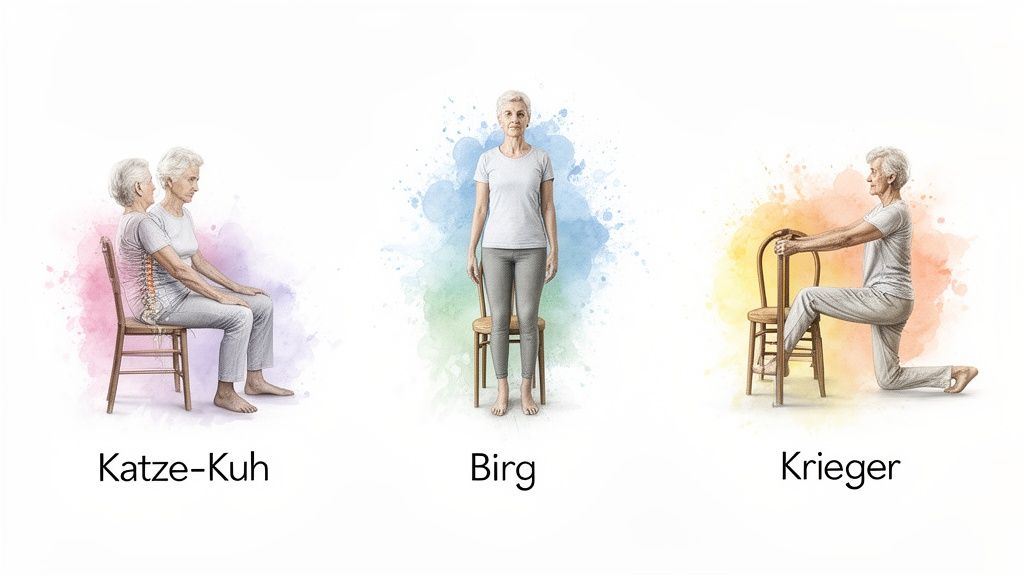
This sequence is worth its weight in gold for dispelling morning stiffness and starting the day off right. All you need is a sturdy chair.
Arrival (1 minute): Sit up straight on the front edge of your chair. If you like, close your eyes for a moment and take three deep, conscious breaths. Feel the firm contact of your feet with the ground.
Gentle warm-up (3 minutes):Begin with relaxed shoulder circles, first forward, then backward. Let your head gently roll from one shoulder to the other. Also move your foot and wrist joints in circular motions, in both directions.
Cat-Cow in sitting (3 minutes):Place your hands loosely on your thighs. Inhale to open your heart and come into a gentle backbend – this is the cow. Exhale to round your back, pulling your chin to your chest – the cat. Repeat this flowing transition8-10 timesin the rhythm of your breath.
Seated twist (2 minutes):Inhale and lengthen your spine. As you exhale, gently rotate your upper body to the right. Your left hand comes to the outside of your right knee, your right hand reaches back to the chair’s backrest. Hold for three breaths, then switch sides.
Leg raises for strengthening (3 minutes):Hold onto the seat for stability. Exhale to extend your right leg straight out in front of you and engage your thigh. Inhale to lower it back down in a controlled manner. Repeat8 timesper side.
Conclusion (3 minutes):Finish your short practice with theMountain Pose standing (Tadasana).Simply stand behind your chair and use the backrest for support. Find a firm stance, stand tall, and breathe deeply and calmly for a few moments.
This short session mobilizes your spine, awakens your leg muscles, and gives you mental clarity for everything the day brings.
Always remember: every movement should feel good. If something pinches or hurts, make a smaller movement or pause briefly. Your body is your best teacher.
This longer practice builds on the morning routine but goes a step further. Here we integrate additional exercises that specifically promote your strength and balance. At the end awaits well-deserved relaxation.
Warm-up (5 minutes):Start just like in the morning routine. Take your time to settle in while sitting, warm up your joints, and flow through a few rounds of cat-cow.
Strength building standing (10 minutes):Your chair is once again your reliable partner.
Balance and stretch (10 minutes):
Relaxation (5 minutes):Sit comfortably and upright. Close your eyes, rest your hands loosely in your lap, and let your breath flow naturally. Feel the effects of the practice and enjoy a few minutes of soothing silence.
Sometimes you have little time in the morning, on other days you want to treat yourself a bit more. This table helps you quickly decide which yoga unit suits your time and needs best today.
| Feature | 15-Minute Morning Routine | 30-Minute Full Body Session |
|---|---|---|
| Focus | Gentle Awakening, Mobilization | Strength Building, Balance, Stretching |
| Intensity | Low | Moderate |
| Duration | 15 Minutes | 30 Minutes |
| Best Time | Directly after waking up | Anytime, e.g. in the morning/afternoon |
| Equipment | Only a chair | Only a chair |
| Ideal for | A quick, energetic start to the day. | Days when you have more time for yourself. |
No matter which option you choose, the most important thing is consistency. Even a short daily practice can make a huge difference for your well-being. Listen to your body and choose what feels right today.
Moving together is often much more fun. Practicing in a group can be incredibly motivating and creates a valuable sense of connection. But how can you recognize a good class forYoga in Older Age, where you feel safe and well taken care of?
The key lies clearly in the qualifications of the instructor. They should not only be certified but ideally also have solid experience in teaching older adults or in senior yoga. A good teacher will always ask you about any physical limitations and will naturally offer variations and the use of props.
Start looking for a suitable offering and pay attention especially to an atmosphere that resonates with you. It’s about finding a place where you feel welcomed – completely without pressure to perform.
Here are some concrete pointers that can help you with your decision:
A supportive community is at least as important as the exercises themselves. It gives you support, motivation, and makes your yoga practice a consistent and joyful part of your life.
At Templeshape in Zurich, we place great emphasis on cultivating exactly this supportive and friendly atmosphere. Our classes are designed so that everyone feels comfortable, whether you are just starting out or returning after a break. If you are curious, here’s an overview of ourYoga classes in Zurich.
Statistics from Switzerland underline the value of yoga for prevention and quality of life in older age. Especially in cities like Zurich, many people specifically use yoga for stress relief. There are even enlighteningstudy results on yoga in Germany, which also provide interesting insights for us in Switzerland.
Whether online, in a local senior group, or in a studio like ours – find the place that feels right for you.
Are you considering starting yoga, but still have some questions floating around in your head? That is perfectly understandable and a great sign. It shows that you are consciously and mindfully handling your health. Let’s tackle the most common concerns together so that you can step onto the mat with confidence and a good feeling.
This is probably the biggest myth of all and unfortunately keeps so many people from discovering the wonderful benefits of yoga. The clear answer is: Absolutely not! Yoga is not acrobatics. It’s not about putting your feet behind your head, but rather about mindfully listening to your own body.
Each individual exercise can be adapted – with props like a chair, blocks, or a strap, really anyone can experience the positive effects. Remember: It isnever too late to start.Flexibility comes naturally over time, we promise.
The basic principles – breathing, movement, mindfulness – remain the same, of course. The big difference lies in the focus: Senior yoga is specifically designed for safety, stability, and gentle mobilization of the joints. The pace is usually significantly slower, which gives you more time to explore a pose calmly and feel the correct alignment.
In addition, aids are used much more often to perfectly adapt the exercises to the needs of older age. Everyday relevant topics like balance, strength, and joint health are at the center – not the spectacular pose for Instagram.
Yoga in older age does not mean ‘less’ yoga, but ‘smarter’ yoga. It is a practice that meets you exactly where you are today and supports you in staying strong and independent.
Here it is quite clear: Regularity beats length. Even if you manage to get on the mat once or twice a week, you will notice a surprisingly quick positive change in your body awareness and flexibility.
Many of our members also swear by a short daily routine of only 10–15 minutes.This can be a small sequence in the morning to get the circulation going, or a few relaxing exercises in the evening to wind down. Just find a rhythm that fits well into your daily life, without any pressure.
We hope this little guide has shown you how enriching and accessible yoga can be in older age. At Templeshape, it is our heartfelt concern to accompany you on your path to greater well-being and joy in life. Come visit us and find the course that perfectly suits you.
Tags