March 18
Yoga for Back Pain: Effective Exercises for a Strong Back
0 comments

If your back is constantly hurting, yoga can be a real revelation. It’s not just about stretching. Rather, it’s a powerful tool to strengthen the deep supportive muscles, relieve tension, and finally regain confidence in your body. With a targeted combination of movement, conscious breathing, and mindfulness, you can sustainably break the cycle of pain and tension.

You probably know this feeling: the constant pulling in your back that accompanies you throughout the day. Whether it’s the tense neck after hours of working on the computer or the lower back that speaks up after lifting a heavy box – the causes often resemble each other.
Most of the time, it’s muscular imbalances, poor posture, and mental stress that come together and cause the problems. Your body reacts to pressure by tensing the muscles. When this becomes a permanent state, you quickly get stuck in a vicious circle: pain leads to more tension, and that in turn intensifies the pain.
Many of your daily habits contribute unnoticed to the discomfort. Sitting for long periods, for instance, weakens your abdominal and gluteal muscles while simultaneously shortening the hip flexors. This imbalance tips your pelvis forward and exerts unnatural pressure on the lumbar spine.
And then there’s stress. Under pressure, your body releases hormones like cortisol that further tense your muscles – especially in the neck and shoulder areas. Learning how to reduce stress through exercise and yoga has a direct and tangible impact on your physical well-being.
This problem is widespread in Switzerland. The 2020 Back Report of the Swiss Rheumatism League showed that 88 percent of respondents had back pain in the last 12 months. The most common triggers? Muscle tension, overexertion, and stress. You can read more about these alarming numbers directly in the comprehensive study of the Rheumatism League.
This table gives you a quick overview of how yoga addresses the most common causes of back pain and what specific benefits you can expect.
| Cause of your back pain | How yoga specifically helps | Your direct benefit |
|---|---|---|
| Muscular tension (e.g. neck, shoulders) | Gentle stretches (asanas) and conscious breathing (pranayama) loosen hardened muscles and improve circulation. | You feel immediate relief and feel more flexible. |
| Weak core muscles (abdominals, lower back) | Targeted strengthening postures (e.g. plank, boat) build the deep muscles that support your spine like a corset. | Your back becomes more stable and is better protected from stress in everyday life. |
| Poor posture from prolonged sitting | Yoga enhances your body awareness and stretches shortened muscles (hip flexors) while activating weakened muscles (glutes). | You develop a sense of an upright posture and can actively implement it in daily life. |
| Stress-related tension | Mindfulness exercises and meditation calm the nervous system and lower the levels of the stress hormone cortisol. | Your body can relax, breaking the vicious circle of pain and tension. |
The combination of these elements makes yoga so effective. It is an active form of self-care that helps you regain control.
This is exactly where yoga comes in – and it is so much more than a quick stretching exercise. Yoga takes a holistic approach that works on multiple fronts simultaneously:
The key lies in the connection of conscious breathing and targeted movement. That’s what helps you break the cycle of pain and regain trust in the strength of your body.
With a regular practice, you address the causes instead of just treating the symptoms. You give your body the tools it needs to help itself.
The office job is often the culprit when your back bothers you. The good news? You can effectively counteract this right at your workplace. Sitting for long periods in the same position inevitably leads to tension, weakens the important core muscles, and shortens the hip flexors. That’s basically the recipe for pain in the neck, shoulders, and lower back.
But you don’t have to wait until the end of the workday to do something good for your back. A few minutes of targeted movement in between can make a huge difference. They stimulate circulation, loosen the muscles, and break the harmful monotony of sitting.
These short breaks are your secret tip to Preventing tensions before they develop into a real problem.It’s about integrating small but incredibly effective habits into your workday.
Here are five simple yoga exercises that you can discreetly perform in your office chair – without sportswear and without needing much space. They are designed so that you can implement them in just a few minutes and feel immediate relief.
Seated Cat-Cow (Marjaryasana/Bitilasana seated)
Slide to the front edge of your chair and place your feet firmly on the ground. Inhale as you arch your spine, lift your chest, and look slightly up (the Cow). As you exhale, round your back completely, draw your chin to your chest and your navel in (the Cat). Repeat this flowing movement 5–8 times in the rhythm of your breath. This gently mobilizes your spine.
Gentle seated twist (Ardha Matsyendrasana variant)
Sit up straight. Inhale and create length in your spine. With the exhale, gently twist your torso to the right and place your left hand on the outer edge of your right thigh. Your right hand is simply resting behind you on the chair. Hold the position for 3–5 deep breaths and then switch sides. This twist is pure gold against tensions along the spine.
Eagle arms at the chair (Garudasana arms)
Stretch your arms straight out in front of you. Now place your right arm over your left, bend your elbows, and try to bring your palms together. Now gently lift your elbows and pull your shoulder blades apart – you should feel a deep stretch in your upper back. Hold that for 3–5 breaths and then switch sides.
This mini-routine is more than just a short break. It is a conscious choice for your back health and breaks the vicious cycle of stiff posture and increasing tension that is so typical of office life.
The neck and shoulder area particularly suffers from hours of screen work. These two exercises provide you with quick and noticeable relief.
These little sequences are an excellent starting point. If you are looking for more ideas to incorporate more movement into your workday, check out our guide on Office workouts additional routines for professionals. The exercises there can be perfectly combined with these yoga breaks.
Imagine waking up and instead of the usual pulling in your back, you feel a pleasant lightness. This is exactly what a targeted, just 15-minute yoga routine in the morning can achieve. This short flow is like a wake-up call for your spine – it drives away the nighttime stiffness and prepares you optimally for the day.
It’s not just about rushing through a few exercises. Consider it a small, conscious ritual that awakens your body and centers your mind. We focus on gently mobilizing the spine, activating the vital core muscles, and getting the circulation going. That’s the best base for a powerful and pain-free day.
The key to an effective morning flow lies in the connection of dynamic movement and conscious breathing. Let’s get started right away.
Begin in a tabletop position with a few rounds of Cat-Cow (Marjaryasana/Bitilasana). Inhale as you go into a gentle arch (the Cow), and exhale as you round your back completely (the Cat). Really try to feel how each individual vertebra moves along.
From here, you gently push into the Downward Dog (Adho Mukha Svanasana). In the morning, it can be a bit more dynamic here: Alternate bending your knees as if you were marching in place. This gently stretches the back of your legs and brings length to your entire spine.
Then flow forward into the Plank position (Phalakasana). Hold it for just a few breaths. That’s enough to activate your core without overwhelming it right away. Then lower your knees, chest, and chin to the floor and glide into a gentle Cobra (Bhujangasana) – a blessing that opens your chest and strengthens your lower back.
A morning ritual doesn’t have to be complicated. It’s about creating a consistent habit that benefits you and your back. Even 15 minutes of conscious movement can make the difference between a day filled with pain and a day full of energy.
This infographic shows you three simple yoga exercises that you can even perform directly at your desk to relieve tensions in your spine, neck, and shoulders.
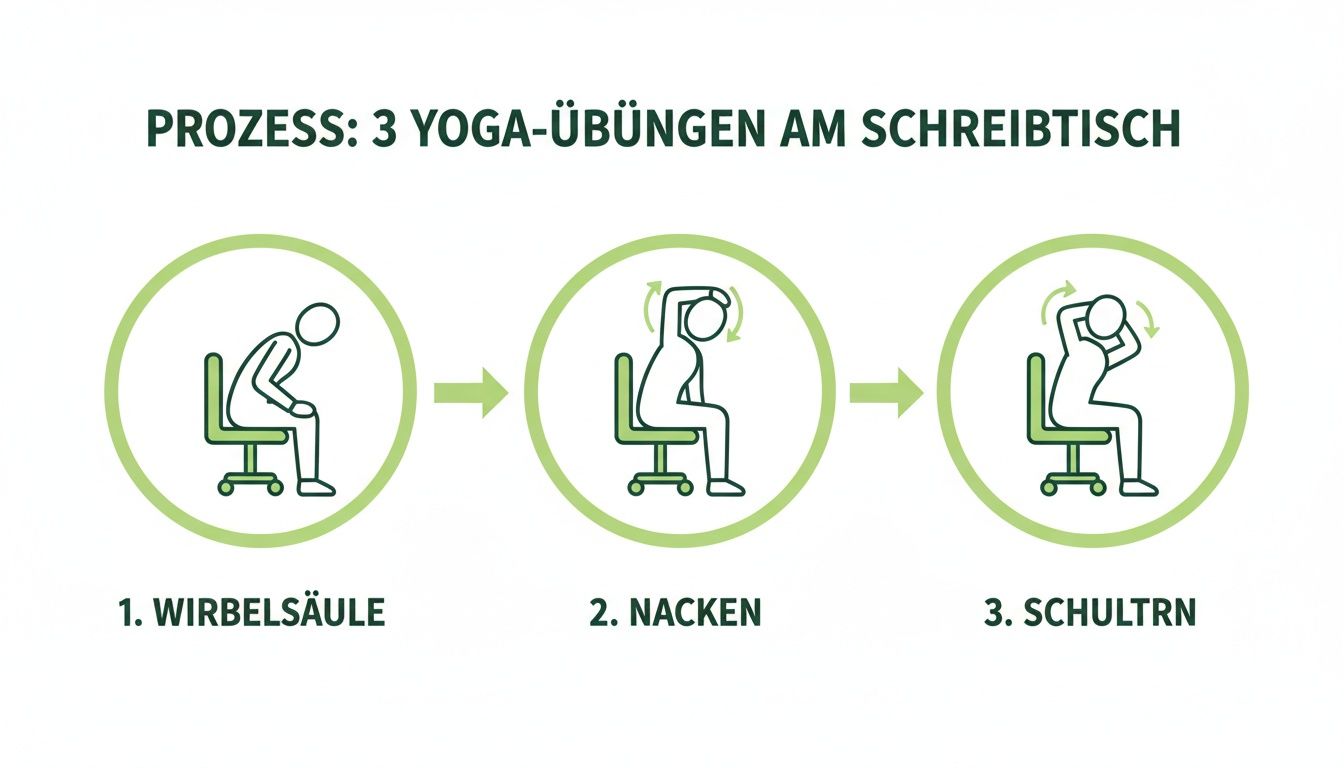
You can see very nicely here how you can target the areas that suffer the most in everyday office life with minimal effort.
Don’t forget your breath during all the movements – it is your most important anchor. Deep, even breathing optimally supplies your muscles with oxygen and simultaneously helps to calm your nervous system. Let the breath guide the movement: The inhalation creates space and length, the exhalation lets you sink deeper into the pose or transition to the next movement.
Yoga as a means against back pain is becoming increasingly popular in Switzerland. According to the report ‘Sport Switzerland 2020’ from the Federal Office of Sports, already13 percent of the populationpractices yoga on at least 50 days a year – a significant increase of 6 percentage points since 2014. Studies support this trend and show that even more intense forms like Ashtanga yoga can relieve chronic back pain as effectively as conventional therapies.
End your morning routine in theChild’s Pose (Balasana).Let go of everything here, especially your lower back. Breathe deeply into your belly and take a moment to reflect. These minutes of silence are just as valuable as the movement itself.
If you want to do even more specifically for your lower back, you can find hereadditional exercises for the lower back, which can be effectively integrated into your routine.
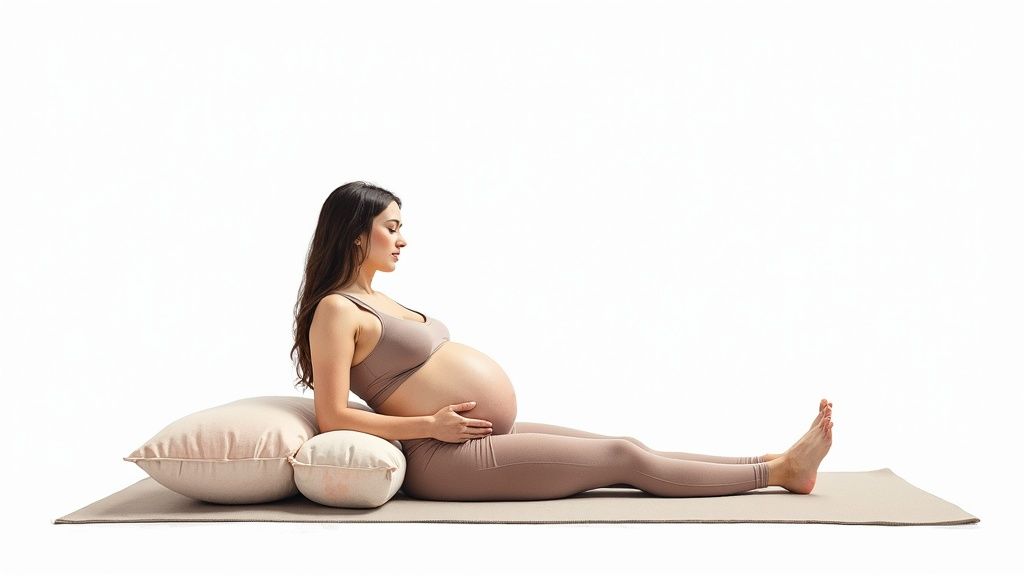
Some phases of life present our bodies with entirely new challenges – foremost among them pregnancy and the time immediately after childbirth. Your back, especially the lower region, works exceptionally hard during these months. The good news: Yoga can accompany you gently and safely.
With the right adjustments, your yoga practice becomes a true source of strength and relaxation. It’s no longer about performance, but about creating space, relieving your back, and consciously connecting with your body as it changes.
During pregnancy, your center of gravity shifts naturally forward. This often leads to an exaggerated lumbar curve and the typical pain in the lumbar area. A gentle yoga program helps you actively counteract, improve your posture, and significantly relieve these discomforts.
It’s now very important to avoid intense abdominal exercises and deep twists. Your focus is instead on gentle mobilization and targeted strengthening of the supporting muscles.
These exercises are especially beneficial for you now:
Your body is doing great things. Don’t see yoga in pregnancy as a physical performance, but as a loving gesture to yourself. It’s about nourishing yourself, relieving pressure, and building a deep connection with your baby.
A well-guided practice can also optimally prepare you for childbirth. More detailed information and special courses can be found in our comprehensive guide on the topic ofPregnancy and Prenatal Yoga..
After giving birth, your body needs primarily one thing: time. Time for healing and regeneration. Your core muscles are weakened, and especially your pelvic floor requires special attention. So start very slowly and listen carefully to the signals your body sends you.
Your goal is to gently reactivate the deep abdominal and back muscles without overstraining the pelvic floor. It’s best to start with exercises that you can perform lying on your back. For example, gently draw one knee to your chest alternately or activate your pelvic floor with very light tension exercises.
At first, absolutely avoid all exercises that put pressure on the rectus abdominis – crunches are thus off-limits. Give your body the time it needs. When you feel ready, gentle postures like theBridge (Setu Bandhasana)are ideal for strengthening the glutes and back and gradually rebuilding your core.
Yoga is an incredibly powerful tool against back pain to relieve tension and strengthen the core. But there are moments when mindfulness and caution are paramount.
Your body is speaking to you, and it is crucial to understand and take its signals seriously. Yoga is meant to heal, not harm.
The most important principle remains: Listen to your body. A feeling of stretching is great; that is what we want. However, a sharp, stabbing, or burning pain is an absolute stop signal. In such a case, always exit the pose slowly and controlled. Please never ignore such warnings; they are your built-in protection mechanism.
It is absolutely essential to know when you need professional help. Particularly if you notice serious warning signs for back pain,a visit to the doctor is essential before you continue your yoga practice.
If any of the following symptoms occur, stop your yoga routine immediately and seek medical advice. These so-called ‘Red Flags’ may indicate a cause that goes far beyond simple muscle tension.
Pay special attention to these signs:
Even if you already have a diagnosis, a responsible approach to your yoga practice is essential. An acute herniated disc for example, is a clear contraindication for most yoga exercises. Here the rule is: first let the acute phase subside under medical supervision. Only after the doctor or physiotherapist gives the green light, can you start again with a specially adapted program.
Yoga is not a cure-all, but a tool. With diagnoses like an acute herniated disc, severe osteoarthritis, scoliosis, or spondylolisthesis, a professional assessment is indispensable. An experienced yoga teacher or physiotherapist can help you develop a safe and effective practice tailored to your individual needs.
The effectiveness of yoga is well documented. After all, about 75 percent of Swiss between 30 and 60 years old have experienced back pain firsthand. A study even showed a 61 percent improvement with yoga in combination with stress reduction. In comparison, the improvement with medication alone was only 44 percent.
Nevertheless: Diagnoses like spondylolisthesis require an adapted practice. The focus here is clearly on stabilization, not extreme flexibility. Safety and the awareness of your own limits are the key to a sustainably healing experience.
This table gives you a quick orientation on which yoga exercises are safe for certain diagnoses, which need to be modified, and which you should avoid altogether.
| Complaint | Green (Recommended exercises) | Orange (Only with modifications) | Red (Absolutely avoid) |
|---|---|---|---|
| Herniated disc (acute) | Gentle breathing exercises lying down | None | All forward bends, twists, backward bends |
| Herniated disc (post-acute) | Cat-Cow, Child’s Pose, gentle core stabilization | Gentle twists, Chair Pose | Deep forward bends (e.g., Paschimottanasana) |
| Spondylolisthesis | Core stabilization (Plank), Bridge, Bird-Dog | Gentle backward bends, Warrior poses | Deep backward bends (e.g., Wheel), intense twists |
| Scoliosis | Side stretches (to the convex side), asymmetrical strengthening | Modified twists, Warrior poses | Symmetrical poses without modifications |
| General tension | Cat-Cow, Needle Eye, gentle twists, Child’s Pose | Almost all exercises are possible | None, as long as no pain occurs |
Remember, this table is a general guideline. Your body is unique. When in doubt, always consult your doctor, physiotherapist, or a qualified yoga teacher to make your practice safe and effective.
You’re considering starting yoga to benefit your back, but something is holding you back? That’s completely normal. Especially when there are niggles and pains, the same questions and uncertainties often arise.
Don’t worry, you’re not alone. I’ve gathered the most common concerns and provide you with practical answers so you can step onto your mat with confidence and a good feeling. Think of this section as your personal guide.
Here it is clear: consistency beats duration. It benefits your back much more if you manage to practice three to four times a week for 15 minutesto practice, rather than tormenting yourself for a 90-minute session on the weekend. The trick is to find a routine that really integrates well and without pressure into your daily life.
Most people feel a noticeable relief after just a few weeks, more flexibility, and less discomfort. It’s important to stay consistent and learn to listen to the signals of your body rather than overwhelming it.
A clear no. With an acute herniated disc, yoga is off-limits for the time being. During this phase, rest and medical treatment take absolute priority. Please be sure to talk to your doctor or physiotherapist first before even considering any movement.
As soon as you get the green light from a medical perspective for gentle movement therapy, targeted, stabilizing exercises under expert guidance can greatly support the healing process. However, intensive forward and backward bends or twists are still a no-go. Your safety always comes first.
For beginners, gentle, calm styles are ideal. They give you the time to truly understand the postures and to connect with your body.
I would advise against very powerful, fast styles like Power Yoga or Ashtanga at the beginning – unless the class is taught by a very experienced instructor who knows what to pay attention to with you.
The golden rule in yoga is: it should never hurt. A pull or stretching feeling is great; that’s what we want. But a stabbing, burning, or sharp pain is a clear stop signal from your body.
Listen to that signal. Then, slowly and mindfully exit the posture. Try a gentler variation, use props like a block or a cushion, or simply skip the exercise for today. It’s not about perfection, but about doing good for your back.
At Templeshapeyou will find a wide selection of yoga classes taught by experienced instructors. We create a safe space where you can experience the beneficial effects of yoga for yourself. Find the right class for you and start your journey to a strong, pain-free back. Discover our offerings at https://templeshape.com.
Tags