March 19
Yoga training in Switzerland: Discover the yoga training that fits you
0 comments

March 19
0 comments
Are you considering a yoga teacher training in Switzerland? Wonderful! This is the first decisive step of a journey that will enrich you incredibly and take you far beyond the yoga mat. A solid training, such as is now offered in many places in Switzerland, not only provides you with the necessary tools to teach. It also deepens your own practice and your understanding of yourself.
A yoga training is much more than the correct execution of postures. It is a deep examination of yourself, your body, and a millennia-old philosophy. Imagine this path as building a house: each level of training is an important construction step that builds on the previous one and makes everything stronger.
The demand for well-trained yoga teachers has literally exploded in Switzerland in recent years. This is your chance to turn your passion into a profession or to elevate your knowledge to a new level just for you.
Yoga is no longer a niche topic, but is firmly rooted in Swiss society – a practice recognized for more health and well-being. The numbers speak for themselves: according to a survey by the Federal Office of Sport (BASPO), about 12 percent of the Swiss population aged 15 and older regularly practices yoga. This represents about 1.04 million people!
For comparison: in 2007, this percentage was still only about 6 percent. We are therefore talking about a doubling in less than two decades. More details about this exciting evolution can be found at bildung-schweiz.ch.
This growing demand creates a stable base for you if you are aiming for a yoga training in Switzerland This means more opportunities to teach in studios, lead your own classes, or offer specialized workshops.
To establish yourself in this world, it is important to know the internationally recognized standards. They form the structure of almost all serious training you will find and help you assess the quality of an offer.
The most common formats are:
200-hour training (Your foundation): This is the classic entry point and the basis for everything that follows. Here, you learn the basics of asanas (postures), pranayama (breathing techniques), anatomy, and philosophy. After completing it, you are qualified to teach your first yoga classes safely and competently.
300-hour continuing education training (The advanced training): This training is aimed at you if you already have a 200-hour certification and wish to deepen your knowledge. Here, you specialize your knowledge in advanced themes such as therapeutic yoga, complex sequencing, or a particular style of yoga.
500-hour certification (Your completed house): This title is not a separate unique training. It is the result of your foundational training of 200 hours plus the 300-hour continuing education. When you reach this level, you signify a truly complete and in-depth knowledge.
An important thought for your path: The number of hours is a good indicator of the depth of a training. But what really matters in the end is the quality of the teachers and the course plan. They are decisive for your personal and professional development.
This guide is here to give you a clear view of the different yoga trainings in Switzerland so that you can make an informed decision that feels right for you.
When you are looking for a yoga training in Switzerland, you will quickly realize: the number of hours is only half the truth. A 200-hour training is not simply a 200-hour training. Let’s take a closer look at what lies behind the numbers so that you find exactly what suits you and your journey.
Imagine the stages of training as building a house. Each level has its own objective and prepares you for the next step. The foundation must be solid before you build the walls and cover the roof.
This diagram clearly shows how the levels traditionally build on each other.
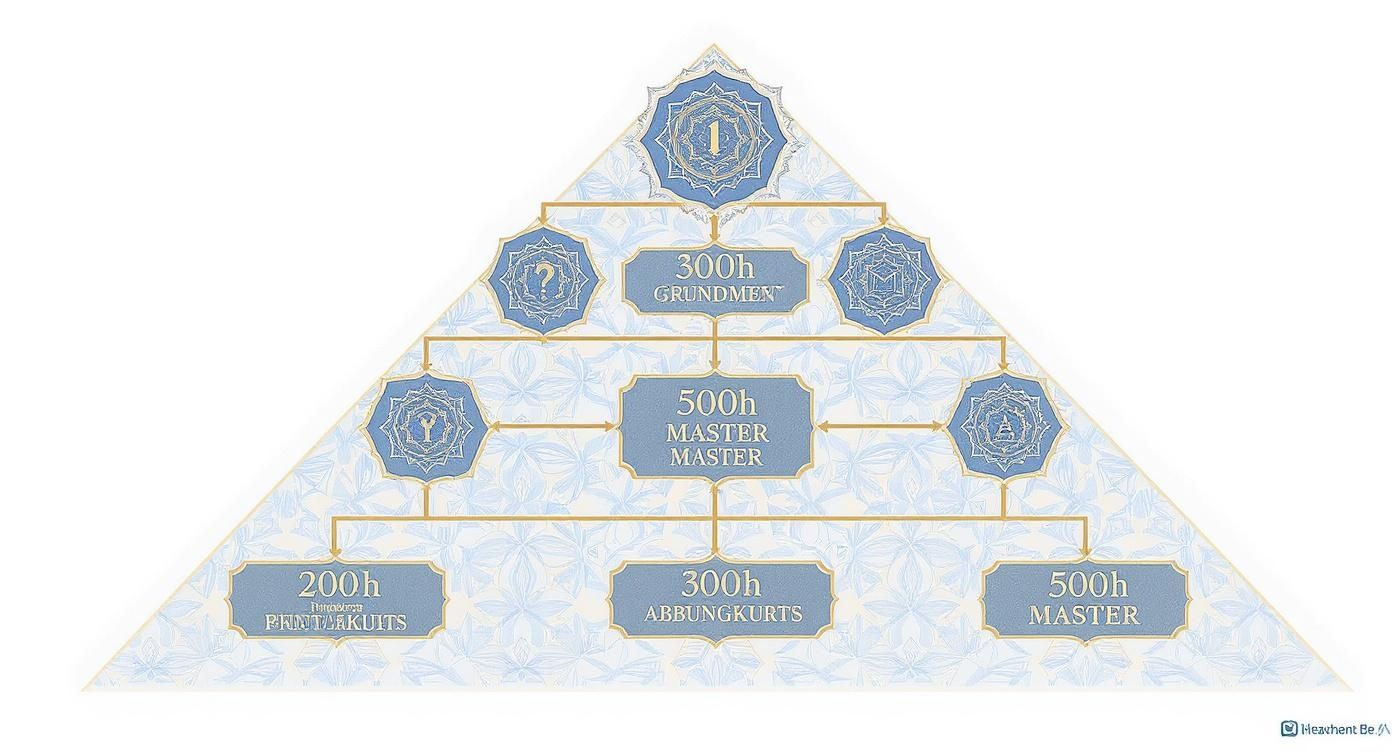
You see for yourself: the 200-hour training is the essential basis for everything that will follow.
The 200-hour training is your base, the absolute core of your knowledge. Here, you receive the basic tools you need to teach safely and confidently.
You dive deep into the proper alignment of asanas (postures) and learn how to direct them precisely and adapt them to different bodies. A significant portion is also devoted to anatomy – because only if you understand how the body works can you help avoid injuries.
At the same time, the door opens to the fascinating world of yoga philosophy. You will delve into ancient texts such as the Yoga Sutras of Patanjali and learn how to build your first yoga class meaningfully.
The 200-hour training is not an end, but the beginning of your journey. It gives you the license to learn and grow – both on the mat and as a human being.
In Switzerland, most trainings align with international standards. Basic trainings include 200 hours of courses and generally last, depending on the employment, between 9 and 12 months.In terms of pricing, you usually find yourself between 2,500 and 4,500 CHF.
You have your 200 hours in hand, perhaps you have already been offering classes for some time and feel: there is more. So, the 300-hour training is the next logical step. Think of it as a master’s after the bachelor’s. Here, it is no longer about the basics, but about deepening and specializing.
Now, you can focus on themes that truly interest you. Possible highlights are, for example:
This advanced training turns a good teacher into an excellent one. You gain confidence, find your own voice, and can offer your students a much richer, deeper experience.
In addition to the major trainings, there are countless shorter courses that allow you to specialize in a specific yoga style or target group. These courses usually last between 30 and 100 hours.
A classic example is a Yin Yoga training.Here you focus entirely on this calm, meditative practice, learn the specific postures, the underlying meridian theory, and how to create a space for deep relaxation.
Other popular niches include:
Such specializations are perfect to find your niche and become an expert in a specific field. They complement your basic training ideally and make your profile as a teacher unique. A deep understanding of body and mind, as taught in mindful movement practices, is of great value here. If you are interested in the connection between body awareness and movement, you might also enjoy our article on somatic Pilates as a revolution of your fitness.
The following table summarizes the key differences compactly for you.
A direct comparison of the content, goals, and prerequisites of various yoga training formats in Switzerland.
| Feature | 200-hour basic training | 300-hour advanced training | Specialized training (e.g., Yin Yoga) |
|---|---|---|---|
| Goal | Establish a foundation to be able to teach safely | Deepen knowledge, find own voice as a teacher | Become an expert in a specific niche |
| Target group | Yoga practitioners who want to become teachers | Certified 200h teachers (RYT-200) | Teachers who want to expand their offerings |
| Content | Asana alignment, anatomy, philosophy, sequencing basics | Advanced asanas, therapeutic approaches, in-depth philosophy | Specific techniques, target group adjustments, style theory |
| Duration | 9-12 months (part-time) | Variable, often modular over 1-2 years | 30-100 hours, often on weekends or as an intensive course |
| Prerequisite | Solid personal yoga practice | Completed 200h training | Usually a 200h training recommended |
| Outcome | Certification as a yoga teacher (e.g., RYT-200) | Advanced certification (e.g., RYT-500 after completion) | Certificate for the corresponding specialization |
As you can see, each step logically builds on the previous one. In the end, the choice of the right format is a very personal decision. Ask yourself: where am I on my path? What do I want to learn? And above all: what style and philosophy resonate in my heart?
A beautiful certificate can be quickly printed, but what really lies behind it? If you are looking for the perfect yoga training in Switzerland, it is essential to separate the wheat from the chaff.
Quality and recognition are not just empty marketing slogans here. They are your ticket to professional studios and the guarantee that your significant investment in time and money will pay off in the long run.

In the world of yoga, there are different organizations that aim to establish standards. In Switzerland, you will mostly encounter two names: the Yoga Alliance and the Yoga Verband Schweiz. If you understand what they are fighting for, you will be able to better assess the orientation of a school.
The Yoga Alliance is an American organization and the largest union in the industry worldwide. If a school is registered as an RYS (Registered Yoga School), it meets certain minimum standards in terms of curriculum and class hours. For you, as a graduate, this means a foundation that is recognized internationally – particularly valuable if you wish to teach abroad one day.
The Yoga Verband Schweiz, on the other hand, emphasizes quality criteria specific to the country, which are more in-depth. Recognition is often linked to a longer training duration (often over four years) and stricter examination regulations. This label becomes particularly relevant if you aim for recognition by Swiss health insurance companies so that your future students can reimburse part of the course fees.
One could say: a certificate from the Yoga Alliance is like a bachelor’s degree recognized internationally – it opens doors worldwide. Recognition by the Yoga Verband Schweiz resembles a federal certificate – a strong mark of quality, specifically tailored to the Swiss market.
A nice logo does not alone make a good training. True quality hides in the details. Use the following checklist to critically examine each school you are considering. This way, you can ensure that in the end, you hold not just a piece of paper but solid and real knowledge.
The main criteria for checking your choice:
Sometimes, it’s the small things that should raise questions. Learn to listen to your intuition and recognize alarm signals as early as possible.
A classic alarm signal is a vague description of the teachers. If the website simply states, “taught by a team of experienced yoga teachers,” without names, photos, and concrete bios, be cautious. You have the right to know who will be teaching you.
Another alarm signal is a lack of credible testimonials. If you find only perfectly phrased anonymous quotes but no real stories of graduates with names or social media profiles, you should investigate. Genuine enthusiasm cannot be hidden so easily.
By checking these points, you transition from a mere interested person to an informed candidate. You are not investing blindly but are making a conscious decision for a training that will truly help you progress as a yoga teacher and as an individual.
Yoga training is undoubtedly one of the most valuable investments you can make for yourself. But between us: along with all this anticipation, there also needs to be an honest look at finances and time. Let’s talk frankly about the numbers, so you know what to expect and can make a decision that truly fits your life.
For a 200-hour yoga training in Switzerland, you should budget between 3,500 and 5,000 CHF. This price range is quite normal and has good reasons – it depends on several factors that we will examine more closely now.
Costs consist of many small elements that ultimately shape the quality and experience of your training. One of the major items is often the location of the school. For example, a training in the heart of Zurich or Geneva will logically cost more than training in the countryside. This is simply due to higher rents for studios and the cost of living in general, which is reflected in the total price.
Other important pricing factors are:
My advice:Ask the schools you are interested in directly what is included in the price. Are exam fees covered? Do you need to purchase specialized literature separately? Make sure to clarify this in advance to avoid unpleasant surprises later.
Apart from money, time is the second big variable to consider. Basically, there are two common formats, each with its own pace.
1. The intensive course (Sprint)
This format is like a deep immersion: you dive completely into the world of yoga for three to four weeks in a row. Imagine living and breathing yoga from morning to night, without distraction.
2. The alternating training (Marathon)
This model typically spans nine to twelve months, often with courses over weekends or in block weeks. You integrate learning into your existing life.
The choice between these two paths is very individual. Be honest with yourself: what pace suits my learning style and my current life situation? There is no right or wrong here – only what works for you, without exhausting you.
Let’s get concrete: Where exactly do you find the yoga training in Switzerland, that makes you feel at home? The offer may seem overwhelming at first glance, but with the right approach, the search becomes clear and focused. Switzerland offers you a fascinating diversity – from dynamic studios in urban centers to tranquil oases in the midst of the mountains.
Imagine your search as a map. There are clear hotspots, but also hidden gems. Your task is to find the place whose energy and philosophy are truly in harmony with your own vision.
A look at the geographical distribution shows a clear trend: most yoga training providers are located in urban and German-speaking regions. About 70 percentof schools are in German-speaking Switzerland, with Zurich, Lucerne, and Basel being the main centers. In Zurich alone, there are at least five renowned schools offering 200 and 500-hour trainings. More details on the distribution of yoga schools in Switzerland can be found on bookyogaretreats.com.
Cities like Zurich naturally offer you a wide selection. You can experience different styles and teachers, attend trial classes, and thus develop a real feel for the respective community. This is a great advantage for making comparisons and ensuring it fits. If you want to know more about the diverse scene on site, check out our article on Yoga in Zurich Wiedikon (District 3).
But don’t underestimate the magic of training away from the hustle and bustle. A retreat format in the Alps can be an incredibly deep and intense experience. The calm of nature helps you to fully concentrate on yourself and the teachings – an uninterrupted journey within, without daily distractions.
Your choice of location shapes the entire experience. Ask yourself honestly: do I need the energy and diversity of the city or the calm and focus of nature to learn and grow optimally?
Every yoga school has its own DNA, its unique philosophy. It’s not just about whatis taught, but especially about how.To help you navigate, we present here three typical orientations that you will often encounter in Switzerland.
1. Traditional and classic: for example, Hatha Yoga according to Sivananda
Imagine a school based on a clear and proven tradition. Here, you learn a holistic approach that considers asanas, pranayama (breathing exercises), relaxation, nutrition, and positive thinking as equivalent pillars.
2. Modern and athletic: for example, Vinyasa Flow
On the opposite side is a modern and dynamic school. Here, everything revolves around fluid movements that are synchronized with breathing. Creativity, music, and an athletic approach are often at the forefront.
3. Spiritual and Energetic: for example, Kundalini Yoga
These schools place a strong emphasis on working with vital energy (Kundalini). It is a highly transformative practice that goes far beyond the pure physical aspect and dives deep into energetic levels.
These examples show howyoga teacher trainings in Switzerlandcan be different. Take the time to study the websites of the schools, attend information events, and – very importantly – talk with graduates. Find the community where you feel not only welcome as a student but also truly at home.
Congratulations, your certificate from youryoga training in Switzerlandis freshly printed in your hands! But what happens now? The reality after training is often a bit different from what you may have dreamed of. This section aims to give you an honest and practical compass for your first steps into the professional world.
It’s better to let go of the idea of immediately leading full classes in a chic studio. This is certainly a wonderful goal, but the path to that usually starts with smaller yet extremely important steps. For most recently graduated yoga teachers, this means gaining valuable experience by offering substitute classes or teaching your first classes to friends, family, and acquaintances.
These first hours are pure gold. Here, you can practice in a secure setting, refine your instructions, learn to work with highly varied body types, and slowly build the self-confidence you will need later for larger classes.
Fundamentally, two main paths lie before you after your training. Both have their own advantages and disadvantages. It is important that you honestly decide which path suits your personality and current life situation best.
As an independent yoga teacher, you are your own boss, your own marketing department, and your own accountant. This means you have to take care of things like registration with social security, insurance, and finances. This requires discipline and a certain entrepreneurial mindset.
The yoga market may seem gigantic and perhaps even overcrowded at first glance. That is precisely why it is crucial that you find your own little niche. Ask yourself very honestly: Who does my yoga heart beat the most for? What are my particular strengths?
Having a niche does not mean excluding others. It means being the absolutely best and clearest solution for a very specific group of people.
Perhaps you are the perfect teacher for stressed office workers and offer short, impactful yoga classes directly in companies. Or your strength lies in gentle, restorative yoga for the elderly, promoting mobility and joy of living. Your niche makes you visible and attracts exactly the students who resonate with you. A targeted offer like focused private lessons can also be an excellent starting point; if you would like to learn more about this, you will find valuable tips in ourGuide to Private Yoga Classesabout this topic.
You will rarely find your first students through large, expensive advertising campaigns. It is rather about authentic connections and creative ideas in your immediate environment.
A personal Instagram profile, where you show not only perfect poses but also share your thoughts on yoga, can work wonders. How about a collaboration with your favorite café for a “Yoga & Brunch” event? Or you offer free trial classes in the park during the summer. Talk to people, share your passion, and have courage. Your enthusiasm is your best marketing tool to successfully start your yoga teaching career.
Here, we clarify the questions that are constantly raised in the studio when it comes to yoga teacher trainings in Switzerland. We want to answer you directly and honestly so you can make your decision with a good feeling.
No, absolutely not. A yoga training is not about bending your feet behind your head. It is rather about learning to understand your own body and adapting the postures to work foryou.The journey is the goal, not the perfect acrobatic posture.
Honestly: many do a training just for themselves. Imagine it as an intensive journey to yourself, deepening your understanding of yoga like would never be possible in normal classes. It’s an investment in your personal development.
Yes, the certificate officially grants you the qualification to do so. But the best approach is to start slowly and consciously. Perhaps you will first give classes to friends, offer free classes in the park during summer, or take a substitute class in the studio.
Every great teacher started small. Courage and confidence grow with each class you teach. It’s all about hands-on experience.
For a solid 200-hour training, you should expect prices between3,500 and 5,000 CHFin Switzerland. Be skeptical of extremely cheap offers – they often seem too good to be true.
Quality comes at a price, especially when it comes to the experience of the trainers and personal support. Always take a close look at what is included in the price to avoid unpleasant surprises like additional costs for teaching materials or exams.
Your yoga training in Switzerland is the foundation of a wonderful new path. Make this decision consciously and informed.
Ready to start your own journey and make movement an integral part of your life? At Templeshape GmbH in Zurich, you’ll find a community that supports you, as well as classes ranging from yoga to HIIT, that accompany you on your path. Discover our offerings and find the perfect class for you at https://templeshape.com.
Tags