March 17
What is Hatha Yoga and how this style enriches your life
0 comments

Imagine you are looking for a yoga style that grounds you, gives you strength, and at the same time creates an oasis of calm in your daily life. That is exactly what Hatha Yoga is: the original form of yoga, which unites body postures (asanas), breathing techniques (pranayama), and meditation into a profound, balancing practice. It is the foundation upon which many modern yoga styles are built today.
Have you ever wondered what lies behind the name “Hatha”? The answer lies in ancient Sanskrit, the language of yoga. “Ha” stands for the sun – the active, warming, masculine force within us. “Tha” symbolizes the moon – the passive, cooling, female energy.
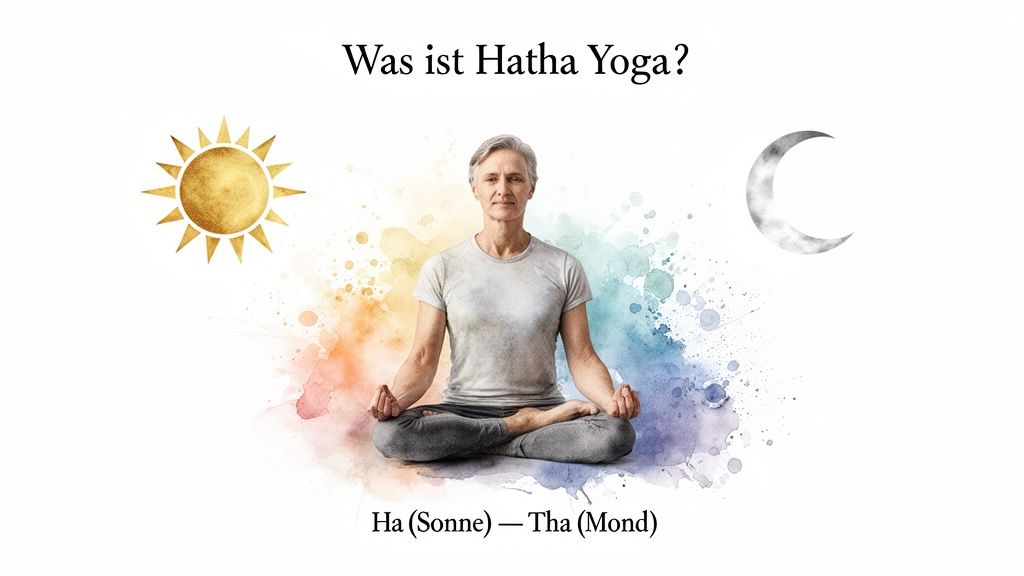
Hatha Yoga is thus the art of uniting these two opposites within you and finding an inner balance. It’s not about bending yourself into complicated poses. Rather, Hatha Yoga invites you to consciously perceive and feel your body.
In contrast to dynamic styles like Vinyasa, where movements flow into each other, you usually hold the postures in Hatha Yoga for several breaths. A good example is the “Tree” pose (Vrksasana): Instead of quickly switching from one leg to the other, you take your time to find balance on one leg, breathe deeply, and feel the stability within you.
Hatha Yoga is an invitation to pause and consciously feel the connection between body, breath, and mind. It creates an anchor of tranquility in your often hectic everyday life.
This focus on mindfully holding the poses gives you the time to find the right alignment, breathe deeply into the stretch, and truly arrive at yourself. You learn to let go of tension while simultaneously building targeted strength.
Here you will find a summary of the central elements that define Hatha Yoga and their significance for your practice.
| Element | What it means for you |
|---|---|
| Asanas (body postures) | Held poses that promote your strength, flexibility, and body awareness. |
| Pranayama (breath control) | Conscious breathing techniques that calm your nervous system and focus your mind. |
| Meditation & relaxation | Moments of silence that help you reduce stress and find mental clarity. |
It is precisely this combination of strength, calm, and conscious breathing that makes Hatha Yoga the perfect starting point for your personal yoga journey.
To truly understand Hatha Yoga, we must take a little journey back in time. Forget for a moment the modern gym or the stylish yoga mat. Hatha Yoga is not a creation of our time, but a millennia-old practice from ancient India.
The original goal had little to do with the perfect beach body. It was about strengthening and purifying the body so that it could sit for hours in meditation.
The ancient yogis viewed the body as a temple of the soul. Each posture (asana) and each breathing exercise (pranayama) was a tool to care for this temple. For example, imagine a simple forward bend: Originally, this was not just a stretch for the back of the legs, but a gesture of devotion to calm the mind and allow life energy – the prana – to flow freely again.
At the heart of the Hatha philosophy lies the idea of preparation. Through physical exercises, the mind is calmed. That might sound paradoxical, but it is quite logical: An agitated, aching body constantly distracts you. A strong, flexible body, on the other hand, becomes a silent partner on the way to inner reflection.
Hatha Yoga teaches you that your body is not your enemy, but your ally. With each conscious movement, you prepare it to allow the mind to settle.
This ancient wisdom is more relevant today than ever. Hatha Yoga, which once emerged in Shaivite Tantrism, has developed into a globally practiced discipline. In Germany alone, the percentage of yoga practitioners increased from only 5 percent in 2018 to a remarkable 20 percent by 2023. This trend is also reflected globally: The yoga market reached a value of 105.9 billion USD in 2022. If you want to dive deeper into this fascinating history, you will find further insights into the development of Hatha Yoga on Wikipedia..
This historical foundation gives your practice a whole new depth. So the next time you stand on your mat, remember: You are part of a long tradition that honors the body in order to free the mind.
Imagine a typical Hatha Yoga class as a stable, harmonious building. It stands firm on three fundamental pillars. Each of these elements has its own unique role, but only in perfect interplay do they unleash their full power for your body and mind.
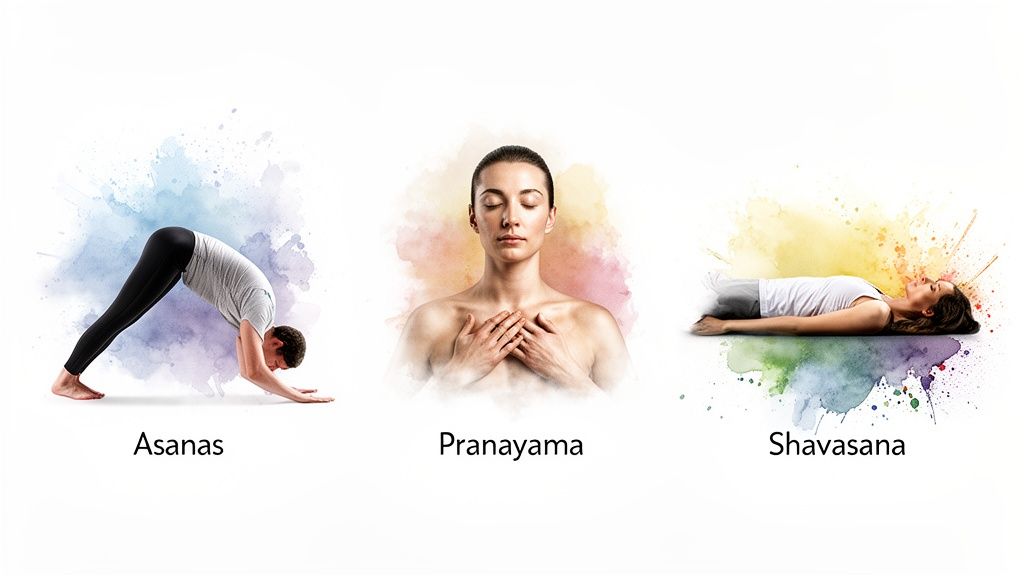
These three pillars are the building blocks that help you build inner strength, find deep calm, and firmly anchor the positive effects of the practice within you.
The heart of your physical practice is the asanas. The big difference from more dynamic yoga styles is that you hold the individual poses for several breaths in Hatha Yoga. This gives you valuable time to consciously align your body, grow into the posture, and truly feel its effect.
Two absolute classics that you will surely encounter are:
Die zweite, ebenso wichtige Säule ist Pranayama, die Kunst der bewussten Atemlenkung. Dein Atem ist ein unglaublich mächtiges Werkzeug, mit dem du dein Nervensystem direkt beeinflussen und deinen oft flatterhaften Geist zur Ruhe bringen kannst.
Durch einfache, aber enorm wirkungsvolle Atemübungen lernst du, aktiv von einem gestressten, gehetzten Zustand in einen ruhigen und entspannten zu wechseln. Ein einfaches Beispiel ist die Wechselatmung (Nadi Shodhana), bei der du abwechselnd durch das linke und rechte Nasenloch atmest, um dein Nervensystem auszugleichen. Diese Techniken sind ein zentraler Teil dessen, was Hatha Yoga so besonders macht. Wenn du tiefer eintauchen willst, findest du in unserem Guide zu Breathwork in Zürich weitere spannende Techniken. Die Praxis des Hatha Yoga baut auf verschiedenen Säulen auf, darunter Körperhaltungen, Atemtechniken und meditative Elemente, die auch spezielle Achtsamkeitsübungen umfassen, um innere Stärke und Konzentration zu fördern.
In der Stille zwischen dem Ein- und Ausatmen findest du den Raum, in dem dein Geist zur Ruhe kommt. Pranayama ist der Schlüssel zu diesem Raum.
Die dritte Säule wird oft unterschätzt, ist aber vielleicht die wichtigste von allen: Shavasana, die Endentspannung. Am Ende jeder Stunde legst du dich bequem auf den Rücken und tust… scheinbar nichts.
Doch genau in diesem Moment geschieht die eigentliche Magie. Dein Körper integriert die Effekte der Asanas, dein Nervensystem fährt herunter und reguliert sich, und dein Geist bekommt die Chance, das Erlebte zu verarbeiten. Diese Phase ist absolut entscheidend, um die Balance zwischen Anspannung und Entspannung zu finden und gestärkt aus der Stunde zu gehen.
"Ich bin doch viel zu unbeweglich für Yoga." Diesen Satz höre ich immer wieder. Vielleicht denkst auch du, Yoga sei nur etwas für extrem flexible Menschen oder dass dir im stressigen Alltag einfach die Energie fehlt.
Gute Nachrichten: Hatha Yoga ist da, um genau diese Vorurteile aus dem Weg zu räumen. Es ist einer der zugänglichsten Stile überhaupt – und wahrscheinlich genau das, was du gerade brauchst.
Hatha Yoga holt dich genau dort ab, wo du heute stehst. Vergiss komplizierte Verrenkungen oder ein Tempo, das dich aus der Puste bringt. Hier geht es um langsame, bewusst ausgeführte Bewegungen.
Jede Haltung, auch Asana genannt, wird für mehrere Atemzüge gehalten. Das gibt dir die Zeit, in deinen Körper hineinzuspüren, die richtige Ausrichtung zu finden und ein Gefühl für die Grundlagen zu entwickeln. Ganz ohne Druck und Leistungsgedanken.
Gerade wenn dein Job viel von dir abverlangt – wie es hier in Zürich ja oft der Fall ist – kann Hatha Yoga zum Rettungsanker werden. Die Kombination aus bewusster Atmung und dem Wechselspiel von An- und Entspannung hilft dir, das Gedankenkarussell anzuhalten und mentalen Ballast abzuwerfen.
Im Hatha Yoga gibt es keinen Wettbewerb. Es geht nicht darum, eine Pose perfekt auszuführen, sondern darum, den Moment bewusst zu erleben. Eine Fähigkeit, die uns im Alltag so oft abhandenkommt.
Diese beruhigende Wirkung ist übrigens mehr als nur ein Gefühl. Eine repräsentative Studie aus dem Jahr 2014 hat gezeigt, dass 89,7 Prozent der Yoga-Praktizierenden von positiven Effekten berichten. Genauer gesagt fühlten sich 58,8 Prozent im Alltag ausgeglichener. Interessant ist auch, dass Hatha Yoga besonders bei Menschen in Grossstädten und bei Selbstständigen beliebt ist – also genau bei den Gruppen, die oft hohem Druck ausgesetzt sind. Wenn du tiefer einsteigen möchtest, findest du hier mehr Details zur Yoga-Forschung.
Die Praxis löst nicht nur mentale Blockaden, sondern auch die typischen Verspannungen im Nacken- und Schulterbereich, die vom langen Sitzen am Schreibtisch kommen. Du lernst, wieder tief durchzuatmen und einfach mal neue Energie zu tanken.
Vinyasa, Ashtanga, Yin Yoga – die Welt des Yogas ist riesig und kann am Anfang ganz schön unübersichtlich wirken. Damit du den Durchblick behältst und den passenden Stil für dich findest, schauen wir uns mal an, was Hatha Yoga von den anderen grossen Richtungen unterscheidet.
Man könnte sich Hatha Yoga wie das solide Fundament eines Hauses vorstellen. Die Praxis ist eher ruhig und methodisch, mit einem klaren Fokus auf das Halten der einzelnen Posen. Das gibt dir die nötige Zeit, um die korrekte Ausrichtung zu finden und wirklich in deinen Körper hineinzuspüren.
Im krassen Gegensatz dazu steht das dynamische Vinyasa Yoga. Hier fliesst alles. Stell es dir wie einen Tanz vor, bei dem du jede Bewegung nahtlos mit deinem Atem verbindest. Ein Beispiel ist der Sonnengruss: Im Vinyasa Yoga fliesst du dynamisch von einer Position zur nächsten, während du im Hatha Yoga jede einzelne Haltung des Grusses länger halten könntest. Die Übergänge sind fliessend und oft kreativ, du bist also ständig in Bewegung. Das macht Vinyasa körperlich fordernder und oft auch schweisstreibender. Während Hatha dich erdet, bringt Vinyasa dich in den Flow.
Ashtanga Yoga legt noch eine Schippe drauf. Dieser Stil ist extrem diszipliniert und körperlich fordernd, da er auf einer festen, unveränderlichen Serie von Haltungen basiert. Es ist wie ein strukturiertes Trainingsprogramm, das Kraft, Ausdauer und mentale Disziplin in den Vordergrund rückt.
Hatha Yoga ist dein Ankerpunkt – langsam und achtsam. Vinyasa ist der Fluss – dynamisch und kreativ. Ashtanga ist die Disziplin – kraftvoll und strukturiert.
Am anderen Ende des Spektrums liegt das tiefenentspannte Yin Yoga. Während Hatha deine Muskeln aktiv anspricht und kräftigt, zielt Yin auf die tieferen Schichten ab: dein Bindegewebe, die Faszien und die Gelenke. Die Posen werden hierfür komplett passiv und für mehrere Minutenheld on the ground. A typical example is the “Caterpillar” (a seated forward fold), where you simply surrender to gravity instead of actively pulling into the stretch. It’s all about pure letting go and a gentle yet intense stretch.
So if you’re looking for a deeply relaxing practice that passively promotes your flexibility, our courses for Yin Yoga in Zurich could be a wonderful addition for you.

To make your decision even easier, here’s an overview. This table shows you the main differences in pace, focus, and intensity between the most popular yoga styles.
| Feature | Hatha Yoga | Vinyasa Yoga | Yin Yoga |
|---|---|---|---|
| Pace | Slow, static | Flowing, dynamic | Very slow, passive |
| Focus | Correct alignment, body awareness | Breath-movement synchronization, flow | Deep connective tissue, joints, letting go |
| Intensity | Low to medium, good for beginners | Medium to high, physically challenging | Gentle but mentally intense |
| Goal | Strength, flexibility, inner calm | Strength, endurance, cardiovascular | Deep stretching, relaxation, flexibility |
With this knowledge, you can now much better assess which style and which course at Templeshape in Zurich currently best fits your needs.
You now have a good picture of what Hatha Yoga is and what it can do for you. The next step? To experience it on the mat yourself. Your entry should feel primarily good and uncomplicated. That’s exactly what we make possible for you at Templeshape.
For your first class with us, you only need comfortable clothing that allows you to move freely. We take care of everything else. Yoga mats and all accessories are available for you in our studios.
Our philosophy is simple: It’s all about you and your well-being, not about acrobatic performance. Our experienced teachers guide you through the asanas without pressure and with much empathy. You will learn to listen to the signals of your body and lovingly accept your limits.
It’s not about the perfect pose with us, but about the perfect moment for you. A moment of peace, strength, and mindful presence in the here and now.
Many people start their yoga practice at home – a statistic shows that 74 percent of yogis mainly practice at home. That’s a great start! But a studio like Templeshape offers invaluable added value: You receive professional guidance, are part of a motivating community, and give yourself a conscious break from everyday life. If you’re interested in the latest developments in the yoga world, you can read more insights into yoga trends here.
Ready to start your journey? We look forward to welcoming you in our studios Health Temple CITY or AIRPORT. Simply book your Yoga trial class in Zurich and feel for yourself how good Hatha Yoga feels.
Finally, we want to clarify a few questions that are often asked in our Zurich Templeshape studios. Perhaps yours is one of them? This way, we clear the last doubts out of the way and make it even easier for you to get started on the mat.
No, not at all! This is probably the biggest misconception that circulates about yoga. Flexibility is not an entry ticket but a wonderful result of your practice.
Hatha Yoga is ideally suited to gently and step by step build your flexibility. Our experienced teachers at Templeshape show you different variations for each exercise. This way, you can always adapt them to your current level and meet your body exactly where it is right now – without performance pressure.
Even a single class per week can make a noticeable difference for your body awareness, posture, and inner calm. In yoga, the rule is clear: Regularity beats intensity.
Many of our members in Zurich come to the class once or twice a week and tell us how this helps them have less stress and more energy in their daily lives. Just find a rhythm that fits well into your life.
Hatha Yoga may not be a sweaty cardio workout, but it can be an incredibly valuable companion on your journey to your ideal weight. On one hand, it strengthens the muscles, which slightly increases your basal metabolic rate.
However, the mental aspect is much more significant: Yoga sharpens your awareness of your own body and helps reduce stress. And this stress is often the trigger for unhealthy eating habits. Hatha Yoga therefore supports you on a much deeper, holistic level.
Have you become curious and want to experience the balancing power of Hatha Yoga for yourself? At Templeshape, you will find the perfect place to start in a respectful atmosphere and make health your new habit.
Discover our courses in Zurich and sign up for a trial class. We look forward to seeing you.
Tags