March 18
Strength training during perimenopause: Your shield made of muscles
0 comments

March 18
0 comments
Strength training in perimenopause is your personal shield against the unwanted companions of declining estrogen levels. It is indeed the most effective method to combat age-related muscle and bone loss. At the same time, it keeps your metabolism active and helps you manage the typical weight gain during this life phase. In short: Strong muscles are your best protection for more stability, energy, and joy of life.
Do you sometimes feel like your body is suddenly playing by completely new rules? Energy fluctuates, sleep is restless, and your overall body feeling changes – these are quite typical companions of perimenopause. For many women, this intense phase of change begins around the age of 40.
The main reason for this adjustment is a slowly declining estrogen level. Imagine this hormone as a diligent manager who has previously controlled numerous processes in your body. When her presence diminishes, it has noticeable consequences. At this point, targeted strength training becomes your most important ally, and your muscles an irreplaceable shield.
Your body is slowly switching to a kind of energy-saving mode. As estrogen declines, your metabolism slows down, which means you burn fewer calories at rest than before. This is one of the main reasons why many women gain weight during perimenopause, especially around the belly – often even without significantly changing their eating habits.
At the same time, a creeping loss of muscle and bone mass begins if you do not actively counteract it. Each year, you lose about 1-2% of your muscle mass, which additionally slows down your metabolism. In parallel, the density of your bones decreases. This significantly increases the long-term risk of osteoporosis and bone fractures.
These physical changes can certainly also affect your mood and emotional balance. But the good news is: You are not helplessly at the mercy of these processes.
Strength training is much more than just lifting weights. It is the most effective strategy to stop bone loss, control unwanted weight gain, and regain your emotional balance.
Targeted strength training sends powerful signals to your body that directly counteract hormone-induced breakdown processes. Every single training stimulus prompts your body to not only maintain valuable muscle mass but even to rebuild it.
More muscles mean a higher basal metabolic rate. They function like your personal power plant that burns calories around the clock, even when you are sitting on the couch.
In addition, the training exerts a mechanical pressure on your bones. This stimulus is essential to activate the bone-building cells (the osteoblasts) and keep your bones strong and resilient. Thus, you invest directly in your strength, stability, and joy of life for the coming years.
In perimenopause, your body begins to gradually downregulate the hormone estrogen. Imagine estrogen as an indefatigable manager who has previously ensured that countless processes run smoothly in the background. She was responsible for keeping your bones strong, ramping up your metabolism, and protecting your valuable muscle mass.
As this manager becomes less frequent in the office, important processes start to stagnate. Without her guidance, your bones begin to slowly lose density. At the same time, your muscle mass shrinks, which in turn lowers your basal metabolic rate – you burn significantly fewer calories at rest than a few years ago.
This process triggers a chain reaction that takes many women completely by surprise. Suddenly, you gain weight even though you haven’t changed your eating habits at all. This is because your body uses less energy and stores excess calories faster as fat, especially around the belly. You can learn more about this in our article on the challenges of weight gain during menopause.
These changes are far more than just a matter of aesthetics. They have profound health implications. The combination of muscle loss (sarcopenia) and bone loss (osteoporosis) significantly increases your risk of falls and fractures in old age.
But you are not helpless in the face of this change. Strength training is the most effective and direct response you can give your body. Every training stimulus is a clear signal: "Stop the breakdown! Build new, strong substance!"
The following graphic shows you how your muscles become a central shield against the typical challenges of perimenopause.
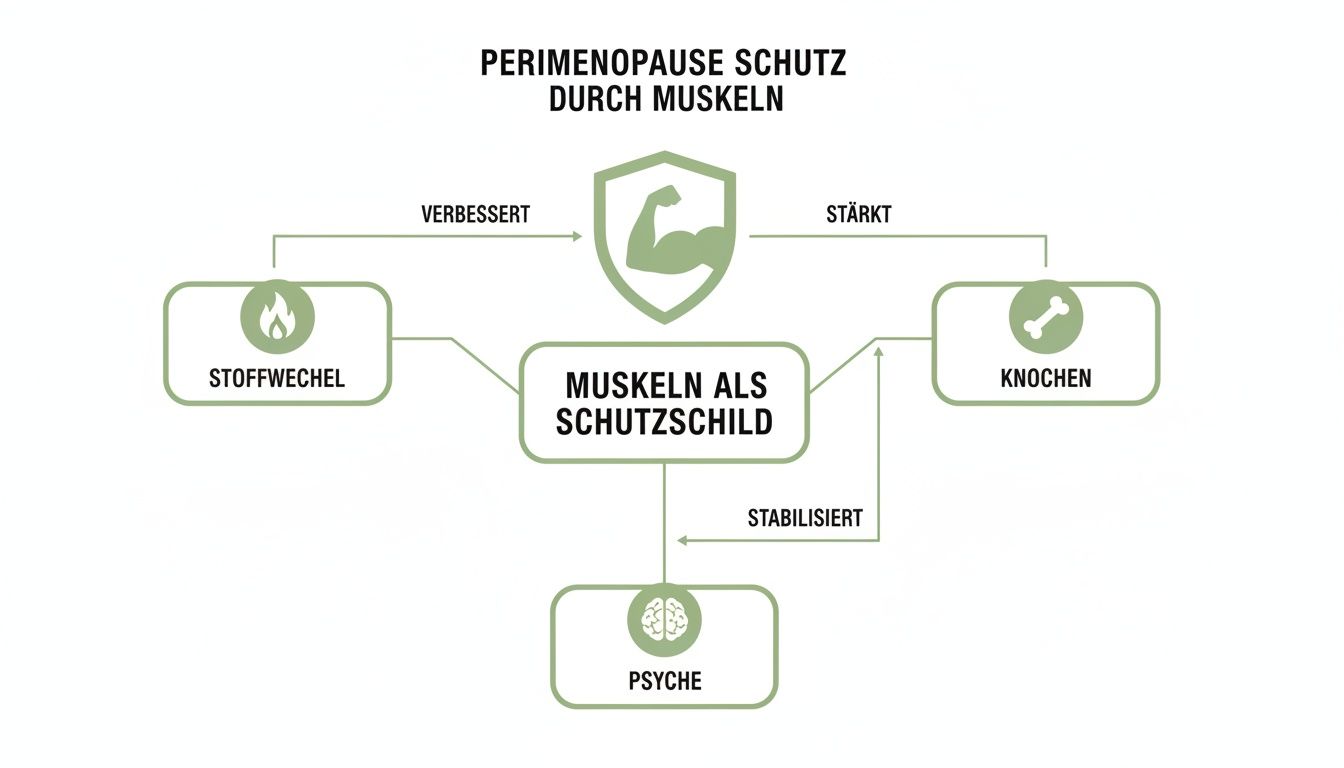
As you can see, strong musculature directly positively impacts your metabolism, bone health, and even your mental stability.
This table gives you a quick overview of the typical physical changes of perimenopause and how strength training serves as a targeted protective mechanism.
| Challenge in perimenopause | Cause (Hormonal change) | How strength training acts as protection |
|---|---|---|
| Loss of bone density (risk of osteoporosis) | Less estrogen stimulates bone-resorbing cells and slows down bone-building. | Mechanical pull of muscles on bone stimulates bone building and increases density. |
| Loss of muscle mass (sarcopenia) | Estrogen deficiency accelerates age-related muscle loss. | Sets targeted growth stimuli that counteract muscle loss and build new mass. |
| Slowed metabolism & weight gain | Less muscle mass lowers the basal metabolic rate (calorie consumption at rest). | More muscles burn more calories, even at rest. The basal metabolic rate increases again. |
| Increased risk of falls and fractures | Weaker muscles and bones as well as declining balance increase the danger. | Strengthens the supporting musculature, improves coordination and balance, preventing falls. |
Krafttraining ist also nicht nur eine einzelne Massnahme, sondern ein umfassender Schutzschild, der genau dort ansetzt, wo die hormonellen Veränderungen ihre grösste Wirkung entfalten.
Der Schutz deiner Knochen ist einer der wichtigsten Gründe für Krafttraining in der Perimenopause. Wenn du beim Heben einer Hantel deine Muskeln anspannst, ziehen sie an den Knochen, an denen sie befestigt sind. Dieser mechanische Reiz ist genau das Signal, das deine knochenaufbauenden Zellen (Osteoblasten) brauchen, um aktiv zu werden.
Stell es dir wie bei einem Haus vor: Wenn es regelmässig leichten Erschütterungen ausgesetzt ist, werden die Bauarbeiter gerufen, um die Fundamente zu verstärken. Genau das tut Krafttraining für dein Skelett.
Die Zahlen sprechen eine klare Sprache. Studien wie die bekannte LIFTMOR-Studie haben gezeigt, dass Frauen durch zweimal wöchentliches Krafttraining mit schweren Gewichten die Knochendichte in der Lendenwirbelsäule um 3 % und in der Hüfte sogar um beeindruckende 13,6 % steigern konnten.
Gleichzeitig baust du durch das Training aktive Muskelmasse auf. Und Muskeln sind deine grössten Kalorienverbraucher. Je mehr Muskeln du hast, desto höher ist dein Grundumsatz – dein Motor läuft also auch im Leerlauf heisser.
Dieser Effekt hilft dir, die hormonell bedingte Gewichtszunahme zu kontrollieren und das hartnäckige Bauchfett in Schach zu halten. Indem du deinen Körper gezielt stärkst, gibst du ihm die Werkzeuge an die Hand, um auch in dieser neuen Lebensphase stark, widerstandsfähig und voller Energie zu bleiben. Es ist deine beste Investition in eine gesunde und aktive Zukunft.
Mit dem sinkenden Östrogenspiegel in der Perimenopause klopfen plötzlich zwei grosse Gesundheitsrisiken an die Tür: Osteoporose, also der schleichende Knochenschwund, und Herz-Kreislauf-Erkrankungen. Deine Knochen können poröser werden, deine Blutgefässe an Elastizität verlieren. Das klingt erstmal beunruhigend, aber die beste Nachricht ist: Du bist dem nicht hilflos ausgeliefert.
Dein mächtigstes Werkzeug in dieser Phase ist gezieltes, intelligentes Krafttraining.
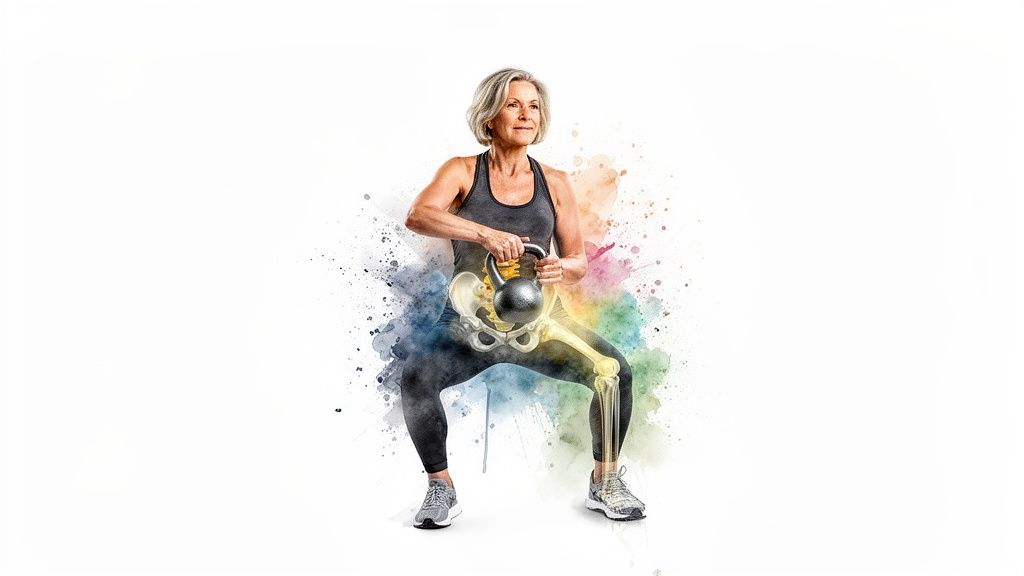
Stell dir vor, bei jeder Kniebeuge, jedem Kreuzheben oder jedem Schulterdrücken sendest du ein direktes Signal an dein Skelett. Der mechanische Zug, den deine Muskeln bei der Arbeit auf die Knochen ausüben, ist wie ein Weckruf für deine knochenaufbauenden Zellen, die Osteoblasten.
Dieser gezielte Reiz fordert sie auf, aktiv zu werden und neue, dichte Knochensubstanz aufzubauen. Ohne diesen Impuls würde dein Körper im hormonellen Wandel eher dazu neigen, wertvolle Knochenmasse einfach abzubauen.
Krafttraining zwingt deinen Körper förmlich dazu, in die Stabilität deines Skeletts zu investieren. Es ist die effektivste Methode, um die Knochendichte zu erhöhen und dich aktiv vor Osteoporose zu schützen.
Die Wirkung von Krafttraining geht aber weit über die Knochen hinaus. Es ist ein ebenso entscheidender Schutzschild für dein Herz-Kreislauf-System. Wenn der schützende Effekt des Östrogens nachlässt, werden deine Blutgefässe tendenziell steifer, was das Risiko für Bluthochdruck und andere Herzprobleme erhöht.
Starke Muskeln sind aber wie ein eingebauter Regulator: Sie verbessern deine Insulinsensitivität. Das bedeutet, dein Körper kann Zucker viel effizienter aus dem Blut in die Zellen schleusen und als Energie nutzen. Das entlastet nicht nur deine Bauchspeicheldrüse, sondern senkt auch das Risiko für Typ-2-Diabetes, eine der grössten Bedrohungen für die Herzgesundheit.
Ausserdem wird dein Herz selbst gestärkt. Es muss weniger hart arbeiten, um Blut durch den Körper zu pumpen, was den Blutdruck ganz natürlich senken kann. Die Effekte sind enorm: Studien zeigen, dass Sport, insbesondere Krafttraining, in der Schweiz das Sterberisiko durch Herz-Kreislauf-Erkrankungen bei Frauen um unglaubliche 36 % reduziert – das ist mehr als doppelt so viel wie bei Männern (14 %). Mehr dazu erfährst du hier: Bedeutung von Krafttraining in den Wechseljahren.
Ein oft übersehener, aber absolut entscheidender Vorteil ist der Schutz vor Stürzen. Die hormonellen Veränderungen der Perimenopause können die Koordination und das Gleichgewicht beeinträchtigen. Krafttraining schult genau diese Fähigkeiten.
Du baust nicht nur pure Kraft auf, sondern verbesserst auch die neuromuskuläre Verbindung – also die Kommunikation zwischen deinem Gehirn und deinen Muskeln. Das macht dich im Alltag sicherer, stabiler und reaktionsschneller.
Dieser Schutz wirkt gleich doppelt:
Genau hier setzen wir bei Templeshape in Zürich an. Unser Ziel ist es, dir ein Training zu bieten, das exakt auf diese Schutzmechanismen einzahlt. Unsere Kurse wie HIIT & Bootcamp sind darauf ausgelegt, intensive, aber sichere Reize zu setzen, die den Muskelaufbau ankurbeln und deinen Stoffwechsel auf Hochtouren bringen.
In unseren Kleingruppen und Personal Trainings legen wir grössten Wert auf eine saubere Technik. So holst du den maximalen Nutzen aus jeder Übung, ohne dich zu überlasten. Wir schaffen eine Umgebung, in der du dich stark und sicher fühlst, während du an deiner Gesundheit für die Zukunft arbeitest. Mit jeder Einheit investierst du aktiv in deine Knochen, dein Herz und deine allgemeine Widerstandsfähigkeit.
Okay, jetzt weisst du, warum Krafttraining in der Perimenopause dein stärkster Verbündeter ist. Aber wie packst du das Ganze konkret an? Wie sieht ein Trainingsplan aus, der in dieser entscheidenden Lebensphase wirklich etwas bewirkt?
First of all: Forget the myth that women should only train with light, pink dumbbells. That is long outdated.
To kickstart real changes – denser bones, tighter muscles and a metabolism that runs at full speed – you need a very simple but powerful principle: progressive overload.Sounds technical, but it just means: You have to challenge your muscles a little bit more every time so they have a reason to grow.
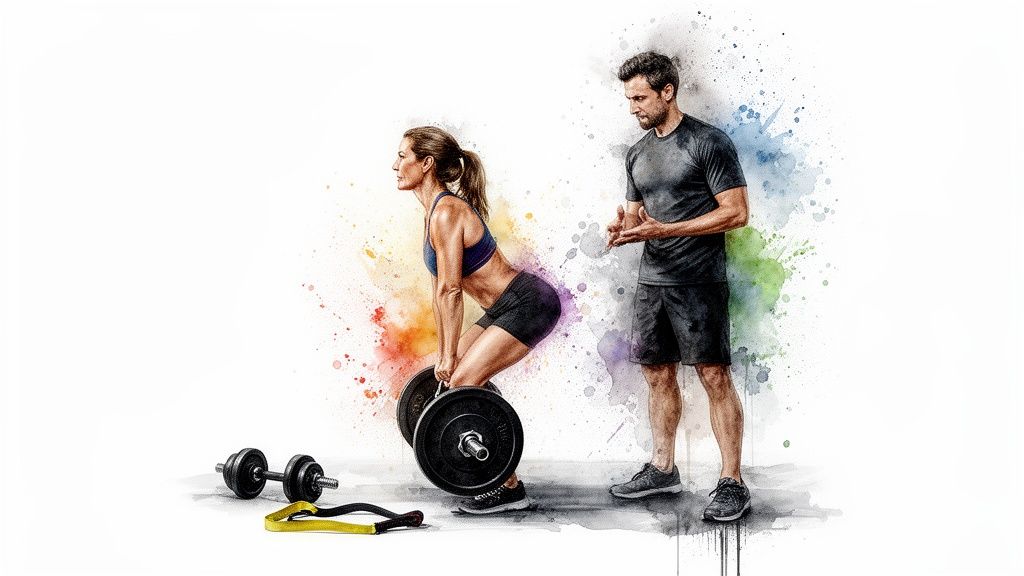
Your plan should be based on big, fundamental movements – the so-called basic exercises.These are exercises that engage multiple joints and muscle groups at once. They are brutally efficient because they not only build muscle but also increase your strength for everyday life and give your bones the strongest stimulus to become stronger.
These are the Big Five that should not be missing from any plan:
These exercises are the core of your success. They give you the greatest “bang for your buck” – maximum benefit for your invested time and energy.
In perimenopause, the rule is: quality over quantity. Your body responds more sensitively to stress and needs targeted breaks to become stronger.
Two to three strength sessions per weekare the sweet spot. This gives your body – from muscles to tendons to the nervous system – enough time to recover and make the important adaptations.
Intensity is key. You need to train with a weight that truly challenges you. A good rule of thumb: Choose a weight with which you can perform 8 to 12 clean repetitionswhere the last one or two should be really challenging. You should feel like maybe one more repetition is possible, but definitely not more. This is exactly the stimulus your muscles need to grow.
Recovery is now more important than ever. Learn to pay close attention to your body’s signals. In perimenopause, your recovery times may extend. Poor sleep, stress, or hormonal rollercoaster – all of this affects how quickly you bounce back.
Watch out for these warning signs:
If you notice this, it’s not a sign of weakness. It’s your body’s signal that it needs more time. Schedule an extra rest day or do a light workout. Active recovery like a walk, gentle stretching, or a round of yoga can work wonders.
This plan serves as a template for how you can combine two to three effective strength training sessions per week with active recovery to achieve optimal results.
| Day | Activity | Focus & examples |
|---|---|---|
| Monday | Strength training (full body) | Squats, bench press, rows, planks |
| Tuesday | Active recovery | 30-45 minutes of brisk walking or gentle yoga |
| Wednesday | Rest day | Complete break for recovery |
| Thursday | Strength training (full body) | Deadlifts, shoulder presses, lunges, pull-up variations |
| Friday | Active recovery | 30 minutes of cycling or swimming |
| Saturday | Optional third session or activity | A HIIT class, a hike, or gentle Pilates |
| Sunday | Rest day | Relaxation, preparation for the new week |
This plan is of course just an example. The key is to adapt it to your needs, your daily routine, and your energy level.
At Templeshape in Zurich, we ensure in our personal trainingand small group sessions that you perform each exercise technically correct and safely. Our coaches help you find the right intensity and adjust your training so that you reach your goals without overwhelming yourself. This way you fully tap into your potential and build sustainable strength. If you want to learn more about how to successfully build muscle beyond the age of 50, read our guide on muscle building at 50 years old.
A good workout is only half the battle. Especially in perimenopause, nutrition and recovery become the decisive factors for your success. Imagine your body as a construction site undergoing renovation – for a stable new building you need the right, high-quality materials. Without them, all the hard work in training goes to waste.
Your most important building block is now: protein.
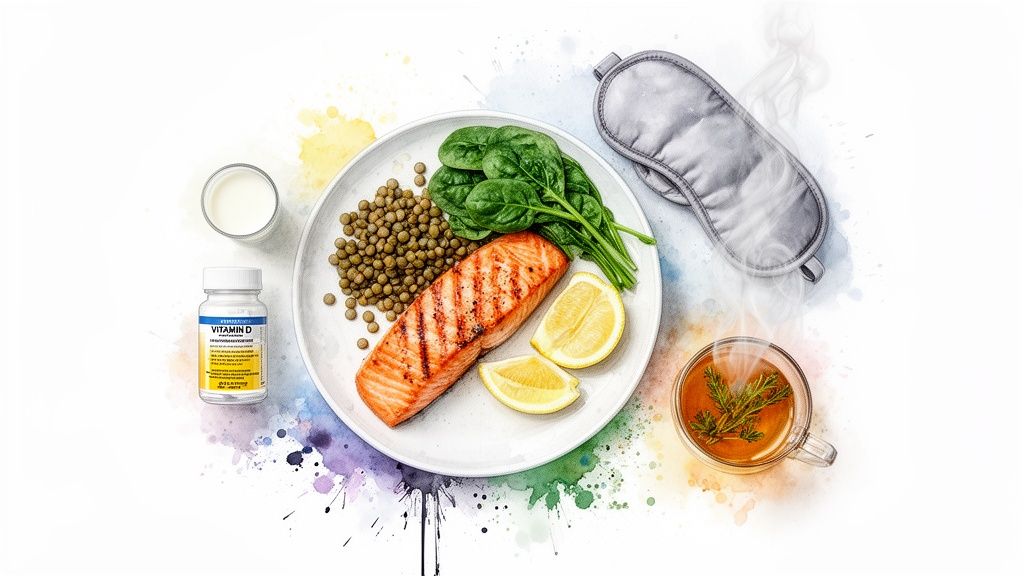
The hormonal changes make it harder for your body to build and maintain muscle mass. This is also referred to as anabolic resistance. This means your muscles respond to training stimuli less efficiently than before. You need to provide them with more building material – that is, protein – to achieve the same effect.
Your goal should be about 1.6 to 2.0 grams of protein per kilogram of body weight daily. For a woman weighing 70 kilograms, this means about 112 to 140 grams of protein.
To achieve this, make protein a staple in every meal. Here are a few simple examples:
If you want to dive deeper into the topic, check out our beginner’s guide to protein.
Besides protein, two other nutrients come into focus: calcium and vitamin D. They are the unbeatable duo for strong bones. Calcium is the primary building block of your bones, while vitamin D ensures that your body can actually absorb the calcium.
So consciously add calcium-rich foods to your plate – think of dairy products, green leafy vegetables like kale, or calcium-fortified plant-based milk alternatives. Your body produces vitamin D through sunlight, but in our latitudes, a supplement, especially in winter, is often a good idea.
During perimenopause, your basal metabolic rate decreases by 300–500 calories per day. A study by the German Sports University Cologneshowed that a combination of strength and endurance training along with adjusted protein and carbohydrate intake resulted in significant improvements in strength capacity, fat loss, and bone metabolism.
Just as important as the building materials is the construction pause. Your body repairs and strengthens itself not during training, but in the rest periods afterwards. Quality sleep is now your most important recovery strategy.
During sleep, your body releases growth hormones that are essential for repairing muscle tissue. However, many women struggle with sleep disturbances during perimenopause, which makes a relaxing evening routine even more important. Imagine sipping herbal tea, reading a few pages of a book, or taking a warm bath – small rituals can make a big difference.
Targeted breathing exercises can be a great help here. At Templeshape, we offer breathwork sessions that help you calm your nervous system and prepare for a restful night.
Active recovery like gentle yoga or a walk in the fresh air can work wonders. By consciously prioritizing recovery, you support your hormonal balance and get the most out of your training.
You now know how incredibly valuable strength training is during perimenopause as a protective shield for your body. But the big question remains: How on earth are you supposed to fit that into the hectic everyday life of Zurich? We at Templeshape understand the hurdles that working women or mothers face during this life phase. Time is tight, energy is on a rollercoaster, and often the right support is simply lacking to keep going.
That’s exactly why we created a place where you feel safe, understood, and truly motivated.
We know that the first step is often the hardest. You are not alone with us. In our studios CITY and AIRPORT, our qualified coaches will guide you – no matter if you are a complete beginner or already have training experience. They pay close attention to ensure you perform each exercise safely and effectively to achieve your goals.
Our diverse course offerings are perfectly tailored to your needs. You can choose exactly what feels good for you and challenges you the most:
We are more than just a gym – we are a community. Our goal is to help you make health a sustainable, positive habit: “Make Health Your Habit”.
And if you want even more individualized support, we address your wishes and physical conditions in our personal training.
Your well-being goes far beyond just training. Exchange ideas in the Motherhood Club with like-minded individuals about the joys and challenges of motherhood or find new energy and a precious moment of peace just for yourself at one of our retreats. At Templeshape, you will find the space and support you need to navigate through perimenopause strong, healthy, and full of confidence.
Deciding to start strength training is one of the best decisions for your health. However, in perimenopause, very specific questions and uncertainties often arise. Here, we answer the most common questions so that you can start confidently and securely.
Absolutely: Yes, to improve your bone density and build muscle, you need a noticeable resistance. The myth of light pink dumbbells for women is long outdated. Your body needs a real incentive to adapt and grow stronger – and you provide that by challenging it.
That doesn’t mean you have to start with maximum loads right away. The magic word is progressive overload. You gradually increase, but surely. The weight is right when you can perform an exercise cleanly, but the last repetitions really cost you effort.
For the best results, a rhythm of two to three times per week has proven to be ideal. In perimenopause, your body often needs a bit more time for recovery. This frequency gives your muscles, tendons, and bones enough time to recover between training sessions and complete the important adaptation processes.
Always remember: Quality absolutely comes before quantity here. Two focused, really good training sessions are worth much more than five half-hearted ones.
That’s not a problem at all – on the contrary! As a beginner, you will likely see and feel progress very quickly, which is incredibly motivating. The key is simply to start safely and pay attention to the right technique from the beginning.
Especially for beginners, professional guidance is worth its weight in gold. A coach ensures that you learn the movements correctly from the ground up. This way, you avoid injuries and get the most out of every repetition.
You start with simple exercises and learn the movement first before increasing the weight. Our trainers at Templeshape are specialized in safely and effectively guiding you to your first training.
If done correctly, the opposite happens. Strength training strengthens the muscles surrounding your joints. Imagine these muscles as a supportive corset that stabilizes the joints and relieves them in everyday life.
It’s important to listen to your body and adjust an exercise or choose an alternative if you’re in pain. Properly dosed and executed strength training is one of the best measures against joint discomfort..
Are you ready to make your body strong and resilient for all that is yet to come? At Templeshape in Zurich, you will find the perfect support and a community that motivates you to get started safely and effectively. Discover our classes or book a personal trial training session.We look forward to seeing you.
Tags