March 17
How to overcome your inner pig dog: The simple way to motivation
0 comments

Overcoming your inner couch potato has less to do with struggle and discipline than you think. It’s more about tricking the deeply ingrained impulse of your brain to conserve energy. The trick lies in taking small, almost laughably simple steps, to break the initial resistance. This way, you establish new routines without having to exert enormous willpower every day.

Imagine a completely normal evening: You had the firm plan to go to training. But as soon as you get home, the sofa pulls you in with almost magical force. What happens in this moment has nothing to do with laziness, but is pure biology.
Your brain is programmed to save energy since ancient times – a perfectly sensible survival strategy. Constantly fighting against this instinct is incredibly exhausting and often doomed to fail.
The key is to not view this inner resistance as an enemy. Instead, see it as a part of you that you can manage cleverly. Rather than condemning yourself for hesitation, try to understand the real reasons behind it.
Most of the time, it’s not the huge hurdles that slow you down, but rather many small, inconspicuous stumbling blocks. Behind them are simple but extremely effective mechanisms:
Stop fighting your inner couch potato. Instead, make a pact with him. The goal is not to defeat him, but to outsmart him with clever strategies and use his energy for your benefit.
This shift in perspective is absolutely crucial. If you sit in the office all day, you know the phenomenon all too well: You firmly resolve to train after work, but end up straight on the sofa.
Yet the will to move is very much present in Switzerland. Over 1.37 million people are members of a gym in this country. Among those aged 15 to 65, it’s even around one in five.
To view the overcoming of obstacles from another perspective, it’s worth taking a look at the Bash-Busters philosophy. It’s also about creating a completely new dynamic through conscious mindfulness and small adjustments in everyday life. You can learn more about the incredible power of mindfulness in our guide on the topic.

The biggest mistake when building new routines? You take on way too much from the start. This initial overzealousness is your inner couch potato’s best friend, as it almost always leads to disappointment and gives him the perfect excuse to send you back to the couch.
A concrete example: You have been hardly active for months, but you plan to complete an intense workout five times a week from now on. That’s a surefire recipe for frustration. The key to success lies in the exact opposite: in the quiet but enormous power of tiny, almost laughably simple habits.
Exactly here is where the principle of micro-habits comes into play. It’s about finding actions so small that your brain finds no reason to resist. Instead of an hour of HIIT, you simply start with a snappy 10-minute workout at home. Instead of 30 minutes of meditation, you just take five conscious breaths after getting up.
The real trick is to anchor these mini-routines to already existing, fixed habits. This method is called Habit Stacking and is an incredibly effective tactic to outsmart your inner couch potato.
You use an action that you already do every day as a trigger for your new micro-habit. Your brain doesn’t have to make a new decision; it simply follows a familiar pattern.
Here are a few simple examples from practice:
Your goal: Bring more movement into everyday life.
Your goal: Less stress, more mindfulness.
Your goal is not perfection but consistency. A two-minute exercise that you do daily is infinitely more valuable than the one-hour workout that you keep postponing.
Once these small steps become absolute second nature, you can slowly increase them. This gentle approach creates a positive feedback loop: You immediately experience small successes, which greatly boosts your motivation for the next day. If you want to delve deeper into the psychology behind it, you will find valuable strategies in our Guideline for Habit Change..
Your start with micro-habits.
Big goals can seem intimidating. The trick is to break them down into tiny first steps that are so easy that you can’t postpone them. Here are a few ideas of what that might look like:
| Your big goal. | Your micro-habit (max. 5 minutes). | When & Where? |
|---|---|---|
| Daily workout. | 10 push-ups and 20 squats. | Right after getting up, next to the bed. |
| Meditate regularly. | Concentrate on your breath for one minute. | After you sit down at your desk. |
| Drink more water. | Drink a large glass of water. | Right after brushing your teeth in the morning. |
| Eat healthier. | Eat an apple. | As a snack at 3 PM, before the cravings hit. |
| Read every day. | Read one page in a book. | Right before falling asleep in bed. |
Even one of these small actions, consistently carried out, builds a momentum that takes you further than any overly ambitious plan.
A often underestimated but crucial factor is your environment. Make it as easy as possible to do the right thing and as hard as possible to neglect it.
Lay out your sports clothes the night before in a visible place. Place your yoga mat already rolled out next to the bed. Put a filled water bottle directly on your desk, in your line of sight.
Each of these small adjustments reduces the mental effort you need to get started. This way, you trick your inner procrastinator before it even has the chance to come up with its typical excuses. You build an unstoppable momentum based on small but consistent successes.
Is your calendar bursting at the seams? And the thought of squeezing regular exercise in there feels like you’d have to invent an eighth day of the week. You know this feeling well. But the key to finally putting your inner procrastinator on a leash isn’t about finding more time. It’s about using the time you have more wisely.
From now on, consider movement an unbreakable appointment with yourself. This takes a bit of discipline at first, sure. But you will quickly realize that this routine gives you far more energy in the end than it costs you.
If you are employed, your calendar is sacred. So treat your workout sessions exactly like your most important business meeting: schedule them as fixed, non-negotiable appointments. A vague plan like “Exercise on Tuesday evening” is practically a written invitation for your procrastinator to mess up your plans.
Make it specific. An entry like “Tuesday, 6:30 PM – 7:15 PM HIIT class at the Temple” creates a completely different level of commitment. Block out this time in your calendar and defend it as if it were a client appointment. It’s a conscious decision for your health – and it has at least the same priority as any professional project.
Daily life as a mother is often unpredictable and dictated by the needs of others. Fixed, hour-long training times? Mostly a utopia. The trick is to seamlessly weave movement into the existing routines of family life.
Lass den Perfektionismus los. Das ist der wichtigste Punkt. Ein unperfektes, aber gemachtes 10-Minuten-Workout ist unendlich wertvoller als die perfekte Stunde im Fitnessstudio, für die du am Ende doch nie Zeit findest.
Für Teams in Unternehmen liegt hier eine riesige Chance. Gemeinsam Sport zu treiben, ist nicht nur gut für die Gesundheit jedes Einzelnen, sondern schweisst auch das Team unglaublich zusammen. Wenn dein Kollege neben dir Zähne zusammenbeisst und durchzieht, gibst du auch nicht so schnell auf.
Regelmässige Team-Workouts, eine gemeinsame Laufgruppe in der Mittagspause oder eine firmeninterne Schrittzähler-Challenge können den Schweinehund des Einzelnen durch diesen sanften, sozialen Druck überlisten. Plötzlich macht es Spass, gemeinsam Ziele zu erreichen. Sobald die ersten Glückshormone fliessen, entsteht ein positiver Kreislauf, denn Endorphine sind der Schlüssel zum Glücklichsein beim Sport.
Und es ist übrigens ein Mythos, dass nur junge Leute nach Wegen suchen, aktiver zu werden. Gerade die Generation 50+ ist oft extrem motiviert, den inneren Schweinehund zu überwinden – meist aus sehr konkreten Gründen wie Gesundheitsprävention, Schmerzreduktion oder dem Wunsch, lange fit und selbstständig zu bleiben. Die Fitnessbranche stellt sich darauf ein, mit Angeboten, die mehr auf Gesundheit und eine wertschätzende Betreuung setzen, ganz ohne Leistungsdruck.
Theorie ist gut und schön, aber jetzt geht es ans Eingemachte. Lass uns die Puzzleteile zusammensetzen und eine Struktur bauen, die dich fast schon automatisch an dein Ziel bringt. Dieser praxiserprobte 4-Wochen-Fahrplan ist dein ganz persönlicher Guide, um deinen inneren Schweinehund Schritt für Schritt zu zähmen und Bewegung zu einer festen, selbstverständlichen Gewohnheit zu machen.
Jede Woche hat einen klaren Fokus, der auf der vorherigen aufbaut. So überforderst du dich nicht, sondern baust ein stabiles Fundament für nachhaltigen Erfolg. Du rennst hier keinen Sprint – du etablierst eine Routine, die bleibt.
In der ersten Woche zählt nur eines: Konsequenz. Vergiss erst mal die Intensität oder irgendwelche Leistungsziele. Dein einziger Job ist es, deine winzige Mikro-Gewohnheit jeden einzelnen Tag umzusetzen. Es geht darum, deinem Gehirn zu beweisen: Hey, diesmal meine ich es ernst.
Ob das nun zehn Kniebeugen direkt nach dem Aufstehen sind oder eine fünfminütige Dehnübung vor dem Zähneputzen – die Handlung selbst ist fast nebensächlich. Wichtig ist nur, dass du sie ohne Ausnahme durchziehst. Damit giesst du das Fundament und schaffst die Selbstverständlichkeit, die du für alles Weitere brauchst.
Okay, du hast sieben Tage lang gezeigt, dass du dranbleibst. Zeit für den nächsten, logischen Schritt. Jetzt schrauben wir die Intensität ganz langsam und kontrolliert nach oben. Dein innerer Schweinehund hat gemerkt, dass du nicht lockerlässt, also ist er bereit für eine kleine, machbare Herausforderung.
Die folgende Infografik zeigt dir, wie du diese neuen Routinen clever in deinen Alltag integrierst – egal ob im Job, mit der Familie oder als Teil eines Teams.
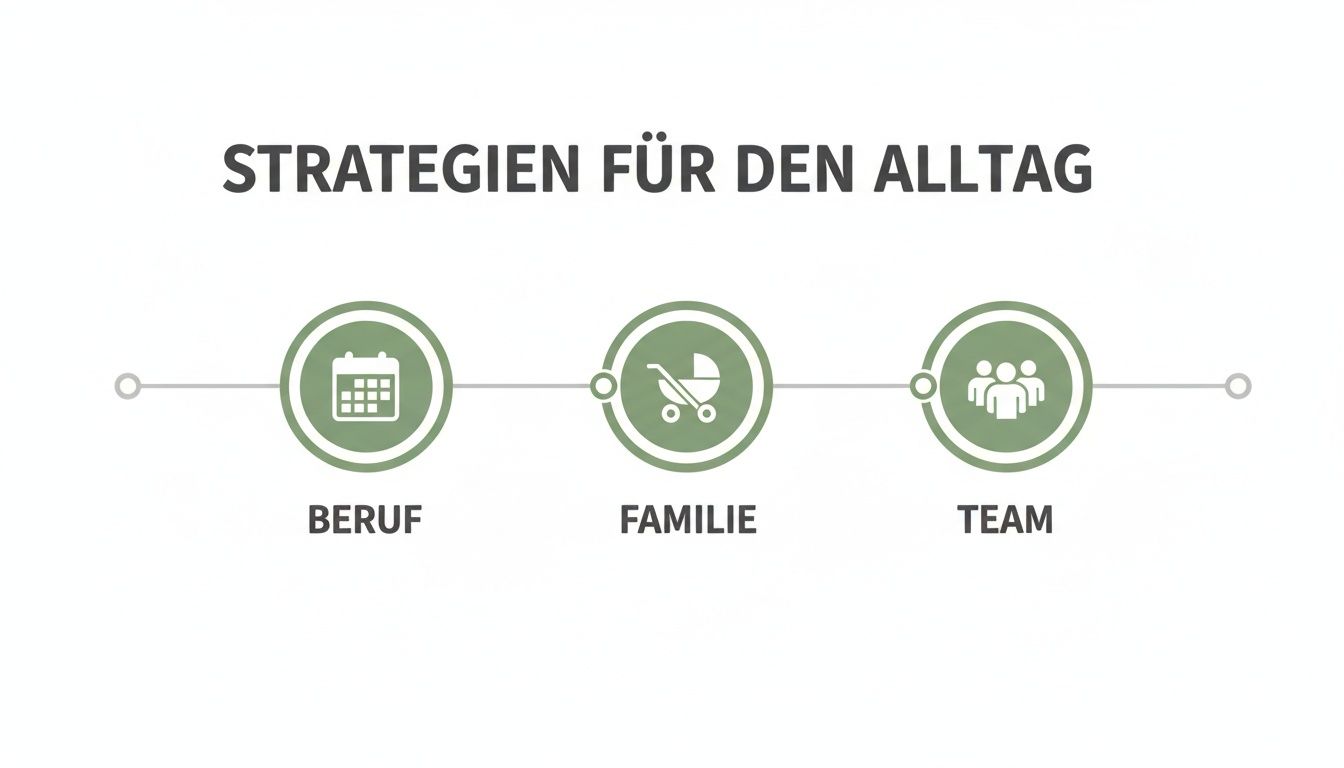
Du siehst: Es gibt für jede Lebenssituation passende Ankerpunkte, um Bewegung zur Normalität werden zu lassen.
Du hast dir eine solide Basis geschaffen, auf die du stolz sein kannst. In Woche drei zapfen wir eine der stärksten Motivationsquellen überhaupt an: soziale Verbindlichkeit. Alleine anzufangen, ist eine riesige Leistung. Aber gemeinsam dranzubleiben, ist oft um ein Vielfaches einfacher und macht deutlich mehr Spass.
Dein Schweinehund ist ein Meister der Ausreden, wenn er nur mit dir allein verhandeln muss. Sobald eine andere Person im Spiel ist, wird er erstaunlich still.
Verabrede dich mit einer Freundin zum Sport, buch dich fest in einen Gruppenkurs ein oder schliess dich einer lokalen Laufgruppe an. Die positive Energie und der sanfte Druck der Gemeinschaft wirken oft Wunder. Sie tragen dich auch durch die Tage, an denen deine eigene Motivation mal im Keller ist.
Die vierte Woche ist absolut entscheidend für deinen langfristigen Erfolg. Jetzt geht es darum, kurz innezuhalten, Bilanz zu ziehen und deine Strategie für die Zukunft zu justieren. Du hast in den letzten Wochen wertvolle Daten über dich selbst gesammelt und weisst jetzt viel besser, was für dich funktioniert – und was eben nicht.
Nimm dir ganz bewusst Zeit, um dir diese Fragen ehrlich zu beantworten:
Dieser Reflexionsprozess hilft dir, deine Routine immer weiter zu optimieren. So stellst du sicher, dass sie wirklich zu deinem Leben passt und du motiviert bleibst. Du hast jetzt das Rüstzeug, um aus diesem 4-Wochen-Plan eine lebenslange, gesunde Gewohnheit zu machen.
Um dir den Einstieg zu erleichtern, habe ich den Plan in einer übersichtlichen Tabelle zusammengefasst. Sie dient dir als Leitfaden und zeigt, wie die einzelnen Wochen logisch aufeinander aufbauen.
| Woche | Focus | Concrete Action | Goal |
|---|---|---|---|
| Week 1 | Regularity | Carry out a micro-habit daily (e.g., 5 min stretching). | Make the action a given. |
| Week 2 | Increase Intensity | Schedule a 20-30 minute workout 2x per week, maintain the micro-habit. | Get your body used to a higher load. |
| Week 3 | Commitment | Plan at least one athletic activity with others (class, friend, team). | Use social support as a motivation booster. |
| Week 4 | Optimization | Reflect on the previous weeks and adjust the plan for the future. | Develop a sustainable, personalized routine. |
Don’t see this table as a rigid rule book, but as your personal roadmap. Adjust it, make it your own, and celebrate every small success along the way.
Sure, there will be those days. Days when your motivation is at its lowest point. You wake up and just the thought of exercising feels like climbing Mount Everest. That’s completely normal, that’s human.
What’s important is how you deal with it. Such a day is not a setback, but simply a part of the bigger picture, your journey.
The first and crucial step? Be honest with yourself. Learn to distinguish precisely between genuine physical exhaustion and the loud, convincing voice of your inner couch potato. Do you actually feel drained, sick, or are you overtrained? Then a break is exactly what you need and absolutely necessary. Most of the time, however, it’s just the mental resistance trying to hold you back.
When you realize it’s just the couch potato whining, you need an emergency kit. A few instantly effective techniques that break through that initial resistance and get you moving before the excuses take over.
A good example is the 5-Minute Rule. You simply tell yourself: “Okay, I’ll just do five minutes.” Nothing more. Anyone can do that. Put on your workout clothes and get started. The trick here? The beginning is almost always the biggest hurdle. And after those five minutes, you often feel so good that you continue on your own.
What also helps immensely is visualization. Close your eyes for a moment and recall your personal “why”. Feel the sensation after a really good workout – that energy, that pride. This positive image is often the little spark needed to get off the couch.
A bad day doesn’t mean a bad week. How you react to a drop in motivation determines whether it will be a one-time slip or if you risk your hard-won routine.
If your original plan just feels wrong today, then be flexible. Instead of completely skipping your workout, simply adjust it. Maybe today isn’t the day for an intense HIIT workout, but how about a brisk walk in the fresh air? Or a relaxing yoga session?
Sometimes it’s enough to look at inspiring motivational quotes and sayingsto gather new energy.
External commitments are also a powerful lever. The yoga class you already paid for, or the fixed appointment with a workout partner – these are often the critical nudges. You don’t want to let anyone down, and least of all yourself.
These strategies are your safety net. They catch you and prevent a small motivation dip from becoming a complete standstill. Learn to listen to your body, but don’t let your inner couch potato trick you.
To conclude, let’s address a few questions that we frequently encounter in our courses and discussions. They should clear up any last uncertainties and provide practical guidance.
There isn’t a one-size-fits-all answer, but studies show that on average, it takes about 66 daysfor a new habit to really run on autopilot. But more important than the exact duration is the Regularity.
Focus on really carrying out your new, small routine every single day. The magic moment comes when you no longer think about it but just do it. That’s the point at which you’ve finally put your couch potato on a leash.
Not the end of the world! A missed day doesn’t mean you’ve failed or that everything was in vain. The biggest mistake you can make now is to give up completely. Be lenient with yourself and just carry on the next day as if nothing had happened.
A slip-up doesn’t make you a failure. What matters is how quickly you get back up and keep going.
Just don’t fall into the “all-or-nothing” trap. An imperfect plan that you consistently follow through on is worth a thousand times more than the perfect plan where you throw in the towel at the first obstacle.
Long-term motivation has little to do with sheer willpower. Instead, it’s about creating a system that supports you even when the initial excitement fades. Here are the three key pillars for that:
When you incorporate these elements into your daily life, you create an environment where your inner lazy side feels increasingly pressured. You develop a positive self-dynamics that allows you to keep going almost on your own.
Are you ready to take the first, decisive step and finally tame your inner lazy side? At Templeshape GmbH you will find the structure, energy, and community you need to make movement a solid and positive habit in your life.Discover our courses now and start your journey.
Tags