March 19
Increase VO2 Max: The most important number for your fitness – more endurance
0 comments

March 19
0 comments
Increasing your VO2 Max is one of the most effective levers you can pull for your fitness and health. Essentially, it trains your body to use oxygen more efficiently. The result? More energy in daily life, a significantly higher performance capacity during sports and a stronger cardiovascular system. You could say it’s a direct investment in your long-term vitality.
You’ve probably heard the term VO2 Max, especially if you wear a fitness watch or are into endurance sports. But what does it actually mean?
Think of your VO2 Max as the engine of your physical performance. It’s the maximum amount of oxygen (in milliliters) that your body can absorb, transport, and use per minute and per kilogram of body weight at full capacity.
A higher number simply means: your engine runs more efficiently. You can train more intensely, you don’t get tired as quickly, and you recover faster. But the benefits are felt well beyond the gym or the running track.
A good VO2 Max is not a figure that only matters for professional athletes. It’s a clear indicator of your overall health and has a direct impact on how you feel every day.
In the often fast-paced life of the city of Zurich, good basic endurance holds invaluable value. A study from the Federal Office of Sports (BASPO) in Switzerland showed that professional active women aged 30 to 45 could increase their VO2 Max by 15 à 20 %through regular HIIT training. According to an analysis from the University Hospital of Zurich (USZ), such an improvement reduces the risk of cardiovascular diseases by up to 25 %. If you want to delve deeper into the topic, you will find here on helios-gesundheit.de other fascinating facts.
This chart helps you place your own VO2 Max value and set realistic goals.
| Assessment | Women (age 30-39) | Men (age 30-39) |
|---|---|---|
| Excellent | > 45.0 | > 52.5 |
| Good | 39.0 – 45.0 | 45.0 – 52.4 |
| Average | 33.8 – 38.9 | 41.0 – 44.9 |
| Low | 29.0 – 33.7 | 35.5 – 40.9 |
| Very low | < 29.0 | < 35.5 |
Table: Reference values for VO2 Max for men and women. Source: Inspired by the American Heart Association.
No worries if your value isn’t where you’d like it to be. It’s just a snapshot.
Your VO2 Max is essentially the most honest measure of your cardiorespiratory fitness. It shows not only how fit you are today but also gives a strong indication of your future health.
And now, here’s the best news: this value can be significantly improved. With the right methods, you can refine your personal “engine” and thus sustainably improve your quality of life.
Before you start improving your VO₂-Max, you need to know where you stand. This is the absolute foundation. Only then can you see your progress in black and white and truly direct your training in a targeted way. Fortunately, there are several ways to discover this crucial value – from super precise laboratory tests to practical methods that you can easily do at home.
The reference method is clearly the spirometry in a sports medicine laboratory. You run on a treadmill or pedal on an ergometer, while a breathing mask precisely measures the amount of oxygen your body uses. The result is extremely precise, but let’s be honest: it’s also the most expensive and complex method.
For most of us, the so-called field tests are a much more accessible and better alternative. You can perform them yourself with relatively little effort and get a solid estimate of your VO₂-Max. Perfect for establishing a starting base and regularly checking in which direction you’re heading.
Important for field tests: The correct execution is crucial. Warm up properly and then really push your limits. Be honest with yourself – only then will you get a value you can actually work with.
The following decision tree gives you a great overview of how different fitness levels and training methods relate to each other when you want to specifically increase your VO₂-Max.
The graphic makes it clear: The path from an untrained state to top fitness inevitably goes through regular and especially intense training.
Almost every modern sports watch today provides you with an estimated VO₂-Max value. This is powered by complex algorithms that calculate data such as your heart rate at a certain speed, your heart rate variability, and personal information like age and gender.
These values are a great orientation in daily life, no question about it. But they are just not as precise as a lab test. Even an inaccurate pulse measurement on the wrist, uneven terrain, or simply your daily condition can distort the numbers. My tip: Use the value from your watch mainly to observe the Trend over a longer period of time. Don’t get hung up on individual numbers.
By the way, if you are aiming for bigger goals like longer distances, check out our ultimate guide to the 20km run.There you will find valuable tips on how to prepare optimally.

Okay, you now know your baseline value and are eager to rev up your engine. Perfect. But don’t rely on blanket advice – to truly increase your VO2 Max, you need targeted training stimuli that challenge your body and force adaptation. It’s about consciously pushing your cardiovascular system out of its comfort zone.
The most effective methods all work on a similar principle: They bring you to the limit of your maximum oxygen uptake capacity. When you train regularly in these high-intensity areas, you send your body an unmistakable signal to become more efficient. Your heart learns to pump more blood per beat, and your muscles become absolute masters at extracting oxygen from the blood.
High-Intensity Interval Training, or HIIT, is the absolute game-changer when you want to improve your VO2 Max. The method is simple, but brutally effective: Short, extremely strenuous exertion phases alternate with recovery phases.
This constant switch between full throttle and active rest is the decisive stimulus. Your body is forced to adapt rapidly to high lactate levels and a massive oxygen debt. As a result, not only does your maximum oxygen uptake increase, but also your ability to sustain high performance over longer periods.
A classic example you can implement immediately is hill sprints. Find a short, steep incline and sprint for 30–45 seconds as hard as you can. After that, walk back down leisurely – that gives you about 90 seconds of recovery. Repeat this whole thing 6 to 8 times and feel how your engine works.
In addition to the short, crisp intervals, longer, intensive units are also an important building block. Tempo runs, also known as threshold training, take place right at your anaerobic threshold – that’s the point where your body can just about break down lactate without completely ‘over-acidifying’.
By training in this range (often referred to as training zone 4), you teach your body to better cope with fatigue. You will become more resilient and can maintain a high pace significantly longer.
A tempo run is not a sprint. It is a controlled, hard pace that you can maintain over a longer distance. Imagine it like a race against yourself – one that you can just about finish.
A practical example would be a 20-minute run at a pace that feels ‘comfortably challenging’. You could still have a conversation, but only in short, choppy sentences.
One of the smartest and most sustainable strategies combines the two approaches mentioned above. Polarized training follows the so-called 80/20 rule, which has long proven itself among professional athletes:
This mix is brilliant because it prevents overtraining and ensures that you are truly fresh and capable for the hard sessions. If you want to delve deeper into the benefits of intensive training, check out our article on the 10 power reasons why it will change your life.
The effectiveness of structured training is impressively demonstrated by a longitudinal study from SIS Magglingen. Re-entrants who were guided through boot camp and personal training increased their VO2 Max by an impressive 25 % – this corresponds to a projected life extension of 3.5 years! The key lies in a smart mix of intensity and recovery.
Let’s be honest: The best training plan in the world is absolutely useless if it doesn’t fit into your daily life. The good news is that a plan doesn’t have to be rigid. On the contrary, flexibility is the key to success.
You also don’t have to train every day to noticeably boost your VO2 Max. It’s more about the right mix and targeted stimuli.
The following 8-week structure is designed as a sort of map, not as a law set in stone. It shows you how to smartly combine intensive units, moderate endurance, and those important recovery days to make sustainable progress – without burning out. Whether you find time two, three, or four times a week, you can adapt this plan to your schedule.
An effective week for increasing your VO2 Max always rests on the same essential elements. You simply adapt the frequency and duration to your personal possibilities.
The real art lies in slowly but surely increasing intensity and duration over the weeks. This way, you challenge your body each time without overloading it.
A fixed plan helps a lot to keep an overview and maintain motivation. Here is a sample structure that shows you how to gradually increase the load. The important thing is to listen to your body and adapt the units to your condition of the day.
A good plan is not a rigid corset. It’s a map that shows you the direction. Sometimes, you have to take a little detour, but the goal remains the same: to become stronger and fitter.
The following table serves as your plan. It combines the focus of each phase with concrete training examples that you can implement immediately.
A clear plan that combines phases of intensive training with targeted recovery to sustainably improve your fitness.
| Week | Focus | Examples of training units |
|---|---|---|
| Week 1-2 | Build foundations | HIIT:6x 1 minute fast, 2 minutes rest.Endurance:30-45 minutes of easy running or cycling. |
| Week 3-4 | Increase the stimulus | HIIT:4x 3 minutes intensive (Zone 4), 3 minutes rest.Endurance:45-60 minutes of easy running. |
| Week 5-6 | Intensify the load | HIIT:4x 4 minutes very intense (Zone 4/5), 3 minutes rest.Endurance:60-75 minutes, potentially with small increases in pace. |
| Week 7-8 | Integrate & build fitness | HIIT:Pyramid intervals (e.g., 1-2-3-2-1 min hard).Endurance:60 minutes of easy running for recovery. |
This plan is your starting point. If you feel good, you can increase the number of intervals in the HIIT units or slightly reduce the rest periods. For the endurance units, you can gradually increase the duration.
However, there is a golden rule: never do intensive units on two consecutive days. Your body needs this time in between to adapt and get stronger. It’s precisely during the rest that the magic happens.
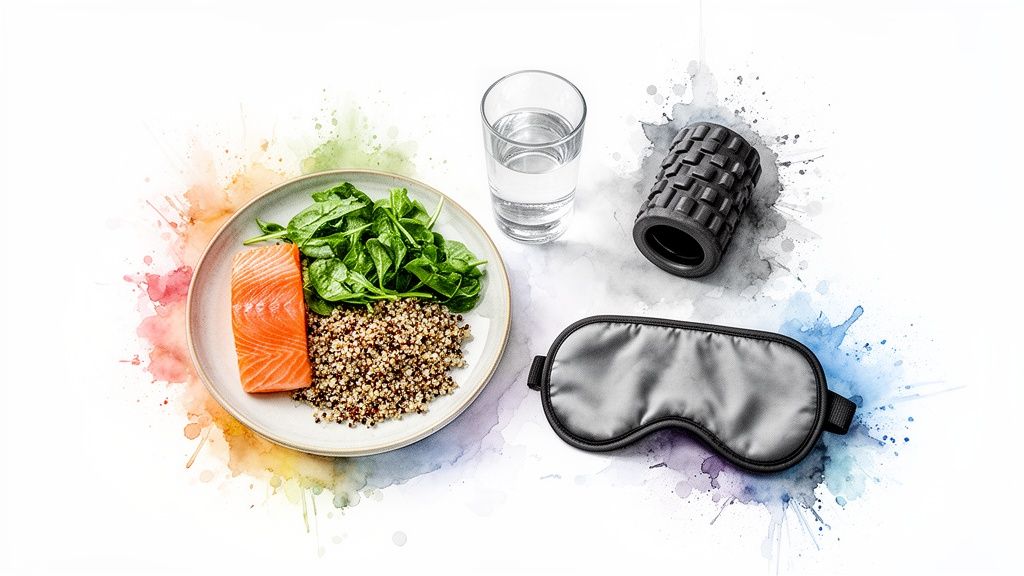
Intensive training is the spark that triggers adaptation – but the real magic happens during the breaks. Your body doesn’t get stronger while you’re sweating, but in the time that follows when it recovers. Without the right elements of nutrition and recovery, even the best training plan evaporates.
Imagine it as a construction site: training breaks down old structures so that during the recovery phase, something bigger and stronger can be built. But if the building materials are lacking due to poor sleep or bad nutrition, progress stalls. In the worst case, you might even regress.
Your nutrition is much more than just counting calories. It’s the fuel for your performance and the repair kit for your muscles. In particular, two things are essential to increase your VO2 Max:
Timing also plays a role. A carbohydrate-rich meal two to three hours before training ensures fully charged batteries. Just afterward, a combination of protein and carbohydrates helps to optimize recovery. For example, a shake or yogurt with fruit.
The most important regenerating measure remains sleep. This is where your body secretes growth hormones, repairs muscle damage, and processes training stimuli.Seven to nine hours per nightare non-negotiable if you want to see real progress.
But recovery is more than just doing nothing. The time between training sessions can be used actively. Active recovery doesn’t mean sinking into the couch, but speeding up the process through gentle movement.
Your biggest performance leaps do not happen during training, but during the time in between. Recovery is not a luxury, but a fundamental part of your training plan.
A quiet walk, gentle stretching, or targeted breathing exercises (Breathwork) stimulate blood circulation and help eliminate metabolic waste more quickly. This reduces recovery time and gets you ready again faster for the next intense session. But be careful, don’t overdo it. Pay attention to theovertraining alert signalsand also allow yourself true breaks.
That this holistic approach works, we see again and again in practice. For example,70% of company teamsin the canton of Zurich that participated in the Templeshape programs were able to improve their average VO2 Max of12 %in just 10 weeks with Hyrox and Pilates.
When you set out to improve your endurance, the same questions often arise. It’s perfectly normal to wonder if you are doing everything right.
No worries, here we clarify the most frequent points so that you can approach your training to improve your VO2 Max with confidence and well-informed.
Patience is an important factor, but you don’t have to wait forever.
If you train regularly two to three times a week, you will notice the first noticeable improvements afterfour to six weeks.Suddenly, the stairs seem easier, or your usual running routine is less strenuous.
Measurable jumps in VO2 Max typically show up after about eight to twelve weeks.
Yes, but probably differently than you think. Traditional strength training with heavy weights and long breaks has little impactdirectlyon your maximum oxygen consumption.
But – and this is crucial – strength training is an extremely important support. A stronger musculature works more efficiently and fatigues more slowly. This helps you to last longer during intense intervals and to create stronger training stimuli.
Circuit training with short breaks or complex exercises like Kettlebell Swings are an exception: they challenge both your strength and cardiovascular system and can therefore also contribute indirectly to the increase.
Genetics and age do set a certain framework, but they are not insurmountable walls. Imagine your genes determine your theoretical potential – that is, how high your VO2 Max could ideally be. Age then influences how much you can tap into this potential. From the age of 30, the value naturally starts to slowly decline –but only if you do nothing to counteract it..
The good news is: no matter your age or what genetic cards you’ve been dealt, with targeted training you canstill significantly improve your value.You can not only stop the age-related decline but even reverse the process.
Your fitness watch provides an estimate, not a precise lab measurement. This value is influenced by many factors that often have nothing to do with your actual endurance.
Poor sleep, stress, heat, or even an inaccurate pulse measurement because the strap has moved – all of this can change the value from day to day.
My advice: don’t consider this number as an absolute truth, but as along-term trend.As long as the curve shows an upward trend over weeks and months, you are definitely on the right path.
Are you ready to take your fitness to the next level and rediscover your body? AtTempleshape GmbHyou will find the structure, motivation, and community you need to achieve your goals. Visit us athttps://templeshape.comand find the course that suits you perfectly – from intensive HIIT to restorative Pilates.
Tags
 DE
DE FR
FR EN
EN