March 19
Mitochondria: cellular energy against chronic fatigue – More energy every day
0 comments

March 19
0 comments
Do you know that? You’ve actually slept enough, but still feel like you’re going through the day with the handbrake on? This feeling of inexplicable exhaustion often has a deeper, cellular cause. The key to your energy lies in your mitochondria – the tiny power plants in your cells. When their performance declines, you feel it as a chronic fatigue, which can literally paralyze your daily life.

Imagine your body as a huge, pulsating city. Each individual cell is a building that needs electricity to function. And in each of these buildings? Thousands of little power plants are working hard – those are your mitochondria. Their job is to convert the nutrients from your food into the universal energy currency of our bodies: adenosine triphosphate (ATP).
Without enough ATP, your muscles cannot function properly, your brain can’t think clearly, and your immune system weakens. You don’t just feel tired; you feel profoundly and fundamentally exhausted.
Our modern lifestyle is often the biggest enemy of our mitochondria. There are a number of factors that impair their function and throttle the crucial ATP production. You feel the result directly as a lack of energy.
The most common energy thieves include:
All these stresses mean that your cellular batteries can no longer be fully charged. The result is this leaden fatigue that simply cannot be dispelled by a night’s sleep alone.
This is the crucial point: Chronic fatigue is rarely just a feeling. It is often a direct biological signal that indicates your cells can no longer produce the energy your body needs for an active daily life.
If you constantly feel powerless, you are part of a growing group. The CSS Health Study 2025 revealed that last year a shocking 69 percent of Swiss aged 18 to 35 suffered from exhaustion and fatigue. A major reason for this: When mitochondria are slowed down by stress or nutrient deficiencies, ATP production drops dramatically – and that precisely explains this debilitating fatigue. You can find more about the study results in the article on the health of young adults at css.ch.
The good news is: You can regain control over your cellular energy. You are not helpless against these empty batteries. By understanding the causes and applying targeted strategies, you can get your mitochondria back in shape and renew your energy from the ground up. This article shows you how to recognize the warning signs and activate your cellular power against chronic fatigue.

Chronic fatigue is so much more than just the feeling of being exhausted after a short night. It is an all-encompassing exhaustion that settles over your daily life like a heavy coat and grips you. When your mitochondria, your small cell power plants, are no longer running at full speed, your body sends you quite clear warning signals.
The key is not to ignore these signals but to interpret them correctly. You need to learn to distinguish between normal, temporary fatigue and a deeper cellular problem. Because only when you truly understand the language of your body can you take targeted countermeasures and reactivate your cellular power.
Do you know that? You make a seemingly small effort – a walk, a focused meeting – and then feel as if you’ve been hit by a truck for days. This phenomenon is not a figment of your imagination; it has a name: Post-Exertional Malaise (PEM). It is probably the clearest sign that your mitochondria are seriously out of sync.
Imagine your body reacting to climbing stairs as if you just ran a marathon. That’s exactly how PEM feels. It is a massive, often delayed worsening of your condition after physical, mental, or emotional exertion. This extreme reaction is not a figment of the imagination, but has a tangible biological cause.
PEM is the leading symptom that indicates your cells can no longer meet the energy demands after exertion. Your mitochondria simply can’t produce new ATP quickly enough. The result is a real energy crash.
This symptom sadly is more common than one might think. In Switzerland, experts estimate that between 17,000 and 34,000 people are affected by chronic fatigue syndrome (CFS), where a mitochondrial dysfunction is often the root of the problem. The prolonged fatigue observed in PEM can be traced back to an ATP production that is reduced by up to 50 percent in the mitochondria. More background information on this common illness can be found in the Blick article about chronic exhaustion.
In addition to PEM, there are several other signs that often occur together and indicate weakened mitochondria. They affect not just your body but also your mind.
Listen to yourself and see if the following sounds familiar:
Wenn dir diese Signale nur allzu bekannt vorkommen und sie deinen Alltag massiv einschränken, ist es an der Zeit, genauer hinzuschauen. Sie sind der unmissverständliche Hilferuf deines Körpers, dass deine Energiereserven auf zellulärer Ebene leer sind – und dass es Zeit wird, professionelle Unterstützung zu suchen.
Bewegung ist wahrscheinlich der mächtigste Hebel, den du hast, um die Anzahl und die Leistung deiner Mitochondrien zu steigern. Aber genau hier machen viele einen entscheidenden Fehler: Bei chronischer Müdigkeit geht es nicht darum, sich komplett auszupowern. Es geht darum, die richtigen, smarten Reize zu setzen, die deine Zellkraftwerke zum Wachsen anregen, anstatt sie zu überlasten.
Wenn du diesen Mechanismus einmal verstanden hast, wird Bewegung von einer lästigen Pflicht zu deinem stärksten Verbündeten gegen die Erschöpfung. Bestimmte Trainingsmethoden geben deinen Zellen quasi den Befehl, neue und stärkere Mitochondrien zu bauen – ein Prozess, der als mitochondriale Biogenese bekannt ist.
Eine der effektivsten Methoden, um diesen Neubildungsprozess anzukurbeln, ist das High-Intensity Interval Training (HIIT). Das Prinzip dahinter ist genial einfach: Du wechselst zwischen sehr kurzen, extrem intensiven Belastungsphasen und ebenso kurzen Erholungsphasen.
Stell dir vor, du gibst für 30 Sekunden absolut alles – ob beim Sprinten, auf dem Velo oder bei simplen Körpergewichtsübungen. Direkt danach gönnst du dir eine kurze Verschnaufpause. Dieser abrupte Wechsel von maximaler Anforderung zu Erholung signalisiert deinen Muskelzellen einen akuten Energiemangel.
Deine Zellen deuten diesen kurzen, heftigen Stress als Alarmsignal. Ihre Reaktion darauf ist pure Überlebensstrategie: Sie fangen an, mehr und leistungsfähigere Mitochondrien zu produzieren, um für die nächste Herausforderung besser gewappnet zu sein.
Dieser gezielte Trainingsstress ist das genaue Gegenteil von chronischem Alltagsstress. Während permanenter Stress deine Mitochondrien kaputt macht, fordert HIIT sie so, dass sie stärker werden. Du zwingst deinen Körper förmlich dazu, seine Energieinfrastruktur aufzurüsten. Mehr dazu liest du in unserem Artikel, der dir 10 Power-Gründe zeigt, warum hochintensives Training dein Leben verändern wird.
Ein typisches HIIT-Workout, wie wir es bei Templeshape durchführen, könnte so aussehen:
Schon ein paar solcher Einheiten pro Woche können die Anzahl deiner Mitochondrien spürbar erhöhen und damit dein grundlegendes Energielevel anheben.
Aber es muss nicht immer Vollgas sein. Während HIIT die Anzahl deiner Mitochondrien vermehrt, können sanftere Methoden wie Yoga ihre Effizienz entscheidend verbessern. Gerade bei chronischer Müdigkeit ist ein ausbalancierter Ansatz, der beides verbindet, oft der Schlüssel zum Erfolg.
Yoga arbeitet auf einer ganz anderen, aber ebenso wichtigen Ebene für deine Zellgesundheit:
Ein smarter Plan, wie wir ihn bei Templeshape verfolgen, kombiniert diese beiden Welten. Du könntest zum Beispiel zweimal pro Woche ein forderndes HIIT- oder Bootcamp-Training absolvieren, um die Bildung neuer Mitochondrien anzuregen. An den anderen Tagen unterstützt du deinen Körper mit einer regenerativen Yoga-Session, um Stress abzubauen und die Effizienz deiner bestehenden Kraftwerke zu optimieren.
Dieser Mix stellt sicher, dass du deinen Körper forderst, aber nie überforderst. Genau das macht den Unterschied: Du nutzt den positiven Trainingsstress, um stärker zu werden, und vermeidest den schädlichen Dauerstress, der dich ausbrennt. So baust du deine Energie von Grund auf neu auf – Zelle für Zelle.
Bewegung ist ein gewaltiger Hebel für deine Zellkraftwerke. Aber es gibt noch andere, mindestens genauso wirkungsvolle Wege, um deine Mitochondrien gezielt wachzurütteln und deine Energie von Grund auf zu erneuern. Deine Zellen reagieren nämlich extrem feinfühlig auf gezielte, positive Stressreize – und zwei der kraftvollsten Werkzeuge dafür sind bewusste Atmung und Kälte.
Diese Techniken klingen vielleicht erstmal intensiv, aber sie wirken wie ein Neustart für dein gesamtes zelluläres System. Sie helfen dir, Stress auf der tiefsten Ebene abzubauen und die Energieproduktion direkt an der Quelle anzukurbeln.
Breathing is much more than just taking in air. It is your direct switch to regulate your nervous system and flood your cells with energy. Through targeted breathing techniques, known as Breathwork, you can consciously increase the oxygen saturation in your blood. Why is this so important? Oxygen is the essential fuel for your mitochondria.
Imagine providing your cells exactly what they need most for ATP production. Techniques like Wim Hof breathing – a kind of controlled hyperventilation followed by phases where you hold your breath – create a short and intense physiological stress. This stimulus trains your cells to use oxygen far more efficiently and to become generally more resilient.
By breathing consciously, you actively take control of processes that otherwise happen entirely automatically. You give your mitochondria exactly the boost they need to pull themselves out of a low-energy phase and significantly increase their performance.
Just like breathing, targeted exposure to cold acts as a powerful positive stimulus for your cells. A brief immersion in ice-cold water triggers a powerful biological response called Hormesis. To put it simply: a short, intense stress stimulus forces your body to adapt – making it stronger and more resilient.
Once your body is exposed to the cold, your mitochondria react immediately. They are prompted to increase heat production, improving their efficiency. But more importantly, this cold stimulus stimulates the mitochondrial biogenesis mentioned earlier. Thus, your body begins to form new, healthy, and efficient mitochondria.
This graph nicely shows how targeted stimuli like HIIT or yoga directly influence your energy powerhouses.
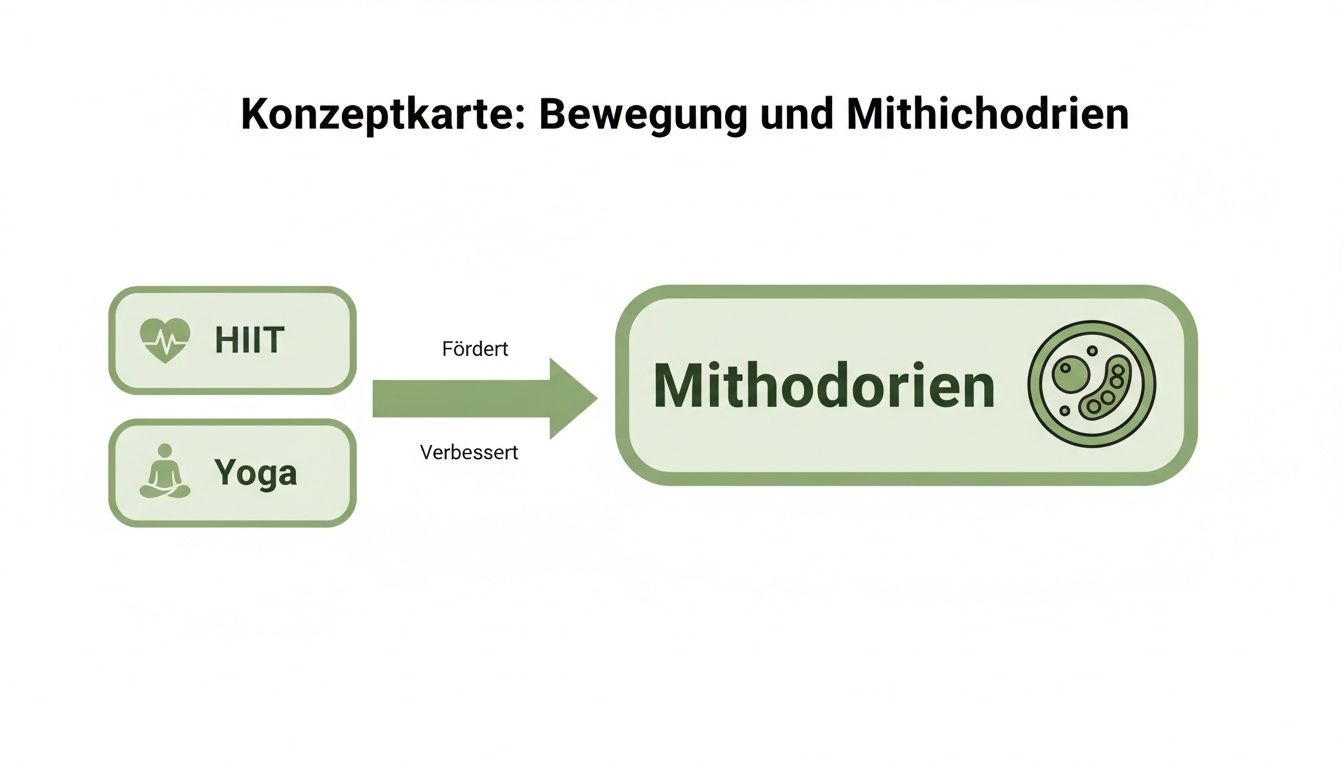
It’s clear that a mix of intense and restorative methods is required to effectively promote mitochondrial health.
The feeling after a session in an ice bath is hard to describe: a wave of clarity, focus, and pure energy sweeps through your body. You feel awake, alive, and incredibly powerful. This is the direct consequence of activating your mitochondria and releasing neurotransmitters like norepinephrine. Learn more about this unbeatable combination in our offer Fire & Ice at Templeshape.
The combination of breathing and cold exposure is an extremely effective strategy for sustainably recharging your cellular batteries. You learn to emit targeted stimuli that do not drain your body, but encourage it to improve its own energy infrastructure. This is how you directly combat chronic fatigue at the root – in the energy powerhouses of your cells.
Knowing the best strategies for your energy powerhouses is the first crucial step. But the real magic happens when you transfer this knowledge into your often-busy day-to-day life. The best plans are useless if they cannot fit in with your work, family, and all your other obligations.
This is where we come in. This section is your practical guide for implementation. It is not about radical changes overnight, but rather small realistic steps. Those that fit perfectly into your schedule and make a huge difference to your energy levels.
Your workday in Zurich is timed from morning to evening and barely leaves room for you? We know it too well. Yet even in those moments, small islands of energy are absolutely crucial to support your mitochondria and prevent burnout.
Here are some simple yet extremely effective strategies for your professional daily life:
These small habits take little time, but constantly send the signal to your body: regeneration and energy production are a priority.
It’s about making health a habit, not another burdensome task on your to-do list. A smoothie in the morning, a brief stretch before the first call – these micro-habits add up to create a powerful routine.
As a mother, you juggle countless tasks, and your own energy often suffers. Yet you need fully charged batteries. The key lies in creating small conscious rituals for yourself while the kids are occupied or sleeping.
Here are some concrete tips that really work:
In addition to these lifestyle adjustments, you can also specifically support energy production in your cells with certain nutrients. If you want to learn more about how certain coenzymes enhance the function of your mitochondria, read our detailed guide on NMN (Nicotinamide Mononucleotide). Thus, you create the best conditions for your body to regain its full strength.
Alright, now you understand the big picture: your energy is directly linked to the health of your tiny energy powerhouses, the mitochondria. You know which warning signals to listen to from your body, and you know the smart methods – from HIIT to yoga and breathwork to cold – to recharge your cellular batteries. Now comes the most important part of this journey: the first step.
And don’t worry, this path doesn’t have to be complicated. At Templeshape, we have designed everything so that your initiation is as simple and enjoyable as possible. We meet you exactly where you are and guide you step by step towards more power and joy of living – without performance pressure.
We know that no two days are alike. That’s why we have two central locations in Zurich that fit perfectly into your day. Each place has its own character, so you find exactly what you need at that moment.
No matter which location you choose, you’ll always find yourself in a community that motivates and supports you. With us, there is no rivalry, but a common goal: to live healthier and with more energy.
The best way to find out if our approach works for you? Just give it a try. We want you to discover our team and our classes before making any decision.
Your journey to more energy is not a sprint, but a marathon where every step counts. The most important step is the first – and we will help you do it with joy and confidence. Your cellular energy is just waiting to be awakened.
Are you ready to recharge your batteries? Then start now simply with a trial class. Discover which class and which location suit you best, and feel for yourself what’s possible.
Book your trial class at Templeshape now and start your journey towards a new energy today!
When you start to regain your energy and leave behind chronic fatigue, questions naturally arise. That’s a good sign! It means you are beginning to understand your body at a much deeper and cellular level.
To give you a bit more clarity and security on this path, we have answered the most frequently asked questions here. They are here to help you avoid typical pitfalls and ensure that your efforts to activate the mitochondria as cellular power against chronic fatigue are truly rewarded.
This is probably the burning question on everyone’s lips. The honest answer: it’s very individual and depends heavily on your current situation and consistency. Your mitochondria are not a switch that can be flipped in an instant. Their regeneration is a biological process that simply takes time.
Some people already feel a light initial improvement after one to two weeks of significant changes – a suitable diet and targeted movement. However, truly noticeable and especially stable results generally manifest after four to twelve weeks.Give your body this time. It needs to build new, stronger mitochondria and repair damaged cells.
Never forget: you are working to reverse a state that has often developed over years. Patience is your strongest muscle here. Every small step today is an investment in your energy for tomorrow.
Oh yes, absolutely! Especially if you are chronically exhausted, this is one of the most common traps. Short and targeted stimuli like HIIT can stimulate the formation of new mitochondria, but too much of it has the opposite effect. If you overload your body before it has a chance to recover, you create massive oxidative stress.
This stress harms your mitochondria instead of strengthening them, and can plunge you even deeper into exhaustion. Pay very close attention to the signals from your body, especially to what is known as post-exertional malaise (PEM).This is the heavy, delayed fatigue that can occur hours or even days after exertion. Always adjust your training to your day’s condition and schedule fixed recovery days – they are just as important as training itself.
Imagine your mitochondria as tiny engines. For them to work well, they need the right “fuels”. If these essential micronutrients are missing, the whole system jams.
Here are some of the most important helpers for your powerhouses:
The foundation is always a balanced diet rich in vegetables, healthy fats, and high-quality proteins. If a targeted nutritional supplement might be helpful to fill gaps, it’s best to discuss it with your doctor.
Are you ready to systematically recharge your cellular batteries? At Templeshape, we accompany you with the perfect mix of activating workouts, regenerative classes, and a community that understands and supports you. Discover how to turn your health into a habit – cell by cell. Learn more and start your journey at https://templeshape.com.
Tags
 DE
DE FR
FR EN
EN