March 18
Micro-Rest: How 90 seconds can reduce your burnout risk – faster stress relief
0 comments

March 18
0 comments
Do you often feel like you’re in a marathon, with the finish line ever moving further away? The solution is surprisingly simple: targeted, ultra-short breaks of just 90 seconds – so-called Micro-Rests – can actively calm your nervous system. They counteract the chronic overload that drives you directly into emotional exhaustion and burnout.
It’s not about taking more breaks. It’s about taking smarter breaks.
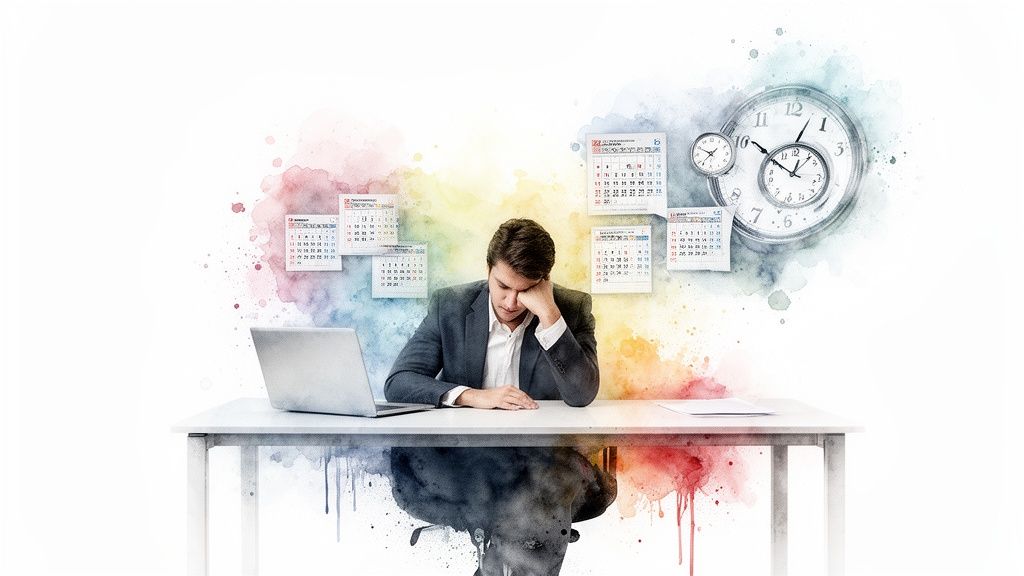
Let’s be honest: your calendar is probably bursting at the seams, the to-do list is getting longer rather than shorter, and the pressure to always be available and productive is omnipresent. Does this sound familiar? Then you’re definitely not alone. This feeling of constant tension has become the new normal for many of us.
But this chronic strain comes at a price. It quietly but inexorably gnaws at your mental energy, your focus, and ultimately your health. The emotional exhaustion that develops from it is not a sign of personal weakness. It is the logical consequence of a way of working that simply cannot be healthy over the long term.
The figures from Switzerland speak a shockingly clear language and show how widespread this problem has become.
This table summarizes the most important statistics on emotional exhaustion and stress levels among Swiss employees to illustrate the extent of the problem.
| Statistics | Percentage / Value | What This Means for You |
|---|---|---|
| Emotional Exhaustion | 30,3 % | Almost one in three people feels emotionally burned out – an alarming high. |
| Risk of Depression | 6 times higher | Those who are emotionally exhausted have a sixfold higher risk of developing depressive symptoms. |
| Job Stress Index (2022) | Highest level since 2014 | Workplace stress has reached a record level since measurements began. |
These numbers show: The feeling of constantly running on ‘reserve’ is not an illusion. It is a widespread phenomenon with serious consequences.
This constant barrage of stress quickly leads to a downward spiral:
Traditional breaks, like the classic lunch break, often are not enough to break this cycle. They usually come too late and are not designed to specifically regenerate the nervous system. Especially when you’re on the go or your daily life is particularly demanding, the emotional and mental health on the go becomes an invisible but massive additional burden.
We must tackle the problem at its root: It’s about managing the accumulating stress load during the day instead of just sweeping up the pieces in the evening.
This is exactly where Micro-Rests come in. They are not a nice wellness option, but an absolutely necessary strategy to remain healthy and effective in the modern workplace in the long term.
This article shows you how to achieve maximum impact for yourself and your health with minimal time investment.

Forget about the long lunch break for a moment. The real key to tricking daily exhaustion often lies in tiny, targeted interruptions of just 90 seconds. This method, known as Micro-Rest, is much more than just a simple break – it is a strategic reboot for your brain.
Imagine your brain like the fan of your laptop, running at full speed after hours of intense work. If you don’t give it a short cooling time, the whole system overheats and eventually crashes. A micro-break is exactly that brief moment of shutdown that brings everything back into balance before a major crash even occurs.
So, what actually happens during those 90 seconds that makes such a difference? The answer lies in pure neurobiology. When you work without interruption, your cortisol levels rise – the most well-known stress hormone in our body. Persistently high cortisol levels inevitably lead to mental fatigue, concentration problems, and, in the long term, burnout.
A micro-break specifically breaks this vicious cycle. It signals to your autonomic nervous system to shift from sympathetic mode (the ‘fight or flight’ state) to parasympathetic mode (the ‘rest and digest’ state). In just 90 seconds, your body can begin to lower its cortisol levels, which you often perceive as an immediate feeling of relief.
A micro-break is not a luxury, but a necessity. It is the art of deliberately allowing your nervous system to recalibrate and recharge cognitive resources instead of exhausting them to the limit.
These little breaks also help you break the mental tunnel vision. After a long phase of highly concentrated work, your perception naturally narrows. A brief moment of disconnection broadens your field of vision again and clears the way for creative and flexible thinking. If you want to dive deeper into how you can deliberately calm your nervous system, check out our article on Vagus nerve stimulation.
It is extremely important to distinguish a true micro-break from a simple distraction. The two have completely opposite effects on your brain.
So, a micro-break is nothing but laziness. It is a conscious and strategic action to ensure your performance and well-being in the long term. One could say it is the smallest unit of self-care with the greatest possible impact on your workday.
The theory sounds great, but how do you concretely incorporate these powerful 90-second breaks into your busy daily routine? Don’t worry, it’s much easier than it seems. Here’s your personal toolkit with techniques you can implement immediately – whether in a large office, at home, or even on the go.
You just need to discover which method works best for you and the situation at hand. A bit of experimentation is part of the process to discover your personal preferences.
Your breathing is probably the most powerful tool to directly influence your nervous system. The huge advantage: you always have it with you, and it’s absolutely discreet. If you want to explore the targeted application of breathing exercises further, you can find even more valuable tips in our guide on Breathwork in Zurich.
The 4-7-8 breathing:Inhale through your nose for 4 seconds.Hold your breath for 7 seconds.Then exhale loudly through your mouth for 8 seconds.Repeat this two to three times.
Box breathing:Simply imagine a square. You breathe in for 4 seconds, hold for 4 seconds, breathe out for 4 seconds, and hold again for 4 seconds. Very simple.
Even these simple exercises signal to your body: the danger has passed, you can shift from stress mode to relaxation mode.
Sitting for hours inevitably leads to tension. And this tension, in turn, sends stress signals to your brain. A vicious cycle you can easily break with a few targeted movements.
Neck and shoulder reset:Sit up straight. Gently tilt your head towards your right shoulder and hold the stretch for about 30 seconds. Then do the same on the left side. After that, powerfully raise both shoulders towards your ears, hold the tension briefly, then consciously let them drop.
Wrist and finger stretch:Extend one arm forward with the palm facing up. With the other hand, gently pull the fingers down towards the ground. Hold this for 30 seconds, then switch sides.
Sometimes your body is quite relaxed, but your mind simply won’t give you a break. These mental micro-breaks help you reduce internal noise for a moment.
„Palm“ for eye relaxation:Rub your palms together until they are warm. Close your eyes and gently place your warm hands over them, without pressure. Just enjoy the darkness and warmth for 90 seconds.
When? A true feast for tired and overworked eyes after staring at a screen for hours.
The daydream of 90 seconds: Close your eyes and imagine a place where you feel completely safe and comfortable. Maybe a beach, a quiet forest, or your favorite chair at home. Focus on the details: What do you see, hear, and feel there?
The economic significance of such techniques is enormous. Work-related stress costs annually in Switzerland 6.5 billion francs, primarily due to lost productivity. Investing in simple yet effective stress management techniques like micro-breaks is not only good for you but also extremely sensible from an economic standpoint. You can learn more about how workplace stress affects the economy at 20min.ch.
You now know the theory and have a full range of techniques. But what’s the point of the best method if it gets lost in the hectic daily routine? The truly decisive step now is to turn this knowledge into a solid habit – an automatic response that reliably protects you from burnout.
The secret? Start small and find clever anchor points in your daily routine. Instead of vaguely planning to take breaks “more often”, you need a concrete battle plan.
The easiest way to establish a new routine is to associate it with an already existing one. Such connections act as little reminders for your brain, called triggers or cues.
Think about the moments that repeatedly define your workday. Here are some truly powerful triggers:
Just choose one trigger to start. Once that first micro-break has become second nature, you can add the next one. This way, you don’t overwhelm yourself, and you build your new habit step by step. If you want to dive deeper into the subject, our guide on sustainable habit change provides valuable insights.
This infographic shows you a simple three-step process that you can implement immediately in your workplace.
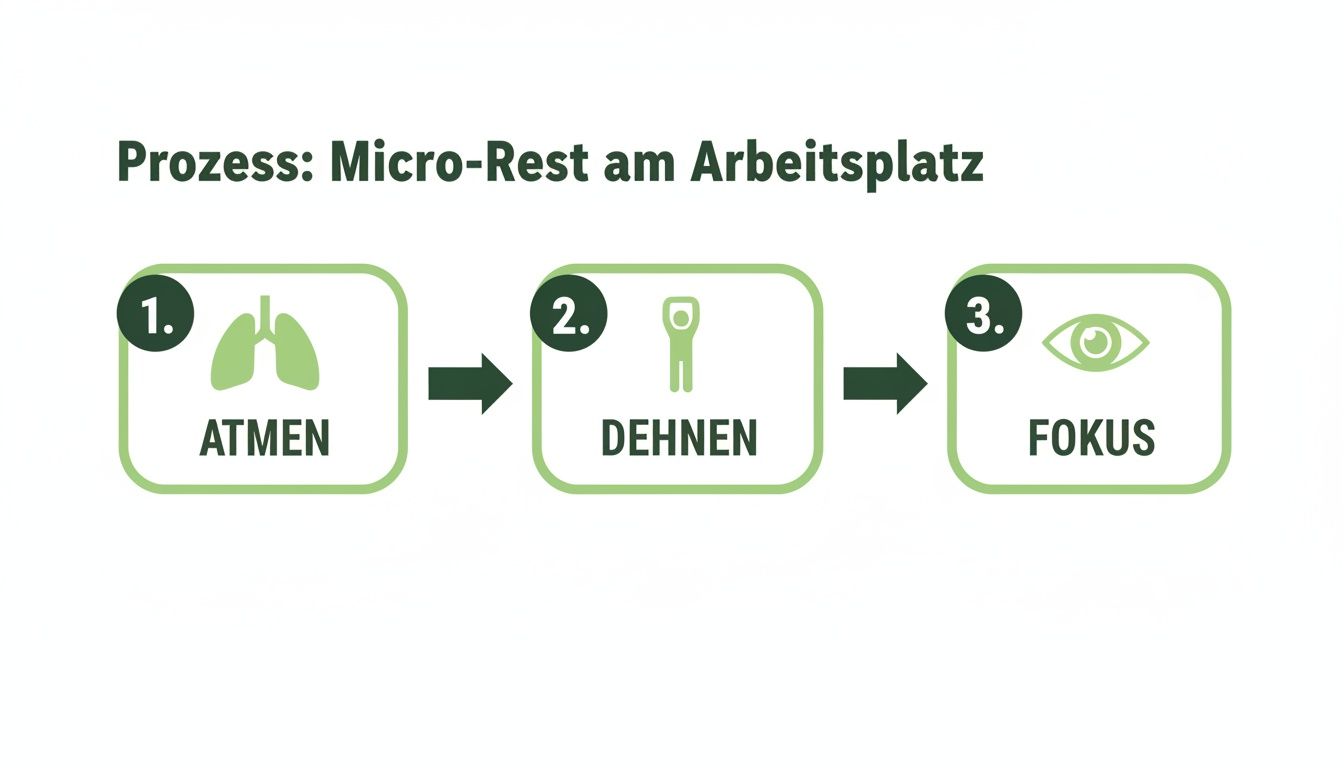
You can see here how you go through a complete regeneration cycle in no time with simple steps like breathing, stretching, and consciously focusing.
Especially at the beginning, a voice in your head will surely whisper: “I don’t have time for this right now!” This thought is the biggest obstacle. Realize that this objection is based on a completely false assumption.
You are not taking the time; you are investing that time. A 90-second break saves you a multitude of time in the long run that you would otherwise lose due to mistakes, lapses in concentration, or burnout.
It’s a sad reality: Many of us work at the limit. A survey by Travailsuisse showed that half of all employees in Switzerland regularly work overtime. Almost a quarter even works more than ten hours a day. This unhealthy workload, often coupled with the pressure to come to work sick, massively propels emotional exhaustion. You can find the complete analysis on emotional exhaustion among Swiss employees at blick.ch.
In addition to micro-breaks, there are certainly many other proven strategies to boost your productivity and thus create more space for recovery.
Do not measure your success solely by your checked task list, but above all by your well-being. Do you feel less exhausted in the evening? Can you focus better again? Those are the true measures of your success.
You discover the true magic of micro-breaks only when you consider them not just as a hack for work, but as a universal tool for your entire life. Their power doesn’t stop at the office door. On the contrary: they are just as effective in enhancing your performance at the gym or finally bringing more harmony into your private life.
Imagine your next intense workout. What do you do after a really tough set? You probably reach for your phone, exhausted. Try something different: Take exactly 90 seconds to breathe deeply and mindfully. Relax the muscles that have just burned and mentally focus on the next round.
This minimal and thoughtful pause helps your nervous system to calm down faster, pumps more oxygen into your muscles, and can even reduce your risk of injury.
One of the biggest risks of burnout? When the boundaries between work and private life completely blur. All the office stress sneaks into your evening without you realizing it and poisons the precious time spent with your family or friends. This is precisely where micro-breaks become your personal shield.
They help you create very conscious transitions – small mental stop signs that leave work stress where it belongs: at the office.
These little rituals are much more than simple breaks. They are conscious decisions through which you regain control of your mental state and prevent work from taking over your private life.
Even in the turbulent family routine, you can create such little oases of calm. While the tea water is boiling – look out the window for 90 seconds instead of at your phone. Before picking up the kids from daycare – a short breathing exercise to welcome them with patience and all your energy.
This is how micro-breaks evolve from a simple work technique into a true life philosophy. They empower you to take a moment to breathe in all areas of your life, recharge your energies, and act more consciously. The result is not only less stress but also a deep sense of balance and control.
The idea of micro-breaks has caught your attention, but do you still have a few question marks floating above your head? Perfect! Let’s clarify the most common uncertainties so you can start your new healthier routine with conviction and a clear plan.
Good question. Longer breaks are absolutely essential, but they fall into another category. They are meant for your lunch break, socializing with colleagues, or a short workout. Micro-breaks are something different: they are the quick restart of your brain in between.
Their superpower lies in the frequency, not the duration.
Think of it this way: instead of waiting for your stress battery to be completely drained, you recharge it briefly throughout the day. A half-hour break often can’t save a mind that is already completely overloaded. But eight strategically placed 90-second breaks can prevent it from getting that far.
A perfectly valid concern, but one that can be easily resolved. The trick is not to disguise it as ‘lazing around’ but to communicate it for what it is: a professional tool to improve your performance and protect your mental health.
Explain to your team that you are using a scientifically proven technique to sharpen your focus and maintain the quality of your work. Most supervisors are open to proactive measures to prevent burnout – after all, the whole company benefits from a healthy break culture.
A clear, strong, and distinct answerNo. And that may be the most important point of all. Social media, news apps, or a quick email check do not constitute a form of recovery. It’s simply another form of mental overstimulation. You’re feeding your brain with more input and increasing the cognitive load instead of decreasing it.
A true micro-break minimizes external input. It’s about giving your nervous system a genuine breath. So deliberately choose activities like conscious breathing, a quick stretch, or simply letting your gaze wander outside through the window.
Listen to your body; it’s your best advisor. A good guideline is to take a break after each phase of focused work of60 to 90 minutes.Otherwise, you can also use a micro-break as a conscious margin between two different tasks.
As soon as you notice your thoughts wandering, that you become restless, or that your shoulders are tensing, that’s your signal. Start with three to four conscious breaks a day and see how it feels. You’ll quickly develop a sense of what you need.
Are you ready to reduce stress and recharge your energy? AtTempleshape GmbH you will find courses like conscious breathing, yoga, and targeted workouts that help you regain your inner balance. Discover our offerings in Zurich now and make health your habit athttps://templeshape.com.
Tags
 DE
DE FR
FR EN
EN