March 17
Exercises for defined arms in women
0 comments

Defined arms are not only a symbol of strength and power, but they also have a significant impact on the overall aesthetics of your body.
In this post, we will show you all the exercises you can do at home and in the gym for defined arm muscles in women.
From triceps with dumbbells to defined upper arms in general.
Whether you're wearing a sleeveless dress in summer or showcasing your muscles at the gym: toned arms can boost your self-confidence and make you feel unstoppable.
In women arm training is often neglected because they prefer to focus on other body areas such as glutes or abs.
Fair enough, that’s nice and important too.
However, if you incorporate arm exercises into your training program, it can have many benefits that go beyond just appearance in a tank top.
Strong arm muscles can improve your posture, enhance your performance in other exercises, and even prevent injuries.
If your arms are weak or lack enough muscle, it can affect your overall posture.
Because your arms play a crucial role in stabilizing your upper body and supporting your spine.
By strengthening your arms through targeted exercises like bicep curls and tricep dips, you can improve your posture and reduce the risk of neck and shoulder pain.
Your 80-year-old future self would surely appreciate it if you start doing these exercises early enough.
You can ask them sometime.
Strong arms not only look good, they are also important for achieving peak performance in other types of training.
Whether you're lifting weights, doing yoga, or running long distances, strong arms help you develop more strength and endurance to withstand challenging workouts.
Moreover, well-defined arm muscles can give you an extra advantage in any kind of physical activity.
Additionally, your basal metabolic rate will be elevated because larger muscles burn more.
Weak arms can make you susceptible to injuries in everyday activities like lifting heavy objects or during sports.
By incorporating arm exercises into your routine, you can strengthen the muscles that support your joints, reducing the risk of strains and sprains.
Moreover, building strong arms can help improve overall stability and balance, which is important for preventing falls and other accidents.
In summary, you should not underestimate the importance of arm training for women.
It not only helps you achieve the toned look you've always wanted, but also offers a range of benefits that enhance your overall health and fitness.
So the next time you go to the gym, don't forget to pamper your arms with a great workout!
HIIT Workouts
at Templeshape
We do exercises for defined arms every week!
Join us!
Now that we have discussed the benefits of why arm training is important, let's focus on the details of how to effectively train your arms and shoulders.
Understanding the anatomy of these muscles is important to optimize your training.
When it comes to arm training, there are a few key muscles you should focus on: the biceps, triceps, and deltoid muscles.
The biceps is located on the front of your upper arm and is responsible for bending your elbow.
The triceps, on the other hand, is located on the back of your upper arm and is responsible for straightening your elbow.
The deltoid muscles, finally, are located on the top of your shoulders and are responsible for allowing you to lift your arms sideways.
It is important to train all of these muscles to achieve a balanced strength and muscle development in your arms.
This means you should incorporate exercises that specifically target each muscle group, such as bicep curls for the biceps, tricep extensions for the triceps, and lateral raises for the deltoids.
In addition to targeting specific muscles, there are also some important principles of strength training that you should consider when designing your arm training.
One important principle is progressive overload, where you gradually increase the weight or intensity of your training to further challenge your muscles and promote growth.
Another important principle is proper form.
It's essential to perform the exercises correctly to avoid injuries and ensure that you effectively target the desired muscle group.
This means you should utilize the full range of motion, maintain good posture during each exercise, and avoid swinging or jerky movements.
Consistency is also key in strength training.
To make progress in your arm strength and muscle definition, you need to train your arms regularly.
This means you should incorporate arm-oriented training into your fitness program at least 2-3 times a week.
And finally, don't forget about rest and recovery.
Giving your muscles time to rest and repair between workouts is crucial for growth and preventing overtraining.
Make sure to include rest days in your training plan and listen to your body if you feel fatigued or sore.
By understanding the anatomy of your arm and shoulder muscles and following these important principles of strength training, you are well on your way to shaped, strong arms that you can be proud of.
So grab some dumbbells and get ready to pump up those arms!

When it comes to shaping defined arms, bicep exercises are an essential component of any workout routine.
The bicep is the muscle on the front of your upper arm that helps you bend your elbow and rotate your forearm.
By targeting these muscles with specific exercises, you can increase their size and strength, thus achieving the toned and defined arms you've always dreamed of.
One of the most popular bicep exercises is the bicep curl.
This exercise can be performed with dumbbells, barbells, or even resistance bands.
To perform a bicep curl, simply hold the weight with your palm facing up and slowly lift it towards your shoulder while keeping your elbow at your side.
Lower the weight back down in a controlled manner and perform multiple repetitions.
Another effective bicep exercise is the hammer curl.
This exercise not only trains the biceps but also the brachialis muscle, which lies beneath the biceps.
To perform a hammer curl, hold the weight in your hand with your palm facing your body. Keep your elbow bent at your side, lift the weight towards your shoulder, and lower it back down in a controlled manner.
This exercise can help make your arms bigger and more defined, as it targets multiple upper arm muscles.
Bicep Exercises Video:
You don't have to worry that a few bicep exercises will make you look like the gentleman below.
The bicep exercises for women are, in any case, the same as for men.
However, it depends on the frequency and the weights you train with.
We recommend women incorporate bicep exercises into their training once a week or every 5 days.
Working on your biceps is important for defined arms in women, but don't forget about the triceps!
The triceps are located on the back of your upper arm and are responsible for extending your elbow.
By incorporating tricep exercises into your training program, you can strengthen and develop this muscle group, complementing your biceps.
An effective exercise for the triceps is tricep dips.
You can perform this exercise on parallel bars at the gym or even on a stable chair at home.
To perform a tricep dip, grip the bars or chair edge with your arms straight and lower yourself by bending your elbows until they reach a 90-degree angle.
Push yourself back to the starting position by straightening your elbows.
This exercise works all three heads of the triceps and can help shape your arms.
Another great exercise for the triceps is the tricep kickback.
This exercise is typically performed with dumbbells or cables and targets the long head of the tricep muscle that runs along the back of your arm.
To perform a tricep kickback, take a weight in each hand with your palms facing each other and bend slightly forward at the waist.
Keep your upper arms still and extend your arms backward at the elbows before returning to the starting position.
When you incorporate these effective bicep and tricep exercises into your training program, you can target all areas of your arms to achieve the toned and defined muscles you've been working towards.
Combine these exercises with other arm exercises like push-ups or shoulder presses to complete a well-rounded arm workout, so you feel strong and confident in no time!
The shoulder muscles are an important part of your upper body strength and there are some key exercises for defined arms that can help you build and strengthen these muscles.
Two popular exercises for your shoulders are shoulder presses and lateral raises.
The shoulder press is a fantastic exercise to train your shoulder muscles, especially the deltoids.
For the shoulder press, start by holding a dumbbell in each hand at shoulder height with your palms facing forward.
Engage your core for stability, then press the dumbbells overhead until your arms are fully extended.
Slowly lower the weights back to the starting position and repeat the desired number of repetitions.
Lateral raise is another great exercise to isolate the shoulder muscles, particularly the lateral deltoids. For the lateral raise, start by holding a dumbbell in each hand at your sides with your palms facing inward. Maintain a slight bend in your elbows and raise the weights out to the sides until they reach shoulder height. Hold the weight at the top of the movement for a moment and then lower it back down in a controlled manner. Repeat as many repetitions as necessary.
Both exercises can be performed with dumbbells or resistance bands, making it easy to incorporate them into your training program, whether you're at home or at the gym. Remember to start with lighter weights and focus on proper form to avoid injuries and get the most out of each exercise.
Another important muscle group to address while working on your shoulders is the rear deltoid muscles.
These muscles contribute to shoulder stability and overall strength, so you should not neglect them in your training.
An effective exercise for training the rear deltoid muscles is face pulls.
To perform a face pull, set up a resistance band or cable machine at chest height.
Grab the handle with both hands and step back so that the band or cable is under tension.
Keep your elbows high and in line with your shoulders and pull the handle towards your face by squeezing your shoulder blades together.
Allow the handle to slowly return to the starting position and repeat the exercise for several repetitions.
In addition to face pulls, exercises like reverse flys and bent-over reverse flys can also help strengthen and tone your rear deltoid muscles.
By incorporating a variety of exercises into your shoulder training, you can ensure that you target all angles of this important muscle group.
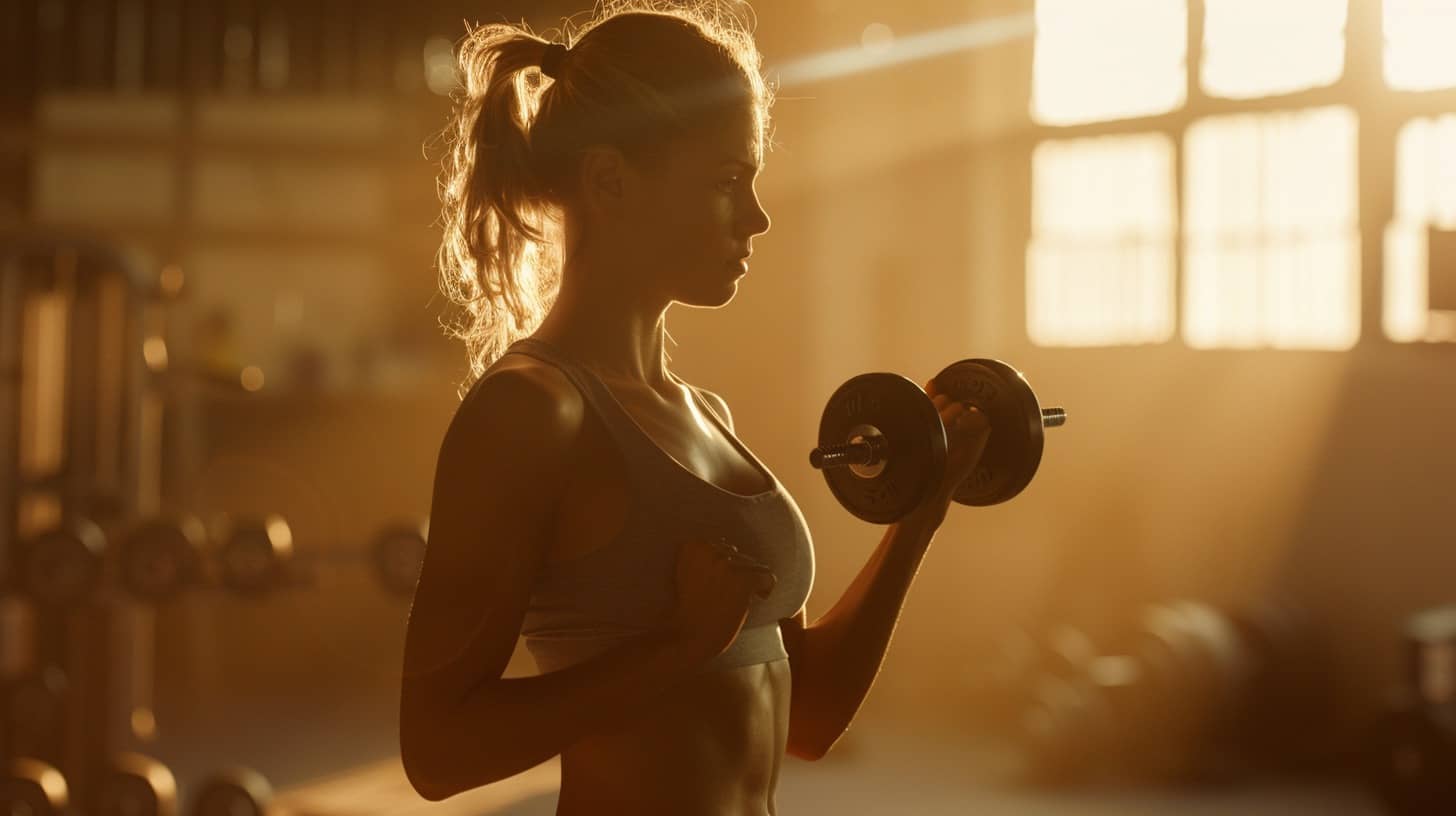
If you want to shape your arms, a solid training plan is essential.
Here is a sample weekly plan that you can follow to train your biceps and triceps.
It is important that you train each muscle group once a week.
In other words, you can just pick 1-2 exercises per muscle group and incorporate them into your workout.
- Barbell curls: 4 sets of 10 repetitions
- Hammer curls: 3 sets of 12 repetitions
- Preacher curls: 3 sets of 15 repetitions
- Concentration curls: 2 sets of 20 repetitions
- Triceps dips: 4 sets of 12 repetitions
- Skull crushers: 3 sets of 15 repetitions
- Triceps kickbacks: 3 sets of 12 repetitions
- Overhead triceps extensions: 2 sets of 20 repetitions
- Alternating dumbbell curls/triceps cable pushdowns: 4 sets of 12 repetitions each
- Barbell curls with reverse grip/triceps extensions: 3 sets of 15 repetitions each
Remember that it is important to vary your exercises and continuously challenge yourself by increasing the weight or repetitions as you get stronger.
If you have little time and want to maximize your gym sessions, you can also incorporate arm training into your full-body workouts during HIIT or Pilates.
This way, you train multiple muscle groups in one session and stay efficient.
For example, you can insert arm exercises like bicep curls or triceps dips between your sets of squats or lunges.
This not only helps keep your heart rate up but also provides a good pump in your arms while training other muscle groups.
Another option is to dedicate one day a week specifically to arm training, where you focus on both biceps and triceps with a mix of isolation and compound exercises.
This way, you can ensure that your arms get the attention they need while you work on other body parts throughout the week.
By combining arm training with full-body training, you can work towards balanced strength and muscle tension throughout the body.
This makes training interesting and prevents you from getting bored with the same routine day after day.
So, let's spice up the gym with a well-rounded training program!

Now that we have discussed the fundamentals of training and muscle building, let’s talk about another important aspect for muscle growth: nutrition and recovery.
Of course, we recommend you first consult a Nutritionist for the best possible results.
However, here are a few guiding principles for your exercises for defined arms.
You can spend hours in the gym lifting weights, but if you don’t provide your body with the right nutrients, you won’t achieve the desired results.
A balanced diet is key to building and maintaining muscle mass.
Make sure your meals contain a good mix of proteins, carbohydrates, and healthy fats to support your training and help your muscles recover.
Protein is especially important for muscle building, as it provides the building blocks your body needs to repair and grow muscle tissue.
Ensure that you include lean protein sources such as chicken, fish, eggs, and tofu in each meal.
Carbohydrates are also important for providing energy during workouts, so you shouldn’t skimp on those either.
Choose complex carbohydrates such as whole grains, fruits, and vegetables to support your workouts.
In addition to a balanced diet, certain nutrients and supplements can support muscle growth and recovery.
Branched-chain amino acids (BCAAs) are essential amino acids that can help prevent muscle breakdown during intense workouts.
You can find BCAAs in supplement form or naturally in foods like meat, dairy products, and legumes.
Creatine is another popular supplement among athletes looking to build muscle mass.
It helps increase energy production in the muscles during high-intensity training, leading to improved performance and faster recovery.
Definitely talk to a healthcare professional before starting any new supplement program.
Rest and recovery are just as important for muscle building as training.
Overtraining is harmful.
Your muscles need time to recover and become stronger after intense workouts, so give them the rest they deserve.
Aim for 7-9 hours of good sleep each night to support muscle recovery.
Active recovery techniques such as foam rolling, stretching, and light cardio can also help reduce muscle soreness and improve blood circulation.
Don't forget to drink enough throughout the day to ensure optimal muscle function and recovery.
In summary, nutrition plays a crucial role in building muscle mass.
Make sure to provide your body with the right nutrients, take supplements if needed, and prioritize rest and recovery for optimal results.
Remember, it's not just about what you do in the gym, but also what you do outside of it to achieve your fitness goals.

So you've decided that you want to work towards defined arms for women - well done! Setting goals and staying motivated is key to long-term success in any fitness program.
When setting your goals, you should formulate them concretely and realistically. Instead of saying, "I want toned arms," you should set a goal like, "I want to do 10 push-ups in a row."
When you have a clear goal to work towards, you stay focused and motivated.
Don't forget to celebrate your progress - every small success is a step in the right direction!
A common mistake many women make when trying to get defined arms is to focus solely on arm exercises.
While it's important to train the arm muscles, it's also important to incorporate a full-body workout into your training routine.
By training all muscle groups, you will not only see faster results in your arms but also improve your overall strength and fitness level.
Another mistake you should avoid is neglecting proper form while training.
It can be tempting to rush through exercises or use weights that are too heavy, but this can lead to injuries and prevent you from getting the desired results.
Take your time to learn the correct form for each exercise and start with lighter weights before gradually increasing them.
To stay motivated and see how far you've come, it's good to track your progress.
Keep a training journal or use a tracking app on your phone to log your exercises, the weights used, and the number of repetitions and sets.
For example, we love using Boostcamp for this.
You can also take regular photos of your progress to see the changes in your arms over time.
Remember: Defined arms take time and consistency. Focus on your goals, avoid common mistakes, and track your progress - and before you know it, you'll confidently be wearing sleeveless tops!
Tags
 DE
DE FR
FR EN
EN