March 18
Cycle synchronization: adapting training to the cycle – More strength & well-being
0 comments

March 18
0 comments
Imagine for a moment that you could tap into your energy and strength exactly when your body is at its peak – and give it in other phases the rest it needs. This is not magic, but the simple and brilliant idea behind the Cycle-Syncing: you adapt your training to your menstrual cycle. Instead of working against your body, you make it your smartest training partner.
Do you know that feeling? Some days you could uproot trees at the gym, other days the walk to the mailbox feels like a marathon. The answer often lies in your hormones. A rigid training program that demands the same power every day completely ignores this biological reality. The result? Often frustration, exhaustion, or, in the worst case, injuries.
Your cycle is much more than just a menstrual concern. It’s a perfectly tuned orchestra of hormones that not only regulates your fertility but also influences your energy, strength, mood, and even the stability of your joints. The two main conductors of this orchestra are estrogen and progesterone. Their rises and falls throughout the month create different phases that grant your body a variety of superpowers.
In the first half of the cycle, just after your period, estrogen takes the lead. You can almost consider it your personal and natural performance booster. It increases your energy, makes you more tolerant to pain, and supports muscle building. This is the time when your body is ready for intense sessions and new performance.
After ovulation, the command shifts to progesterone. This hormone has a rather calming, almost inhibiting effect. Your core body temperature rises slightly, you get out of breath more quickly and your body tends to retain more water. Heavy weights or fast sprints may feel much more exhausting now. And this is where the Cycle-Syncing comes into play: it intelligently adjusts your training according to these hormonal realities.
Cycle-Syncing is not just a passing trend, but a smart strategy to harness the biological advantages of your cycle. It’s about working with your body, rather than against it – for sustainable success and less frustration.
This approach is particularly relevant in Switzerland, where more and more women are actively pursuing their fitness goals. According to the Fitness Tribune, today 1.37 million people train in fitness centers in Switzerland – an all-time record. At the same time, studies from the Federal Office of Sports BASPO show that 68 percent of Swiss women aged 20 to 40 have irregular cycles, often leading to drops in motivation.
It is precisely here that adjusting your training to the cycle can significantly help avoid these drops. If you want to learn more about how a professional can help you, see how a Personal Trainer can help you achieve your goals.
By adapting your training, you say goodbye to the myth that you must give 100% every day. Instead, you learn to see the four phases of your cycle as your personal strengths:
This smart approach is your key to understanding why training in tune with your cycle can be truly revolutionary for your well-being and training success.
To help you get started, I have prepared a clear table for you. It gives you a quick overview of the four phases, what happens hormonally, and the best way to adjust your training.
This table gives you a quick overview of the four phases of your cycle, their typical duration, the dominant hormones, and how it affects your energy and training.
| Cycle phase | Typical duration | Hormonal situation | Energy level & training recommendations |
|---|---|---|---|
| Menstrual phase | 3–7 days | All hormones are at a low level. | Low: Focus on regeneration, gentle yoga, walks, light stretching. Listen to your body. |
| Follicular phase | 7–10 days | Estrogen rises, testosterone also slightly. | Increasing to high: Ideal for strength building (hypertrophy), intense cardio (HIIT), and new challenges. |
| Ovulatory phase | 1–3 days | Östrogen und Testosteron erreichen ihren Höhepunkt. | Peak: Maximale Kraft und Ausdauer. Perfekt für schwere Gewichte, Sprints und persönliche Rekorde. |
| Lutealphase | 10–14 Tage | Progesteron dominiert, Östrogen sinkt ab. | Sinkend: Fokus auf moderates Training, Ausdauer im Steady-State, Techniktraining und aktive Erholung. |
Sieh diese Tabelle als deinen persönlichen Spickzettel. Mit der Zeit wirst du ein feines Gespür dafür entwickeln, was dein Körper in welcher Phase braucht.
So, nachdem wir die Theorie geklärt haben, geht’s jetzt ans Eingemachte. Wir bauen deinen Trainingsplan so um, dass er nicht gegen dich, sondern mit dir und deinem Zyklus arbeitet. Der Gedanke, jeden Tag die gleiche Leistung abrufen zu müssen, ist überholt. Es geht vielmehr darum, die natürlichen Hochs und Tiefs deines Körpers clever zu nutzen.
Diese Grafik gibt dir einen schnellen Überblick über die vier Phasen, die wir jetzt genauer unter die Lupe nehmen.
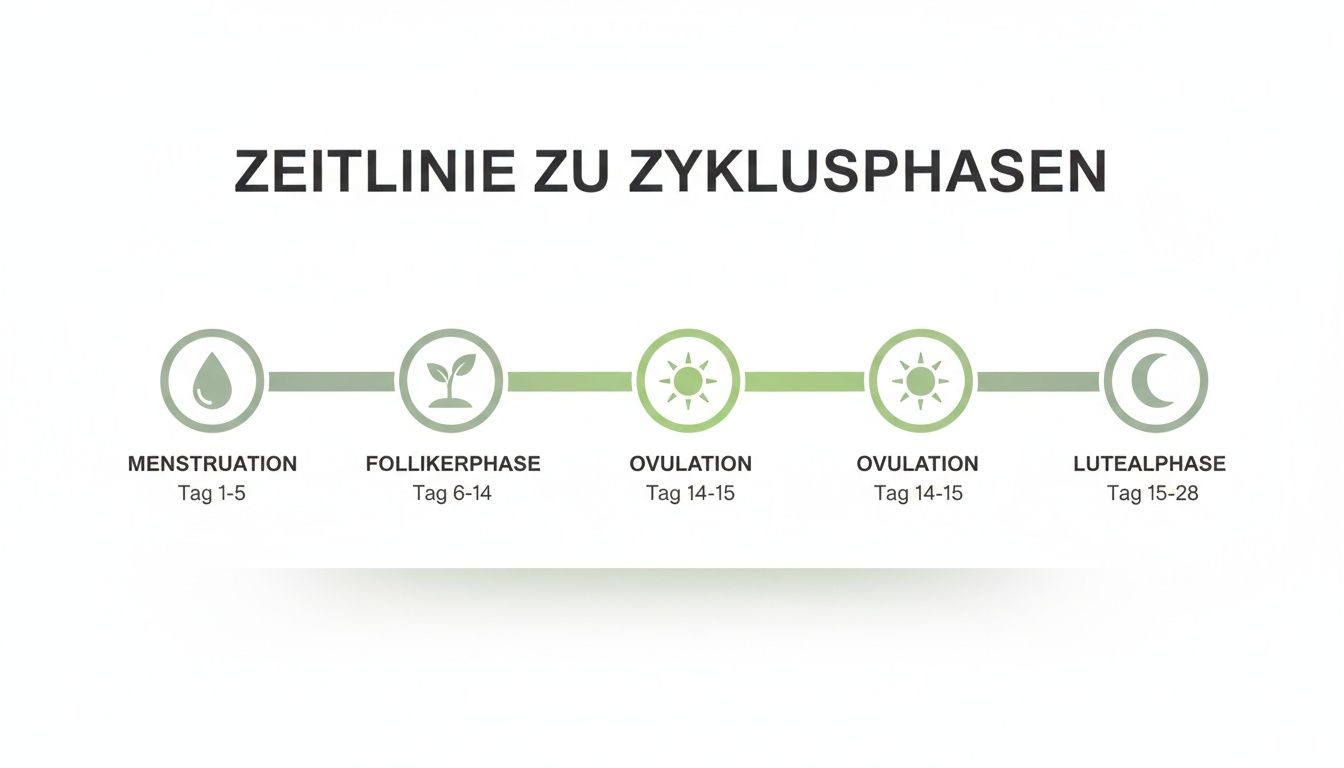
Du erkennst sofort, wie die Energie von der ruhigen Menstruationsphase bis zum Leistungshoch während des Eisprungs ansteigt und dann in der Lutealphase wieder abfällt. Genau dieses Wissen machen wir uns jetzt zunutze.
Während deiner Periode sind deine Hormonspiegel, vor allem Östrogen und Progesteron, im Keller. Kein Wunder also, wenn du dich müde, kraftlos und vielleicht etwas nach innen gekehrt fühlst. Dein Körper leistet gerade Schwerstarbeit und signalisiert ganz klar: Zeit für eine Pause.
Das heisst aber nicht, dass du die Füsse komplett hochlegen musst. Im Gegenteil, sanfte Bewegung kann sogar helfen, Krämpfe zu lösen und die Stimmung zu heben. Der Trick liegt darin, die Intensität radikal runterzufahren und wirklich auf die Signale deines Körpers zu hören.
Dein Training während der Menstruation:
Hochintensives Training, schwere Gewichte oder gar Wettkämpfe sind jetzt tabu. Gib deinem Körper die Erlaubnis, sich zu erholen – er wird es dir danken.
Nach deiner Periode startet die Follikelphase. Stell sie dir wie den Frühling in deinem Körper vor: Das Östrogen steigt langsam an, die Energie kehrt zurück und die Motivation klettert spürbar nach oben.
Dein Körper ist jetzt bereit für neue Reize. Das ansteigende Östrogen verbessert nicht nur deine Laune, sondern auch deine Insulinsensitivität. Das bedeutet, deine Muskeln können Kohlenhydrate viel effizienter als Treibstoff nutzen. Ausserdem unterstützt es den Muskelaufbau. Perfekte Bedingungen also!
Dein Training in der Follikelphase:
Nutze diesen Aufwind, um deine Fitnessziele aktiv anzugehen.
Willkommen auf dem Gipfel deiner Leistungsfähigkeit! Rund um den Eisprung erreichen Östrogen und Testosteron ihre absoluten Spitzenwerte. Du fühlst dich jetzt am stärksten, schnellsten und ausdauerndsten. Dein Schmerzempfinden ist niedriger, und deine Motivation ist auf dem Höhepunkt.
Das ist deine persönliche Prime Time für sportliche Höchstleistungen. Wolltest du schon immer eine neue Bestleistung im Kreuzheben aufstellen oder eine richtig harte HIIT-Klasse durchziehen? Jetzt ist der perfekte Moment dafür.
Ein konkretes Beispiel: Um den Eisprung herum (Tag 12–14) bist du dank der Hormon-Peaks ideal für kraftvolle Hyrox- oder Bootcamp-Sessions gewappnet. Bei Templeshapes Airport Health Temple gibt es dafür Unlimited-Pakete ab 179 CHF/Monat, was auf Sessions ab 8 CHF/Stunde hinausläuft. Eine Umfrage des Schweizerischen Roten Kreuzes (SRK) hat gezeigt, dass 72 Prozent der berufstätigen Zürcherinnen unter Stresssymptomen leiden. Cycle-Syncing kann diese um bis zu 35 Prozent reduzieren, da es PMS-Symptome wie Müdigkeit quasi halbiert. Erfahre hier mehr über die Training possibilities at Templeshape Studio in Wiedikon.
Your training during ovulation:
A little tip: pay attention to technique, even with power. Due to the high presence of estrogen, your joints may be slightly less stable.
After ovulation, your cycle enters its autumn. Progesterone takes command while estrogen slowly decreases. Progesterone has a more catabolic effect on muscles and slightly increases your core body temperature. You will therefore sweat more quickly, and your cardiovascular system is more stressed.
In the first half of the luteal phase, you may still feel fit, but in the second half, just before your next period, premenstrual syndrome (PMS) often manifests. Your energy decreases, you may feel more irritable, and cravings can occur.
Your training focus should now shift from maximum intensity to endurance and technique. Your body excels at burning fat during this phase, which favors longer, moderate sessions.
Your training during the luteal phase:
Listen carefully to what your body is telling you. If you feel tired, it is perfectly acceptable to swap an intense session for a restorative one. The goal is to train sustainably and in harmony with yourself, not to torture yourself.
To make it easier for you to enter, I’ve put together an overview for you. It serves as a compass, showing you at a glance what type of training is best suited to your body in each phase.
| Cycle phase | Optimal training type | Intensity & Volume | Recovery Focus |
|---|---|---|---|
| Menstruation (Day 1–5) | Regenerative movement, gentle yoga, walks, mobility | Very low | High, prioritize active recovery |
| Follicular phase (Day 6–12) | Progressive strength training, cardio, trying new sports | Medium to high, increasing | Moderate, pay attention to good sleep |
| Ovulation (Day 13–15) | HIIT, maximum strength, competitions, demanding classes | Very high, reach peak performance | Important to avoid overtraining |
| Luteal phase (Day 16–28) | Steady-state cardio, technical training, Pilates, yoga | Moderate to low, decreasing | High, especially before your period, stress reduction |
Consider this table not as a strict rule but as a guide. Your body is unique, and there will be days when you feel differently than you expected. This is perfectly normal. Over time, you will develop a sensitivity to what you actually need.
The key to successful cycle syncing lies in understanding your personal rhythm. Before you can adjust your training, you must first understand what is really happening in your body. Don’t worry, it seems more complicated than it is – you don’t need a scientific laboratory.

It’s essentially about creating a connection with yourself and interpreting the subtle signals of your body. This first step is the absolute foundation for everything that will follow. It will help you adjust training to your cycle, without it feeling like a laborious task.
Um mit dem Tracking zu beginnen, hast du verschiedene Möglichkeiten – von ganz klassisch bis digital. Wähle einfach die Methode, die am besten in deinen Alltag passt und die du auch wirklich regelmässig nutzt.
Wichtig ist nicht das Was, sondern das Dass. Finde ein Werkzeug, das für dich funktioniert und bleib dabei. Konsistenz ist hier wirklich der entscheidende Faktor.
Dein Zyklus ist so viel mehr als nur der erste Tag deiner Periode. Um ein vollständiges Bild zu bekommen, solltest du verschiedene körperliche und emotionale Signale über den gesamten Monat hinweg beobachten. Diese Daten sind quasi dein persönlicher Kompass.
Fang einfach damit an, täglich ein paar Notizen zu machen. Das dauert nur ein, zwei Minuten und liefert dir unglaublich wertvolle Einblicke.
Körperliche Signale:
Emotionale und mentale Signale:
Denk daran: Es geht hier nicht um Perfektion, sondern um Bewusstsein. Schon nach dem ersten Monat wirst du wahrscheinlich erste Muster erkennen. Du wirst sehen, wie deine Energie vor dem Eisprung steigt und vor der Periode vielleicht wieder abnimmt.
Der beste Plan nützt nichts, wenn er nicht umsetzbar ist. Damit das Zyklus-Tracking nicht zu einer weiteren Pflicht wird, die dich stresst, habe ich ein paar praxiserprobte Tipps für dich.
Dieses Wissen ist die Grundlage, um dein Training, deine Ernährung und sogar deine beruflichen Aufgaben clever zu planen. Du lernst, wann die beste Zeit für ein intensives Bootcamp bei Templeshape ist und wann eine sanfte Yoga-Session dir viel mehr bringt. Das Training an deinen Zyklus anzupassen, beginnt genau hier – mit dem Zuhören.
The theory behind phase cycle training seems great, but the big question is: how on earth should you integrate this into an already overloaded daily life? Your schedule is overflowing – between work, friends, and thousands of other things.
But here’s the good news: you don’t need to overhaul your entire life. It’s more about making smart adjustments and understanding better what your body really needs at the moment. Think of it as a flexible schedule, not a set of rigid rules.
We all love the energy and structure of group classes in a gym. But does a fixed class schedule align with the dynamic principle of Cycle-Syncing? Absolutely! The trick is to become the curator of your own training plan.
So instead of just booking a class that fits into your schedule, you consciously choose it based on your current cycle phase.
Follicular phase & ovulation (around day 6–15):This is your moment to shine. Lace up your sneakers for intense HIIT classes or demanding workouts at Templeshape. Your body now has the power and resilience to give its best during these sessions.
Luteal phase & menstruation (around day 16–5):When energy starts to decline, it’s time to change strategy. Browse the schedule for offerings like Pilates, Yoga flows, or mobility sessions. These classes will give you strength without overloading your nervous system.
Imagine the class schedule as a buffet. You decide each day which ‘dish’ suits your body best today. It’s not about giving up your favorite classes but enjoying them at the optimal time.
Even within a class, you can adjust your workout. Are you going to a Bootcamp during your luteal phase? No problem. Just take lighter weights, allow yourself longer breaks, or avoid the most explosive jumps. A good coach will understand this and support you.
Let’s get concrete. Let’s take Anna, an active woman in an office, who tries totrain three to four times a week.Here’s what her month could look like:
| Week | Cycle phase | Focus | Anna’s training plan |
|---|---|---|---|
| Week 1 | Menstruation (day 1–5) | Recovery | Mon: rest day, Wed: 30 min walk, Fri: gentle yoga class, Sun: mobility routine at home |
| Week 2 | Follicular phase (day 6–12) | Muscle strengthening & energy | Mon: strength training (whole body), Wed: HIIT & Bootcamp class, Fri: strength training (lower body), Sun: longer bike ride |
| Week 3 | Ovulation (day 13–15) | Peak performance | Tue: Hyrox training, Thu: sprint intervals on a treadmill, Sat: demanding Power Yoga class |
| Week 4 | Luteal phase (day 16–28) | Endurance & technique | Mon: longer run (moderate pace), Wed: Pilates class, Fri: strength training (technical focus, light weights), Sun: hiking |
You see: Anna’s plan is anything but boring and perfectly adapts to her energy level. She doesn’t push herself to do an intense workout on day 3 of her cycle, but uses her energy peaks when they are really there.
Of course, not all cycles run like a Swiss clock. What to do in the face of particular challenges like an irregular cycle, PCOS, or during the postpartum period? Even then – or especially then – Cycle-Syncing is an incredibly valuable tool.
If your cycle is irregular or you’re dealing with PCOS (Polycystic Ovary Syndrome), counting the days rigidly is often ineffective. It becomes even more important to listen to your body’s signals.
After childbirth, your body is in total reconstruction and healing mode. Hormones, pelvic floor, all the statics – everything needs to rearrange. A gentle recovery-focused approach is not just an option, it’s a necessity.
It is particularly in these special phases of life that the true strength of Cycle-Syncing is revealed: it teaches you to stay in constant dialogue with your body and give it exactly what it needs to heal, regenerate, and develop lasting strength. Your training adapts to your life – not the other way around.
This principle of adaptation applies, by the way, not only to the female cycle. If you want to know more about how to generally adapt your training to your internal clock, read our article on training according to the circadian rhythm.
A training adapted to your cycle is a big step towards better well-being, but it’s only half the journey. What you eat, how you sleep, and how you manage stress also have a significant impact on your hormonal balance. You only achieve true harmony when you also synchronize diet and lifestyle.

Your body has different needs at each phase, not only in the gym but also concerning nutrients. By giving it what it truly needs at that moment, you can stabilize your energy levels, alleviate premenstrual syndrome symptoms, and optimize your regeneration.
Imagine your body as a garden, which needs different care depending on the season. In the first half of the cycle, the follicular and ovulatory phase, your metabolism often works a bit slower. A light and nutrient-rich diet is exactly what you need.
Follicular phase (spring): Your estrogen level increases, your body is in building mode. Support it with fermented foods like kimchi or yogurt and light proteins like fish or legumes. Fresh salads and plenty of vegetables will give you the necessary energy.
Ovulatory phase (summer): Around ovulation, your liver needs support, and antioxidants are your best friends here. So don’t hesitate to consume berries, leafy green vegetables, and cruciferous vegetables like broccoli or cauliflower.
In the second half, the luteal phase, your metabolism suddenly kicks into high gear. You burn more calories and your body demands complex carbohydrates and certain minerals to remain balanced.
Especially in the second half of the cycle, magnesium can work wonders. It helps relax muscles – a boon in case of cramps – and supports the nervous system, which can reduce mood swings.
So consciously incorporate magnesium-rich foods like dark chocolate, nuts, seeds, and leafy green vegetables into your diet. You can learn more about the impact of this powerful mineral in our article on theMaster mineral for relaxation in case of magnesium deficiency.
Especially in the luteal phase, when soothing estrogen decreases and progesterone increases, the quality of your sleep may suffer. Many women feel more restless and wake up more often at night. At this time, good sleep hygiene and conscious moments of relaxation are valuable.
Try to avoid screens before bed and instead establish a small relaxing ritual. A cup of herbal tea, a warm bath, or a few pages of a book can signal to your body that it’s time to unwind.
Beyond optimizing training and diet, there are other important aspects of women’s well-being in the workplace, like the topic of aEmployment ban during pregnancy.This holistic approach, which takes your body into account in all its facets, is key to sustainably improving your quality of life and naturally balancing your hormones.
You now have a good overview of how to reconcile your training with your cycle to feel more energetic and simply better. But especially at the beginning, practical questions often arise. Here is a selection of the most common uncertainties we encounter daily at Templeshape, so you can start with confidence.
No worries, even with an irregular cycle, you can greatly benefit from Cycle-Syncing. The focus simply shifts from fixed calendar dates to the direct signals your body sends you. It’s about learning to listen to your inner voice again.
Consciously track your energy level, your mood, and your general physical sensations. Do you feel energetic and strong? Perfect, that’s your green light for an intense workout. On days when you feel rather tired and worn out, opt for restorative sessions like gentle yoga or a long walk. This way, you respect your body’s needs, no matter the length or duration of your cycle.
No, absolutely not! The idea of having to rethink everything often scares many. But Cycle-Syncing isn’t about a radical revolution; it’s about an intelligent evolution of your training.
You can continue with your favorite sports and classes. The key lies in adjusting the intensity. Instead of a very intense weight training session during your luteal phase, you might, for example, choose a lighter technical session, reduce the number of repetitions, or extend the breaks a bit. It’s often these small conscious adjustments that make a huge difference for your well-being and protect you from burnout. If you’re worried about overtraining in general, our guide on theRecognizing and avoiding overtraininggives you additional security.
Your body is not a machine that works on command. It is a complex system and needs time to adapt. But the good news is that many women report noticeable positive changes as early as their first or second cycle.
Perhaps you suddenly notice that you have more energy, that your premenstrual symptoms are less severe, or that you simply feel better in your skin. Give yourself and your body at leastthree complete cyclesto truly understand the patterns and fully benefit from the advantages. Patience and attentive listening to your signals are your best allies here.
An extremely important question. If you use hormonal contraception – like the pill, the ring, or the hormonal IUD – your natural hormonal cycle is suppressed. The typical fluctuations of estrogen and progesterone, which control classic Cycle-Syncing, then do not occur, or only very muted.
This does not mean that you have to forgo the benefits of adapted training. On the contrary, you can apply the principle of “Body-Syncing”. This simply means:
This way, you can work in harmony with your body and its needs – even without the natural hormonal regulator.
Are you ready to take your training to a new level and to work in harmony with your body? At Templeshape GmbH you will find the perfect classes for each of your cycle phases – from dynamic HIIT workouts to restorative yoga flows.
Check out our class schedule now and find your perfect session!
Tags
 DE
DE FR
FR EN
EN