March 18
Circadian Rhythm: Training According to the Inner Clock – Maximum Success
0 comments

March 18
0 comments
Imagine if you could train exactly when your body is at its peak performance – without having to struggle through every single repetition. That’s exactly what your circadian rhythm, your inner 24-hour clock, allows you to do, controlling so much more than just your sleep. By aligning your training with this inner clock, you can make the most of your natural energy highs and recovery phases.
Each of us has this internal clock that regulates hormones, body temperature, and energy levels over approximately 24 hours. This rhythm is primarily controlled by light and darkness. It’s the reason why you feel awake, tired, strong, or hungry at certain times.
Two hormones are particularly crucial for your training:
A workout that goes against this natural hormone cycle often feels unnecessarily strenuous and usually doesn’t deliver the desired results.
Your personal rhythm is determined by your chronotype. Most people can be broadly categorized into two groups: Larks (early risers) and Owls (night owls). Larks are most productive in the morning and tire early in the evening, while Owls get going later in the day and tend to stay awake longer.
Knowing your chronotype is the first and most important step in planning your training intelligently according to your inner clock. This simple infographic will help you categorize yourself.
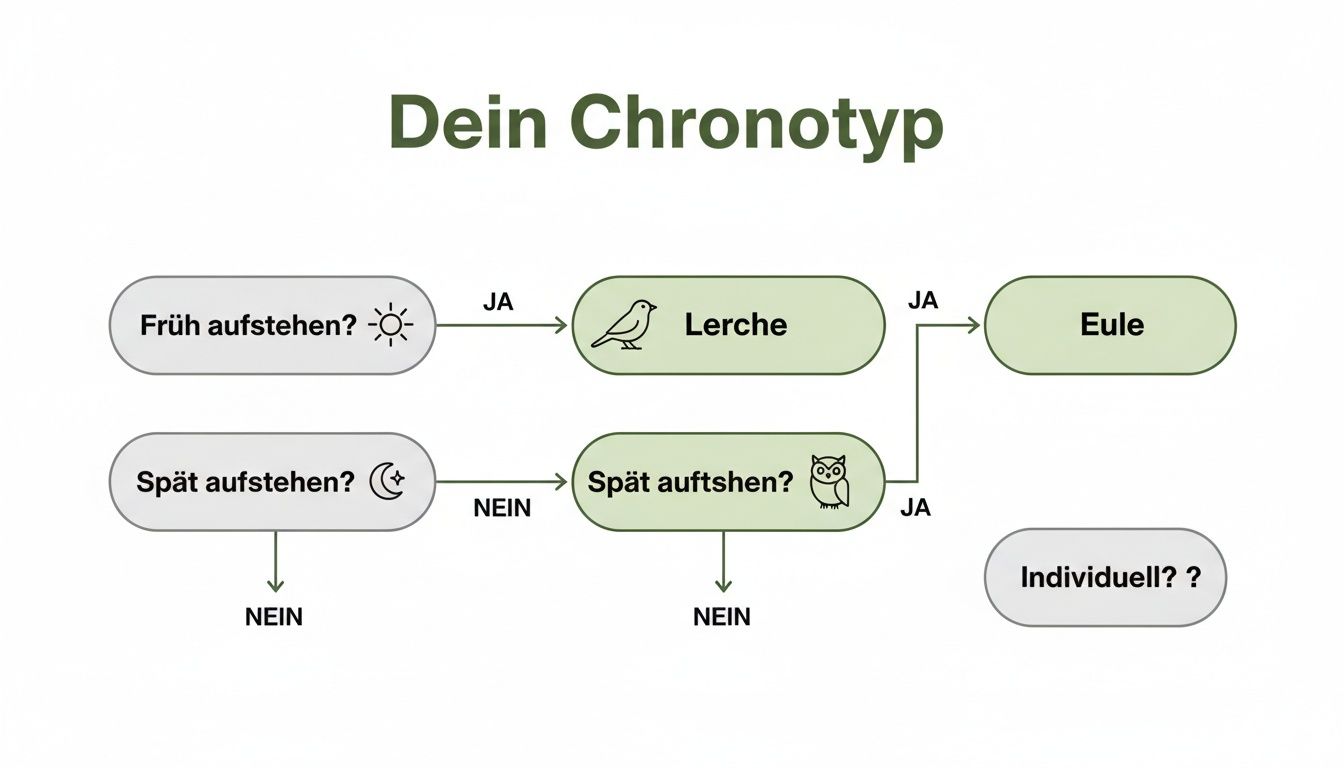
The graphic clearly shows: Your natural wake-up and sleep times are the best indicators of whether you are more of a Lark or an Owl. This knowledge is the basis for truly tailoring your training plan to yourself.
The key is to not ignore the signals from your body but to use them strategically for yourself. Instead of forcing yourself as an Owl to do an intense HIIT workout in the morning, strength training in the late afternoon might be much more effective for you. You can find more details on the scientific background in our comprehensive article about the circadian rhythm.

Once you know your chronotype, it’s time to get into the specifics: planning your workouts. It makes a huge difference when you train – depending on whether you want to build muscle, improve your endurance, or simply become more flexible. The right time of day can be your strongest ally.
The idea is simple: We use your body’s natural energy peaks instead of fighting against them. This way, you not only get more out of each training session but also feel noticeably more energetic and joyful.
Early morning is perfect for short, explosive workouts. Your body releases the most cortisol at this time – a hormone that keeps you awake, alert, and ready for the day. You should take advantage of this natural energy boost for high-intensity workouts.
Imagine you arrive at one of our HIIT & Bootcamp classes in Zurich at 8 AM. This is often exactly when your body reaches its first peak performance. This is not esotericism, but biology. Swiss research confirms this: A study showed that the maximum heart rate of test subjects peaked significantly at this time – a clear indication of higher readiness for performance. If you want to dive deeper, you can find further insights from this Swiss study on circadian rhythms.
This biological “prime time” makes the morning perfect for really challenging your cardiovascular system and revving up your metabolism for the rest of the day.
Is your goal muscle building or increasing your maximum strength? Then plan your sessions for the late afternoon. Between 4 PM and 7 PM, several physiological processes are in full swing:
Strength training in the Templeshape studios after work is not only practical but also biologically absolutely sensible. You train just when your body is best equipped for strength efforts.
Your body is not a machine that delivers the same performance around the clock. Planning training in the late afternoon is like training with a tailwind – you reach your goal with less perceived effort.
The evening should be dedicated to winding down and recovery. Intense workouts are now counterproductive, as they can disrupt the production of the sleep hormone melatonin and keep your nervous system unnecessarily alert. The result: you lie wide awake in bed, even though you should be tired.
Instead, calmer sessions are ideal for winding down the day. Classes like yoga, Pilates, or breathwork help you reduce stress, activate your parasympathetic nervous system (the “rest nerve”), and prepare your body for a restful night.
A gentle evening routine not only improves your flexibility but especially your sleep quality – and that is the absolute foundation for any training progress.

The theory behind training according to the internal clock is one thing. But how do you fit it all into a hectic Zurich everyday life? The good news: you don’t have to turn your life upside down.
The key lies in finding a clever structure that works for you. Your circadian rhythm does not demand perfection, just a bit more consistency.
To show you how this can look, I have designed two exemplary weekly plans. Consider them as inspiration, not a rigid prescription. You can adapt them flexibly, and they show you how to balance different types of training – as you can also find with us inTempleshape– with the all-important recovery.
This plan is for you if your day is dominated by meetings and deadlines, and you need your training as an energy boost and mental balance. The focus here is on short, snappy units that can easily fit into the workday.
A well-structured plan is your anchor in everyday life. It takes the burden of decision-making off you and makes it easier to make health a habit, even when the calendar is full.
This plan is designed for mothers who want to rebuild their energy after giving birth, specifically strengthen their bodies, and consciously take time for themselves. The sessions are designed to support postpartum recovery and soothe the nervous system.
Nochmal: Das sind nur Vorlagen. Finde heraus, was sich für dich gut anfühlt, und spiele mit den Zeiten und Aktivitäten, bis sie zu deinem ganz persönlichen Rhythmus passen.
Dein Training nach der inneren Uhr auszurichten, ist ein riesiger Schritt nach vorn. Aber ehrlich gesagt, ist das nur ein Teil des Puzzles. Damit dein zirkadianer Rhythmus wirklich stabil und kraftvoll schwingt, braucht er ein solides Fundament. Und das steht auf drei entscheidenden Säulen: Schlaf, Ernährung und Licht.
Stell dir diese drei Elemente wie die präzisen Stellschrauben für deine innere Uhr vor. Wenn du sie bewusst steuerst, optimierst du nicht nur deine Erfolge im Training. Du steigerst ganz nebenbei deine Lebensqualität, deine Konzentration und deine Stimmung. Oft sind es die kleinen, unscheinbaren Anpassungen, die eine erstaunlich grosse Wirkung haben.
Was du isst und vor allem wann du es isst, hat einen direkten Draht zu deinem Energielevel und deiner inneren Uhr. Es geht hier nicht nur um Kalorien, sondern darum, die Nährstoffaufnahme so zu timen, dass sie deinen Körper perfekt synchronisiert.
Zwei simple Regeln können hier schon einen gewaltigen Unterschied machen:
Allein diese kleinen Anpassungen im Timing deiner Mahlzeiten unterstützen deinen natürlichen Rhythmus und sorgen für stabile Energie – ganz ohne das Nachmittagstief.
Licht ist der mit Abstand wichtigste äussere Taktgeber für deinen zirkadianen Rhythmus. Morgens ist es das Signal für deinen Körper, die Produktion des Schlafhormons Melatonin einzustellen und stattdessen das aktivierende Hormon Cortisol auszuschütten. Abends bewirkt die Dunkelheit dann genau das Gegenteil.
Dein Körper braucht klare Signale. Gib ihm morgens helles Licht und abends konsequente Dunkelheit. So einfach ist das Grundprinzip für einen gesunden Schlaf-Wach-Rhythmus.
Und so setzt du das ganz praktisch um:
Gerade wir in der Schweiz spüren doch jedes Jahr aufs Neue, wie empfindlich unser System ist. Die Zeitumstellung bringt den zirkadianen Rhythmus messbar aus dem Takt. Daten des Bundesamts für Statistik zeigen, dass nach der Umstellung auf die Sommerzeit die Anzahl der Notfälle um 6,5 Prozent ansteigt. Herzinfarkte und Schlaganfälle häufen sich, weil unsere innere Uhr gewaltsam verstellt wird. Ein starkes Argument, den eigenen Rhythmus im Alltag bewusst zu pflegen.
Diese Routinen rund um Licht und Schlaf sind keine Kleinigkeiten – sie sind die Basis für alles andere. Wenn du diese Säulen stärkst, wirst du merken, wie viel leichter dir plötzlich auch dein Training fällt. Viele dieser Prinzipien sind übrigens auch Teil unseres Ansatzes, den du in unserem Guide zum Thema Biohacking für Anfänger nachlesen kannst.

Ein zirkadianer Rhythmus, der aus dem Gleichgewicht ist, macht dich nicht nur müde – die Auswirkungen sind viel tiefgreifender. Stell dir deine innere Uhr wie den Dirigenten eines riesigen Orchesters vor. Gerät er aus dem Takt, spielen bald alle Instrumente chaotisch durcheinander. Dieses Chaos spürst du auf allen Ebenen, körperlich und mental.
Wenn dein Schlaf-Wach-Zyklus immer wieder durcheinandergerät – sei es durch Schichtarbeit, Jetlag oder einfach einen Lebensstil mit langen Nächten vor dem Bildschirm –, dann leidet dein gesamtes Hormonsystem darunter. Das kann dein Wohlbefinden massiv beeinträchtigen und langfristig zu ernsthaften Gesundheitsrisiken führen.
Einer der empfindlichsten Bereiche ist unsere Psyche. Ein chronisch gestörter Rhythmus erhöht nachweislich das Risiko für affektive Störungen wie Depressionen und Angstzustände. Die Verbindung ist so stark, dass Schlafprobleme oft als eines der ersten Warnsignale gelten.
Wusstest du das? Bis zu 80 % der Patienten in der Schweiz, die an Depressionen oder Schizophrenie leiden, haben auch mit Schlafstörungen zu kämpfen, die direkt auf einen gestörten zirkadianen Rhythmus zurückzuführen sind. Bei Menschen mit einem verzögerten Schlafphasensyndrom wurde sogar bei 75 % eine Depression diagnostiziert. Du kannst mehr über diese Schweizer Studie zu innerer Uhr und Psyche erfahren, um die Zusammenhänge noch besser zu verstehen.
A stable rhythm is the foundation for mental resilience. If you ignore your internal clock for an extended period, you weaken not only your body but also your ability to cope with everyday stress.
Your metabolism also follows a strict schedule. If you eat at irregular times or are active at night, you disrupt exactly the hormones responsible for hunger, satiety, and fat burning.
This has very concrete consequences:
This knowledge should not unsettle you but show you how much power you have over your well-being. It emphasizes how important it is to consciously shape your daily life – from the right timing for workouts to optimal recovery.
A balanced rhythm not only enhances your performance but is also the key to how youactivate your mitochondria and find 100% more vitality.
Theory is one thing, everyday life is another. You have now read a lot about how to align your training, sleep, and even your meals with your internal clock. But what if real life interrupts?
I have gathered the most common questions that I encounter repeatedly in coaching and our courses. Consider them your personal compass that helps you eliminate the last uncertainties and truly make the principles of biorhythm work for you.
This is probably the biggest hurdle for most of us. You are a “night owl,” but your job practically forces you into sneakers before the sun rises? Don’t worry, it’s not about perfection. It’s about smart adjustments.
In such a case, flexibility is everything. Don’t force yourself into a brutal HIIT workout in the morning that only stresses your body. Instead, choose a gentler session that wakes you up rather than drains you – a dynamic yoga flow or a Pilates session, for example.
Maybe you can use lunch break for a brisk walk in the fresh air? That not only soaks up daylight and stabilizes your rhythm but also gives you a real energy boost. In the end, it’s not about the perfect timing onevery day, but the consistency of your routine throughout the week.
Yes, absolutely. Your physical performance fluctuates throughout the day, and this also affects factors that are crucial for injury prevention. Your coordination, muscle strength, and even your flexibility are not constant.
In the late afternoon, your core body temperature reaches its peak. This means that your muscles and ligaments are more supple and better supplied with blood. This time is often ideal for technically demanding or heavy strength exercises, as the risk of injury is generally lower here.
But no matter when you train: A thorough warm-up remains your best insurance against injuries. Just adjust the intensity of your warm-up to the time of day – in the morning, it can take a few extra minutes to get your body up to operating temperature.
The most important thing first: Be patient with yourself. A change is initially a significant shift for the body, and it loves habits. Depending on how much you adjust your routine, it can take anywhere from a few days to two weeks for everything to settle down.
Take it step by step. Instead of setting your alarm two hours earlier overnight, try it in15-minute increments.Push your wake-up time forward a little every day or every other day. Actively support your body:
A fixed routine is the strongest anchor for your internal clock. The more consistently you use these little helpers, the faster your body will adapt to the new rhythm – and you will feel the positive energy.
Are you ready to take your training to the next level and make your health a habit? At Templeshape in Zurich, you will find the courses, community, and expertise to perfectly align your training with your internal rhythm. Discover our schedule and find the energy that lies within you.Visit us at templeshape.com and start your journey.
Tags
 DE
DE FR
FR EN
EN