March 17
Your introduction to Vinyasa Flow Yoga for more strength and clarity
0 comments

March 17
0 comments
Have you ever heard of Vinyasa Flow Yoga and wondered what lies behind it? Imagine a dance where your breath is the music and each movement flows harmoniously into the next. This is exactly the magic of Vinyasa – it’s not about the perfect final pose but the fluid path to get there.
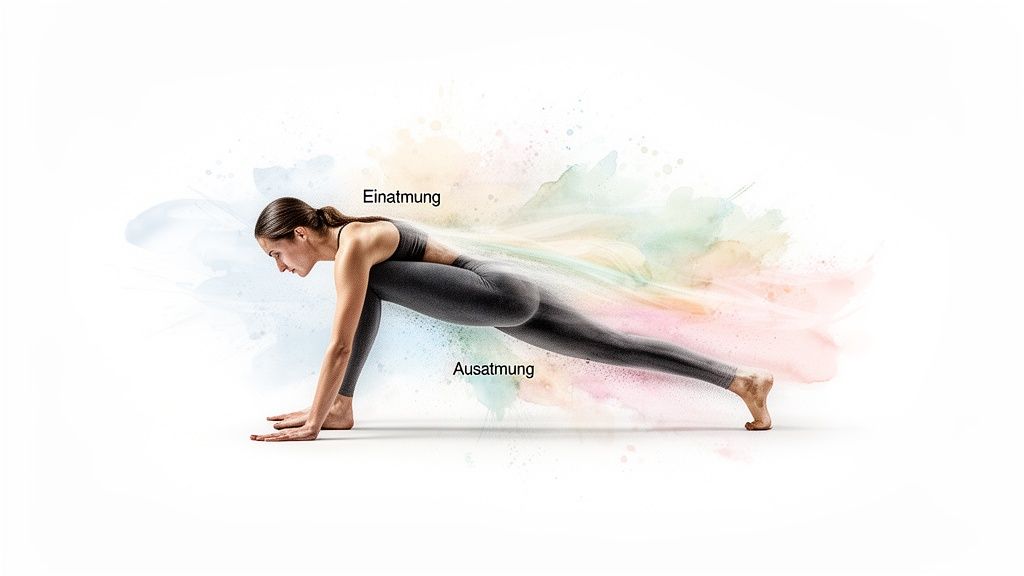
Vinyasa Flow is a dynamic and fluid form of yoga, often described as ‘meditation in motion.’ What makes it special? The conscious synchronization of breath and movement. Each pose, each asana, is intentionally linked to an inhale or an exhale. This creates an uninterrupted flow of movement that fully immerses you in the present moment.
The term ‘Vinyasa’ comes from Sanskrit and means something like ‘to place in a particular way.’ This perfectly highlights the conscious intention behind each movement. You do not simply place your body into a pose; you let your breath guide you there. This approach helps you shift from your head directly into your body.
In Vinyasa Flow, your breath is the conductor of your personal orchestra. It sets the rhythm and speed at which you transition from one pose to another. You will quickly realize: the breath here is not just background music, but the true driver of your practice.
A classic example is the transition in the sun salutation:
This constant connection makes your yoga practice a deep and meditative experience. The emphasis on breath calms your nervous system and helps you cut through the mental noise of daily life. It’s about being present here and now – just you, your breath, and your mat.
Vinyasa Flow is the art of connecting movement and breath so that they become a single fluid unit. It’s not so much a workout as it is an ‘inner work’, cultivating inner strength and outer flexibility.
Unlike yoga styles with fixed sequences, like Ashtanga yoga, Vinyasa Flow thrives on its creativity and diversity. No class is the same. Teachers create sequences anew every time, focusing on different aspects and integrating surprising transitions.
This variety not only keeps your mind alert but also challenges your body in renewed ways. Sometimes the focus is on heart-opening poses, sometimes on powerful standing poses or detoxifying twists. It is precisely this diversity that makes the style so exciting and ensures that your motivation remains intact.
For you, as a busy person, Vinyasa Flow offers the perfect balance. In a 60 or 75 minute class with us at Templeshape in Zurich, you find everything you need for a balanced body and a clear mind: a comprehensive workout that reduces stress while boosting your energy. You strengthen your muscles, improve your flexibility, and find inner peace – all in a single breath.
Vinyasa Flow Yoga is much more than just a series of elegant poses. It’s an incredibly powerful tool you can use to sustainably elevate your physical and mental health to a new level. Think of it as a complete system whose positive effects radiate far beyond the yoga mat into your daily life.
Each session is a dynamic full workout. The flowing movements gently engage your muscles but in an incredibly effective way. Thus, you are not only building strength but also visibly improving your flexibility.
Unlike isolated gym workouts, in Vinyasa Flow, you work with sequences of complex movements. These simultaneously activate entire chains of muscles. This not only strengthens the large visible muscles but especially the important deep muscles – your foundation for a stable and upright posture.
Regular practice can help you target daily pains and discomforts:
Thanks to the constant movement, you also train your body awareness. You learn to listen to your body’s signals again and develop a better sensitivity to your own limits and needs.
Perhaps the deepest effect of Vinyasa Flow manifests at a mental level. The key lies in the synchronization of breath and movement. This helps you calm the constant flow of thoughts and be fully here and now.
This conscious emphasis on breath has direct physiological effects. It activates the parasympathetic nervous system – the part of your nervous system responsible for relaxation and regeneration. The result? A visibly reduced stress level.
Vinyasa Flow teaches you to find stillness amidst movement. This ability to stay present, even when it’s challenging, is one of the most valuable lessons for everyday life.
Especially in Switzerland, particularly in a dynamic city like Zurich, Vinyasa Flow has become one of the key trends for holistic well-being. Especially for active individuals, it’s an ideal way to reduce stress. Studies show that 72 percent of practitioners notice a significant reduction in the stress hormone cortisol of 22 percent after just eight weeks. At Templeshape GmbH in Zurich, we closely observe this trend: since 2023, we have seen an increase of 35 percent during reservations for Vinyasa classes, which confirms the growing demand for a conscious balance facing busy urban life.
Practicing on the mat trains your ability to concentrate quite naturally. By regularly refocusing your attention on your breath and your next movement, you train your mind to stay focused – almost like a moving meditation.
This enhanced concentration directly impacts your life off the mat, whether at work or in personal projects. You’ll notice that you can think more clearly and focus better on a task. The combination of physical effort and mental relaxation also provides a sustainable energy boost that carries you through the day. Would you like to dig deeper into how reduce stress through sport and yoga ? Vinyasa Flow is the ideal starting point for that.
The world of yoga is vast and colorful. Honestly? At first, it can be quite overwhelming to find the style that suits you. Terms like Vinyasa, Hatha, and Ashtanga are thrown around everywhere – but what do each of them really mean and which path is right for you? No worries, we’ll clarify the jungle of yoga styles together.
Imagine the different styles as music genres. Hatha Yoga would be like calm classical music – basically, the foundation on which much is built. Ashtanga? It’s energetic techno: a fixed, powerful, and disciplined sequence that really makes you sweat. And Vinyasa Flow Yoga ? It’s like a creative DJ mix, where no playlist is the same.
Hatha Yoga is somewhat the origin of many modern yoga styles and a great starting point if you’re a beginner. Here, the focus is clearly on the slow and mindful holding of certain body postures (asanas). You consciously take the time to feel each pose, find your alignment, and breathe deeply into the stretch.
In Hatha Yoga, there are often longer breaks between exercises. This gives you the precious opportunity to really feel the effect of each posture on your body and mind. If you’re looking to slow down and learn the basics of yoga in a calm manner, Hatha is a wonderful starting point.
Ashtanga Yoga is practically the opposite of slowness. It’s a very dynamic and physically demanding style that relies on a fixed series of postures. Each person practicing Ashtanga always performs the same sequence – the “Primary Series” for beginners – at a clearly defined pace.
The transitions between postures are fluid and synchronized by a special breathing technique, Ujjayi breathing. This practice quickly develops strength, endurance, and flexibility but also requires a high degree of discipline. If you like having a clear structure and are looking for an intense physical challenge, Ashtanga might be for you.
Vinyasa Flow Yoga takes the fluid transitions of Ashtanga and the postures of Hatha, but connects them in a completely free and creative manner. There are no fixed series here. Each class is unique, instructors compose the sequences anew, often inspired by a particular theme or intention for the class.
The heart of Vinyasa Flow is the uninterrupted interconnection between breath and movement, which creates a meditative and dancing state. It’s less about perfection and more about expression in the moment.
This is precisely what makes this style incredibly versatile. Sometimes the flow is fast and powerful, sometimes slow and almost meditative. It’s this variation that makes Vinyasa Flow Yoga so interesting and accessible to many people. You learn to listen to your body and move intuitively. If you’re looking for creative expression and a dynamic balance with daily life, you’re in the right place. To give you an idea of the diversity of classes, take a look at our different yoga classes in Zurich.
To make your decision easier, we have summarized the main characteristics of the three styles in a table. This table will help you quickly grasp the main differences between Vinyasa Flow, Hatha, and Ashtanga Yoga.
| Characteristic | Vinyasa Flow Yoga | Hatha Yoga | Ashtanga Yoga |
|---|---|---|---|
| Tempo | Variable, often dynamic and fluid | Slow and thoughtful | Fast, powerful and rhythmic |
| Sequence | Creative and always new | Individual postures with breaks in between | Fixed and unchanging series |
| Concentration | Connection between breath and movement, flow | Correct alignment, long hold | Discipline, strength, Ujjayi breathing |
| Suitable for | Everyone who loves variety and creativity | Beginners and seekers of relaxation | Athletes looking for a challenge |
Ultimately, there’s no “right” or “wrong”. The best style of yoga is the one that makes you feel good and that you want to practice regularly. My advice: just try different styles and discover what resonates with you and your body.
Enough talk, let’s get on the mat! The best way to understand Vinyasa Flow Yoga is to simply practice it. We will guide you step by step through a simple and safe sequence that you can easily try at home.
It’s not about perfection, but about feeling the flow. Feel how your breath carries you from one pose to another. Be curious, have fun, and let’s get started.
Before you start moving, take a moment to really arrive. Settle comfortably on your mat, perhaps on a cushion, so that your hips are slightly elevated. Gently close your eyes.
Take a few deep breaths through your nose and let the air escape through your mouth. Imagine releasing a bit of daily stress with each exhale. Then, focus on your natural breath, flowing autonomously without you having to do anything.
A good warm-up is essential to prepare your body for the flow. The movement of Cat and Cow is perfect for this – it awakens the spine and establishes an initial conscious connection between breath and movement.
Repeat this fluid movement5-10 timesat your own pace. Feel how your spine becomes more supple with each cycle and how your breath becomes deeper.
Now, we move on to the serious stuff. We will link a few classic poses in a short powerful sequence. This little flow uses elements of sun salutations and guides you through fundamental standing poses. Be aware of how each movement is initiated by your breath.
The sequence:
Tip for beginners:Use props! If you have difficulty bringing your foot forward, place two yoga blocks under your hands. This will give you more space and stability.
A central element of Vinyasa Flow is the transition, called ‘Vinyasa’, which links different parts together. We will practice a simple and modified variant here to gracefully return to Downward-Facing Dog.
Take a few deep breaths here, then repeat the whole sequence with your left leg. So restart with the inhale in Three-Legged Dog, this time lifting your left leg.
Before you start, take a look at this decision tree. It can help clarify your motivation for today: are you seeking relaxation, strength, or rather creative expression?
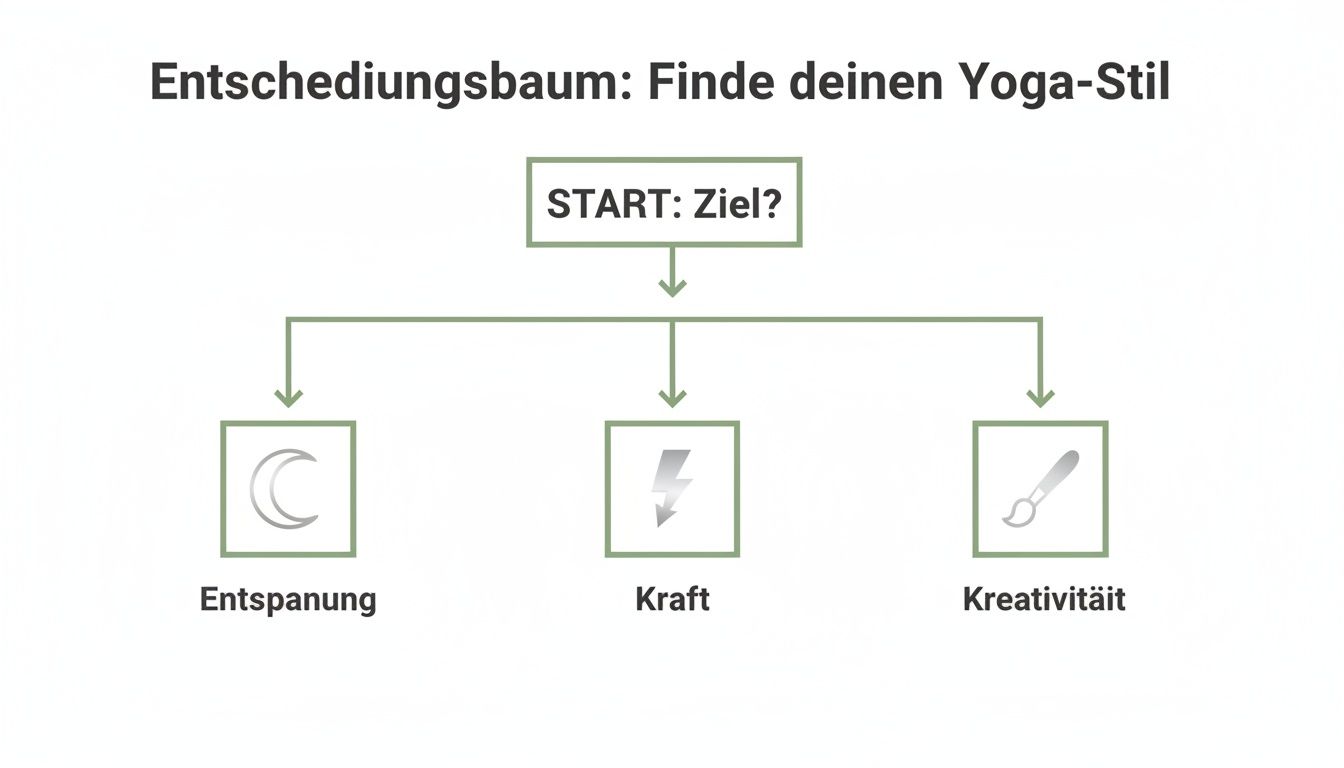
As the chart shows,Vinyasa Flow Yogais an ideal choice if your goal is creativity and dynamic expression. For pure relaxation or targeted strengthening, other styles may sometimes suit better.
Congratulations! After practicing on both sides, slowly come from Downward-Facing Dog onto your knees and sit on your heels in Child’s Pose (Balasana). Let your forehead rest on the mat, arms relaxed by your sides. Stay here for a few truly calm breaths.
Finish your short practice by lying flat on your back (Savasana) for a few minutes. Gently cover yourself to avoid getting cold. Give your body time to process and integrate the sensations of movement.
Congratulations! You have just mastered your first Vinyasa Flow. This simple sequence offers you a first glimpse of the magic of the connection between breath and movement. It is the perfect preparation to confidently attend your first yoga class with us at Templeshape.
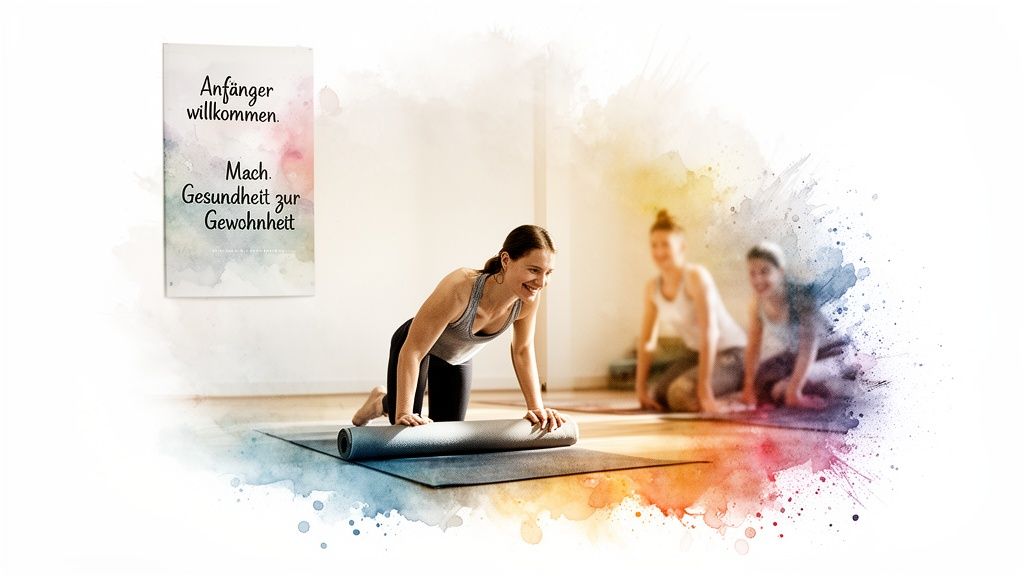
Enough theory – are you ready to start your yoga journey here in Zurich? Wonderful! Consider this section as your personal guide to Vinyasa Flow at Templeshape. We hold your hand and show you how simple and rewarding it can be to start with us.
Our philosophy is simple:“Make health your habit.”With us, it’s not about acrobatic performances or who is the most flexible. On the contrary, we want to help you make exercise and mindfulness a joyful and regular habit. A perfect balance in the midst of Zurich’s often busy program.
No matter where you are in Zurich, we are just near you. You can find our Vinyasa Flow classes at two central locations: atHealth Temple CITYand atHealth Temple AIRPORT.Both studios are designed for you to disconnect immediately and focus entirely on yourself and your mat.
Our Vinyasa classes are open to all levels. Whether you are stepping onto a yoga mat for the first time or looking to deepen your practice, our experienced teachers welcome you exactly where you are. They will always show you different variations so you can adapt each pose to your shape of the day and your needs.
Preparation is extremely simple. The essentials, you already have: your curiosity and the desire to do good for yourself. We will take care of the rest.
To help you get started in a relaxed manner, here is a small checklist:
We provide in our studiosfor freeyoga mats, blocks, straps, and everything you need for a good practice. So, you really only need to bring yourself.
At Templeshape, you are not just a member but an integral part of a warm and supportive community. Our members are as diverse as Zurich itself: workers seeking balance, beginners taking their first steps, and mothers from our Motherhood Club enjoying a conscious break.
Many women discover in Vinyasa Flow a powerful way to improve their well-being. The numbers speak for themselves: in Switzerland,82 percentof yoga practitioners are women; in studios like ours in Zurich, even88 percent.Since 2020, we have seen a40 percent increasein our classes for moms – a clear sign of the demand for targeted offerings.65 percentof our female members use Vinyasa specifically to reduce stress, and78 percentreport a significant energy boost after just 12 weeks.
In this pressure-free atmosphere, you can thrive freely, ask questions, and simply be. We create a safe space where you can grow and achieve your personal goals.
Are you curious? The next step is very simple: book yourtrial yoga session without commitment in Zurichand feel for yourself how enjoyable Vinyasa Flow is with us. We really look forward to welcoming you.
You’ve already read quite a bit about this dynamic style of yoga, but some questions are still lingering in your mind? No worries, it’s completely normal. Here, we clarify the most frequently asked questions we encounter in the studio – briefly, honestly, and directly from practice, so you are perfectly prepared for your first class.
A very clear answer is yes! This is one of the most common uncertainties we hear. You absolutely do not need prior experience to start withVinyasa Flow Yoga.It’s not about perfectly mastering every pose from the start or being super flexible.
The most important thing is that you learn to connect your movement with your breath – and this is where we hold your hand. Our experienced teachers will show you adaptations suitable for beginners for more delicate poses in each class. You will be encouraged to listen to your body and respect your own limits.
A classic example: instead of doing a full push-up (Chaturanga), you can always lower your knees to the mat. This gentle entry ensures that you practice safely, build your strength, and most importantly discover the joy of the flow, without overexerting yourself.
To really feel the positive effects of Vinyasa Flow – both physically and mentally – consistency is key. To start,one to two hours per weekis an excellent goal. This gives your body enough time to adapt to the new movements and recover between sessions.
Even with this frequency, you’ll soon notice your first progress: you’ll feel stronger, your posture will improve, and you’ll find it easier to calm down after a stressful day.
If you find that the flow feels good and you want more, you can certainly increase your practice to three hours or more per week. But remember: consistency outweighs intensity. A regular practice once a week is more valuable than four hours in one week followed by a month off.
That’s a very good question, as both styles are dynamic and powerful. The terms are sometimes used interchangeably, but there is a subtle yet decisive difference in emphasis.
Power Yoga is a fitness-oriented variant of Ashtanga Yoga developed in the West. Here, the focus is clearly on developing physical strength and endurance. The sequences are often intense and push you to your physical limits.
Vinyasa Flow Yogaplaces more emphasis on the creative and meditative connection between breath and movement. While the practice can also be very powerful, the regular, almost dancing flow is at the forefront. The creative freedom in designing the sequences makes each class unique.
You might see it this way: Power Yoga is the intense workout that pushes you to your strength limits. Vinyasa Flow is the meditative dance where strength appears as a wonderful side effect.
Yes, a regular practice of Vinyasa can really support you on your journey. The dynamic nature of the classes boosts your metabolism and burns calories. By engaging complete muscle chains, you’re also building lean muscle mass, which increases your basal energy expenditure – you burn more energy even at rest.
But yoga is much more than just a physical outcome. The practice also has a profound impact on your mental habits:
Vinyasa Flow is therefore a holistic approach that helps you not only to achieve physical goals but also to establish a healthy and loving relationship with yourself.
Ready to experience the flow for yourself? WithTempleshape GmbHyou create a sustainable health habit within a supportive community. Find your class in Zurich now and feel for yourself how enjoyable Vinyasa is.
Tags
 DE
DE FR
FR EN
EN