March 18
Magnesium deficiency: The master mineral for relaxation – Your path to calm
0 comments

March 18
0 comments
Do you often feel overwhelmed, tired, or tense? If yes, you are not alone. What many do not know is that a magnesium deficiency could be the invisible cause behind it. This mineral is indeed absolutely essential to your ability to truly relax and reduce stress. One could almost say that magnesium is the natural sedative of your nervous system.
Imagine your body as an immense orchestra. For the music to sound harmonious in the end, there needs to be a conductor who gives the right signal to each instrument. That is exactly the role that magnesium plays in your body – it directs the interaction between the nervous system and the muscles.
Without this conductor, the entire system goes out of control. The consequence is inner chaos: your nerves are constantly overstimulated, muscles contract much more easily, and you feel like you are constantly under tension. This is not a coincidence, as magnesium directly intervenes in our stress axis.

When you are stressed, your body secretes the hormone cortisol – this puts you on high alert. This is where magnesium comes into play: it acts as a natural antagonist and helps reduce cortisol secretion. In case of deficiency, this regulatory mechanism can be disturbed, and your stress level remains chronically high.
At the same time, magnesium stimulates the production of an important messenger in the brain: GABA (gamma-aminobutyric acid). GABA has a calming effect on your central nervous system and slows down excessive neuronal reactions. Just imagine it as the brake pedal for your brain.
Magnesium is much more than just a mineral – it is a fundamental element for your inner peace. It helps your body switch from ‘fight or flight’ mode to ‘rest and digest’ mode.
The demands of our modern life – whether in your demanding job, as a mother, or in corporate health programs – explode your need for magnesium. Many people feel strongly stressed by their work. Especially in professions like caregiving, this is often aggravated by structural problems such as constant overtime due to staff shortages.
A magnesium deficiency directly sabotages your ability to relax. The good news: you can break this cycle. Once you understand how this master mineral works for relaxation, the first step is taken to regain your inner balance. In addition to proper nutrition, exercise also makes a huge difference. In our article, you will learn more about how to reduce stress through sports and yoga.
The following sections will show you concretely how to recognize the signs of a deficiency and what you can do about it.
A magnesium deficiency rarely knocks on your door loudly. It often sneaks into your daily life much more quietly, disguised as daily discomforts that you might simply attribute to stress or lack of sleep. But it is precisely these subtle signals that your body sends you when it lacks the essential ‘relaxation mineral.’
Forget for a moment the infamous calf cramps – that is a well-known sign, but by no means the only one. A magnesium deficiency can manifest itself in various ways and notably affect your physical and mental performance.

Do you often feel in the morning as if you have been crushed, even when you seem to have slept enough? This constant and inexplicable fatigue is a typical warning signal. Magnesium is involved in more than 300 metabolic processes that produce energy for your cells. In its absence, your body operates almost at low intensity. Everything about the causes and what you can do about them, you will learn in our article on Fighting Fatigue – Causes and Tips..
But the signs go even further. Perhaps you feel this inner agitation or constant nervousness without any particular reason. Your thoughts are spinning, you have difficulty disconnecting, and you are easily irritated. This is due to the fact that magnesium calms your nervous system. In case of deficiency, the reactivity threshold decreases – you simply react more sensitively to stress.
This table shows you at a glance which physical and mental signs indicate a magnesium deficiency and what processes are behind it in the body.
| Symptom | Possible physical cause | Example from your daily life |
|---|---|---|
| Sleep problems | Magnesium regulates sleep hormones like melatonin and soothes the nervous system. A deficiency disrupts this rhythm. | You toss and turn in bed for hours, wake up often at night, or don’t feel rested in the morning despite 7-8 hours of sleep. |
| Headaches & migraines | A lack of magnesium leads to muscle tension and spasms in the blood vessels of the head and neck. | You often suffer from tension headaches, especially after a long day at the office. |
| Irresistible craving for chocolate | Your body instinctively signals the need for magnesium-rich foods. Dark chocolate is an excellent source. | In the afternoon, an almost irresistible craving for chocolate hits you while you aren’t really hungry. |
| Muscle twitching | The nervous system is hyperactive, leading to fine, uncontrollable muscle contractions. | Your eyelid has been twitching for days or you notice slight tremors in your thigh after exercising. |
Often, it is the sum of these small but persistent discomforts that indicates a deficiency.
By the way, these symptoms are not rare in Switzerland. An in-depth study by the Federal Office of Food Safety and Veterinary Affairs (OFAL) shows that a large part of the population does not reach the recommended intake of magnesium. In particular, young women aged 18 to 34 consume on average only 282 mg per daywhat is often insufficient, although the reference values are between 300 and 310 mg. You will find more information on these interesting conclusions in the detailed OFAL report.
To make these abstract symptoms more tangible, let’s look at two typical examples you may know from your own surroundings.
Case Study 1: The working mother
Anna juggles between a demanding job and her family life. In the evening, she is completely exhausted but cannot fall asleep because her thoughts are racing. At night, she often wakes up with tense shoulders and suffers from headaches during the day. She attributes her chocolate cravings in the afternoon to stress – it could be a cry for help from her body for magnesium.
Case Study 2: The stressed manager
David is constantly under pressure at work. He has noticed a constant twitch in his eyelid for some time now and often feels nervous and unfocused. Although he exercises regularly, he suffers from muscle cramps after training more frequently than in the past. His inner stress makes it difficult for him to truly disconnect after work.
The two examples show how a magnesium deficiency manifests in daily life. They are not dramatic illnesses, but a sum of small discomforts that insidiously reduce your quality of life. By learning to correctly interpret these hidden signs, you are taking the first and most important step to regain your energy and inner calm.
You pay attention to your diet, but you often feel exhausted, tense, or just not on top? No worries, you are absolutely not alone. Many wonder why this essential “relaxation” mineral is lacking despite their efforts. The answer is often much more complex than simply “not enough spinach” – it is deeply rooted in our modern lifestyle.
A magnesium deficiency never occurs due to a single mistake. It is usually the result of several interacting factors. Imagine your magnesium level like a bank account: when the expenses (consumption) consistently exceed the income (absorption), you find yourself in the red. This is exactly what happens with your bodily reserves.
Even if you shop mindfully, it has become a real challenge to cover your magnesium needs solely through diet. A major problem lies in our soils. They are often so depleted by intensive agriculture that they contain much fewer minerals than in the past. This means that the carrot or broccoli on your plate often provides less magnesium than the vegetables from grandmother’s garden.
Furthermore, there is the high proportion of highly processed foods in our diet. During the processing of whole grains into white flour or sugar beets into refined sugar, up to 80 %the original amount of magnesium is lost. These “empty” foods fill your stomach but not your mineral reserves – and quickly drag your balance down.
A magnesium deficiency is often not the result of a lack of effort. It is much more common for it to be a direct consequence of our modern environment and eating habits.
Is your daily life demanding? Are you juggling between a demanding job, family, and perhaps intense training sessions at Templeshape? This is where one of the biggest magnesium thieves of our time lurks: stress.
Under pressure, your body releases stress hormones such as cortisol and adrenaline. This reaction prompts your cells to release magnesium, which is then further eliminated through urine. The more stress you have, the more quickly your reserves are depleted. The problem is the vicious circle: stress consumes magnesium, and a magnesium deficiency makes you more vulnerable to stress again.
The same goes for sports. If you push yourself hard during an intense HIIT workout or train for a Hyrox competition, you lose not only water through sweat but also precious minerals like magnesium. At the same time, your body desperately needs this mineral for muscle contraction, energy production, and the crucial recovery afterwards.
Your need may therefore quickly climb, especially due to:
In addition to diet and stress, there are other habits that silently nibble away at your magnesium reserves on a daily basis. These factors can significantly increase the elimination of this mineral and promote a deficiency.
Coffee and alcohol
Your beloved morning coffee or a glass of wine to unwind in the evening can stimulate magnesium elimination through the kidneys. Caffeine and alcohol have a diuretic effect, leading to a higher-than-normal loss of minerals from your body. If you consume regularly, you can thus drag your magnesium balance down.
Certain medications
Some classes of frequently prescribed medications are also known to be magnesium thieves. They can either block absorption in the intestines or increase elimination through the kidneys. Among them are for example:
If you recognize yourself in one or more of these points, it is the first and most important step toward improvement. It’s not about having to do everything perfectly overnight. It’s about understanding the real causes so you can then act purposefully. In the next section, we will show you how to intelligently and sustainably refill your reserves.
The good news is that a magnesium deficiency is not a fate you simply have to accept. Quite the opposite! You can refill your reserves purposefully and above all sustainably – and usually without expensive mixes or pills, directly through your plate.
This section is your practical plan for a diet rich in this important relaxation mineral. We focus on how to easily incorporate the power of magnesium into your daily life so that you feel energized and serene again.
Think of magnesium in everything that is green, nutty, and whole. Mother Nature has offered us a plethora of delicious foods that are packed with this precious mineral.
Your shopping list for full magnesium reserves might look something like this:
Cette diversité te permet d’intégrer facilement le magnésium de façon naturelle dans tes repas.
Le savoir, c’est bien, mais le mettre en pratique, c’est mieux. Il ne s’agit pas de bouleverser complètement ton plan de repas. Souvent, ce sont les petites modifications conscientes qui font la plus grande différence.
Imagine que tu établis une petite habitude après l’autre. Chaque repas riche en magnésium est comme un dépôt sur ton “compte relaxation” personnel. Avec le temps, ces contributions s’accumulent et se traduisent par plus d’énergie et de sérénité intérieure.
Voici quelques idées simples que tu peux mettre en œuvre immédiatement :
Ces petits changements s’intègrent dans n’importe quel emploi du temps chargé et t’aideront à augmenter facilement ton apport.
Il est une chose de manger des aliments riches en magnésium. Une autre, c’est de s’assurer que ton corps absorbe réellement le minéral. Ce processus est appelé biodisponibilité, et avec quelques astuces, tu peux l’améliorer considérablement.
Un partenaire important pour le magnésium est la vitamine B6. Elle agit comme une clé et aide à faire entrer le magnésium dans tes cellules. De bonnes sources de vitamine B6 sont par exemple les bananes, les pois chiches, le saumon ou la volaille.
Évite également d’associer des repas riches en magnésium avec des aliments très riches en calcium, comme un grand verre de lait. Les deux minéraux sont en compétition dans l’intestin pour l’absorption, et un excès de calcium peut ralentir l’absorption du magnésium.
La réalité en Suisse montre qu’une alimentation consciente est importante. Selon l’étude menuCH, les femmes de tous âges n’atteignent en moyenne pas les valeurs de référence recommandées pour le magnésium. Surtout en Romandie et au Tessin, l’apport des femmes est souvent seulement de 85–90 % % du quota. Une exception concerne les hommes en Suisse alémanique âgés de 35 à 50 ans. Ils sont le seul groupe dont l’apport est d’environ 105 % au-dessus de la valeur de référence. Pour plus d’informations, consulte les résultats de l’enquête nationale sur l’alimentation..
En te concentrant sur une alimentation riche en nutriments et sur des combinaisons intelligentes, tu jettes les bases d’un équilibre en magnésium – et donc d’une plus grande détente et bien-être.
Bien sûr, une alimentation riche en magnésium devrait toujours être la priorité. Mais il y a des phases de vie et des situations où tes besoins augmentent tellement que tu ne peux presque plus les couvrir seulement par l’alimentation. C’est précisément à ce moment-là que des suppléments de magnésium de haute qualité peuvent être une véritable complémentation utile pour remplir tes réserves et assurer ton bien-être.
Il ne s’agit pas de suivre aveuglément une tendance. Il s’agit de soutenir intentionnellement ton corps lorsqu’il en a le plus besoin. Certaines circonstances sont en effet de véritables “voleurs de magnésium” et nécessitent simplement un apport plus élevé.
Tout le monde ne doit pas immédiatement se tourner vers les capsules ou les poudres. Mais pour certains groupes, une dose supplémentaire de magnésium peut faire une différence significative pour l’énergie et la sérénité intérieure.
Cet arbre décisionnel te donne une vue d’ensemble rapide pour déterminer si un supplément vaut la peine d’être envisagé pour toi.
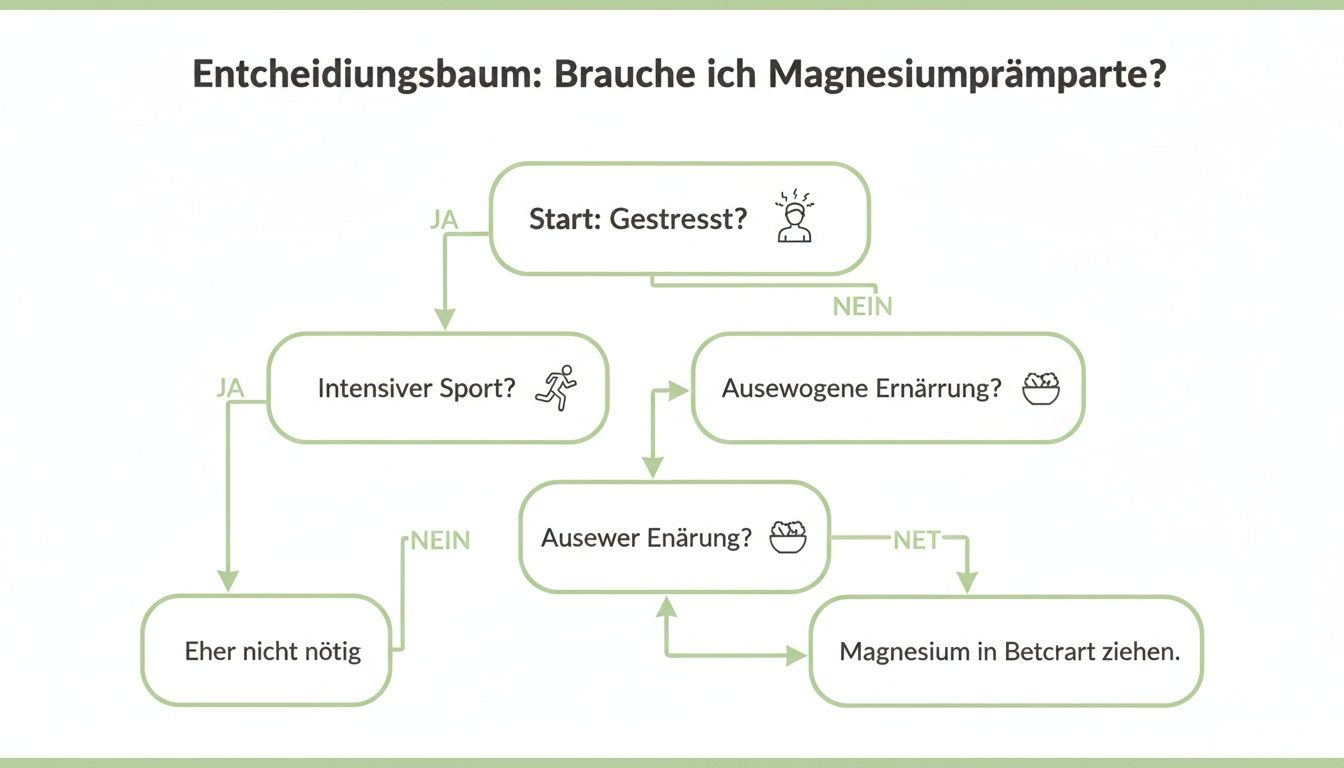
Le graphique l’illustre clairement : ton mode de vie et ton alimentation sont les facteurs déterminants qui déterminent si un supplément de magnésium est pertinent pour toi.
Lorsque tu choisis un supplément, tu te retrouves rapidement devant une immense étagère. Le point crucial réside dans la composition chimique à laquelle le magnésium est lié. Cette composition détermine à quel point ton corps peut bien absorber le minéral (Biodisponibilité) and for what use it is most suitable.
Choosing the right form of magnesium is essential for effectiveness. Think of it like buying running shoes: you choose the model that fits your goal – whether it’s a short sprint or a long marathon.
So, when you find yourself in front of the shelf, it’s good to know which form is right for you.
A comparison of the most common magnesium compounds, their bioavailability, and their specific benefits for relaxation, digestion, and muscle health.
| Form of magnesium | Main advantage | Ideal for you |
|---|---|---|
| Magnesium citrate | Very well bioavailable, slightly laxative effect | Quick replenishment of your stores, supports digestion |
| Magnesium glycinate | Excellent bioavailability, very well tolerated by the stomach, calming effect | Reduction of stress, better sleep and relaxation (your best choice!) |
| Magnesium oxide | High magnesium content, but low bioavailability | Short-term relief from constipation, less effective for addressing deficiencies |
In summary: if your goal is inner serenity and better stress resistance, then theMagnesium glycinateis clearly the best choice for you.
The dietary supplement market is booming, and for good reason. In Switzerland alone, an impressive number of1.9 million packagesof magnesium preparations have been sold, equivalent to a turnover of 65 million francs – a significant increase since27 %2019. However, despite this popularity, about29% of womenand26% of menare still suffering from a deficiency. This shows the importance of the right choice and application. You can learn more about theorigins of this trend in Switzerlandhere.
Having knowledge about magnesium is the first important step. The real magic happens only when you integrate this knowledge into your daily life. It’s not about transforming your life overnight. Your journey towards more relaxation begins with small conscious decisions that, over time, turn into powerful habits.
The goal is a lifestyle that naturally supports your magnesium balance and sustainably strengthens your stress resistance. Consider this like muscle building here at Templeshape: continuity and good technique lead to success, not one-time strength effort.
Even tiny adjustments in your daily routine can make a huge difference for your well-being. It’s these little rituals that signal to your body: it’s time to switch from stress mode to recovery mode.
Here are some simple yet effective strategies you can try immediately:
These practices are the perfect complement to a conscious magnesium-focused diet. Together, they provide a solid foundation for your inner balance.
Your path to a relaxed life is not a sprint, but a marathon. Every conscious decision for a magnesium-rich meal or a short relaxation break is a step in the right direction.
Ultimately, it’s about finding a routine that suits you and fits into your life. Maybe it’s the magnesium-rich smoothie in the morning, a handful of nuts in the afternoon, or taking magnesium glycinate in the evening. Combine these elements with practices that help you mentally disconnect.
By skillfully combining nutritional knowledge, targeted supplementation if needed, and habits that promote relaxation, you build yourself a powerful shield against daily stress.
If you wish to dive deeper into relaxation techniques, you will find valuable tips around the theme ofmindfulness.Your journey to a more relaxed and energized self starts now – with the first small conscious decision.
You have now learned a lot about the central role of magnesium for your relaxation and stress levels. Yet, at the end, several very concrete questions may still arise. No worries, this is completely normal.
Here, I have gathered the most common uncertainties and I answer them briefly and effectively, so you can start implementing with a good feeling.
This is a very individual question and depends heavily on the state of your reserves and the form of magnesium you choose. For very acute issues like severe muscle cramps, a higher dose of a well-absorbed magnesium citrate can often provide noticeable relief within a few hours.
But when it comes to the deeper effect on your nervous system – that is, stress, inner agitation, and sleep issues – you need a bit more patience. Here, it’s about sustainably replenishing your body’s reserves. Many feel a significant improvement in their inner calm and the quality of their sleep after about two to four weeksof regular intake. This effect is particularly observable with magnesium glycinate. So give your body a little time to accept the change.
Yes, it is theoretically possible, but fortunately, it generally poses little problem with healthy kidneys. Your body indeed has a clever protective mechanism: anything it doesn’t need is simply excreted through the intestines. The typical sign of a too high dose is therefore loose stools or mild diarrhea.
A overdose only through your normal diet is practically excluded. The risk really only arises with uncontrolled high-dose supplement intake. It is therefore best to always follow the dosage recommendation on the product.
If you notice that your digestion reacts, you just need to reduce the dose or divide it into several small portions spread throughout the day.
The perfect timing depends entirely on your goal. Do you mainly want to use the relaxing effect for better sleep and prepare your nervous system for nightly regeneration? Then, the intake about an hour before bedtimeis ideal. In particular, magnesium glycinate can effectively deploy its calming effect here.
If your focus is rather on general energy production and supporting your muscles during the day, you can also take your magnesium in the morning without any problems. If you have a rather sensitive stomach, it is often a good idea to take magnesium with a meal – this significantly improves its tolerance.
If you are specifically looking to reduce stress and sleep better, then magnesium glycinateis clearly the best choice. In this compound, magnesium is bound to the amino acid glycine.
This provides you with two decisive advantages:
This clever combination makes magnesium glycinate the first choice for anyone looking to specifically calm their nervous system and find more inner peace.
Are you ready to make your health a habit and find your inner balance? At Templeshape GmbHwe support you with courses like yoga, pilates, and breathing to help you reduce stress and recharge your batteries. Discover our diverse offerings and find the perfect course for you at https://templeshape.com.
Tags
 DE
DE FR
FR EN
EN