March 18
Food Without Regret: Why Caloric Deficits Harm Your Metabolism
0 comments

Die simple Formel «weniger essen, mehr bewegen» klingt nach einer schnellen Lösung, doch die Realität sieht oft ganz anders aus. Ein aggressives Kaloriendefizit führt nicht selten in eine Sackgasse aus Frust und einem ausgebremsten Stoffwechsel. Warum? Weil dein Körper auf Überlebensmodus schaltet. Essen ohne Reue ist deshalb kein Luxus, sondern die biologische Notwendigkeit für langfristige Gesundheit und Erfolg.
Du kennst das Versprechen: Reduziere einfach nur deine Kalorien, und die Pfunde werden purzeln. Auf den ersten Blick scheint das auch logisch. Dein Körper braucht Energie, und wenn er weniger bekommt, als er verbraucht, muss er an die Reserven gehen. Aber was passiert wirklich, wenn du deinen Körper auf eine ständige Diät setzt?
Die Antwort ist deutlich komplexer, als die simple Kalorien-rein-Kalorien-raus-Rechnung es uns weismachen will. Dein Körper ist ein unglaublich intelligentes System, das seit Jahrtausenden darauf programmiert ist, dich am Leben zu erhalten. Ein dauerhaftes und starkes Kaloriendefizit interpretiert er nicht als bewussten Versuch, am Strand besser auszusehen – er interpretiert es als Hungersnot.
Als Reaktion auf diese wahrgenommene Bedrohung fährt dein Körper eine ganze Reihe von Schutzmechanismen hoch. Sein einziges Ziel: Energie sparen, wo immer es nur geht.
Konkret heisst das:
Dieser Zustand ist der perfekte Nährboden für den gefürchteten Jojo-Effekt. Sobald du wieder anfängst, «normal» zu essen, speichert dein Körper die zusätzliche Energie mit aller Macht als Fett – um für die nächste Hungersnot besser gewappnet zu sein.
Dein Körper kämpft nicht gegen dich, sondern für dich. Er versucht, dein Überleben zu sichern. Eine drastische Kalorienreduktion ist für ihn eine existenzielle Bedrohung.
Dieser schnelle Vergleich zeigt die kurzfristigen 'Erfolge' einer Crash-Diät im Gegensatz zu den langfristigen Vorteilen einer nachhaltigen, bewussten Ernährung.
| Aspekt | Crash-Diät (starkes Kaloriendefizit) | Nachhaltige Ernährung (bewusstes Essen) |
|---|---|---|
| Ergebnisse | Schneller, aber oft kurzlebiger Gewichtsverlust (Wasser & Muskeln) | Langsamer, aber stetiger und nachhaltiger Fettverlust |
| Stoffwechsel | Verlangsamt sich stark, um Energie zu sparen («Hungermodus») | Bleibt aktiv oder wird durch Muskelaufbau sogar angekurbelt |
| Hormone | Stresshormone steigen, Sättigungshormone sinken | Hormonelles Gleichgewicht wird gefördert, Heisshunger nimmt ab |
| Psychisches Wohlbefinden | Führt oft zu Frust, Heisshungerattacken und Schuldgefühlen | Fördert ein positives Verhältnis zum Essen, steigert Energie |
| Nachhaltigkeit | Praktisch unmöglich, langfristig durchzuhalten (Jojo-Effekt) | Wird zu einer lebenslangen, flexiblen Gewohnheit |
Am Ende ist die Entscheidung klar: Während Crash-Diäten dich in einen Teufelskreis aus Verzicht und Rückschlägen führen, baut eine nachhaltige Strategie Gesundheit und Wohlbefinden von Grund auf.
Dieses Problem ist weit verbreitet. Die ständige Jagd nach der perfekten Diät ist oft eine Reaktion auf gesellschaftlichen Druck und echte gesundheitliche Sorgen. Daten des Bundesamts für Statistik aus dem Jahr 2022 zeigen, dass bereits 43 % der Schweizer Bevölkerung übergewichtig oder adipös waren. Und die Prognosen deuten darauf hin, dass dieser Trend weiter zunimmt.
Diese Zahlen machen eines ganz deutlich: Simple Diät-Ansätze, die den Körper ignorieren, sind nicht die Lösung. Die Hintergründe von Übergewicht in der Schweiz auf dropa.ch beleuchten das Problem noch genauer.
Es geht also nicht darum, deinen Körper durch Verzicht zu bestrafen. Es geht darum, clever mit ihm zusammenzuarbeiten. Du wirst verstehen, warum das strikte Zählen von Kalorien oft mehr schadet als nützt und warum Essen ohne Reue der wahre Schlüssel zu einem gesunden Stoffwechsel ist. Wenn du noch tiefer in diese Thematik eintauchen willst, lies unbedingt auch unseren Artikel darüber, warum Kalorien zählen ein gefährlicher Trend sein kann.
Imagine your metabolism as a clever power plant. Its job? To convert food into the energy you need for absolutely everything – from breathing to thinking to your next workout. As long as this power plant regularly receives good fuel, everything runs smoothly.
But what happens when supplies suddenly run out? A short, small deficit is easily handled by your body. However, if you provide it with far too little energy for weeks or even months, all alarms in the power plant go off.
Your body cannot distinguish between a diet and an actual famine. For it, this prolonged deficiency is an existential threat. To ensure your survival, it initiates hard countermeasures and switches to a rigorous energy-saving mode. This clever but fatal protective mechanism for your goals is called metabolic adaptation.
Metabolic adaptation is not a myth from some fitness magazine, but a real, measurable process. Your body becomes incredibly creative in reducing its energy expenditure to cope with scarce resources. Instead of continuing to run at full throttle, it systematically reduces its performance.
Specifically, the following happens:
Basically, your body is sending a distress signal: “Attention, crisis! Shut down all non-essential consumers. We need to maximize efficiency to get through this.”
This graphic illustrates how a constant calorie deficit pulls you into a vicious cycle of frustration, yo-yo effect, and an ever-slower metabolism.
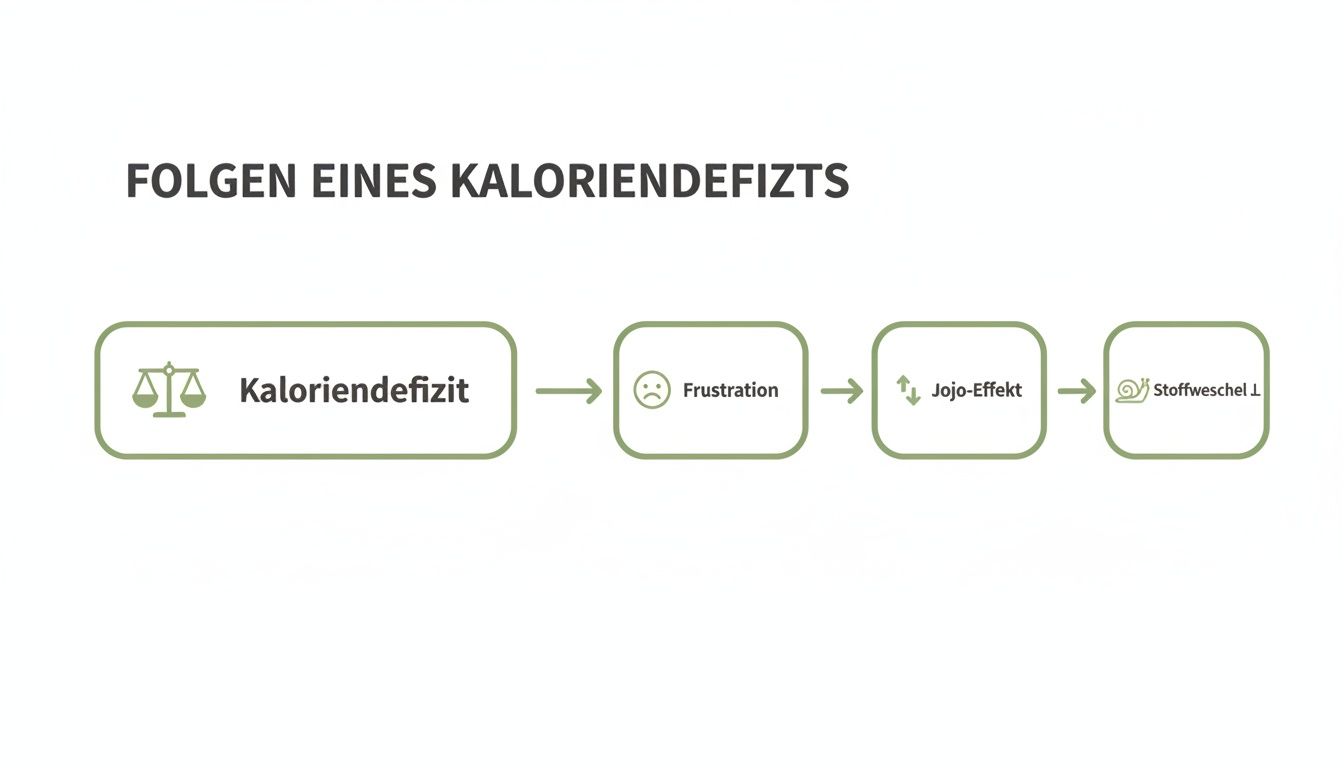
As you can see: Your body’s response is not a simple slowdown. It’s a whole cascade of adjustments that often leaves you miles away from your actual goal.
This energy-saving mode does not go unnoticed, of course. Your body sends you unmistakable signals that its power plant is no longer running smoothly, but is fighting for every single calorie. Some of these may seem familiar to you.
Example from your everyday life:
You’re sitting in the office. Your colleagues find the room temperature pleasant, but you’re wrapping yourself up in a blanket, shivering. Your hands and feet are constantly cold. That’s not a coincidence. Constant chilling is a classic symptom that your body is shutting down thermogenesis – that is, heat production – to save energy.
Other typical warning signals you should definitely pay attention to:
If you notice these signals in yourself, your body is not fighting against you. It is trying to communicate with you and protect you from the long-term consequences of too harsh a deficit.Eating without regret means exactly that: listening to these signals and working with your body again instead of continuing to starve it.
After shedding light on the dark side of a strong calorie deficit, you might ask: Is every deficit bad? Absolutely not. That is a misconception that holds many back on their path to their goals. A calorie deficit is and remains a prerequisite for fat loss. The crucial point is, how you achieve this deficit.
The way you create this energetic deficit sends completely different signals to your body. Physiologically, there are worlds of difference between a deficit caused by starvation and one that you earn through movement and performance.
Now imagine this in two very concrete scenarios:
For your metabolism, these are two completely different stories. In the first case, you’re sounding alarm bells: Famine! In the second case, you send a strong signal: “We are active, we need energy – be ready to perform and tap into our reserves!”
A calorie deficit created through activity is not an alarm signal for a famine, but a training stimulus for an efficient and flexible metabolism.
Your body responds to this stimulus not with panic, but with clever adjustments. It learns to tap into its energy sources more efficiently – specifically targeting fat reserves instead of sacrificing valuable muscle mass.
To make this even clearer, let’s look at extreme athletes. An ultracyclist can easily during a race750 bis 850 Kalorien pro Stunde verbrennen. Um diesen irren Verbrauch zu decken, isst er vielleicht 6000 Kalorien am Tag – und befindet sich trotzdem in einem massiven, aber gesunden Kaloriendefizit.
Sein Körper denkt nicht mal im Traum daran, in den Hungermodus zu schalten. Im Gegenteil: Sein Stoffwechsel läuft auf Hochtouren. Er ist darauf trainiert, einen riesigen Teil seiner Energie direkt aus den Fettreserven zu ziehen; eine Fettverbrennungsrate von bis zu 60 % ist hier drin. Die reichliche Zufuhr an Nährstoffen signalisiert ihm, dass keine Krise herrscht und er weiter Vollgas geben kann. Mehr spannende Einblicke dazu findest du übrigens bei 20 Minuten.
Was heisst das für dich? Du musst natürlich keine Radmarathons fahren. Aber das Prinzip bleibt dasselbe: Ein hoher Energie-Output durch Bewegung, gepaart mit einer Top-Nährstoffversorgung, hält deinen Stoffwechsel auf Trab.
Der Schlüssel liegt also darin, deinen Energieverbrauch gezielt hochzufahren, statt die Zufuhr radikal zu drosseln. Das ist das Fundament für nachhaltigen Erfolg, ohne deinen Stoffwechsel zu sabotieren.
Hier sind ein paar konkrete Ansätze, die wirklich funktionieren:
Ein durch Bewegung geschaffenes Kaloriendefizit – das ist der Weg zum Essen ohne Reue. Es erlaubt dir, deinen Körper optimal zu versorgen, deine Ziele zu erreichen und deinen Stoffwechsel zu einem starken Partner zu machen, statt zu einem Gegner.
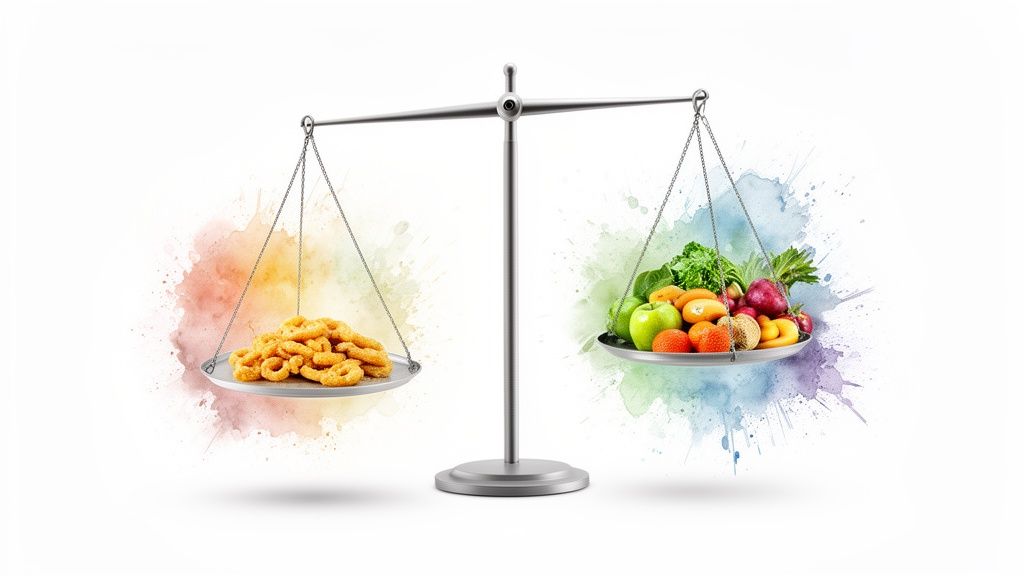
Stell dir deinen Stoffwechsel wie ein Feuer vor. Kalorien sind dabei nur das Holz, das du nachlegst. Aber wie gut dieses Feuer brennt, hängt von ganz anderen Dingen ab. Die Qualität deiner Nahrung, wie tief du schläfst und wie du mit Stress umgehst – das sind die wahren Brandbeschleuniger. Und genau die werden oft komplett übersehen.
Es geht eben nicht nur darum, wie viel du isst, sondern vor allem darum, was auf deinem Teller landet. Dein Körper reagiert auf 200 Kalorien aus einem frischen Salat mit Poulet fundamental anders als auf 200 Kalorien aus einem Schokoriegel. Die Gleichung ist also viel komplexer, als es auf den ersten Blick scheint.
Stark verarbeitete Lebensmittel sind darauf getrimmt, die Belohnungssysteme in deinem Gehirn zu kapern. Sie stecken voller Zucker, Fett und Salz – eine Kombination, die es uns unglaublich schwer macht, mit dem Essen aufzuhören, selbst wenn wir längst satt sind. Dein Körper bekommt zwar Kalorien, aber so gut wie keine wertvollen Nährstoffe.
Das ist keine Einbildung, sondern wissenschaftlich gut belegt. In der Schweiz machen solche Lebensmittel bereits rund ein Viertel dessen aus, was wir täglich konsumieren. Eine vielbeachtete Studie zeigte, dass Teilnehmende, die hauptsächlich stark verarbeitete Lebensmittel (sogenannte «Ultra-Processed Foods») assen, im Schnitt rund 500 kcal pro Tag mehr zu sich nahmen als eine Vergleichsgruppe, die unverarbeitete Kost erhielt. Und das, obwohl die Mahlzeiten in Bezug auf Kalorien, Fett und Zucker eigentlich aufeinander abgestimmt waren. Mehr dazu findest du in den Einblicken zur Gewichtsreduktion auf rosenfluh.ch.
Essen ohne Reue beginnt bei der bewussten Wahl deiner Lebensmittel. Gib deinem Körper den Brennstoff, den er wirklich braucht – nicht nur leere Kalorien.
Mit der Wahl von naturbelassenen Lebensmitteln versorgst du nicht nur deine Zellen, sondern gibst auch deinen Mitochondrien, den kleinen Kraftwerken deines Körpers, richtig Zunder. Wenn du lernen willst, wie du diese Energielieferanten gezielt auf Touren bringst, schau dir unseren Leitfaden an, wie du deine Mitochondrien aktivieren kannst.
Ein weiterer unglaublich mächtiger, aber oft vernachlässigter Faktor ist dein Schlaf. Bereits eine einzige Nacht mit zu wenig oder schlechtem Schlaf kann deine Hormone durcheinanderwirbeln und deinen Stoffwechsel sabotieren.
Was passiert da genau?
Sleep is therefore not a waste of time. It is an active recovery phase that is absolutely essential for a healthy metabolism.
Chronic stress puts your body in a constant state of alarm. Your brain cannot distinguish whether you are fleeing from a saber-toothed tiger or just the deadline for a project is approaching. The physical reaction is the same: the release of the stress hormone cortisol.
A typical example from your daily life:
Imagine you have a demanding job in the city. Meetings, deadlines, always being reachable. In the evening, you try to ‘wind down’ with a glass of wine. But this very combination can be fatal.
Active stress management – whether through exercise, yoga, or simple breathing exercises – is therefore not a luxury. It is a central component to bring your metabolism back into balance and to stay sustainably healthy.

If you have recognized yourself in the last sections – constantly tired, frustrated by the stagnation on the scale, and always feeling cold – then the time has come to finally break this diet spiral. Your metabolism is not broken. It has just cleverly adapted to the circumstances. And the best news is: You can get it back on track.
The key lies in giving your body the signal that the famine is over. You need to regain its trust and show it that it is receiving regular and sufficient energy again. Only then will it abandon its saving mode and switch back to full performance. Of course, this requires some patience and a clear strategy, but it is the only way to achieve a body that works sustainably for you – and not against you.
One of the most effective methods for this restart is what is called Reverse Dieting. Just imagine it as the exact opposite of a crash diet. Instead of radically cutting calories, you increase them very slowly, step by step, and absolutely controlled.
The goal is simple: To teach your metabolism to process more energy again, without your body immediately storing it as fat. You are essentially giving your inner powerhouse more fuel bit by bit so that it can ramp up its performance again. This process is ideal for specifically reversing metabolic adaptation.
Reverse Dieting is not a free pass for uncontrolled eating. It is a strategic and patient method to revive your metabolism and restore your hormonal balance.
This approach can initially be a real mental challenge. After months or even years of abstinence, consciously eating more again takes courage. But it is the crucial step to finally build a relaxed and healthy relationship with food.
Alongside Reverse Dieting, it is equally important to listen to the signals of your body again. Years of dieting and rigid meal plans have often made us forget what real hunger is or when we are truly full. Intuitive eating is nothing more than the ability to perceive and trust these inner signals again.
To retrain this ability, a few simple steps can help you:
An example for you:
Imagine a working mother who often eats only while standing between meetings and childcare. She can practice mindfulness by consciously blocking out 15 minutes just for her lunch. During this time, she eats slowly, chews thoroughly, and is fully present. Just that can already make a huge difference for her satiety and digestion.
To help you visualize the start, we have created a simple weekly overview for you. It shows you how to slowly and safely increase your calorie intake based on your current (low) calorie consumption.
| Week | Strategy | Focus | An example for you |
|---|---|---|---|
| Week 1-2 | Increase calories by 50-100 kcal per day | Stability and observation. Your weight should remain stable or fluctuate only minimally. | Add a small protein-rich snack, such as Greek yogurt or a handful of nuts in the afternoon. |
| Week 3-4 | Increase by another 50-100 kcal | More energy during training. You should notice that you have more strength and endurance in the HIIT class or during yoga. | Increase your carbohydrate portion after training, for example, an additional half cup of quinoa or a small sweet potato. |
| Week 5-6 | Further increase by 50-100 kcal | Hormonal balance. Pay attention to signs such as better sleep, less cravings, and a more stable mood. | Incorporate an additional serving of healthy fats, like a quarter of an avocado for breakfast or a bit of olive oil over the salad. |
| From week 7 | Repeat the process until the goal is reached | Long-term adjustment. Continue the gradual increase until you reach your maintenance calories and your metabolism has normalized. | Enjoy larger, balanced meals again that truly satisfy and nourish you, without fear of weight gain. |
This path takes you step by step back to a state where food becomes what it should be again: valuable energy, pure enjoyment, and a central building block for your health. That is what we understand as a true Guilt-free eating.
At Templeshape, we are not chasing short-term goals. From experience, we know: real, lasting change takes time and an approach that suits you and your life. That is what we care about – your long-term health and the joy of movement.
Let’s bundle all the insights about metabolism and turn them into a strategy that strengthens you rather than punishes you.
Forget the idea of disciplining your body through deprivation. We invite you to nourish and challenge it through variety. Your metabolism loves diversity! Our broad range of courses is specifically designed to build a robust and flexible metabolism that supports you through a demanding everyday life.
A healthy metabolism is never the result of a single diet or a specific training method. It is the result of a lifestyle that gives your body what it truly needs on all levels.
Here’s how we specifically support you:
To sustainably boost your metabolism and enjoy a Guilt-free eatingit’s also important to understand the positive Effects of healthy eating at workbecause what you eat during the day lays the foundation for your evening.
Chronic stress is one of the biggest saboteurs for your metabolism. It throws your hormones out of balance and puts your body in a constant state of alarm. That’s why mindful practices like breathwork are an essential part of our concept.
In a positive and appreciative atmosphere, you’ll learn to actively reduce stress and bring your body back to its natural balance.
We do not see movement and nutrition as a duty, but as a strengthening and positive part of your life. Your path to a healthy metabolism begins right here: with the decision to finally work with your body instead of against it.
We want to help you internalize this new understanding. If you want to dive deeper and learn how to specifically boost your metabolism, check out our contribution on the 5 best ways through nutrition and movement.
Consider this your personal invitation to redefine health – with joy, energy, and absolutely no guilt.
Phew, quite a lot of information all at once, right? The topic of metabolism, diets, and the eternal fear of the yo-yo effect is a jungle of myths and half-truths. It can easily make your head spin.
That’s why we have gathered the most burning questions for you here. We provide you with clear, scientifically grounded answers, so you can finally see clearly and make the right decisions for you and your health. It is completely normal to feel unsure – especially if you have heard conflicting advice for years. Let’s bring light into the darkness together and give you back the confidence in your own body.
Yes, absolutely! And that is the most important message of all. Your metabolism isn’t really ‘broken’ – it has just adapted incredibly intelligently to a perceived famine in order to protect you. This state is completely reversible.
With a smart and patient strategy, such as Reverse Dieting, you can signal to your body: ‘The crisis is over, you are safe.’ By slowly and controlly increasing your calories again, you give your metabolism the chance to rev up its engines again.
Targeted strength training to build valuable muscle mass and conscious stress reduction are your best allies in this process. It takes some time, no question, but your body is a marvel of adaptation and can completely regenerate.
That’s the classic “It depends” question. Unfortunately, there’s no straightforward answer that fits everyone, as the recovery phase is as individual as you are.
Several factors play a decisive role:
As a rough estimate, you can assume it takes anywhere from a few weeks to several months. The most important thing is to be patient with yourself and your body. Focus on the small, positive signals – more energy in your daily life, better sleep, less cravings – instead of fixating solely on the number on the scale.
The key is not in the speed, but in sustainability. Give your body the time it needs to regain its balance and trust you completely again.
We are all too familiar with this fear. It is the main reason why so many people remain trapped in the dieting spiral. But here’s the good news: If you proceed slowly and in a controlled manner, like with reverse dieting, the risk of significant fat gain is minimal.
A slight weight gain at the very beginning is actually quite likely and often a good sign! Most of the time, it involves replenished glycogen stores (i.e., carbohydrates in your muscles) and the associated water – not body fat.
Your goal is to allow your metabolism to adjust to the higher caloric intake. If you gradually reintroduce energy, it has the chance to get its “engine” running again, rather than panic and shovel the surplus into fat stores. Eating more to heal your metabolism is the first step toEating Without Regret.
Are you ready to finally break the vicious cycle of dieting and frustration? Do you want to build a healthy, strong, and sustainable relationship with your body? AtTempleshape GmbHwe accompany you on this journey – with enjoyable movement, a supportive community, and the knowledge you need to take your health into your own hands.
Tags
 DE
DE FR
FR EN
EN